

Qinux PolarBreeze is being promoted as a compact cooling device for bedrooms, offices, and small living spaces. Its ads promise fast relief from summer heat, simple setup, and lower energy use than traditional air conditioning.
But does it really perform as advertised, and is it worth the price? This article examines the product, its marketing, customer feedback, pricing, and return terms before you order.
What Is Qinux PolarBreeze?
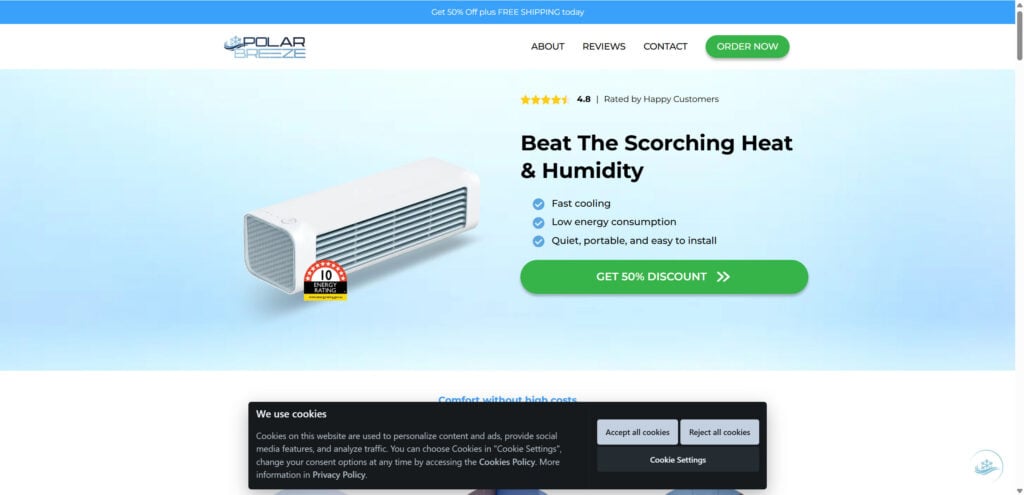
Qinux PolarBreeze is a narrow, bladeless fan supplied with a detachable stand, remote control, rechargeable battery, and adhesive wall mounts. It can be placed upright on a table, laid horizontally beside a bed, or attached to a wall without drilling.
The official website describes it as “the future of efficient cooling” and repeatedly calls it a portable air conditioner. According to the advertising, its CryoFlux® spiral-air system provides effective cooling throughout a room, prevents hot spots, operates almost silently, and uses far less energy than traditional air conditioning.
The site goes even further by claiming that ordinary fans merely push hot air around, while Qinux PolarBreeze “actually cools it.” Testimonials displayed on the same page describe customers replacing their air conditioning, cooling small apartments, and enjoying a noticeable temperature difference throughout their rooms.
Those claims create a very specific expectation. Buyers are not being encouraged to think of PolarBreeze as a simple personal fan; they are being told that it produces genuinely cooled air.
The hardware does not support that story.
Qinux PolarBreeze Is a Fan, Not an Air Conditioner
A genuine air conditioner cools a room by removing heat from the indoor air and transferring that heat somewhere else. This normally requires refrigerant, an evaporator, a compressor, a condenser, and either an outdoor unit or an exhaust hose through which the collected heat can escape.
The U.S. Department of Energy explains that air conditioners use refrigerant and cooling coils to absorb indoor heat, while the condenser releases that heat outside. Qinux PolarBreeze does not appear to contain any of those components, nor does the seller provide a BTU rating or another measurable cooling-capacity specification.
Instead, PolarBreeze appears to use a small electric motor to move room-temperature air through its vertical grille. The bladeless description refers only to the fact that the internal impeller is hidden inside the casing rather than exposed like the blades of a traditional desk fan.
That may make the device look cleaner or safer, but it does not turn it into an air conditioner.
The Department of Energy states plainly that fans do not generate cold air. They move the air already present in the room and make people feel cooler by increasing evaporation from the skin. The sensation can be useful when airflow is directed toward a person, but the actual room temperature does not fall.
Qinux PolarBreeze may therefore provide a breeze at a desk or beside a bed. It cannot refrigerate a bedroom, cool an apartment, eliminate hot spots, or replace a window or portable AC unit.
There Is No Water-Based Cooling System Either
Some “mini AC” products use a small water reservoir and wet filter to provide limited evaporative cooling. Qinux PolarBreeze does not appear to be one of those products.
The official sales page does not describe a water tank, cooling pad, ice compartment, misting function, or evaporative filter. In fact, the checkout offers a separate humidifier as an optional paid add-on, which further suggests that the fan itself does not include a water-based system.
A customer reviewing an apparently identical Polar Breeze device reported that the included instructions specifically stated that it had no compressor, water tank, or misting function and that any “cooling” came only from driven airflow. That is an individual customer report rather than an independent laboratory examination, but it is entirely consistent with the visible design and published specifications.
Without refrigeration or evaporation, PolarBreeze has no mechanism for producing air that is colder than its surroundings.
“CryoFlux® Technology” Appears to Be Marketing Language
The central technical claim is something the seller calls CryoFlux® Technology.
According to the product page, CryoFlux uses spiral air circulation to deliver even, effective cooling across a room. However, the seller does not publish a meaningful technical explanation of how the system reduces air temperature.
There is no measured temperature difference between the intake and outlet air, no cooling capacity in watts or BTUs, no airflow figure, no independently tested room size, and no laboratory report demonstrating that CryoFlux removes heat.
“CryoFlux” appears to be a brand name for the fan’s airflow pattern, not a new form of refrigeration.
A fan can create spiral airflow. It can oscillate, concentrate air, and distribute a breeze over a wider angle. None of those functions lowers the underlying temperature of the room.
The Advertising Uses Fake-Looking Cold-Air Effects
The promotional images show bright blue beams and snowflake graphics blasting from the front of the fan. Other images present the product as though it were producing a stream of intensely refrigerated air.
Those effects are not photographs of cold air, because cold air is invisible.
They are digital graphics designed to communicate cooling. The problem is that they also make the product look as though it contains a refrigeration coil or another active cooling mechanism when the available specifications show no such system.
The website then reinforces that visual illusion with statements claiming that PolarBreeze cools spaces in seconds and works differently from ordinary fans.
A consumer who sees blue air, snowflakes, “portable air conditioner” language, and claims of room-wide cooling could reasonably believe that the device physically lowers air temperature. In reality, the customer appears to receive a fan that circulates ambient air.
A Generic Chinese Fan Sold at a Premium Price
Qinux presents PolarBreeze as a proprietary product with exclusive CryoFlux technology, but generic listings tell a different story.
An Amazon listing shows the same narrow white fan, detachable circular stand, horizontal wall-mounting option, remote control, and identical dimensions. The listing identifies the brand as “Generic,” describes the product as a fan, and states that its country of origin is China.
Other listings use dimensions of approximately 79 × 82.5 × 341 millimeters without the stand and 120 × 120 × 354.6 millimeters with the base, matching the product format shown in PolarBreeze promotions. These listings describe it as a rechargeable bladeless tower fan rather than an air conditioner.
Chinese wholesale platforms offer wall-mounted bladeless and rechargeable fans in roughly the $9 to $12 range, depending on the model, supplier, and quantity ordered. This does not prove which exact factory supplies Qinux PolarBreeze, but it shows that this product category is widely available as inexpensive generic merchandise.
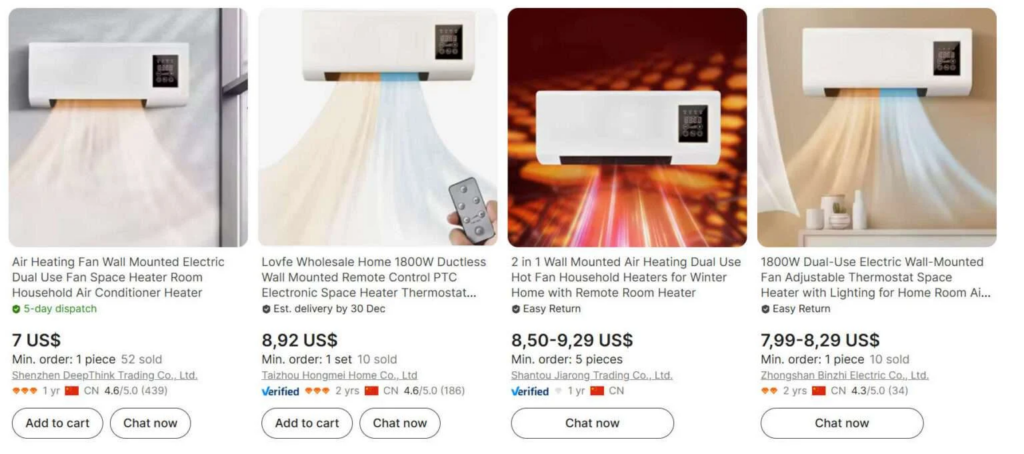
Qinux’s checkout, meanwhile, has recently priced one PolarBreeze at approximately $75 to $89 depending on the buyer’s region, with bundle prices falling to around $53 to $59 per unit when purchasing five. The company displays a reference price roughly twice as high and frames the current offer as a 50% discount.
Retailers are entitled to charge more than wholesale cost. The concern is that the markup is supported by claims suggesting that a generic Chinese fan is a revolutionary air-conditioning device.
The Seller’s Own Terms Confirm a Dropshipping Model
The legal terms behind Qinux PolarBreeze provide unusually direct confirmation of how the operation can work.
The seller is identified as Cablelinker Electronics Limited, a Hong Kong company. Its terms state that the company may use a direct-shipping or dropshipping model in which it purchases a product from a third-party manufacturer or supplier located anywhere in the world and instructs that supplier to ship directly to the customer.
The same terms say that Cablelinker may never store, handle, repackage, or reship the item itself. They also state that Cablelinker is not the manufacturer and warn that product components, specifications, origin, or quality may differ from what customers expect.
This is not speculation about dropshipping. It is described in the seller’s own legal agreement.
Qinux may therefore create the brand, sales page, CryoFlux story, promotional videos, review section, and checkout funnel without manufacturing or even physically inspecting the product sent to each buyer.
How the Qinux PolarBreeze Scheme Works
The social media ad sells an impossible shortcut
The campaign begins by targeting people struggling with summer heat and high electricity bills. The ads present traditional AC as expensive, noisy, inefficient, and difficult to install, then introduce PolarBreeze as a compact alternative that supposedly delivers cold air instantly.
This is a powerful message because it promises all the benefits of air conditioning without any of the equipment or energy ordinarily required to produce it.
The buyer is not encouraged to ask how heat leaves the room. Instead, the advertising replaces technical evidence with blue airflow, snowflakes, smiling customers, dramatic claims, and a trademarked name that sounds scientific.
A generic fan receives premium branding
A common rechargeable fan is then wrapped in the Qinux identity and renamed PolarBreeze. Ordinary airflow becomes “CryoFlux® Technology,” a hidden impeller becomes a sophisticated bladeless system, and adjustable fan speeds become advanced cooling modes.
This branding changes how buyers perceive the product even though the basic function remains the same.
The seller’s terms make clear that the underlying merchandise may come from a third-party supplier through dropshipping and that Cablelinker is not the manufacturer. Generic listings showing the same design as a Chinese-made fan reinforce the concern that Qinux is primarily adding marketing rather than new cooling technology.
The page creates trust with reviews and authority symbols
The sales page shows a 4.8 rating, 1,273 reviews, a 94% recommendation rate, and claims that the wider business has served more than 500,000 happy customers.
The testimonials are perfectly aligned with the marketing message. Customers supposedly say that the fan cools rooms, replaces air conditioning, makes no noise, and works throughout small apartments and studios.
However, these reviews appear on a page controlled by the seller. There is no visible independent review platform attached to the 1,273 testimonials, and buyers cannot easily verify who wrote them, whether they purchased the product, or whether negative submissions are displayed.
The independent feedback tells a very different story.
Fake urgency pushes customers into buying bundles
The checkout uses a countdown timer, claims that the sell-out risk is high, describes certain packages as popular or best-selling, and repeatedly displays a 50% discount.
Customers are pushed toward bundles of two, three, or five fans, with the per-unit price falling as the order size grows. This can turn disappointment with one overpriced fan into a significantly larger financial loss.
The checkout also promotes extra wall mounts, additional remote controls, a separate humidifier, extended warranties, and package protection. These additions can increase the final total beyond the price that originally attracted the customer.
The customer receives a fan rather than an AC
The parcel may arrive successfully, which gives the seller a valid tracking number and makes the transaction appear completed.
When the customer switches on the device, it may circulate air, oscillate, respond to the remote, and operate from its rechargeable battery. In that limited sense, it works.
What it does not do is lower room temperature.
Because the fan still turns on and blows air, the seller can argue that the product is functional. The customer must then prove that the device was materially misrepresented as an air conditioner rather than simply defective.
This distinction is central to the business model. Sending a cheap but operational fan is less risky for the seller than sending nothing because delivery tracking can be used to fight payment disputes.
Complaints are redirected into a difficult return process
Customers who discover the problem have only a short window in which to act.
Cablelinker’s terms provide a 14-day right of withdrawal after delivery, but the product must be returned in its original condition and packaging. The customer pays return shipping, and the seller may withhold the refund until it receives the product or proof that it was sent.
The terms also say that orders are normally processed immediately and generally cannot be canceled or modified after purchase. This means someone who realizes the problem minutes after ordering may still be told to wait for delivery and then arrange an international return.
Cablelinker is registered in Hong Kong, disputes are governed by Hong Kong law, and its formal claims address is in Hong Kong. A promotional review that examined the seller’s terms also reports that customers returning PolarBreeze are responsible for shipping and customs costs to Hong Kong.
For a relatively inexpensive fan, tracked international return postage may be high enough that many customers decide not to proceed.
Independent Customer Reviews Are Overwhelmingly Negative
The Trustpilot page for PolarBreeze GetQinux currently has a score of 2.0 out of 5, with 88% of reviewers awarding one star.
Customers repeatedly describe the item as nothing more than a rechargeable fan with no air-conditioning capability. Several say the advertising led them to expect real cooling, while others report ignored return requests or frustration after learning that the product had to be sent back to Hong Kong at their own expense.
The wider Cablelinker support profile performs even worse, with a TrustScore of 1.3. Its review summary highlights complaints involving misleading products, unexpected charges, difficult cancellations, high international return costs, short deadlines, missing orders, and items advertised as air conditioners that function only as fans.
Customer reviews are individual allegations and do not prove that every buyer will have the same experience. However, the consistency of the complaints is significant because they describe exactly the outcome predicted by the product’s visible hardware: the unit moves air but does not refrigerate it.
The 14-Day Guarantee Is Not Truly Risk-Free
The sales page prominently advertises a 14-day money-back guarantee, making the purchase sound safe.
In practice, the window is narrow, particularly when the seller’s own pages provide conflicting delivery information. The terms allow up to 30 calendar days for delivery, while the FAQ states a maximum of 21 days.
Once the package arrives, the buyer must act quickly, preserve the original packaging, complete the required withdrawal process, pay return postage, and provide tracking.
The guarantee therefore does not mean that the seller provides a prepaid label or a simple local return. The financial and administrative burden remains with the buyer.
A customer who has already unpacked, mounted, and tested the fan may also worry that the seller will claim the item was handled beyond what was necessary or was not returned in perfect condition.
Is Qinux PolarBreeze a Scam?
Qinux PolarBreeze appears to be a real physical product, and some customers report that their orders arrived. This is not necessarily a simple operation in which the seller accepts payment and sends nothing.
The more relevant issue is misrepresentation.
The customer is shown a “portable air conditioner” that supposedly cools air rather than circulating it. The delivered product appears to be a rechargeable fan with no compressor, refrigerant, water-based cooling system, or measurable cooling capacity.
The official page uses digital cold-air effects, claims of room-wide cooling, a proprietary-sounding technology name, seller-controlled reviews, a large reference price, and aggressive scarcity messages to turn an ordinary fan into something that looks revolutionary.
Meanwhile, the seller’s legal terms confirm that it may use dropshipping, does not manufacture the merchandise, may never handle the product, cannot guarantee real-time supplier inventory, and acknowledges that product origin or quality may differ from expectations.
That makes Qinux PolarBreeze a highly misleading and high-risk purchase.
Final Verdict: Do Not Order Qinux PolarBreeze
Qinux PolarBreeze is not a genuine portable air conditioner.
It appears to be a generic rechargeable bladeless fan made in China and sold at a large markup through exaggerated advertising. Although it may provide a breeze to someone sitting nearby, it cannot actively remove heat from a room or deliver the air-conditioning performance suggested by the website.
CryoFlux® does not appear to be a refrigeration technology. The blue beams and snowflake graphics are marketing effects. The claimed room cooling is not supported by BTU figures, temperature tests, airflow data, compressor specifications, or independent laboratory evidence.
The seller-controlled website displays hundreds of glowing testimonials, while independent reviewers overwhelmingly describe a basic fan, poor cooling performance, and difficult returns.
Do not order Qinux PolarBreeze AC. Buy a normal fan when you only need airflow, or purchase a genuine window, split, or portable air conditioner from an established retailer when you need to lower the temperature of a room.
What to Do If You Already Ordered Qinux PolarBreeze
Check the order total immediately
Review your confirmation email and bank statement to make sure the number of units, warranties, accessories, package protection, and final charge match what you intended to purchase.
When the quantity or total is wrong, contact the seller in writing immediately. Although its terms say orders generally cannot be modified after placement, a prompt written objection will help document that you did not authorize the final transaction.
Save the advertisement before it changes
Take screenshots of the portable-air-conditioner description, CryoFlux claims, blue cold-air graphics, customer testimonials, discount, countdown timer, guarantee, checkout total, and order confirmation.
Keep copies of any social media advertisement or video that persuaded you to order. This evidence may be important when explaining to your payment provider why the product was materially different from what was advertised.
Record the unboxing and test the product
Film the sealed package, shipping label, contents, instruction manual, product label, charging cable, remote, and accessories in one continuous video.
Use a thermometer to test the alleged cooling effect. Measure the room temperature before switching on PolarBreeze, place the thermometer away from the direct airflow, and check the temperature again after the device has operated for a reasonable period.
A breeze against the thermometer or your skin is not evidence that the room has cooled.
Request a refund in writing
Contact the seller within the 14-day period and state clearly that the product was marketed as an air conditioner but functions only as a fan.
A suitable message is:
“Qinux PolarBreeze was advertised as a portable air conditioner that actively cools the air and the surrounding room. The delivered product contains no refrigeration or evaporative-cooling system and only circulates room-temperature air. The item is significantly not as described, and I am requesting a full refund.”
Ask for the complete return address and written authorization before sending anything.
Escalate the transaction when support does not help
When the seller ignores the request, delays until the return window closes, or requires an unreasonable international return, contact your credit-card issuer, bank, or PayPal.
Explain that the product was materially misrepresented as an air conditioner and provide the screenshots, unboxing video, product manual, temperature test, support messages, and proof of the advertised guarantee.
Useful dispute descriptions include “item significantly not as described,” “misleading advertising,” and “merchant refused advertised return.”
FAQ
Is Qinux PolarBreeze a real air conditioner?
No. The product does not appear to contain a compressor, refrigerant, cooling coil, exhaust system, or published BTU capacity. It is best understood as a rechargeable bladeless fan.
Does Qinux PolarBreeze actually cool the air?
The seller claims that CryoFlux technology cools the air, but it provides no independent temperature testing or technical explanation showing how this occurs. A fan can make a person feel cooler without lowering the room temperature.
Does it have a water tank or misting system?
The official materials do not describe a water tank, evaporative filter, or misting function. A separate humidifier is offered as an optional checkout accessory.
What is CryoFlux Technology?
CryoFlux appears to be the marketing name for the fan’s spiral airflow system. There is no evidence that it is a refrigeration process or that it removes heat from the room.
Is Qinux PolarBreeze made in China?
The exact factory used for each Qinux order is not disclosed. However, a generic listing for the same-looking model identifies its country of origin as China, and Qinux’s terms state that products may be dropshipped directly from third-party suppliers anywhere in the world.
Is Qinux PolarBreeze a dropshipping product?
The seller’s own terms explicitly allow orders to be fulfilled through dropshipping. Cablelinker may purchase the product from a third-party supplier and have that supplier ship it directly to the customer without Cablelinker storing, handling, or repackaging it.
How much do similar fans cost wholesale?
Wall-mounted bladeless fans are available from Chinese wholesale suppliers for roughly $9 to $12 in quantity, although the exact Qinux supplier and unit cost have not been confirmed.
Why does the website call it a portable air conditioner?
The air-conditioner language makes an ordinary fan sound more valuable and capable. The product’s visible design and available specifications do not support genuine air-conditioning performance.
Are the reviews on the Qinux website reliable?
The sales page displays 1,273 reviews and a 4.8 rating, but those testimonials are hosted on a seller-controlled page. The independent PolarBreeze Trustpilot profile has a 2.0 score, with 88% one-star reviews at the time checked.
Can Qinux PolarBreeze cool a bedroom?
It may provide personal airflow when placed near the bed, but it should not be expected to lower the overall temperature of the bedroom.
Can I cancel my order?
The seller’s terms say orders are normally processed immediately and generally cannot be canceled or modified after placement.
Can I return Qinux PolarBreeze?
The terms provide a 14-day withdrawal period, but customers are responsible for return shipping. The seller is based in Hong Kong, and an international tracked return may be expensive.
Should I order Qinux PolarBreeze?
No. It is an overpriced fan promoted with unsupported air-conditioning claims.








