

Baleag Coolzy Portable AC is promoted as a compact wall-mounted device designed to provide year-round comfort without complicated installation or high energy costs. Its ads promise quick heating, effective cooling, remote control, and easy use in bedrooms, offices, and small living spaces.
But does Baleag Coolzy really work as advertised, and is it worth the price? This article examines the product, its claims, pricing, customer feedback, and return terms before you order.
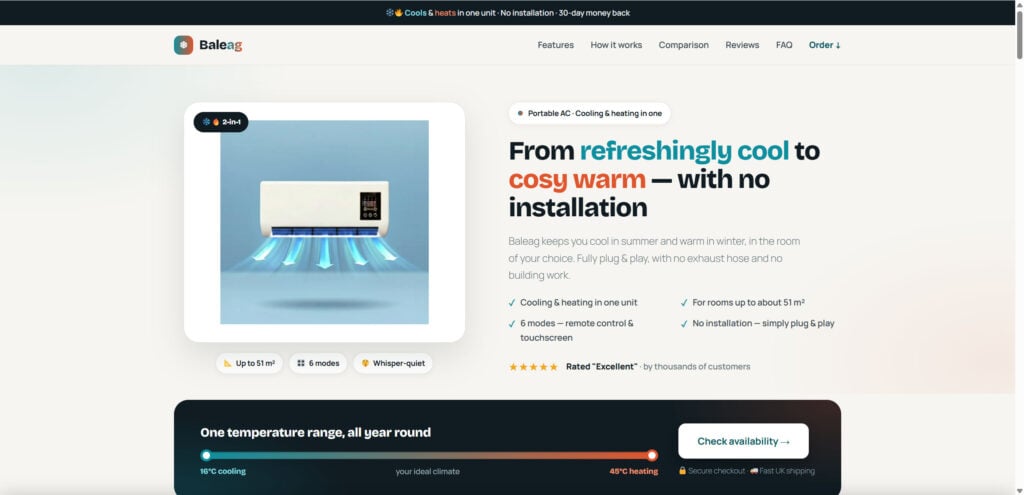
What Is Baleag Coolzy Portable AC?
Baleag Coolzy is presented as a compact wall-mounted appliance that supposedly provides both cooling and heating without the inconvenience associated with conventional HVAC systems.
The Baleag website claims that the device can cool a room to approximately 16°C, heat it to around 45°C, cover spaces of up to 51 square meters, operate in several modes, and provide quiet, energy-efficient comfort throughout the year.
The sales page compares Baleag with traditional air conditioners and suggests that customers can achieve similar results without paying for installation, running refrigerant lines through the wall, placing a condenser outside, or dealing with an exhaust hose.
That comparison is misleading because the appliance shown in the advertising does not appear to contain the technology required to remove heat from a room.
Its visible design is consistent with a basic wall-mounted electric fan heater. It has a rectangular plastic housing, a digital control panel, a lower air outlet, a remote control, and what appears to be a ceramic heating element inside.
Those components can produce warm air. They cannot produce refrigerated air.
Baleag Is Only the Latest Name Used to Sell This Heater
Baleag does not appear to be an original product developed by a new air-conditioning company. It looks like another name applied to a generic appliance that has already circulated through several online advertising campaigns.
Before Baleag, the same wall-mounted device was promoted as EpiCooler. The EpiCooler website described it as a no-installation air conditioner that could provide heating and cooling while consuming less electricity than a traditional system.
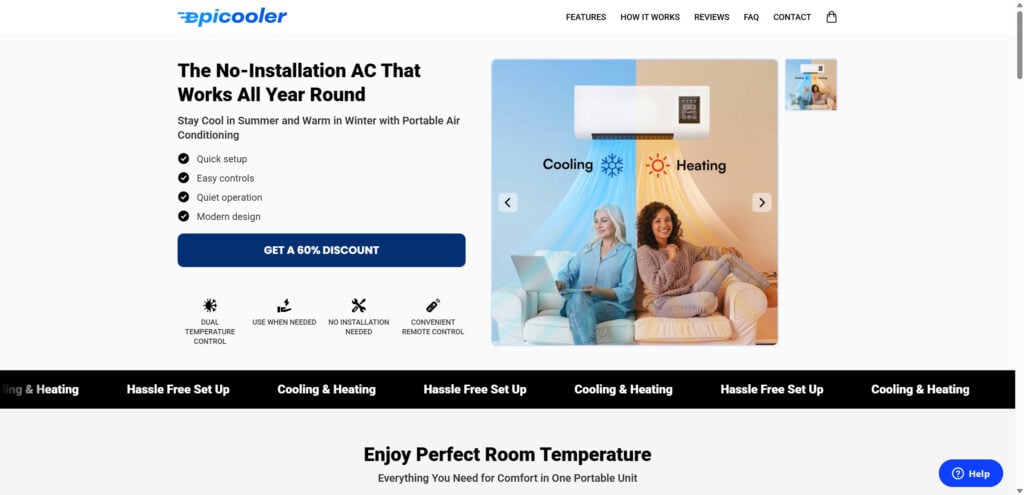
The product also appeared under the name AerioQ, where it was marketed using similar claims about rapid cooling, year-round comfort, remote operation, quiet performance, and major discounts.
Baleag now repeats the same formula with a different name and domain.
The connection becomes even more obvious when examining Baleag’s own website assets. One of the images used by Baleag reportedly contains “epicooler” in its filename, suggesting that the newer site reused material from the earlier EpiCooler campaign.
This pattern is common in aggressive direct-response marketing. Once one product name begins attracting complaints, negative reviews, or scam warnings, the same item can be moved to a fresh domain with new branding. The appearance changes just enough to make the campaign seem new, while the product, imagery, and central promises remain almost identical.
Baleag therefore appears less like a new appliance brand and more like the latest label placed on the same generic heater.
The Same Device Is Sold Wholesale for Around $7 to $9
The wholesale comparison below shows visually matching wall-mounted electric heaters offered by Chinese suppliers for approximately $7 to $9 per unit.
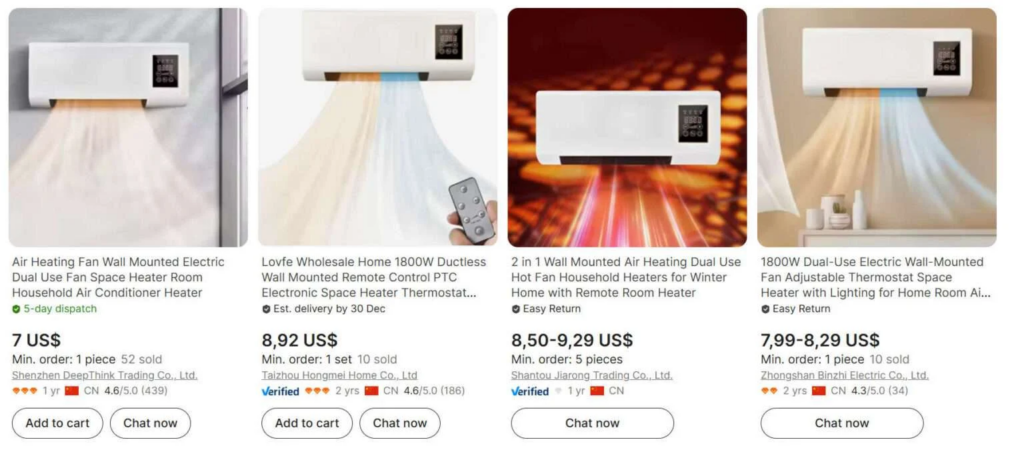
The products in these listings use the same basic design shown in Baleag advertisements: a white rectangular casing, a small black display, a lower air outlet, a remote control, and promotional graphics showing orange air for heating and blue air for supposed cooling.
The wholesale sellers describe these devices as wall-mounted electric heaters, fan heaters, space heaters, or dual-use hot-air fans. They do not provide evidence that the units contain a compressor-based refrigeration system.
There is nothing unusual about a retailer purchasing an inexpensive product and reselling it at a profit. Retail prices normally include advertising, fulfillment, customer service, payment fees, and other costs.
The problem is not simply the markup. The problem is that an inexpensive electric heater appears to be repackaged as a sophisticated air-conditioning system capable of cooling large rooms.
Instead of describing the product honestly as a wall-mounted heater with a fan mode, the advertising creates the impression that buyers are receiving a miniature split AC.
Baleag Is Not an Evaporative Cooler
Baleag does not appear to use water, mist, a wet filter, or any other form of evaporative cooling.
It is not a swamp cooler, humidifier, or water-based personal cooling device.
The most plausible internal design is a PTC ceramic heating element paired with a small electric fan. When the heating element is activated, the fan pushes warm air into the room. When the heating element is turned off, the same fan may continue circulating ordinary room-temperature air.
That basic fan function is likely what the advertisements describe as a “cooling mode.”
A fan can make a person feel cooler by moving air across the skin and increasing the evaporation of sweat. However, the appliance is not lowering the temperature of the room or generating cold air.
Describing ordinary fan airflow as air conditioning is like calling a desk fan a refrigeration system. The user may feel a breeze, but no heat is being removed from the room.
Why Baleag Cannot Cool a Room
Real air conditioning depends on a refrigeration cycle.
An air conditioner absorbs heat from the indoor air and transfers that heat somewhere else, usually outdoors. To accomplish this, it requires a compressor, refrigerant, an evaporator coil, a condenser coil, and a system for releasing the collected heat outside the room.
A genuine portable air conditioner normally uses an exhaust hose. A window unit places its condenser outside the building. A split system connects the indoor unit to an outdoor compressor and condenser.
Baleag appears to have none of these components.
There is no outdoor unit, exhaust hose, refrigerant line, visible compressor, condenser, or published BTU cooling capacity. The website does not provide a credible explanation for how heat would leave the room.
Without a way to remove heat, the appliance cannot reduce the room’s overall temperature.
Even when the heating element is switched off, the fan motor and electronics still consume electricity. That electricity eventually becomes a small amount of additional heat inside the room. The airflow may feel refreshing on the skin, but the appliance is not refrigerating the air.
Blue Air in an Advertisement Is Not Proof of Cooling
The promotional images frequently show orange airflow when the device is heating and blue airflow when it is supposedly cooling.
That color change is a marketing effect, not a technical specification.
The heater may genuinely produce warm air because it appears to contain a ceramic heating element. In its so-called cooling mode, however, it most likely switches off that heater and continues operating as an ordinary fan.
The air then feels cooler only because it is no longer being heated.
This is very different from producing air that is colder than the surrounding room. A thermometer placed away from the direct airflow would likely show little or no meaningful reduction in the room’s temperature.
Consumers should not interpret blue graphics, snowflake icons, animated temperature displays, or edited videos as proof that a refrigeration system exists inside the appliance.
The 51-Square-Meter Cooling Claim Does Not Add Up
Baleag reportedly claims that the appliance can cool or heat rooms measuring up to approximately 51 square meters.
That is a substantial area. Cooling a space of that size normally requires a properly sized air conditioner with a clearly stated BTU rating and significant electrical power.
Baleag does not appear to provide a genuine cooling-capacity figure. There is no compressor output, cooling wattage, energy-efficiency ratio, refrigerant specification, or independent performance test showing how quickly the unit can lower the temperature of a 51-square-meter room.
The website may allow users to select a low temperature on the display, but selecting 16°C does not mean the appliance is capable of cooling the room to 16°C.
A thermostat setting is only a requested temperature. It is not evidence of cooling capacity.
A heater can display almost any number on its screen. Without refrigeration hardware, that number does not make the surrounding air colder.
How the Baleag Coolzy Portable AC Scheme Works
1. A Cheap Heater Is Selected From a Wholesale Supplier
The process begins with an inexpensive wall-mounted electric heater that is already being manufactured and sold by Chinese suppliers.
The appliance is attractive for this type of marketing because its wall-mounted shape resembles the indoor section of a split air-conditioning system. Someone seeing it briefly in an advertisement may assume it contains similar technology.
In reality, the device appears to be much simpler. It is likely a ceramic heater combined with a small fan, digital controls, and a remote.
Instead of developing a new air conditioner, the seller only needs to take the existing product, create new branding, and build a persuasive story around it.
2. The Product Is Renamed and Relaunched
The generic heater is then given a marketable name such as EpiCooler, AerioQ, Baleag Coolzy, or whatever name may follow next.
Each version receives a new website, logo, sales page, and advertising campaign. The product is presented as though it were a recent invention created to disrupt the expensive air-conditioning industry.
This constant rebranding makes it harder for consumers to find older complaints. A shopper searching for Baleag may not immediately discover warnings posted about EpiCooler or AerioQ, even though the physical product and advertising claims appear remarkably similar.
By the time the current name develops a poor reputation, the campaign can be moved to another domain.
3. Edited Visuals Make the Heater Look Like an Air Conditioner
The advertisements rely heavily on visual persuasion.
Blue air streams are added to suggest refrigeration. Temperature graphics imply that the device quickly lowers the room temperature. People are shown relaxing comfortably while the appliance supposedly defeats extreme summer heat.
These scenes may be heavily edited, computer-generated, or created using artificial intelligence.
EpiCooler’s own legal terms reportedly acknowledge that some product images and videos may be digitally enhanced, computer-generated, edited, or AI-created. The same terms suggest that the delivered product may differ visually from the advertising.
That disclosure is important because polished advertising can make an ordinary heater appear far more advanced than it really is.
The customer sees cold blue air rushing from the unit, but the actual product may only contain a fan and heating element.
4. Technical-Sounding Claims Make the Offer Feel Plausible
Once the visual illusion has been established, the sales page adds claims about rapid cooling, six operating modes, large-room coverage, low energy consumption, quiet operation, and year-round comfort.
The website may also compare the device with expensive split systems, emphasizing that Baleag requires no installation, outdoor compressor, exhaust hose, or professional technician.
Those missing components are presented as advantages, even though they are precisely what allow real air conditioners to remove heat.
The seller turns a technical impossibility into a selling point: buyers are told they can receive AC-level cooling without any of the equipment normally required to produce it.
5. Discounts and Stock Warnings Push the Buyer to Order Quickly
The product is usually accompanied by a major discount, limited-stock message, countdown timer, or warning that demand is unusually high.
These tactics are designed to stop shoppers from researching the product carefully.
A buyer worried about missing a 60% or 70% discount may proceed directly to checkout instead of searching for matching wholesale listings, checking whether the unit has a BTU rating, or asking how it can cool a room without transferring heat outside.
The large discount also makes the price feel reasonable. A product listed as being reduced from a much higher amount appears valuable, even when the underlying heater may cost less than $10 at wholesale.
6. The Checkout Adds More Pressure and Potential Costs
The checkout may promote multi-unit packages, extended protection, priority processing, or other add-ons.
A customer who intended to buy one device may be encouraged to purchase two or three because the larger bundle is labeled as the best deal. Shipping, handling, taxes, or warranty charges may then increase the final total.
Because Baleag operates as an affiliate page, the customer may also be redirected to another website to complete the payment. The merchant name on the bank statement may not match Baleag, creating additional confusion if the buyer later needs to request a refund.
7. A Basic Electric Heater Arrives
Customers may receive a real product, which is why this type of offer can be more difficult to dispute than a simple non-delivery scam.
The package is likely to contain a lightweight wall-mounted electric heater, a remote control, basic mounting accessories, and an instruction sheet.
The appliance may provide warm air when the heating element is active, while its fan mode may circulate room-temperature air after the heater is switched off. The display may also allow users to select various temperatures or operating modes, but none of those controls can create refrigeration if the necessary cooling hardware is absent.
The customer therefore receives an appliance that technically powers on and performs part of its advertised function. The problem is that it does not deliver the air-conditioning performance that persuaded the buyer to order it.
8. The Seller Calls Ordinary Fan Mode “Cooling”
When customers complain that the device does not produce cold air, support may point to the fan mode and claim that the appliance includes a cooling function.
This explanation relies on deliberately vague language.
The air coming from the unit may feel cooler than it does during heating mode, but that is only because the ceramic heating element is no longer active. The fan is circulating the same air already present in the room.
There is a fundamental difference between moving air and cooling air. Baleag’s marketing appears to blur that distinction.
9. The Affiliate Structure Makes Responsibility Unclear
Baleag reportedly identifies itself as an affiliate page rather than the official seller.
This means the website can publish the strongest claims, display the testimonials, promote the discount, and encourage the purchase while stating in its legal text that product quality, fulfillment, warranties, and returns are the responsibility of another company.
When something goes wrong, the buyer may be sent from one entity to another. Baleag may direct the customer to the seller, while the seller may refer to a fulfillment partner, manufacturer, or separate return department.
The company that made the advertisement may therefore avoid taking direct responsibility for the promises that convinced the customer to order.
10. The Return Process Becomes Expensive and Frustrating
Returns associated with earlier versions of this product appear to require prior approval, tracking information, and buyer-paid shipping.
Some policies also state that orders may be fulfilled from China. When the return address is overseas, sending a wall-mounted electrical appliance back with tracking can be expensive enough to eliminate much of the refund.
The seller may offer a partial refund and allow the customer to keep the product. This can appear convenient, but it also prevents the buyer from recovering the full amount paid for an item that did not perform as advertised.
Other customers may simply give up because the return costs, delays, and repeated support messages become more trouble than the purchase seems worth.
The Review Numbers Should Not Be Trusted Blindly
Baleag reportedly displays thousands of positive reviews and testimonials describing rapid cooling, quiet performance, low energy bills, and easy installation.
These reviews appear on seller-controlled or affiliate-controlled pages rather than a transparent independent platform with a comparable number of verified buyers.
A website owner can choose which testimonials appear, import reviews from another product, edit submissions, or remove negative feedback. Large numbers displayed beside star ratings are not proof that thousands of genuine customers tested the exact product being sold.
The testimonials also tend to repeat the same benefits emphasized throughout the advertisement, which makes them feel more like extensions of the sales copy than spontaneous customer experiences.
Reliable proof would include independent temperature tests, verified customer videos, clearly identified model numbers, laboratory specifications, and reviews hosted by established retailers.
Can Baleag Work as a Heater?
Baleag may provide some useful heating because visually matching wholesale products are advertised as wall-mounted heaters with ceramic elements.
A PTC ceramic heater can warm a small area, particularly in a reasonably insulated room. However, its real performance depends on its wattage, electrical safety, build quality, room size, local voltage, and the accuracy of the seller’s specifications.
This does not automatically make Baleag a worthwhile purchase.
The website does not appear to provide transparent information about the actual manufacturer, independent electrical safety testing, exact delivered model, internal wiring quality, or warranty service.
Consumers should be cautious about installing a generic high-wattage electrical heater on a wall when it was purchased mainly because of a viral advertisement.
Is Baleag Coolzy Portable AC a Scam?
Baleag may ship a physical appliance, so the concern is not necessarily that every customer will receive nothing.
The central problem is that a basic electric heater appears to be marketed as an air conditioner.
The sales page creates expectations of genuine room cooling, yet the appliance shows no credible evidence of containing a refrigeration system. The same device is sold wholesale as a wall-mounted heater for approximately $7 to $9, while the online campaigns rebrand it under names such as EpiCooler, AerioQ, and Baleag.
The offer becomes even more concerning when combined with edited cooling visuals, exaggerated room-size claims, large artificial discounts, affiliate disclaimers, seller-controlled testimonials, and difficult international returns.
Baleag therefore appears to be a highly misleading and high-risk purchase.
Final Verdict: Do Not Order Baleag Coolzy
Baleag Coolzy Portable AC is not a revolutionary alternative to traditional air conditioning.
It appears to be a generic Chinese wall-mounted electric heater sold through advertisements that dramatically exaggerate its cooling ability.
The unit may heat a small area and circulate room-temperature air when the heater is switched off. It cannot cool a room to 16°C, replace a split AC, or remove heat from 51 square meters without a compressor, refrigerant, condenser, evaporator, or exhaust system.
The blue airflow graphics are advertising effects. The so-called cooling mode is most likely an ordinary fan mode. The discounts are based on inflated reference prices, while the reviews are shown on pages controlled by the seller or its affiliates.
The fact that the same appliance has already appeared under several names makes the campaign even less trustworthy.
Do not order Baleag, EpiCooler, AerioQ, or another renamed version of this wall-mounted heater expecting real air conditioning. Purchase a genuine AC from a recognized retailer that provides a BTU rating, verified safety certifications, clear manufacturer details, and a practical local return policy.
What to Do If You Already Ordered Baleag
1. Save the original advertisement
Take screenshots of the product page, room-cooling claims, temperature promises, coverage area, price, guarantee, checkout total, and order confirmation.
These pages may later be changed or removed, so preserve the exact language that influenced your purchase.
2. Identify the company that charged you
Check your confirmation email and bank statement to determine which merchant actually processed the payment.
Because Baleag appears to operate as an affiliate page, the name on the transaction may be different from the name shown in the advertisement.
3. Request cancellation immediately
When the order has not shipped, contact the merchant in writing and request an immediate cancellation.
Keep copies of every message and avoid relying entirely on telephone conversations.
4. Record the unboxing
When the appliance arrives, record the entire unboxing process in one continuous video. Show the parcel label, sealed package, product, instruction manual, electrical label, and included accessories.
This can help demonstrate exactly what the seller delivered.
5. Test the cooling claim properly
Use a room thermometer rather than judging the airflow with your hand.
Record the room temperature before running the alleged cooling mode, place the thermometer away from the direct airflow, and measure the temperature again after the device has operated for a reasonable period.
A fan may feel cool when pointed directly at the skin, but that does not prove the room temperature has dropped.
6. Request a full refund
State clearly that the product was sold as an air conditioner but does not contain a refrigeration system or provide measurable room cooling.
You can write:
“The product was advertised as an air conditioner capable of cooling a room. The delivered appliance does not produce refrigerated air and only circulates room-temperature air. It is significantly not as described, and I am requesting a full refund.”
7. Escalate the dispute when necessary
Do not allow repeated troubleshooting instructions, partial refund offers, or vague promises to push you beyond your payment provider’s dispute deadline.
When the merchant refuses the refund, stops responding, or demands an unreasonable overseas return, contact your bank, credit-card issuer, or PayPal. Describe the transaction as “item significantly not as described” or “misleading advertising.”
FAQ
Is Baleag a real air conditioner?
There is no credible evidence that Baleag contains a compressor, refrigerant, condenser, evaporator, or any other complete refrigeration system. It appears to be a wall-mounted electric fan heater.
Can Baleag cool an entire room?
It may move air and create a breeze, but it cannot actively remove heat from a room like a genuine air conditioner.
Does Baleag use water or mist?
No. The appliance does not appear to be an evaporative cooler and does not seem to contain a water tank or misting system.
What does the cooling mode actually do?
The cooling mode most likely switches off the heating element while keeping the fan active. This circulates room-temperature air but does not create refrigerated air.
Is Baleag the same as EpiCooler?
The products appear to use extremely similar designs, imagery, and claims. A Baleag image reportedly retains “epicooler” in its filename, which strongly suggests that advertising material was reused.
Is Baleag connected to AerioQ?
AerioQ promotes the same-looking wall-mounted appliance using nearly identical claims about heating, cooling, remote control, easy installation, and energy savings. It appears to be another rebranding of the same generic product.
How much does the wholesale heater cost?
Visually matching wall-mounted heaters are advertised by Chinese wholesale suppliers for approximately $7 to $9 per unit, depending on the supplier and quantity ordered.
Can Baleag really cool 51 square meters?
The site may make that claim, but it does not appear to provide a credible BTU rating, compressor output, cooling wattage, or independent test demonstrating that performance.
Can Baleag at least heat a room?
It may provide electric resistance heating through a ceramic element, although actual performance and safety will depend on the delivered model, wattage, construction quality, room size, and insulation.
Why do the advertisements show blue air?
Blue airflow is used as a visual symbol for cooling. It does not prove that the appliance generates cold air or lowers the room temperature.
Should I order Baleag Coolzy Portable AC?
No. The appliance appears to be an inexpensive wall-mounted heater promoted with misleading air-conditioning claims. It should not be considered a replacement for a genuine AC system.








