

Click “Check availability” on the Baleag Portable AC page and the offer changes character. Instead of buying from Baleag, the shopper is sent through a tracked link toward another website.
That handoff matters because the small, hose-free appliance is making a very large promise: cool a space of about 51 square metres, reach 16°C and require no installation.
Before following the sales funnel, it’s worth asking what Baleag is actually selling.
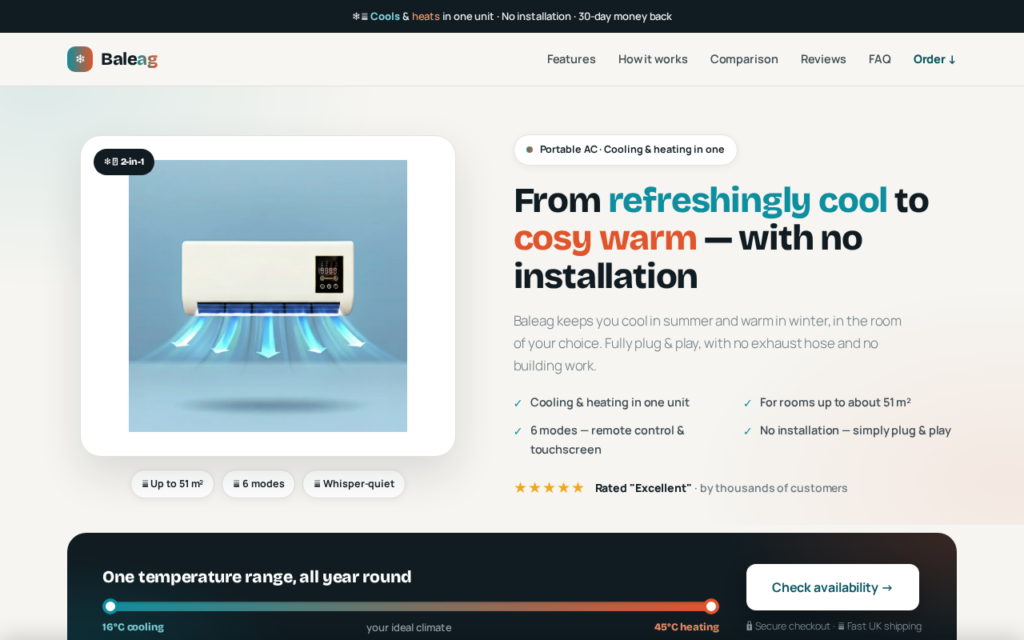
Baleag Portable AC Overview
The Baleag page sells the expectation of a powerful, self-contained room air conditioner. Its promotional material claims cooling down to 16°C, heating up to 45°C, six operating modes, low noise, energy efficiency and coverage of approximately 51 m². It also emphasizes that the unit needs no installation or exhaust hose.
Those are advertising claims, not independent performance results. More importantly, Baleag doesn’t supply the ordinary technical details that would allow a shopper to judge them.
There’s no identifiable model number, BTU or SACC cooling-capacity rating, compressor specification, refrigerant, cooling power consumption or airflow figure. The page also leaves out useful dimensions and weight. It doesn’t explain how a small appliance with no exhaust hose would remove heat from a room while operating as an air conditioner.
That creates the central problem with this dropshipping offer. Baleag uses the language and imagery of full-room air conditioning, yet withholds the information needed to establish that the pictured appliance has full-room refrigeration hardware.
The safest conclusion isn’t that the unit must be one particular type of generic fan or cooler. It’s that Baleag hasn’t substantiated the performance it advertises. Buyers are being asked to trust dramatic temperature and coverage graphics without being given a proper appliance specification sheet.
A Tiny Appliance With a Full-Size Cooling Promise
Coverage of 51 m² is not a modest personal-cooling claim. That’s roughly 549 square feet – an area that can include a large living room, studio apartment or connected living space. Cooling such an area calls for meaningful refrigeration capacity, especially in hot weather or a poorly insulated building.
The “16°C” graphic makes the promise feel even more concrete. But a target temperature is not the same thing as cooling capacity. Any seller can place a low number beside a snowflake. A useful listing explains how much heat the machine can remove, under what test standard and in what room conditions.
Baleag provides none of that context. It doesn’t say whether 16°C is a thermostat setting, an outlet-air temperature or a room-temperature result. The page simply turns the number into a visual shortcut for “very cold.”
The no-installation message is equally attractive. Real portable air conditioners are inconvenient: they’re bulky, use significant electricity and typically need a duct fitted to a window. Baleag’s pitch removes every drawback while retaining the supposed benefit. The shopper is shown something compact and effortless but is encouraged to expect the performance of a much larger appliance.
That’s the expectation gap at the heart of the listing. Convenience is believable on its own. Whole-room refrigeration is believable when backed by suitable hardware. Baleag claims both without showing how they fit together.
The Missing Details That Would Identify a Real AC
A genuine room air conditioner is normally sold with a specification panel that answers basic buying questions. How powerful is it? How much electricity does it use? What room size is it designed for? How does it expel heat? Will the buyer’s window accept the supplied kit?
At minimum, shoppers should expect to find:
- A model number and manufacturer that can be checked against a manual, warranty and safety documentation.
- A BTU or SACC rating showing standardized cooling capacity rather than an unexplained temperature graphic.
- Rated power consumption so the running cost and electrical requirements can be assessed.
- Compressor and refrigerant details for an appliance being marketed as a refrigeration-based room AC.
- An exhaust arrangement explaining where the heat removed from the room goes.
- Dimensions, weight and airflow figures that help establish the scale and suitability of the machine.
Baleag’s presentation doesn’t provide those anchors. Without them, the brand name tells the buyer very little about the underlying product.
The missing exhaust explanation is especially important. Air conditioning doesn’t make heat disappear. A conventional room AC absorbs heat indoors and releases it elsewhere, which is why portable units use exhaust ducts and window panels. If Baleag uses a different cooling method, its page should identify that method and state its realistic capabilities.
Instead, “no exhaust hose” is treated as a selling point while the necessary technical explanation is skipped. That omission makes the 51 m² claim harder – not easier – to accept.
What Comparable Room Air Conditioners Actually Disclose
Portable air conditioners intended for broadly comparable spaces look very different on paper. Documented units in this class commonly advertise around 12,000 to 14,000 BTU, alongside compressor and refrigerant information. They can weigh roughly 29 to 31 kilograms and draw substantial electrical power.
They also come with the less glamorous equipment that room cooling requires: an exhaust duct, a window fitting and installation instructions. Those details aren’t marketing clutter. They reveal the physical work the appliance must perform.
This comparison doesn’t mean every room needs the same capacity. Ceiling height, sunlight, insulation, outdoor temperature and heat from occupants or electronics all affect sizing. It does show why Baleag’s omissions matter. A seller claiming coverage of approximately 51 m² should be more specific than sellers of ordinary desk fans or personal coolers, not less.
Weight can also be revealing. Compressors, heat exchangers, motors and housings add bulk. Baleag’s compact presentation may be appealing, but the page doesn’t disclose enough about the internal hardware to reconcile that form with the advertised performance.
A shopper therefore can’t make a sensible like-for-like comparison. Baleag invites comparison with room air conditioners through its claims, then removes the ratings that room-air-conditioner buyers normally use.
The Baleag Storefront Disappears at the Buying Stage
The product identity isn’t the only thing that becomes vague. Baleag.org functions as an affiliate-style presell page rather than a clearly identified appliance retailer handling the transaction itself.
Its purchase-oriented button directs visitors off-site through PremierDiscountLink. The URL contains campaign and sub-ID parameters used to attribute referral traffic. In plain language, Baleag is sending a trackable click into another sales funnel.
Tracking links are common in online advertising, but here the handoff compounds the uncertainty. The presell page doesn’t clearly identify Baleag as the company taking payment, fulfilling the order or providing the warranty. It also doesn’t name the final merchant before the shopper proceeds.
This structure is common in aggressive dropshipping campaigns: one page builds urgency and desire, while another party handles some or all of the transaction. The customer may focus on the product pictures and overlook that the brand making the promises isn’t clearly accepting responsibility for the sale.
That distinction matters if the delivered item doesn’t match the expectation of a room AC. Buyers need to know which legal business appears on the receipt, where that business is located and who is obligated to handle a cancellation, defect or refund.
Testimonials Don’t Replace Specifications or Accountability
Baleag says the product is rated “Excellent” by thousands of customers. Yet the page doesn’t connect that claim to an auditable third-party review platform or a review integration where shoppers can inspect dates, ratings and customer histories.
Unlinked praise can create the feeling of consensus without giving buyers a way to examine it. Even authentic satisfaction ratings wouldn’t establish that the appliance can cool 51 m² to the advertised standard. Product performance still needs measurable specifications.
The business details are similarly thin. The captured Baleag material supplies no legal company name, business registration, postal address or telephone number. The direct contact identifier shown is the email address contact@baleag.org.
Return arrangements are not transparent either. The page doesn’t provide a Baleag-specific return address, an RMA procedure, telephone support or a clearly attributable refund policy. Buyers should not assume that a generic promise elsewhere in the funnel will translate into a practical return route for this product.
This is where the lack of product identity and seller identity meet. A model number lets a buyer research an appliance. A legal merchant name and return address establish accountability. Baleag asks for confidence while supplying neither.
Before paying through any dropshipping funnel, take screenshots and require the seller to provide the following in writing:
- The exact model number, manufacturer, BTU or SACC rating and rated wattage.
- The cooling method and a clear explanation of how heat leaves the room.
- The total charge, including shipping, bundles and optional additions.
- The legal seller’s name, postal address and warranty provider.
- The return address, deadline, RMA steps and responsibility for return postage.
If those details aren’t supplied before checkout, the temperature graphics shouldn’t carry any weight.
Final Verdict
Skip the Baleag Portable AC offer. The page promises cooling to 16°C across approximately 51 m² without installation or an exhaust hose, but it doesn’t disclose the capacity, compressor, refrigerant, wattage or heat-exhaust system needed to support that pitch. The tracked off-site sales handoff, unlinked customer rating and absence of a clearly identified legal seller make the purchase harder to assess and harder to hold accountable. Baleag is selling the identity of a powerful room AC without providing a proper room AC specification sheet. If you need whole-room cooling, buy from a retailer that names the exact model, publishes standardized capacity and power ratings, includes the required exhaust hardware and gives you a written return address before payment.
Frequently Asked Questions
Is Baleag Portable AC a real room air conditioner?
Baleag doesn’t publish enough technical information to establish that. Its page omits a BTU or SACC rating, compressor, refrigerant, power draw and heat-exhaust explanation.
Can Baleag Portable AC cool 51 m²?
The 51 m² figure is a marketing claim. Baleag provides no standardized cooling-capacity rating or test results showing that the pictured appliance can cool an area of that size.
Why does the lack of an exhaust hose matter?
Conventional portable air conditioners move indoor heat outside through an exhaust duct. Baleag promotes “no exhaust hose” but doesn’t explain an alternative method for removing heat from the room.
Does Baleag sell the product directly?
Baleag.org acts as a presell page. Its purchase button sends shoppers through a tracked PremierDiscountLink referral rather than clearly identifying Baleag as the merchant handling payment and fulfillment.
What should I buy instead?
Choose a properly documented air conditioner with an exact model number, BTU or SACC rating, power consumption, room-size guidance, exhaust kit, named manufacturer and clear retailer return policy.

Join the discussion
0 commentsShare your experience or ask a question about this article.
Discussion
Start the conversation
Have a question or something useful to share? Add the first comment.