

It’s all over Facebook, Instagram, and TikTok—the so-called “Split Max” air conditioner that promises to cool your home in five seconds flat, all while whisper-quiet and energy-efficient. The ads are sleek. The reviews look glowing. The price? A heavily discounted $159.99, down from an alleged $319.99.
But is Climafy’s Portable Air Conditioning Split Max really what it claims to be? Or is it just another overpriced gadget drop-shipped from overseas, masquerading as a high-tech solution to summer heat?
Let’s take a closer look.
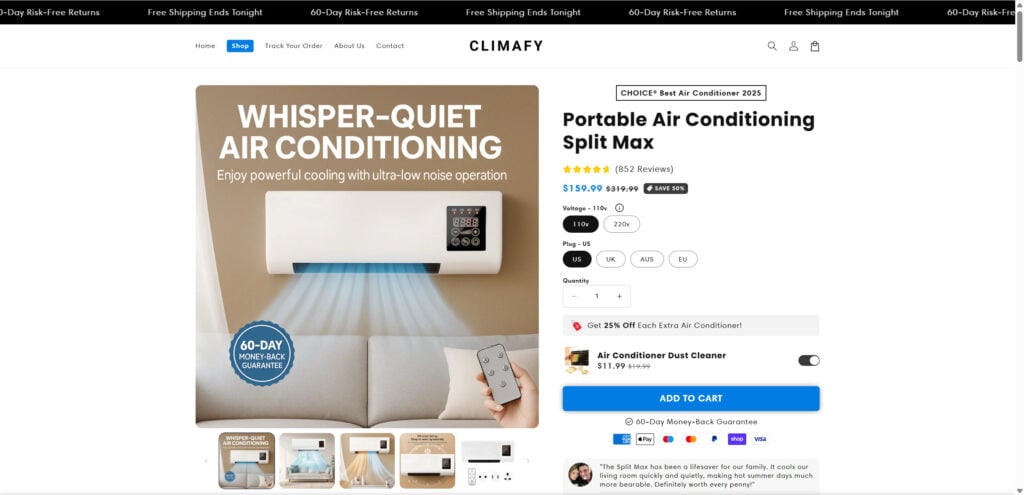
Overview of the Climafy Split Max Portable AC
What Climafy Claims
On their website, ClimafyPro.com markets the “Portable Air Conditioning Split Max” as the future of climate control. It’s framed as a revolutionary wall-mounted AC unit with:
- 3500W of power
- Ultra-quiet operation
- Dual functionality – both heating and cooling
- Energy efficiency
- Easy, no-tool installation
- Remote control operation
- Instant climate response — with the device allegedly heating or cooling a space in under five seconds
The site says it’s the “Best Air Conditioner of 2025,” complete with customer testimonials, a 60-day money-back guarantee, and flashy promotional language that plays on urgency and limited-time offers.
To a casual shopper, this might seem like a deal too good to pass up.
But it is.
What It Actually Is
The Climafy Split Max is not an air conditioner. It’s a compact wall-mounted fan and electric heater. It contains no compressor, refrigerant coil, or exhaust system—all of which are essential for real air conditioning.
In essence, it’s a glorified space heater with a fan function, designed to give the appearance of an air conditioning unit.
This same device, complete with identical control panels and remote, is available from multiple suppliers on Alibaba and AliExpress for as little as $6.10 to $14.30 per unit. It’s sold under generic listings like “Wall Hanging Air Conditioner Fan,” often marketed as heaters that double as decorative fans, not air conditioners.
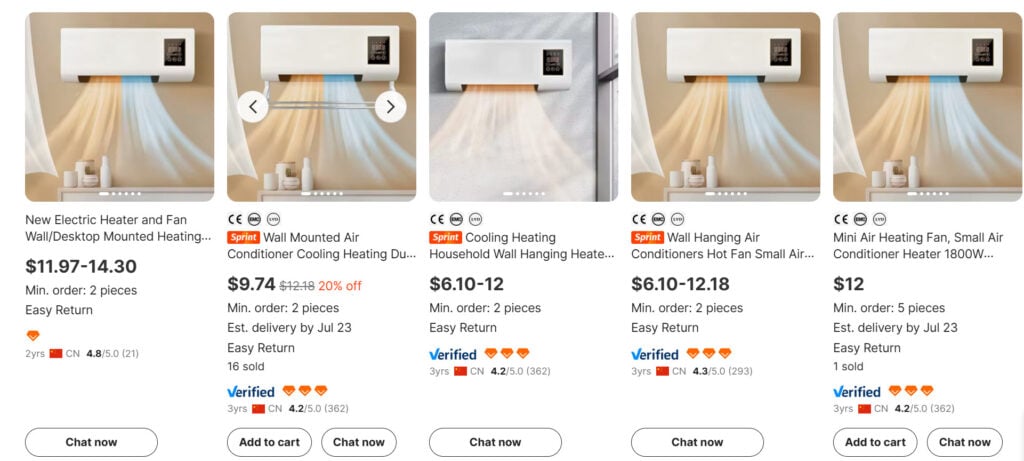
Climafy simply orders these units wholesale, adds a markup of 1,000% or more, and wraps the entire operation in clever branding.
The Power Rating Mismatch
Climafy lists the Split Max at 3,500W, which would require a dedicated high-voltage circuit. Most home wall sockets—especially the kind shown in their product photos—can only handle 1,500W max at 110V before tripping a breaker. And yet they also describe the product as “low energy usage,” a contradiction that immediately raises alarms.
Even more telling: similar versions of the same product list their power draw at 200–400W—appropriate for a space heater or fan, but nowhere near capable of cooling a room, let alone instantly.
The “Cools in 5 Seconds” Lie
No consumer-grade product—not even professional HVAC equipment—can cool a room in 5 seconds. Cooling a space requires removing heat from the air and exhausting it outdoors, usually via refrigerant loops and compressors. The Climafy unit has no such system. Instead, it just blows ambient air—perhaps slightly chilled from a ceramic cooling element—directly at the user.
What you’re getting is closer to a lukewarm desk fan than a climate control solution.
The Red Flags
Here’s what immediately stands out when evaluating Climafy’s website and product:
- No company contact number
- No business address
- No identifiable corporate presence (not registered in the U.S. or EU)
- Fake awards like “Choice Best AC 2025” with no citation
- Fake urgency – “Only a few left in stock” banners, daily timers that reset
- Identical product available wholesale for less than $15
Moreover, every image used is either a stock photo or heavily edited to exaggerate airflow and features. The supposed customer reviews are generic and unverifiable.
How the Climafy Scheme Works
Climafy’s Split Max is not just a misleading product—it’s part of a sophisticated drop-shipping scheme that preys on consumers looking for affordable air conditioning. This section walks through how the scam is set up from start to finish.
Step 1: Setting Up a Professional-Looking Storefront
The first move in the scam is creating a website that looks like a reputable online retailer. ClimafyPro.com is a great example:
- Clean layout
- Trust badges (Visa, PayPal, “Secure checkout”)
- “Expert ratings” and product awards
- A fake promotional tone: “Best AC of 2025,” “Only 5 left in stock,” “Free shipping ends tonight”
In reality, this is just a Shopify or WooCommerce template. There’s no real business infrastructure behind it—no customer service line, no corporate registration data, and no transparency.
The goal: build trust and trigger impulse buying.
Step 2: Running Viral Ads on Social Media
Climafy’s primary marketing method is through aggressive social media advertising. These ads typically feature:
- Fake demonstrations: air blowing ribbons, mist, or cold vapor
- Claims of 5-second cooling or heating
- Stock actors showing instant comfort from the device
- Statements like “Summer 2025 will be the hottest ever” or “Your energy bill is about to spike”
The ads run heavily on TikTok, Instagram, Facebook, and YouTube—especially in late spring and summer. Many are boosted with fake engagement (likes, comments, shares) to build social proof.
It’s a classic fear-based urgency tactic combined with manipulated visuals.
Step 3: Selling at a Huge Markup
While the same device is listed on Alibaba for around $10, Climafy charges customers $159.99 or more. They use artificial discounts (e.g. “50% off today only”) to create the illusion of value.
What’s really happening is that:
- The wholesale unit costs under $15
- The rest goes to profit margins, influencer commissions, and ad spend
In addition, they push upsells—dust filters, extended warranties, and “Buy 2, Get 25% Off” bundles—to inflate the cart value.
Step 4: Fulfilling Orders Through Dropshipping
Once you place your order, the Climafy team doesn’t pack or ship anything themselves. Instead, your info is passed along to a supplier in China, who sends the unit directly to your address.
Here’s what typically happens:
- Shipping takes 2 to 4 weeks, sometimes longer
- There’s no order tracking beyond a generic email
- The product arrives in unbranded packaging or with a foreign-language manual
- In many cases, it’s damaged, missing parts, or barely functional
There’s no local warehouse, no logistics team—just a direct connection from factory to your door with no quality control.
Step 5: Blocking Refunds and Returns
The Climafy website claims to offer a 60-day money-back guarantee. But once you try to use it, things change quickly.
- Refunds are often denied or ignored
- Return policies require you to ship the item back to China at your own expense
- There’s no phone support, and emails are delayed or unanswered
- Some users are offered partial refunds only if they drop complaints
This tactic works because most people won’t pay $40+ in international return shipping for a $15 fan. It creates a dead-end for customer support while still technically claiming to offer refunds.
Step 6: Disappearing or Rebranding
Like many dropshipping scams, Climafy and the Split Max may disappear after negative reviews build up. When that happens, the operators often:
- Launch a new brand under a new name
- Sell the same product with slightly different images
- Recycle the same ad scripts and social proof
This tactic makes it difficult for consumers and review platforms to catch up. You may see the same exact unit sold under names like “AirCool Split Pro,” “QuietHeat Max,” or “WallFlow AC.”
What to Do If You’ve Been Scammed by Climafy
If you ordered the Climafy Split Max Air Conditioner and realized it’s not what was promised—don’t panic. While getting a refund may be difficult, there are steps you can take to recover your money, report the scam, and protect others.
1. Gather All Documentation
Start by collecting everything related to your purchase:
- Order confirmation email
- Receipt or invoice
- Screenshots of the product page, ad, and reviews
- Photos of the product you received
- Shipping label or tracking number
These materials are essential for submitting complaints, chargebacks, or reports.
2. Contact Your Credit Card Company or Bank
Act quickly. If you paid by credit or debit card, immediately call your card provider and request a chargeback for “goods not as described.”
Key terms to use:
- “Misleading advertising”
- “Product is not as described”
- “Fraudulent seller refuses refund”
- “Return not possible due to foreign address”
Most banks allow chargebacks within 60 to 90 days of the purchase date. Visa, Mastercard, and Amex generally offer strong buyer protection policies, especially when deception is involved.
If you paid via PayPal, file a dispute in the Resolution Center under “Item Not as Described.”
3. Do Not Ship the Product Back to China
Climafy’s return policy may state that you need to ship the item to a location in China to receive a refund. This is a tactic to discourage returns. Here’s why you should avoid it:
- International shipping can cost $40–$70
- There is no guarantee they’ll process your refund even if they receive it
- Some customers report returned items are “lost” or “never received”
Instead, focus on getting your money back through your card provider or PayPal.
4. Report the Scam
Filing complaints helps prevent others from falling for the same scheme. Report the scam to these platforms:
- FTC (U.S.): ReportFraud.ftc.gov
- Internet Crime Complaint Center (IC3): www.ic3.gov
- Better Business Bureau (BBB): www.bbb.org
- UK: ActionFraud.police.uk
- Canada: Competition Bureau
- EU: European Consumer Centres Network (ECC-Net)
Include screenshots and a summary of your experience. The more reports filed, the better the chance of triggering platform action or investigations.
5. Leave Reviews to Warn Others
Help others avoid the same trap by posting your honest experience on:
- TrustPilot
- Reddit (e.g., r/Scams, r/ConsumerProtection)
- Facebook groups
- Product review sites
- YouTube or TikTok (if you’re active there)
Be factual and specific. Explain what the product was, what was promised, and what you received.
6. Remove Your Personal Information from Their Database
If you provided your phone number, email, or mailing address, it’s possible your data may be resold. Here’s what you can do:
- Unsubscribe from emails (use a spam-blocking tool if necessary)
- Use a spam call-blocking app
- File a GDPR or CCPA data removal request, if applicable in your region
- Monitor your credit card for suspicious charges
7. Stay Vigilant for Similar Scams
Climafy is likely just one alias. Be cautious of:
- New sites offering “Split AC” units with 50% off
- Ads claiming heating/cooling in 5 seconds
- Products with no brand presence or contact details
- Heavy TikTok/Facebook promotions with urgency countdowns
If it seems too good to be true, it usually is.
The Bottom Line
Climafy’s “Portable Air Conditioning Split Max” is not an air conditioner. It’s a cheaply manufactured wall-mounted fan and heater combo, falsely advertised as a high-powered, whisper-quiet, energy-efficient AC unit. The core deception lies in the mismatch between what’s promised—instant climate control, 3500W performance, and true room cooling—and what’s delivered: a plastic fan that blows ambient air.
This product is part of a broader drop-shipping operation. It relies on:
- Misleading advertising on TikTok, Facebook, and Instagram
- Inflated specs and fake awards
- Artificial urgency and discounts
- An almost complete lack of customer support
- A refund process designed to fail
The same unit is widely available on Alibaba for $10–$15, yet Climafy charges over $150. Customers who attempt to get refunds are asked to return the product to China, which is expensive and often leads nowhere.
If you’ve been affected, take action now. Document your experience, initiate a chargeback, and report the scam to protect others. More importantly, spread the word. These kinds of operations rely on silence, speed, and seasonal urgency to keep scamming more people every year.
Frequently Asked Questions About the Climafy Split Max Scam
Is the Climafy Split Max a real air conditioner?
No. Despite being marketed as a high-performance air conditioning unit, the Climafy Split Max is not a true AC. It lacks the critical components of air conditioning, such as a compressor, refrigerant, and heat exchange system. It is essentially a basic fan and heater combo that cannot cool a room.
Does the Climafy Split Max actually cool or heat a room in 5 seconds?
Absolutely not. The claim that this device can heat or cool a room in five seconds is physically impossible for any consumer-grade unit. At best, it may blow slightly warm or cool air when activated, but it cannot change the ambient temperature of a room that quickly—or at all.
How much power does the Climafy Split Max actually use?
Although the website claims 3,500W of power, this is misleading. The real power draw of the device is typically between 200 and 400 watts, suitable for a small fan or heater. The 3,500W figure is exaggerated and not supported by any technical documentation.
Why does it cost over $150 if it’s worth so little?
The Climafy Split Max is part of a dropshipping scheme. The same unit is available on Alibaba for $10 to $15. The seller inflates the price by over 1,000%, using fake discounts and deceptive advertising to create a false sense of value.
Can I get a refund after purchasing the Climafy AC?
Most customers find it extremely difficult to get a refund. While the site advertises a 60-day money-back guarantee, return instructions usually require the item to be sent back to China at your own expense. Refund requests are often delayed, ignored, or outright denied.
How long does shipping take?
Shipping usually takes between 2 and 4 weeks, as the product is fulfilled directly from overseas suppliers. This long delay is another sign that the company is operating a drop-shipping model, not a professional retail operation.
Are there any real positive reviews of the Climafy Split Max?
Genuine independent reviews are rare or nonexistent. Most positive reviews found on Climafy’s website or promotional content are fabricated or paid testimonials. Objective consumer forums and Reddit threads typically label it a scam or misleading product.
Is the Climafy AC safe to use?
While it may not be dangerous outright, there have been complaints about poor build quality, unreliable performance, and occasional overheating. It is not UL-certified or listed by any trusted electrical safety authority.
What should I do if I’ve been scammed by Climafy?
Take the following steps:
- Document your purchase and all related communication.
- Contact your bank or credit card company to file a chargeback.
- Report the scam to the FTC or your local consumer protection agency.
- Leave public reviews to warn others.
- Do not waste money returning the product to China unless required by your bank during a chargeback process.
How can I spot other scams like this in the future?
Watch for these red flags:
- Over-the-top claims (instant heating or cooling)
- No company contact details
- Products advertised heavily on TikTok or Facebook
- Fake discounts and urgency timers
- Generic-looking products sold under multiple brand names

Join the discussion
0 commentsShare your experience or ask a question about this article.
Discussion
Start the conversation
Have a question or something useful to share? Add the first comment.