Polar Breezy Portable Air Cooler – Should You Buy It? Read This
Written by: Lapain Epuran
Published on:
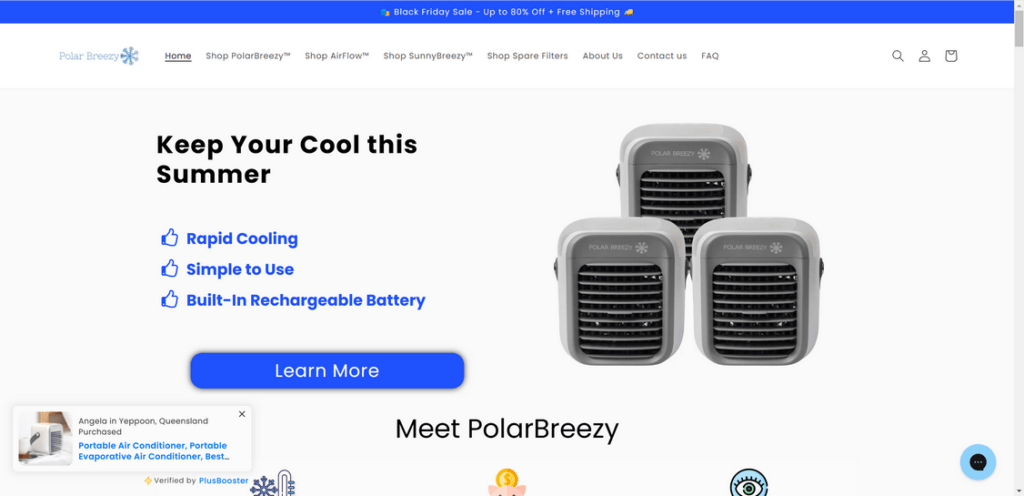
Portable air coolers like the Polar Breezy have exploded in popularity in recent years as an alternative to traditional air conditioning units. Marketed as a convenient way to beat the heat without heavy installation or high energy bills, these devices use water evaporation to provide a cooling effect.
But do portable evaporative coolers like the Polar Breezy really work as advertised? Let’s take a closer look at the facts.
Questionable Reviews and Marketing Claims
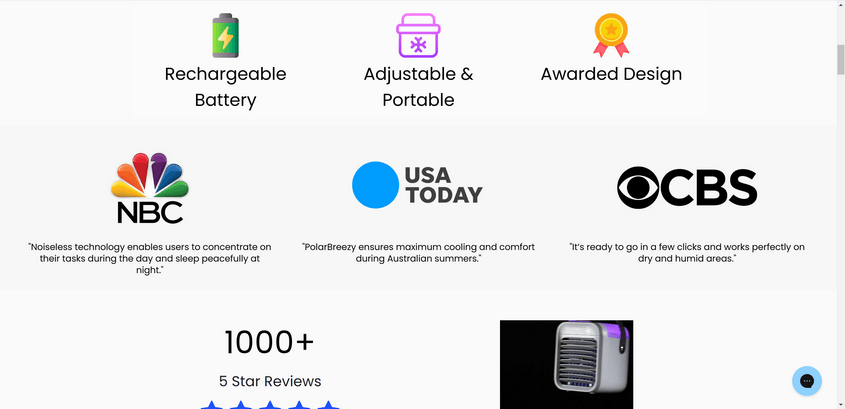
The Polar Breezy website and advertisements boast rave reviews, with claims of a 4.9 star rating from 168 customers. Strangely though, they also cite “1000+ 5 star reviews” – an immediate inconsistency.
Upon closer inspection, the reviews seem suspiciously glowing, reading more like marketing hype than real customer feedback. Many of the images used also appear copied from other products.
These questionable reviews are a red flag indicating that the company may be exaggerating claims.
Realistic Cooling Capacity
The Polar Breezy promises cool air all day on a single charge. But for a compact portable device, this seems unrealistic. Legitimate portable air conditioners require substantial power to make a real difference in cooling. A battery operated unit this small simply can’t produce enough cooling for an entire room or home.
While less energy intensive than full-size air conditioners, evaporative coolers have physical limitations. Realistically, the Polar Breezy is only equipped to provide personal spot cooling. Any claims that it can wholly replace traditional ACs are dubious.
Underwhelming Real-World Performance
According to genuine customer reviews, the Polar Breezy fails to live up to expectations. Many buyers report that it barely cools at all – little more than a fan. Some mention safety concerns like overheating and strange smells from the battery-powered device.
Getting support from the company also appears challenging. Customers cite unhelpful customer service when trying to get issues resolved or request refunds.
Classic Bait-and-Switch Tactics
In the end, the Polar Breezy seems marketed using exaggerated claims, fake reviews, and high-pressure sales tactics. Customers pay far more than a typical fan, expecting a revolutionary cooling device. But in reality the product disappoints.
This follows the pattern of a bait-and-switch scheme designed to hook in buyers with misleading promotions. Once purchased, the true low-quality nature of the product is revealed.
The Verdict: Don’t Waste Your Money
The Polar Breezy portable cooler offers little beyond what a regular fan can provide, despite inflated marketing claims. Customers consistently report disappointing performance and difficulty getting issues resolved with customer service.
For shoppers seeking an affordable way to stay cool, a basic fan is a far better value than the Polar Breezy gimmicky evaporative cooler. Don’t be misled by the hype – save your money and look for other more reputable solutions.
This article is for informational purposes only and should not be relied upon for financial or business decisions. We identify potential scams using research, user experiences, and expert analysis. However, all claims should be independently verified. Mistakes may occur, and legitimate products could be flagged. We strive for accuracy but make no warranties regarding the completeness or reliability of the information.

If you are the owner of the website or product in question and wish to offer clarifications regarding your business or website, please reach out to us via our Contact form.
10 Rules to Avoid Online Scams
Here are 10 practical safety rules to help you avoid malware, online shopping scams, crypto scams, and other online fraud. Each tip includes a quick “if you already got hit” action.
Stop and verify before you click, log in, download, or pay.
Most scams win by creating urgency. Verify using a trusted method: type the website address yourself, use the official app, or call a known number (not the one in the message).
If you already clicked: close the page, do not enter passwords, and run a malware scan.
Keep your operating system, browser, and apps updated.
Updates patch security holes used by malware and malicious ads. Turn on automatic updates where possible.
If you saw a scary “update now” pop-up: close it and update only through your device settings or the official app store.
Use layered protection: antivirus plus an ad blocker.
Antivirus helps block malware. An ad blocker reduces scam redirects, phishing pages, and malvertising.
If your browser is acting weird: remove unknown extensions, reset the browser, then run a full scan.
Install apps, software, and extensions only from official sources.
Avoid cracked software, “keygens,” and random downloads. During installs, choose Custom/Advanced and decline bundled offers you do not recognize.
If you already installed something suspicious: uninstall it, restart, and scan again.
Treat links and attachments as untrusted by default.
Phishing often impersonates delivery services, banks, and popular brands. If it is unexpected, do not open attachments or log in through the message.
If you entered credentials: change the password immediately and enable 2FA.
Shop safely: research the store, then pay with protection.
Be cautious with brand-new stores, “closing sale” stories, and prices that make no sense. Prefer credit cards or PayPal for dispute options. Avoid wire transfers, gift cards, and crypto payments.
If you already paid: contact your card issuer or PayPal quickly to dispute the transaction.
Crypto rule: never pay a “fee” to withdraw or recover money.
Common patterns include fake profits, then “tax,” “gas,” or “verification” fees. Another is a “recovery agent” who demands upfront crypto.
If you already sent crypto: stop paying, save evidence (wallet addresses, TXIDs, chats), and report the scam to the platform used.
Secure your accounts with unique passwords and 2FA (start with email).
Use a password manager and unique passwords for every account. Enable 2FA using an authenticator app when possible.
If you suspect an account takeover: change passwords, sign out of all devices, and review recent logins and recovery settings.
Back up important files and keep one backup offline.
Backups protect you from ransomware and device failure. Keep at least one backup on an external drive that is not always connected.
If you suspect infection: do not connect backup drives until the system is clean.
If you think you are a victim: stop losses, document evidence, and escalate fast.
Move quickly. Speed matters for disputes, account recovery, and limiting damage.
Stop payments and contact: do not send more money or respond to the scammer.
Call your bank or card issuer: block transactions, replace the card if needed, and start a dispute or chargeback.
Secure your email first: change the email password, enable 2FA, and remove unfamiliar recovery options.
Secure other accounts: change passwords, enable 2FA, and log out of all sessions.
Scan your device: remove suspicious apps or extensions, then run a full malware scan.
Save evidence: screenshots, emails, order pages, tracking pages, wallet addresses, TXIDs, and chat logs.
Report it: to the payment provider, marketplace, social platform, exchange, or wallet service involved.
These rules are intentionally simple. Most online losses happen when decisions are rushed. Slow down, verify independently, and use payment methods and account controls that give you recourse.
2 thoughts on “Polar Breezy Portable Air Cooler – Should You Buy It? Read This”
100% true for lack of electrical domination for are using Peltier module, one side of wafer is expelling heat 70°C and cold side -20°C for standard Peltier cooling units. this unit needs active cooling to survive on hot side and those claims are bogus for are in same room that 70°C is dumping in the room.
Thank you – this is the physics the advertising depends on people not knowing. A Peltier element does not create cooling, it moves heat across a junction, so every degree of cold on one face appears as heat on the other plus the electrical energy you fed in. Put the whole assembly in the middle of a room and the room gets warmer, not cooler; the net effect of one of these “personal air conditioners” is a small heater with a fan in front of it.
And your point about the hot side is what kills them in practice. Without a substantial heatsink and real airflow, the hot face saturates within minutes, the temperature differential across the element collapses, and the cold side climbs back to ambient – which is exactly what buyers describe when they say it worked for ten minutes and then did nothing. The tiny units sold in these ads have neither the heatsink nor the power budget to sustain anything close to the claimed differential.
Detail like this is genuinely useful for other readers, so thanks for taking the time to write it out.
Hello! I'm Lapain Epuran, your go-to source for detailed and honest product reviews. From tech gadgets to miracle cures, I provide insights to help you make informed choices. Join me as we discover what's truly worth your time and money.











100% true for lack of electrical domination for are using Peltier module, one side of wafer is expelling heat 70°C and cold side -20°C for standard Peltier cooling units. this unit needs active cooling to survive on hot side and those claims are bogus for are in same room that 70°C is dumping in the room.
Thank you – this is the physics the advertising depends on people not knowing. A Peltier element does not create cooling, it moves heat across a junction, so every degree of cold on one face appears as heat on the other plus the electrical energy you fed in. Put the whole assembly in the middle of a room and the room gets warmer, not cooler; the net effect of one of these “personal air conditioners” is a small heater with a fan in front of it.
And your point about the hot side is what kills them in practice. Without a substantial heatsink and real airflow, the hot face saturates within minutes, the temperature differential across the element collapses, and the cold side climbs back to ambient – which is exactly what buyers describe when they say it worked for ten minutes and then did nothing. The tiny units sold in these ads have neither the heatsink nor the power budget to sustain anything close to the claimed differential.
Detail like this is genuinely useful for other readers, so thanks for taking the time to write it out.