


The ad shows a small white box beside a satellite and promises free, unlimited internet anywhere, with no monthly bill. Under $30, it sounds like the end of your plan.
The Ultra Link free WiFi router is a real gadget you can hold. What it connects to, and what it costs to keep it online, is a different story.
Overview
What the Ultra Link router really is
Ultra Link, also sold as Ultralink Pocket, is a small 4G mobile hotspot. You insert a cellular SIM card, and it shares that SIM’s data over WiFi.
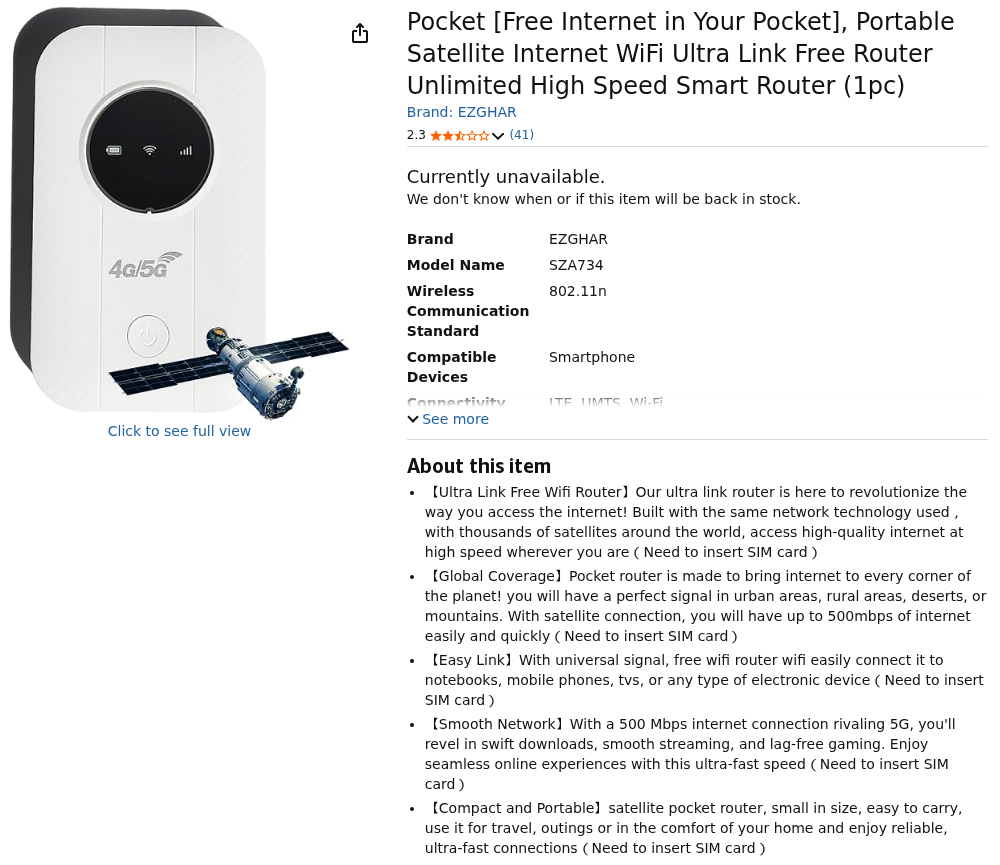
The Amazon listings give its connectivity as LTE and WiFi, and one adds 3G UMTS. These are cellular and local wireless standards, not satellite ones.
What free satellite internet would actually need
Satellite internet for consumers comes from services such as Starlink, which require their own dish and a paid plan. Starlink’s portable Roam service starts at $55 a month.
Phone-to-satellite services such as T-Mobile’s T-Satellite work with recent phones, focus on texting and select apps, and cost $10 a month unless your plan includes them.
Is the Ultra Link free WiFi router legit?
It’s a real, cheap hotspot sold with misleading claims. It won’t give you free or satellite internet, and it does nothing until you add a SIM with a data plan.
- Every Amazon feature bullet ends with a note that you need to insert a SIM card.
- Its listed connections are 4G LTE and 3G UMTS, not satellite.
- A Walmart version lists LTE bands 1, 3, 5 and 40. Only band 5 is used in the US, by AT&T and Verizon.
- Ratings are poor: 2.7 stars on Walmart from 59 ratings, and 2.3 and 3.0 stars on two Amazon listings.
- No FCC ID appears on the listings, and FCC records show no Ultra Link pocket router.
What the Listings Admit in the Fine Print
The clearest evidence comes from the sellers themselves. The Amazon listing pictured above calls the device a portable satellite internet router in its title, then contradicts that in every bullet.
Each feature line ends with the same note in parentheses: you need to insert a SIM card. That marks it as a cellular hotspot that relies on cell towers.
The first bullet says the router is built with the same network technology used with thousands of satellites, without naming any network. Nothing in the specifications backs that up.
The listing names the brand as EZGHAR and the model as SZA734. A second EZGHAR listing, model ASD666, uses the same bullets and lists cellular 4G LTE as its connection.
Both Amazon pages now say the item is currently unavailable. Similar pocket satellite hotspots remain on sale there for $17.99 and $23.99, rated 2.4 and 2.3 stars.
Walmart’s marketplace listing is more specific. It sells a Pocket WiFi Ultra Link router for $21.47 and lists support for 4G LTE bands 1, 3, 5 and 40.
That matters in the US. AT&T, Verizon and T-Mobile don’t use bands 1, 3 or 40, and only AT&T and Verizon use band 5 (850 MHz).
With a SIM, it depends on AT&T’s or Verizon’s band 5 signal and may not connect to T-Mobile. At least four Walmart reviewers say it didn’t connect or work.
Why a Pocket Router Can’t Reach Satellites
Satellite broadband needs a dish built to track satellites, a clear view of the sky and a paid plan. A $20 hotspot has neither a dish nor a plan.
Starlink sells the Starlink Mini as a compact, portable kit that fits in a backpack. It still needs a paid Starlink plan, billed monthly.
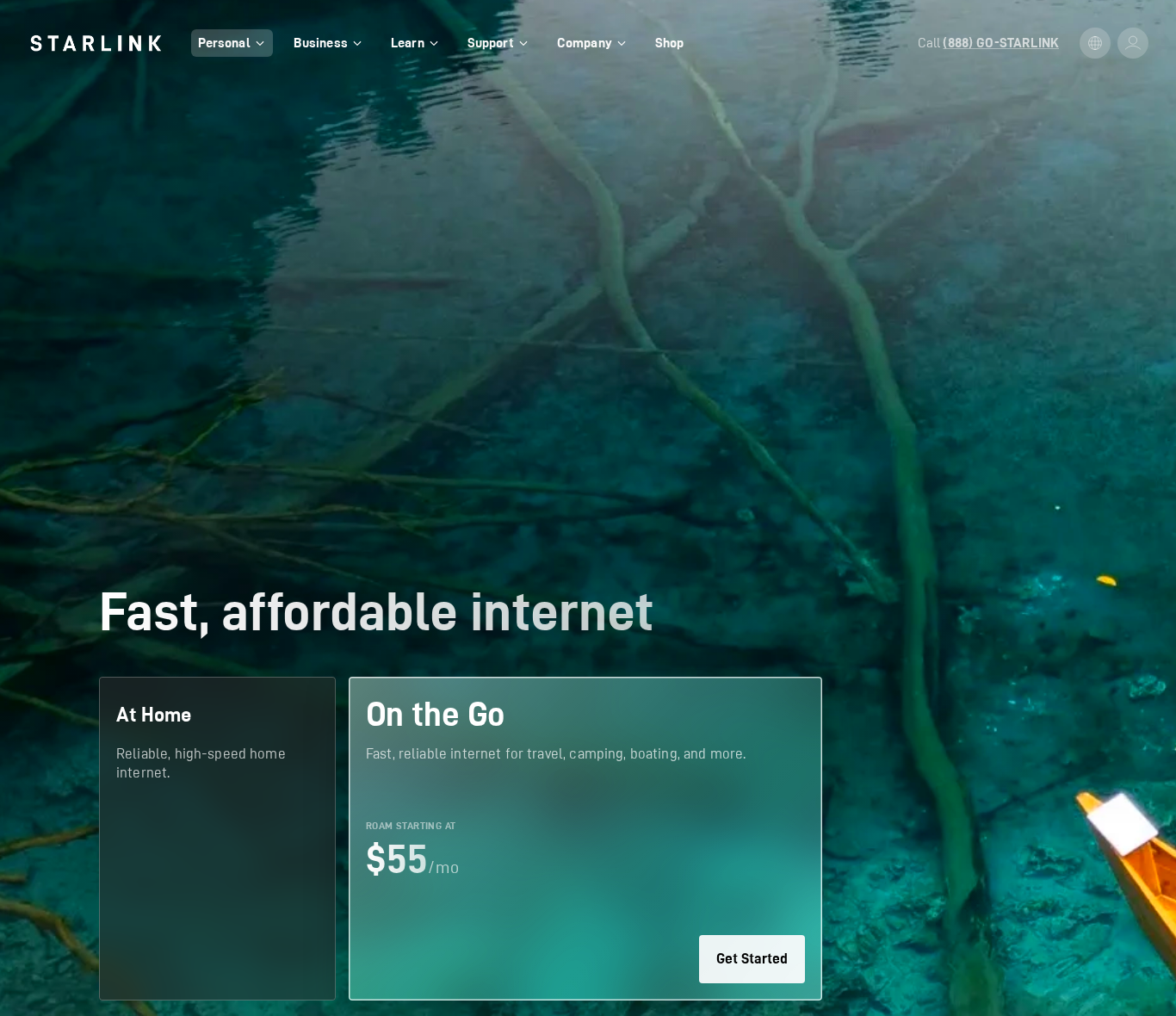
On Starlink’s Roam page, the 100GB plan starts at $55 a month, the 300GB plan at $80 and the unlimited plan at $175, with speeds up to 300 Mbps.
That’s the real cost of satellite internet you can carry. A one-time $20 gadget would be giving away service that Starlink charges for every month.
Direct-to-phone satellite service exists, but it isn’t what Ultra Link describes. T-Mobile says T-Satellite handles texting and select apps outdoors where you can see the sky, with limited data speeds.
T-Satellite works through compatible phones and a T-Mobile plan or a $10 monthly add-on. No separate pocket router is involved, and it isn’t free.
Ultra Link’s 500 Mbps claim also clashes with its own specifications. Both EZGHAR listings and the Walmart listing list a top data rate of 150 Mbps.
How the Ultra Link Pitch Works
The marketing follows a pattern seen with many miracle gadgets. Each step adds a claim that the fine print later walks back.
Step 1: A satellite picture sets the idea
Product images show the hotspot next to a satellite in orbit, with slogans like free internet in your pocket. The device itself is labeled 4G/5G.
Step 2: Free and unlimited do the selling
Store pages promise global coverage and no monthly fees. Sunifty’s page says the Ultralink connects to actual satellites and auto-connects to the nearest one in 30 seconds.
Step 3: Speed numbers borrowed from 5G
Listings claim up to 500 Mbps and compare the device to 5G. The specifications underneath describe ordinary 4G LTE and 3G bands.
Step 4: The SIM card appears only in small print
Amazon’s bullets mention the SIM requirement in parentheses. One Walmart buyer says the listing there didn’t mention a SIM at all, and others say none came in the box.
Step 5: The buyer pays for data anyway
To use the device, you buy a data SIM or plan from a carrier. At that point you’re paying monthly, just as you would with any hotspot.
Ultralink Reviews From Buyers
Walmart shows 59 ratings for its Ultra Link listing, averaging 2.7 stars. There are 28 one-star ratings and 19 five-star ratings, with only 12 in between.
At least five written Walmart reviews mention the SIM card, either because one was needed or because none was included. Others say the device wouldn’t connect or charge.
A December 2025 reviewer says the ad promised free WiFi, but the gadget needed a SIM with a monthly subscription and had to be set up at a phone store.
Others describe a tiny, vague manual with no advice on which SIM to buy, a unit that wouldn’t charge, and a parcel that was lost in shipping.
One five-star review is lukewarm at best. Its author calls the device a semi-effective, cheap knockoff of a better-known travel hotspot.
On Amazon, the two EZGHAR listings average 2.3 stars from 41 ratings and 3.0 stars from 27 ratings.
Real Ways to Get Internet on the Go
If what you want is internet away from home, every working option involves paying for data somewhere. The difference is how you pay and how much you get.
- Your phone’s hotspot uses the data plan you already have, so check its hotspot allowance first.
- A carrier hotspot or a data-only SIM in an unlocked hotspot adds a separate monthly or prepaid plan.
- Travel hotspots with bundled data cost more upfront. One on the same Amazon page sells for $69.99 with 10GB of US data included.
- Starlink’s portable kit reaches the internet by satellite, with Roam plans from $55 a month.
- Satellite texting on recent phones, such as T-Satellite, covers messages and select apps, not full internet.
None of these is free, and none fits in a $20 box with no plan attached. Any ad that says otherwise is selling a claim, not a service.
How to Check the Next Free Internet Gadget
Ultra Link won’t be the last device sold this way. A few quick checks expose most of them before you pay.
- Read the connectivity line. LTE, UMTS or 4G means cellular, which means a SIM and a data plan.
- Look for a SIM slot in the product photos or manual. It means the device runs on cellular data, like any hotspot.
- Search the FCC ID if the listing gives one. If it doesn’t, ask the seller before ordering.
- Compare the listed bands with your carrier’s bands, especially for cheap imports.
- Check whether the seller is a marketplace with a return guarantee or a standalone store.
Ultralink Is Also a TV Antenna Name
If you searched for Ultralink reviews, you may have found pages about a different product. UltraLink is also the name of an indoor TV antenna sold with free TV claims.
Our report on the UltraLink TV antenna covers that device. It receives broadcast channels and has nothing to do with internet access.
Real portable hotspots exist too, with clearer data terms. Our Ryoko Pro investigation explains how those devices depend on cellular data, renewals and speed limits.
And if an ad uses Starlink’s name for a cheap one-time deal, read our report on Starlinkoficial.com, a site that offered Starlink-branded internet for a one-time fee.
Who Sells the Ultra Link Router?
No single company stands behind the Ultra Link name. Different sellers list near-identical hotspots under different brands, which makes support and returns harder to pin down.
EZGHAR on Amazon
The two Amazon listings name EZGHAR as brand and manufacturer, with models SZA734 and ASD666. Both are now unavailable, while similar listings from other sellers remain.
BaoHeng on Walmart’s marketplace
The Walmart listing is sold and shipped by a third-party seller called BaoHeng and names the brand as BINGTAOHU. Buyers can start returns from their Walmart order page.
Sunifty, a clothing store selling routers
Sunifty sells the Pro Portable Ultra Link Free Pocket WiFi Router for $22.99. Its Shopify store profile lists Nanjing, China, and describes the site as an online dress shop.
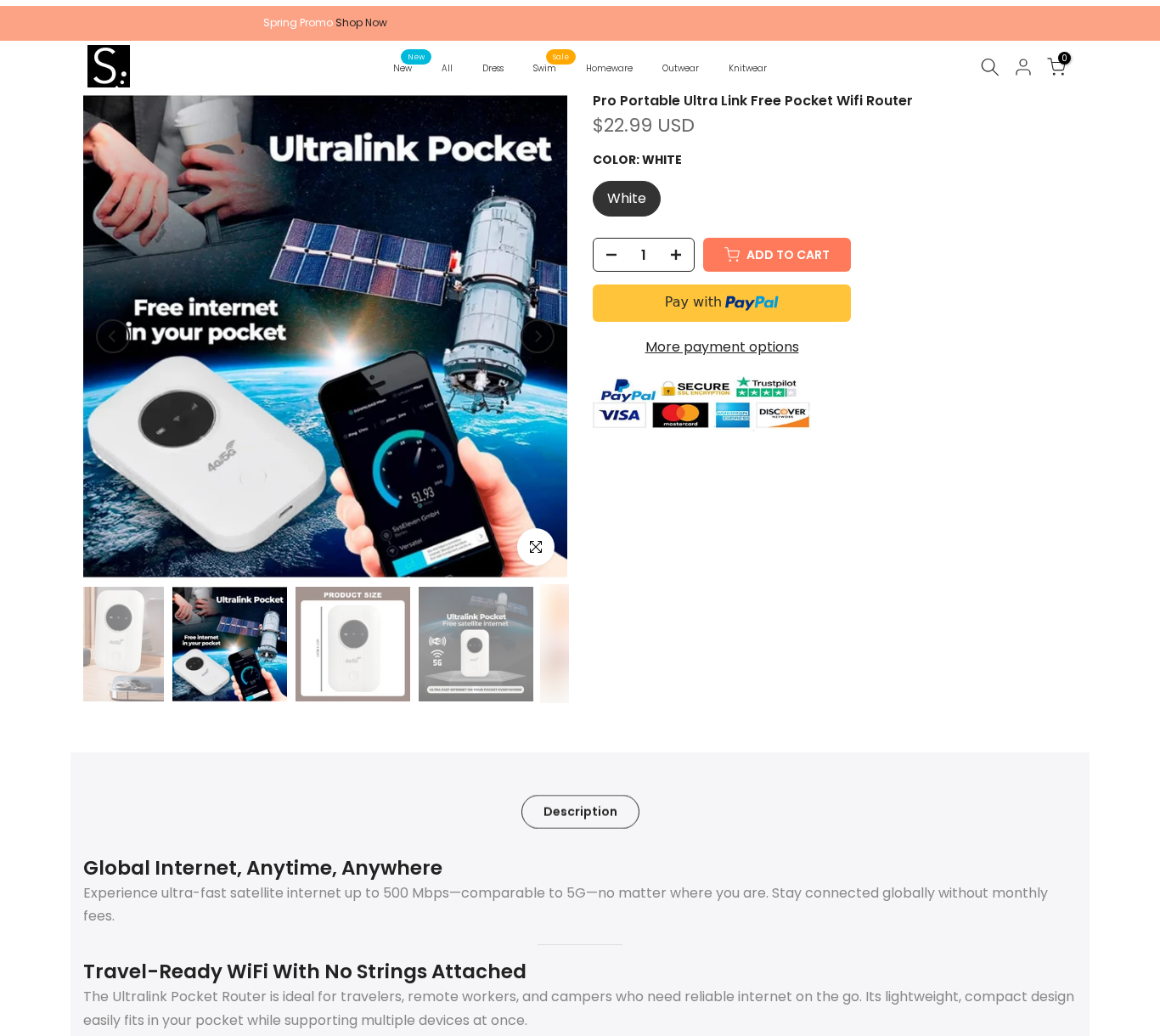
Sunifty’s page is where the satellite promise is strongest. It says the router connects to actual satellites and keeps you online globally without monthly fees, which the device can’t do.
No FCC ID to trace a maker
FCC rules bar marketing radio devices in the US before they’re authorized, and certified devices must carry an FCC ID. None of the listings shows one.
FCC ID records list no pocket router under EZGHAR or Ultralink. The matches are unrelated products, such as a glucose meter and older WiFi adapters.
From 2027, FCC rules also require online marketplaces to show an FCC ID on most new listings. A missing ID today is a warning sign, not proof of a violation.
What the Device Can Do if You Already Own One
If you’ve already bought one, it may still work as a basic hotspot. You’ll need a data SIM from a carrier whose network uses a band the device supports.
Compare the bands printed in the manual or listing with your carrier’s band list. For the Walmart version, only AT&T or Verizon service has a matching band.
Expect modest speeds and battery life. If it won’t connect with a compatible SIM, treat it as defective and ask for a refund rather than buying more data.
What to Do If You Bought an Ultra Link Router
- Find out where you bought it.
Check your receipt for Amazon, Walmart, Sunifty or another store. Each one has its own return window and dispute process.
- Return it through the marketplace.
Amazon and Walmart buyers can usually start a return from their order page. Say it was sold as free satellite internet but needs a SIM.
- Use the marketplace guarantee if the seller ignores you.
Amazon’s A-to-z Guarantee covers unresolved third-party orders, and Walmart customer care handles marketplace problems. Keep screenshots of the claims.
- Dispute a direct-store purchase.
If you paid Sunifty or a similar site, ask your card issuer about an item-not-as-described dispute. Issuers often allow about 120 days.
- Check PayPal’s deadline.
PayPal disputes must be opened within 180 days of payment, so that window has closed for orders paid before early May 2026.
- Don’t buy a data plan just to test it.
A SIM makes it a normal paid hotspot, not free internet. Decide whether you want that before spending more.
- Report misleading ads.
US buyers can report the free internet claim at ReportFraud.ftc.gov. Include the ad, the listing link and your order details.
Frequently Asked Questions
Does the Ultra Link free WiFi router give unlimited satellite internet?
No. It’s a 4G hotspot that needs a SIM card and a data plan. It has no satellite antenna, and consumer satellite internet services charge monthly fees.
Do I need a SIM card for Ultralink?
Yes. The Amazon listings say so in every feature bullet. Without a SIM and an active data plan, the device can’t reach the internet at all.
Will it work with my US carrier?
Possibly on AT&T or Verizon. The Walmart version lists bands 1, 3, 5 and 40, and only band 5 is used in the US. T-Mobile doesn’t use it.
Is Ultra Link the same as Starlink?
No. Starlink is SpaceX’s satellite service, sold with its own dish and monthly plans. Ultra Link listings mention thousands of satellites, but nothing ties the device to Starlink.
Why are there so many Ultralink listings?
The same style of hotspot is sold under several brand names by different sellers. That makes reviews scattered and returns dependent on whichever store you used.
Can I get my money back?
Possibly, if you act within the store’s return window. Use Amazon’s or Walmart’s return tools, or a card dispute for direct purchases, and keep the listing screenshots.
The Bottom Line
Don’t buy the Ultra Link free WiFi router. It’s a basic 4G hotspot sold as free satellite internet, and its own listings admit it needs a SIM card to work.
If you need internet on the go, compare a paid hotspot plan or a real satellite service like Starlink, whose portable plans start at $55 a month.
If you already bought one, start a return through the store or marketplace now, citing the satellite and no-monthly-fee claims, before buying any data plan for it.

Join the discussion
4 commentsShare your experience or ask a question about this article.
Community experiences
Did this happen to you?
Your experience could help someone recognize the same scam. Submit a private report for our team to review.
I experienced this tooReports are reviewed before publication. Sharing publicly is always your choice.
Discussion
Their advert does say in red lettering No sim ??
In reply to Rod
Good catch, Rod – and that line in the ad is the whole story. With no SIM there is no cellular connection, so the device cannot produce internet of its own; at best it repeats a wifi signal you are already paying for. The fine print is written precisely so it can be pointed at later, while the video and the headline promise free unlimited internet. If you have already been charged, your card issuer is the fastest route to a refund.
I don’t believe the product is a scam the way it’s advertised is a scam . The product has WI-FI written all over it and the images clearly show cellular signal. The truth has been deliberately lost in translation . I think it’s a shame products like this aren’t advertised properly as it gives the people actually behind the product design a bad name.
In reply to dan
That is a fair and precise distinction, and I think you are right that it deserves separating. There is nothing inherently fraudulent about the hardware itself – the deception is in how it is presented, and the WiFi-versus-cellular confusion is the clearest example. Showing signal bars that imply it works anywhere, while the device in fact needs to stay within range of a home network, changes what the product is for. Someone buying it to watch a property, a vehicle or an elderly relative’s front door discovers the difference only after paying.
I would push back gently on “lost in translation”, though. These listings are written by marketers who know exactly which capability sells, and the same ambiguity appears across dozens of brands with different suppliers – which suggests a choice rather than a language problem. Careless translation produces odd phrasing; it does not consistently produce claims that happen to favour the seller.
But your underlying point stands and it is one we try to make in these reviews: some of these gadgets do a modest job at a modest price, and it is the advertising, the invented specifications and the subscription billing that turn them into a scam.