

A hand wipes once across a scratched table or car door. In the next frame, years of damage have vanished and the surface looks new enough to reflect the camera. The viral car scratch repair scam sells that impossible transformation as a small tube of polish.
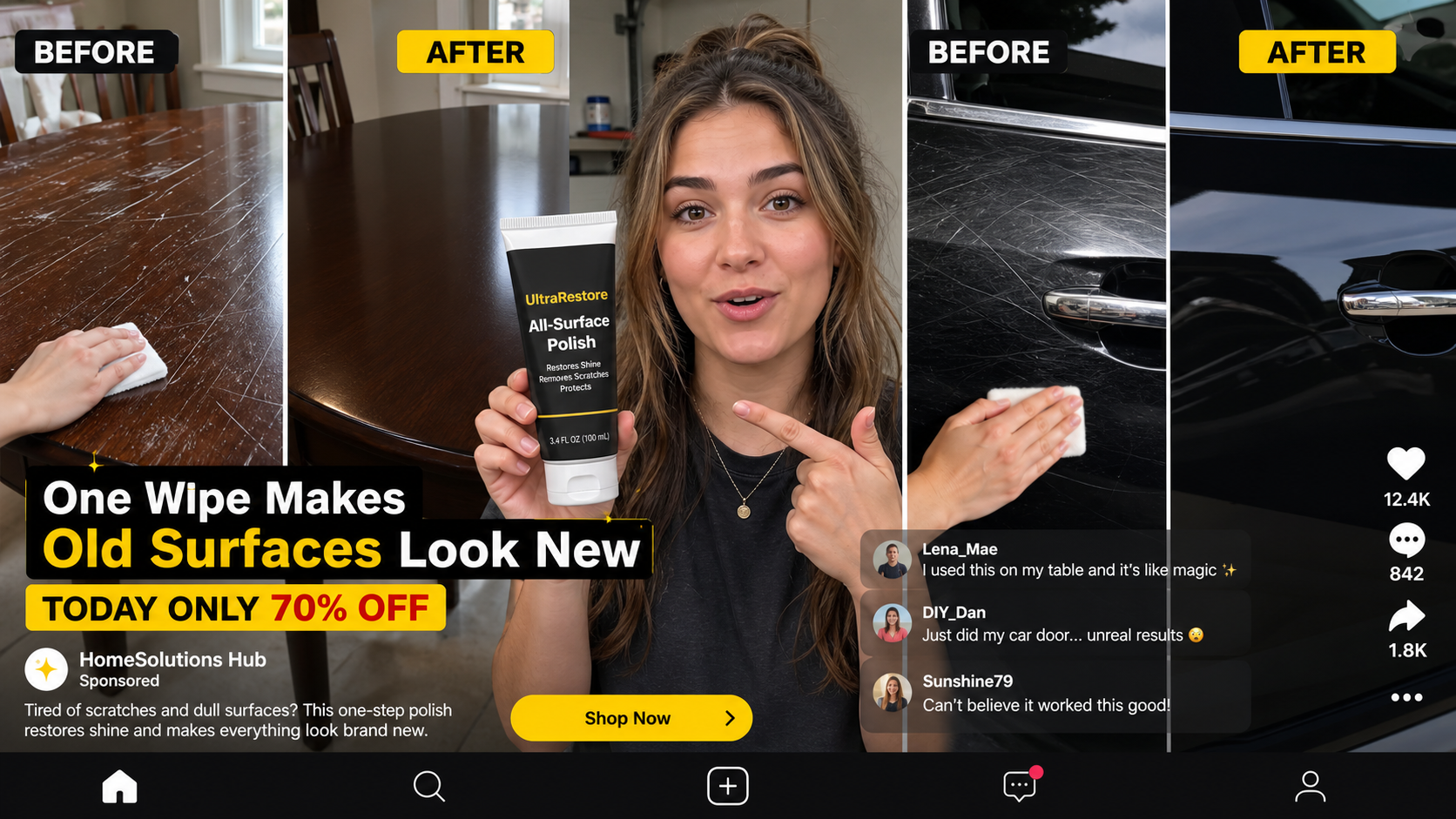
The clips are designed for a phone screen, where quick cuts and dramatic reflections hide the details. A before image may show different lighting, a different panel, or computer-generated damage that disappears on command.
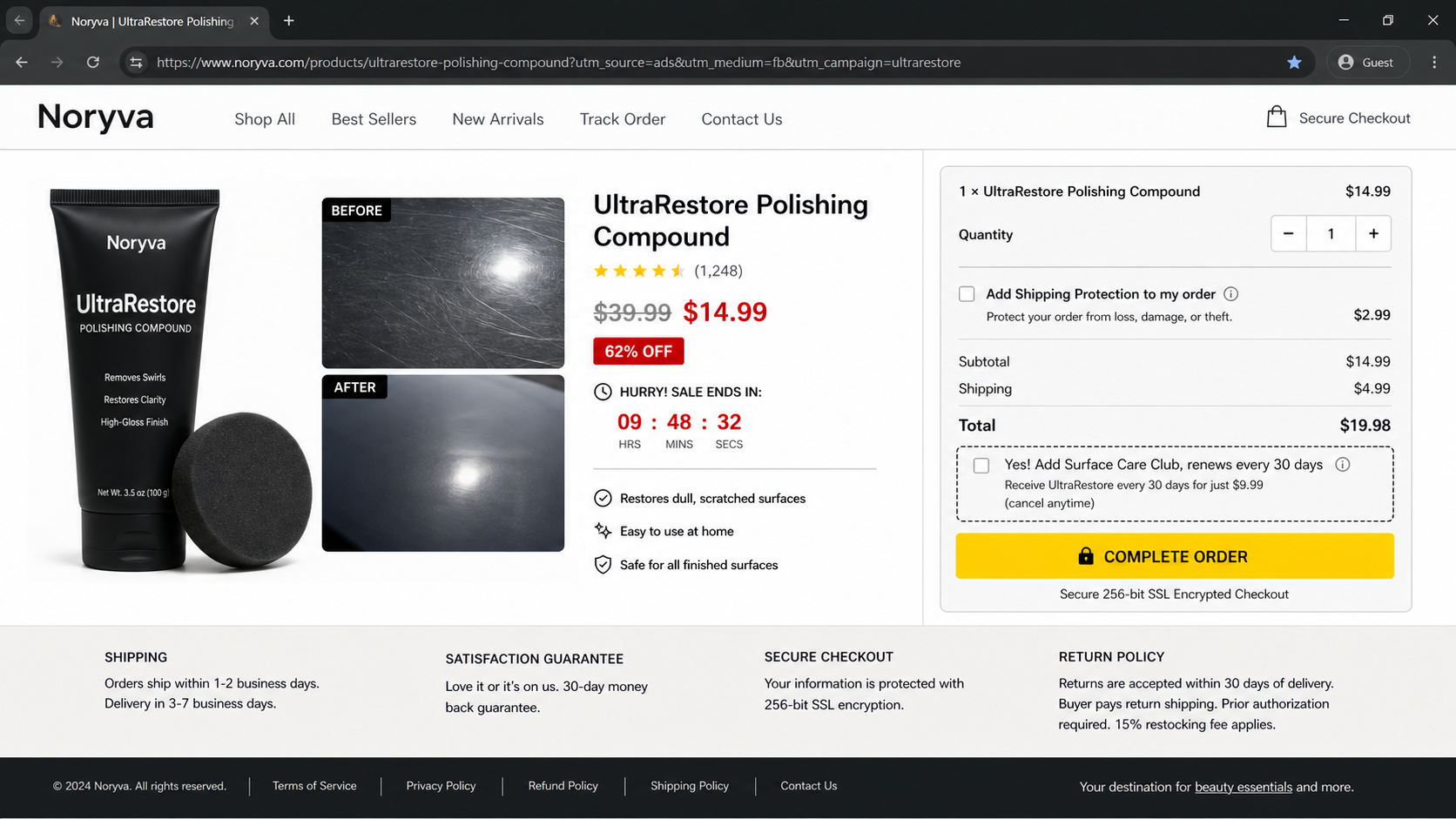
One current sales path has promoted an Ultracut Polishing Compound through Orvyla after social ads showed an all-in-one surface restorer.
The same store sells unrelated beauty and household items, which makes the magic-product story look more like a rotating catalog offer than a specialist detailing brand.
A genuine polishing compound can improve certain shallow defects when used correctly. It cannot replace missing paint or veneer, rebuild gouged material, repair a dent, or safely restore every surface with one casual wipe.
Overview
The product may be real, but the result in the video, the seller behind it, and the path to a refund deserve much closer inspection.
The advertisement demonstrates a result the product cannot explain
The video usually shows a badly scratched car panel, wooden table, countertop, or appliance. A small amount of cream is applied by hand, then the surface becomes smooth, dark, and glossy in seconds.
Real polishing works by removing or refining a very thin surface layer. That process depends on the material, depth of damage, abrasive strength, pad, pressure, preparation, and finish. It is not a universal eraser.
If a scratch cuts through clear coat or paint, polishing cannot create the missing coating. If wood has lost stain or veneer, compound cannot rebuild it.
A temporarily oily shine may also hide defects until the residue is washed away.
Orvyla's current policies create practical refund obstacles
Orvyla's refund policy says returns must be initiated within 30 days of receiving the product. It limits refunds to a maximum of two items per order, applies a 15% restocking and processing fee, and makes the customer pay return shipping.
The policy says unapproved returns will not be accepted and that an order cannot be canceled once placed. It also states that a chargeback or dispute started without first contacting the seller can void eligibility for a refund or trial.
Those terms make the headline guarantee less simple than it looks. A low-cost tube may not be economical to ship back, especially if support directs the buyer to an overseas destination or offers only a small partial refund.
The company information raises additional questions
Orvyla lists a phone number, support email, and 987 Tulip Tree Lane in West Des Moines, Iowa. Public property information identifies that address as a large single-family residence, not an obvious polishing-products headquarters or fulfillment warehouse.
The store's terms and catalog language are inconsistent. Pages promoting home products also refer to beauty products, and contact text contains spacing and copy errors.
These details do not prove every transaction is fraudulent, but they weaken the impression of a focused, accountable manufacturer.
The current site also publishes a subscription policy for optional monthly offers. That does not prove every Ultracut buyer is enrolled.
It does mean shoppers must inspect the exact checkbox, receipt, and card statement instead of assuming every option is a one-time purchase.
- AI-enhanced or edited video creates an impossible one-wipe result.
- A generic compound is presented as suitable for paint, wood, stone, and appliances.
- The social price and checkout total may differ after shipping and add-ons.
- The refund policy includes approval, return shipping, and a 15% fee.
- An optional subscription policy exists, so the selected checkout option matters.
- The listed Iowa contact address appears to be residential property.
- Recent public reviews overwhelmingly describe poor outcomes with the broader store.
What Ultracut and the Orvyla Store Actually Promise
The advertised item is typically shown as a polishing compound supplied with a small foam pad. The pitch says it removes scratches, restores color, and leaves a protective gloss on several materials.
That language blurs cleaning, filling, abrasion, paint correction, and protective coating into one product. Those are different tasks.
A formula strong enough to cut automotive clear coat may be inappropriate for soft plastic or finished furniture, while a mild oily polish may do little more than hide marks temporarily.
Orvyla's site combines household essentials with beauty and self-care products. The variety is common in general dropshipping stores, where products are selected for their advertising potential rather than deep technical support.
The store's public refund terms allow a maximum of two refunded items, deduct 15%, exclude shipping and protection fees, require approval, and place return postage on the buyer.
It also says orders begin processing immediately and cannot be canceled.
A separate subscription policy describes monthly auto-renewal for options selected at checkout. Consumers should not assume that a recurring term applies to every order, but they should never rely on the ad's silence.
The box checked on the final payment screen is what matters.
Trustpilot currently shows Orvyla with a very low score and almost all reviews at one star. Reviewers describe items that did not match ads, delays, non-delivery, poor quality, small partial refund offers, and costly returns.
These are individual reports, not a finding about every order, but the pattern is relevant before paying.
Why the Scratch Demonstration Is Misleading
A real before-and-after comparison should use the same surface, camera position, lighting, focus, angle, and preparation. Viral ads often change several of these at once, making scratches look deeper before and nearly invisible after.
Reflections are especially easy to manipulate. Soft lighting hides fine scratches, while a hard point light reveals them. Moving the lamp or camera can create a dramatic result without changing the panel.
An oily product can fill microscopic defects and deepen color for a short time. Once detergent removes the residue, the scratches may reappear. A proper test cleans the corrected area before the final inspection.
AI-generated video can now invent scratches, hands, tools, and surfaces. Watch for changing grain patterns, scratches that move between frames, warped reflections, smeared fingers, or a product tube whose label changes when it turns.
Even an honest compound needs material-specific instructions and safety information. Aggressive rubbing can thin automotive clear coat, dull plastic, remove furniture finish, spread contamination, or create haze. A one-wipe ad does not show that risk.
How the Viral Car Scratch Repair Scam Works
Step 1: A flawless before-and-after video stops the scroll
The ad chooses damage that every owner hates: white scratches across black paint, cloudy headlights, a gouged dining table, or a dull countertop. The problem looks expensive to fix.
A creator wipes the area once and reveals a mirror finish. The transition may be hidden behind a hand, cloth, jump cut, or camera move, which gives the editor time to replace the scene.
Short-video comments praise the result and ask where to buy. The advertiser can filter criticism, reuse comments, or populate the page with accounts that do not represent verified buyers.
Step 2: The click leads to a rotating general store
The destination may not specialize in vehicle detailing or furniture care. It sells a broad collection of trending products and places the advertised item on a dedicated page built for that campaign.
The product name can change from all-in-one restorer to scratch remover, polishing compound, 5D polish, or ceramic repair cream. The photos and demonstration remain nearly identical.
A new name makes older complaints harder to find. Search the images, support details, policy sentences, and address in addition to the current product title.
Step 3: A deep discount makes testing feel harmless
The item is shown at 60%, 70%, or 80% off, often beside a countdown that restarts. The low entry price makes the buyer think careful research would take more time than the possible loss is worth.
Shipping, priority processing, protection, multiple tubes, or warranties can raise the final amount. Some checkouts also display recurring purchase options.
Read the last authorization screen slowly and take a screenshot. The price in the social clip is not necessarily the amount that will appear on the card.
Step 4: Store-controlled proof replaces an independent test
The product page uses five-star reviews, low-stock messages, recent-purchase popups, and glossy before-and-after images. The store controls all of those elements.
A review saying it worked on everything gives no information about scratch depth, paint thickness, material, lighting, or how the surface looked after washing.
Independent reviews of the exact seller and exact product matter more. Also check whether the reviewer bought through the same domain, because unrelated professional compounds can share similar names.
Step 5: A generic product arrives or the shipment drags on
Some buyers may receive a small tube with limited instructions. Others report long tracking delays or an item that differs from the advertisement.
Keep the package and shipping label because they can reveal another company or country in the chain.
Do not test an unknown abrasive on the middle of a valuable panel. Photograph the unopened item, read the ingredients and warnings, and test a hidden area only if the manufacturer and use instructions are credible.
If the item is wrong, empty, damaged, or unlabelled, document it before contacting support. A video of the unboxing can help show that the mismatch was present on arrival.
Step 6: The refund path costs time and money
Support may ask for repeated photographs, offer a small partial refund, or stress that international return postage will be expensive. Delays can consume the card dispute window.
Orvyla's current policy requires prior approval, makes buyers pay return shipping, and deducts a 15% restocking and processing fee. It also says only two items per order can be refunded.
Ask the card issuer how to proceed before paying for a costly return. Preserve the seller's advertised result and written policy so the issue can be described as merchandise not as advertised when appropriate.
Step 7: The same footage returns with a new tube
Once one store develops a poor reputation, the ad can redirect to another domain. The tube color, product label, and discount change while the magical wipe remains.
The next campaign may target shoes, leather seats, watches, bathroom tile, or phone screens. A single cream is again presented as the universal solution.
Recognizing the production trick is more useful than memorizing Ultracut. Real restoration has limits, steps, and material-specific risks. Scam videos remove all three.
Company, Address, and Fulfillment Checks
The storefront name is not enough
Identify the legal entity behind Orvyla, the entity in the terms, and the merchant shown on the card. A retailer selling physical goods should make that chain clear.
If the policy refers to another store or product category, treat it as a warning that generic documents were copied without careful review. That can complicate refunds and consumer complaints.
Save the footer, terms, privacy policy, receipt, and payment descriptor. A disappearing product page should not erase the merchant identities that accepted the order.
The Iowa address appears to be a residence
Orvyla lists 987 Tulip Tree Lane, West Des Moines, Iowa. Public real-estate information describes the location as a single-family home in a gated residential community.
A home address can belong to a legitimate small business, but it does not resemble the warehouse, manufacturer, or customer-service headquarters implied by a high-volume global store. The seller should explain its role.
Do not send a return there unless Orvyla gives written authorization. The return destination may be different and can determine whether recovering a low-value purchase is practical.
The phone and email must answer product-specific questions
The contact page lists +11840649451 and support@orvyla.com. Call or write before ordering and ask whether the team supports Ultracut, where the product ships from, and whether the chosen offer renews.
A valid-looking number is not proof if no one answers or the agent cannot identify the product. Generic replies and malformed email addresses inside policy text are additional caution signs.
After purchase, communicate in writing. Record the date, agent, cancellation request, return authorization, promised amount, and deadline.
The product's origin and formulation are unclear
A real abrasive should identify its responsible manufacturer, ingredients or safety data, suitable materials, warnings, batch code, and country of origin. A marketing label alone is not technical documentation.
Generic compounds are frequently mass-produced in China and other manufacturing hubs, then relabeled by online stores. That model is not automatically unsafe, but an undisclosed source makes quality, consistency, and liability hard to verify.
Using an unknown compound on paint or furniture can create permanent damage. Stop if the product lacks instructions, smells strongly of solvent, separates unexpectedly, irritates skin, or changes the finish in a hidden test area.
What Real Scratch Repair Can and Cannot Do
A shallow mark in clear coat may improve through careful polishing. A fingernail-catching scratch, exposed primer, missing paint, cracked coating, damaged veneer, or deep gouge normally needs a different repair.
Professional detailers begin by cleaning and decontaminating the surface, inspecting the defect under consistent light, and choosing the least aggressive process likely to work.
They do not treat a painted car, lacquered table, plastic screen, and stone counter as the same material.
A compound can also create damage by removing too much coating or leaving haze. Technique and follow-up polishing matter, which is why the effortless one-wipe story is misleading even when the tube contains a functional abrasive.
Before buying from an ad, ask a local detailer or restoration professional what the damage actually requires. A realistic estimate can prevent both a useless purchase and an expensive attempt to correct new damage.
Warning Signs to Watch For
- Deep scratches disappear after a single hand wipe.
- The same cream supposedly repairs paint, wood, stone, glass, and plastic.
- Before-and-after lighting, angle, reflections, or grain patterns do not match.
- The discount timer resets when the page reloads.
- The store sells unrelated viral products and provides little technical documentation.
- A residential address is presented as the main company contact.
- Refunds require approval, paid shipping, and a 15% deduction.
- The checkout includes add-ons or an optional recurring purchase that the ad never mentioned.
The product does not need to be completely useless for the advertisement to be deceptive. If a mild polish is sold with an impossible AI transformation, the buyer is paying for a result that the tube cannot reliably produce.
What to Do if You Have Fallen Victim to This Scam
- Preserve the advertisement and checkout. Save the before-and-after clip, product page, claims, price, selected options, refund policy, contact page, receipt, and card descriptor.
- Cancel and reject future billing in writing. Tell the seller you cancel the order, add-ons, memberships, and repeat shipments. Ask whether the checkout enrolled you in any recurring option.
- Inspect statements now and for several months. Report duplicate, unfamiliar, or recurring charges to the issuer. Ask whether the card should be replaced and note dispute deadlines.
- Document what arrived before using it. Photograph the sealed package, label, tube, pad, instructions, batch markings, shipping origin, and any mismatch. Keep all packaging.
- Do not risk a valuable surface. If the compound lacks credible instructions or manufacturer details, do not test it on the center of a car panel, table, screen, or countertop. Seek professional advice.
- Start the refund process promptly. Request written authorization and the exact return address, fee, deadline, and refund amount. Ask the issuer before paying expensive return postage.
- Run Malwarebytes after a forced download. A polish store should not require a browser extension, tracking app from an unofficial source, or remote-support program. Scan the device if you installed one.
- Use AdGuard to reduce similar ads. AdGuard can block many deceptive ad networks and redirect chains, though new stores still require independent verification.
- Report misleading proof. Report the ad to the platform and the seller to the FTC. Include the impossible video, store details, and your transaction evidence.
Frequently Asked Questions
Can polishing compound really remove car scratches?
It can improve some shallow clear-coat defects. It cannot recreate missing paint, repair dents, or safely remove every scratch. Defect depth and coating thickness matter.
Is every Ultracut product part of this scam?
No. Several unrelated detailing products use similar words. This warning concerns the specific viral ad and Orvyla sales path, not every professional compound with ultra cut in its name.
Does Orvyla automatically subscribe every buyer?
We did not verify that every Ultracut order includes a subscription. Orvyla publishes a subscription policy for optional recurring offers, so check the exact selection, receipt, and statements.
Why can scratches reappear after polishing?
Oils and fillers can temporarily hide fine marks. Washing may reveal them again. A proper correction test removes residue and inspects the same area under consistent light.
What if the return costs more than the product?
Ask the card issuer whether a return is required for a merchandise-not-as-described dispute. Do not let seller delays push you beyond dispute deadlines.
Is the Orvyla address a fulfillment center?
Public property information describes the listed Iowa address as a single-family residence. That does not establish where the product is manufactured or where returns are processed.
The Bottom Line
The viral car scratch repair scam takes a limited product category and gives it an unlimited promise. A small tube may add shine or soften light marks, but it cannot perform the one-wipe restoration shown in synthetic and heavily edited videos.
Orvyla's low public review score, residential contact address, optional subscription policy, and restrictive refund terms add reasons to pause before buying through this sales path.
Judge the damage first, then the product, then the merchant. If any one of those cannot be verified, keep the card out of the checkout and ask a qualified professional what the surface actually needs.








