

The ad does not sell candles. It sells the feeling that everyone younger, faster, and luckier has already discovered a machine that prints money while you are still scrolling. The AI candles scam claims teenagers are making millions with an automated shopping app.
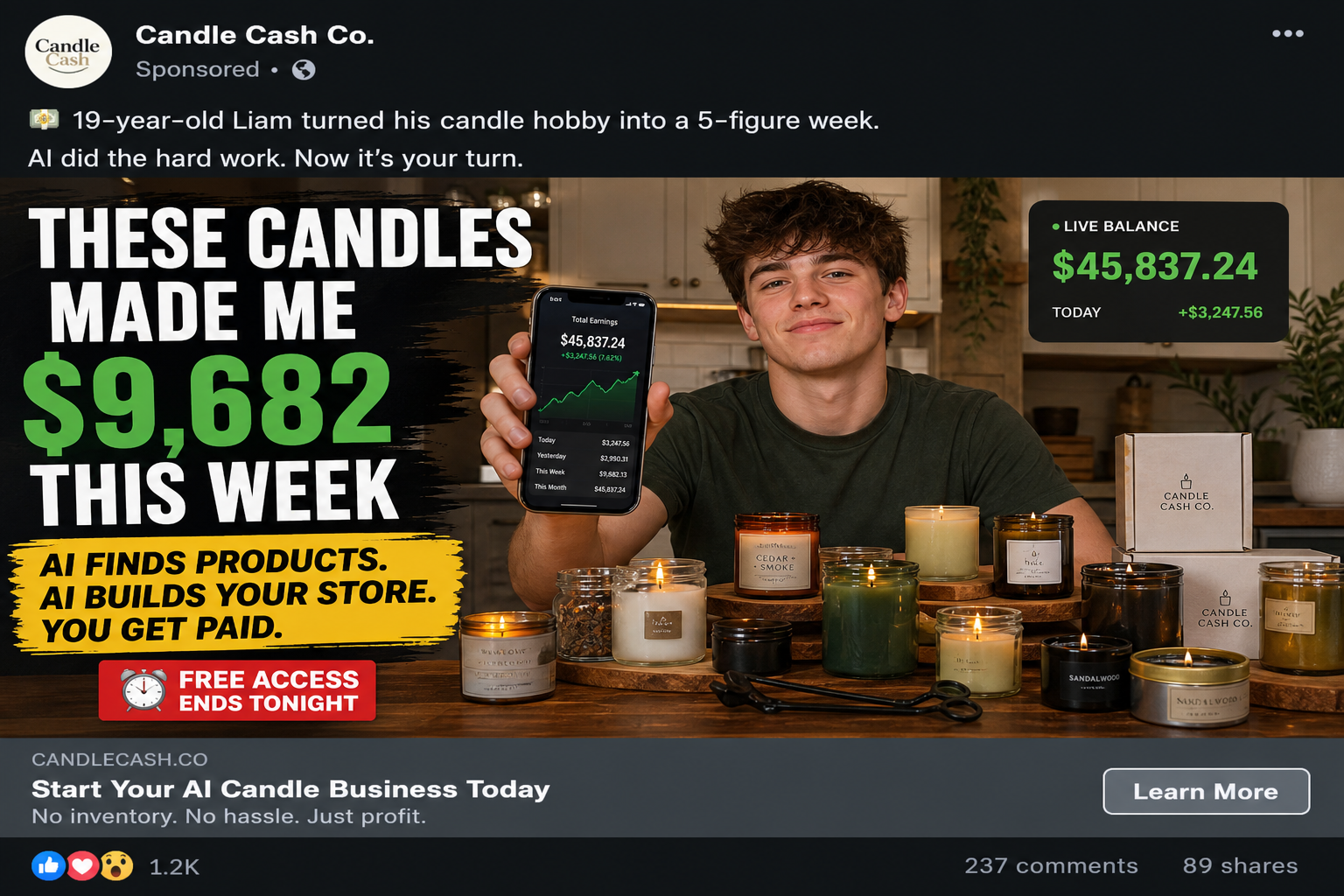
Candles are only the current prop. They are familiar, visual, and easy to imagine selling, which makes a fake weekly profit screenshot feel more concrete than a vague promise about artificial intelligence.
Other versions have used popcorn makers, headphones, kitchen gadgets, and trending products. The alleged software name also rotates, including AIMS AI USA and earlier labels such as InfinitAI, NexusAI, FusionAI, and AI Revolution.
The stable product is not an automated store. It is the sales funnel itself: an emotional ad, a long video, a low starter price, and more paid steps presented as necessary after the first payment.
Overview
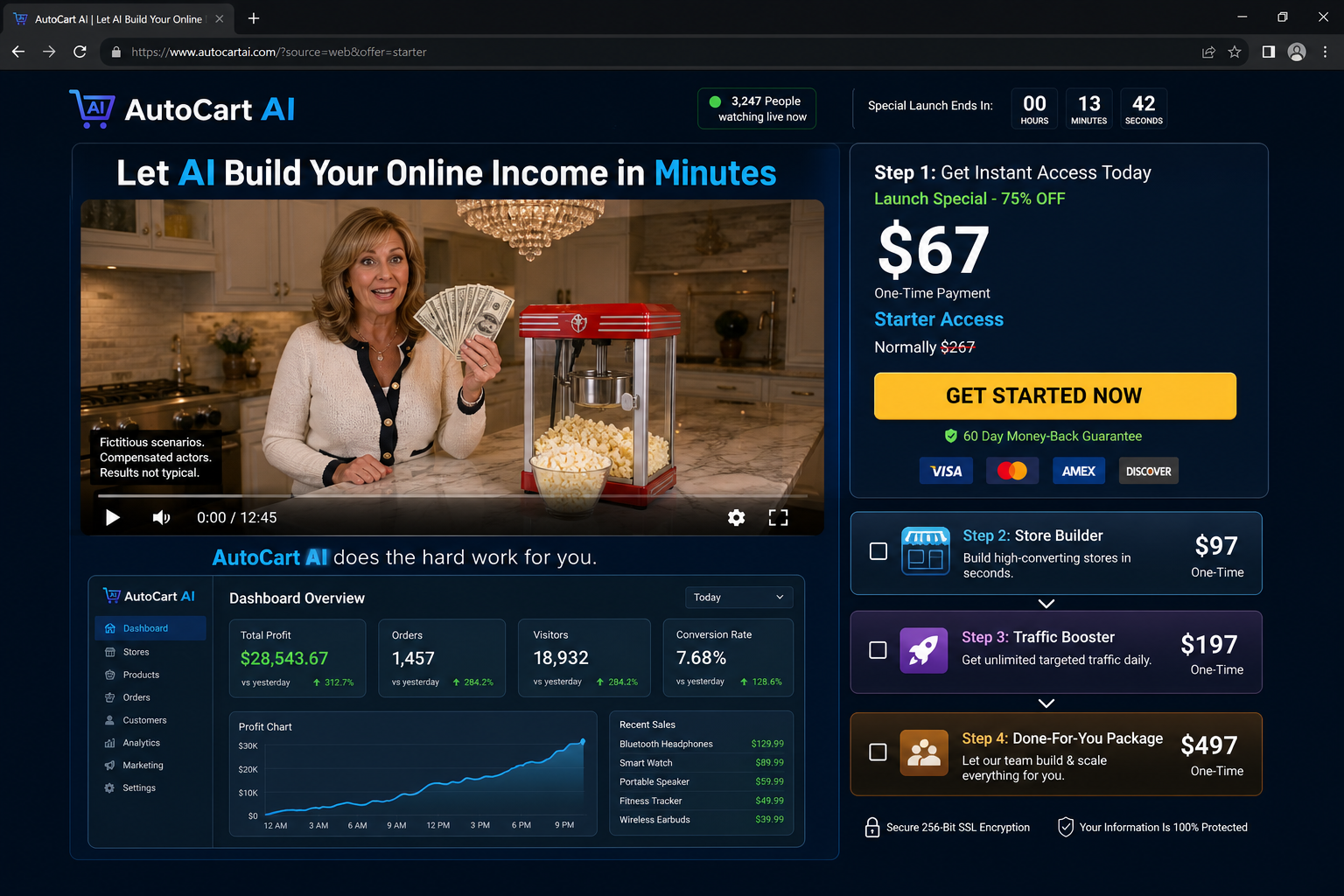
After the eye-catching earnings story, viewers find a $67 program, fictional success scenes, and a ladder of extra purchases rather than an app that creates guaranteed income.
The earnings claims are designed to defeat common sense
One ad says candles generated $9,682 in a week. Another claims a 16-year-old nephew made $45,837 in a month, while a phone dashboard shows hundreds in daily earnings with no experience or technical work.
These numbers are not accompanied by audited sales records, expenses, refunds, advertising costs, supplier invoices, or tax documents. A revenue screenshot would still not show profit, but the ads do not establish even the underlying revenue.
The Federal Trade Commission warns that guaranteed income, large returns, and a proven turnkey system are signs of a likely business-opportunity scam. No honest seller can promise that an unknown beginner will make money.
The long video admits that key scenes are fictional
A sales presentation tied to AIMS AI USA has shown a woman calling herself Melissa inside a luxurious kitchen, holding cash and describing $37,000 earned in six weeks with an AI-assisted product business.
At the beginning, a brief disclaimer says testimonials and scenarios are fictitious, names were changed, compensated actors are used, results are not typical, and events or dialogue were fictionalized.
That disclosure may appear for only a few seconds. The rest of the presentation uses the actor, cash, house, and profit story as if they were a personal account, allowing the emotional impression to overwhelm the legal qualification.
The $67 price can be the first purchase, not the total cost
The starter offer is commonly presented at $67. Viewers are told this unlocks the system that selects products, builds a website, attracts customers, processes orders, and pays commissions automatically.
Consumer reports connected with earlier versions describe additional $30 charges, repeated upgrades, and instructions to buy more tools.
One person described spending about $300, while another said the promised few-button process became website construction and many more purchases.
Those are individual reports and may not describe every checkout. They do match the FTC's warning that a low-cost business system can become a money pit through coaching, services, and upgrades.
- Social ads use candles and teenagers to create envy and urgency.
- AI narration and fake dashboards display unsupported profit figures.
- A luxury-home video presents compensated actors and fictional events as success proof.
- The offer changes names while preserving the same automatic-income promise.
- A $67 entry purchase can lead to extra software, traffic, and coaching offers.
- Past versions have used unclear Cyprus references and a nonexistent Texas address.
- No verifiable mechanism guarantees traffic, customers, profit, or refunds.
What AIMS AI USA Says the App Does
The pitch describes a system that identifies popular products at favorable prices, builds online listings, and connects the user to commissions from major shopping platforms. The user supposedly watches money accumulate without inventory or technical skill.
That description skips the difficult parts of ecommerce: finding lawful suppliers, calculating margins, paying for traffic, creating original content, complying with marketplace rules, handling sales tax, processing returns, and supporting customers.
It also avoids naming a transparent relationship with the major retailers implied by the presentation. An affiliate program can pay commissions for qualified purchases, but it does not grant an unknown app the power to create demand or guarantee conversions.
The candles ad says the software is free or available for a limited time. The destination then asks for $67. That early contradiction is important because it shows the advertisement is optimized for the click, not a complete description of the transaction.
AIMS AI USA belongs to a family of similarly scripted offers. Earlier names have included InfinitAI, NexusAI, FusionAI, AI Revolution, and other AI-themed labels. Rebranding allows the operator to escape searches tied to the previous name.
Past versions placed Cyprus in their terms and used 30 SW Elm Avenue, DeSoto, Texas 75115 as a mailing address. Mapping checks did not locate that street in DeSoto.
An address that cannot be found is a serious obstacle when a buyer needs a refund or legal identity.
Why the Automatic AI Income Story Falls Apart
A legitimate business opportunity should explain what the purchaser sells, how customers are acquired, what expenses are typical, what work is required, and what evidence supports any earnings claim.
The AIMS-style presentation replaces those details with lifestyle scenes and dashboard animation.
Artificial intelligence can help draft product descriptions, organize research, analyze data, or automate limited tasks. It cannot make a weak product profitable, eliminate ad costs, guarantee marketplace approval, or force strangers to buy.
A number on a screen is easy to generate. It can be a mock interface, browser animation, edited video, gross revenue, demo data, or an unrelated account.
Without source records and expenses, it proves nothing about a typical customer's net earnings.
The disclaimer is also revealing. If testimonials, scenarios, names, events, and dialogue are fictionalized, the viewer is not watching documentary evidence. The mansion and cash are stage props serving a scripted sales message.
The product-name rotation makes independent accountability difficult. Honest software can publish a release history, development company, support documentation, privacy practices, and user community.
A funnel that repeatedly adopts a new brand avoids building that traceable record.
How the AI Candles Scam Works
Step 1: A social ad says ordinary products create extraordinary income
The opening shows candles, a phone balance, and a young person who supposedly discovered the system before everyone else. The age claim is meant to make the task look effortless.
Specific figures such as $9,682 per week or $45,837 per month sound like evidence, even though the ad provides no records. Precision is used as a substitute for verification.
AI narration says the system is free, automatic, and available only briefly. The viewer is told that continuing to scroll means missing an economic revolution.
Step 2: The landing page becomes a long personal success story
A presenter appears in an expensive-looking home, often beside a product used in the story. Cash, travel, cars, and family freedom create the picture of life after purchase.
A short disclaimer may reveal that the person is an actor and the events are fictional. It disappears before the emotional narrative begins and may be unreadable on a small screen.
The video cannot be skipped easily. Each new section promises that the actual method is about to be revealed, keeping the viewer engaged until the payment offer.
Step 3: The system is described without a testable business model
The narrator says AI finds products, creates a store, sends traffic, and collects commissions. It does not provide a live public store, audited example, marketplace agreement, or realistic cost breakdown.
Words such as algorithm, automation, proprietary, and artificial intelligence create technical authority while the actual tasks remain vague.
When a business model cannot be explained without lifestyle stories, the buyer cannot evaluate workload, competition, legal duties, or risk.
Step 4: A $67 starter offer lowers resistance
After describing thousands in daily or weekly profit, the video asks for only $67. That contrast makes the price feel trivial and encourages an immediate decision.
The seller may say the fee covers server access or proves commitment. A timer, limited licenses, or rising future price creates pressure.
Before paying, the buyer should ask for a written list of everything included and every expense required to reproduce the advertised process. Vague access is not a deliverable.
Step 5: The first payment opens a series of upgrades
The next pages can offer store builders, traffic packages, automation tools, coaching, premium product lists, and done-for-you services. Each is presented as the missing piece that makes the original purchase work.
Decline links may be visually weak or framed as refusing profit. Some buyers click through quickly because they believe the first $67 has already committed them to the plan.
Save every screen and read the total before authorizing another charge. Do not assume a one-click upgrade has the same refund terms as the starter product.
Step 6: The buyer receives work, generic lessons, or another sales call
Instead of an automatic income app, the purchaser may get videos about building a website, choosing products, affiliate marketing, or buying ads. Those tasks require time, judgment, capital, and no guarantee of profit.
A coach may call to discuss goals, available credit, or faster implementation. High-pressure upselling often begins by asking how much the buyer can invest rather than whether the original system performed.
Never provide remote access, online-banking credentials, or a card limit to a supposed business coach. A legitimate consultant can explain services without inspecting private financial accounts.
Step 7: A new AI name replaces the old one
Complaints eventually connect a product name with disappointing results. The same video structure can then promote a renamed app from another domain.
Candles become headphones or kitchen gadgets, and AIMS AI becomes another futuristic brand. The earnings numbers, actor story, $67 entry, and upsell ladder remain familiar.
Search the phrases, address, terms, support details, video scenes, and merchant descriptor. Those links often survive longer than the logo.
Company, Address, and Fulfillment Checks
A rotating app name is not a legal company
AIMS AI USA sounds like an established technology provider, but a buyer needs the registered legal entity, jurisdiction, officers, and service address that actually accept responsibility for the sale.
Compare the checkout, terms, privacy policy, receipt, support email, and card statement. If each uses a different identity, resolving billing becomes harder.
A real software company should also publish a working product interface, privacy details, data retention, security contacts, documentation, and update history outside the sales video.
Cyprus references and a nonexistent Texas street demand answers
Past versions of this funnel referenced Cyprus while also listing 30 SW Elm Avenue in DeSoto, Texas. Searches did not locate an Elm Avenue in that city.
A false or unusable mailing address is not a harmless typo when customers need to serve notice, return materials, or identify jurisdiction. Ask support to provide the current legal company and a verifiable address before paying.
Do not confuse a payment processor's address with the seller's headquarters. Processors can handle cards for many unrelated merchants without operating the program.
Support should explain the method before taking money
Ask what the software actually does, which retailers authorize it, which costs are mandatory, what typical users earn after expenses, and whether any recurring charges exist.
If support repeats lifestyle claims or refuses to provide a demonstration, the buyer still has no way to evaluate the offer. An honest business does not hide its basic deliverables behind payment.
After purchase, use email and keep copies. A phone promise about refunds or earnings is difficult to prove when the representative disappears.
There is no physical supply chain behind a dashboard claim
The app story says products are found, listed, sold, and delivered automatically. Yet it rarely identifies suppliers, inventory ownership, shipping responsibility, returns, customer service, product safety, or tax obligations.
If cheap goods are sourced through anonymous overseas vendors, including mass-produced products from China, the store owner may still be responsible for descriptions, refunds, safety, and customer complaints. AI does not remove those duties.
A business opportunity that hides its supplier and fulfillment structure can leave the buyer with chargebacks and marketplace bans instead of passive income.
Why Teenagers and Candles Make the Pitch More Powerful
Teenagers create a painful comparison. If a 16-year-old can make $45,837 with no experience, an adult viewer may feel foolish for hesitating. That emotion suppresses questions about evidence and costs.
Candles make the abstract app tangible. The viewer can imagine a familiar object moving from supplier to customer, even though the ad never shows a verified store, order, refund, or bank deposit.
AI then supplies the missing magic. Any unexplained part of the business is attributed to a proprietary algorithm, making normal ecommerce work seem obsolete.
Real online businesses can use AI, but they still compete for attention, pay expenses, serve customers, and sometimes lose money. Any offer that removes risk from that equation is selling a fantasy, not a reliable business plan.
Warning Signs to Watch For
- Teenagers supposedly earn five figures with no experience.
- The ad says access is free but the video ends at a $67 checkout.
- A three-second disclaimer admits actors and fictional scenarios.
- The earnings dashboard has no auditable source records or expenses.
- The business model is described with AI buzzwords instead of specific work.
- The first purchase leads to multiple traffic, coaching, or automation upgrades.
- The brand has used several names with nearly identical sales presentations.
- The legal entity and service address are missing, inconsistent, or unverifiable.
A legitimate opportunity does not need a fictional millionaire, a model home, and a timer to explain how customers make money.
If the proof disappears when the lifestyle video is removed, there is no business case left to evaluate.
What to Do if You Have Fallen Victim to This Scam
- Save every version of the promise. Capture the candle ad, earnings figures, disclaimer, video, offer, upgrades, terms, support details, receipt, and card descriptor.
- Stop new purchases and sales calls. Do not buy traffic, coaching, or automation to rescue the first payment. Tell the seller in writing that you reject further charges and services.
- Ask for cancellation and a refund. Identify each charge separately and request the amount, date, and product associated with it. Keep confirmation numbers and written replies.
- Contact the payment provider. Explain the advertised automatic-income system and what was actually delivered. Ask about dispute deadlines, future merchant blocks, and replacing the card.
- Secure accounts and remove access. Change any password reused with the program, revoke connected store or advertising accounts, remove unknown administrators, and disable remote-support software.
- Do not send more money to recover losses. Ignore coaches, account managers, or recovery agents who say one more payment will unlock profits or release a refund.
- Run Malwarebytes on affected devices. If you installed software, browser extensions, remote tools, or files supplied by the program, scan with Malwarebytes and remove detections.
- Use AdGuard to reduce future funnel ads. AdGuard can block many aggressive ads and trackers, but continue checking companies and claims independently.
- Report the opportunity. Submit the ad, domain, charges, and earnings claims to the FTC and the advertising platform. Detailed reports help connect renamed versions.
Frequently Asked Questions
Are teenagers really making millions selling candles with this AI?
The ads do not provide audited evidence for those claims. Specific dashboard figures and scripted testimonials are not proof that typical users earn any profit.
Is AIMS AI USA a free app?
The advertising has described free or easy access, while the sales funnel asks for a $67 starter payment. Buyers have also reported additional offers and charges.
Can AI build a profitable store automatically?
AI can assist with limited tasks, but it cannot guarantee products, traffic, sales, margins, compliance, customer service, or profit. Those remain business responsibilities.
What does the fictional-scenarios disclaimer mean?
It means the people, events, dialogue, or outcomes shown may be dramatized rather than documented customer results. The mansion and cash should not be treated as evidence.
Why does the app keep changing names?
Rebranding can separate a new sales campaign from complaints tied to an old label. Search the script, company details, address, support contacts, and card descriptor.
What if I spent more than the initial $67?
List every transaction and the promised deliverable, cancel in writing, and speak with the card issuer about charges or services that were unauthorized or materially misrepresented.
The Bottom Line
The AI candles scam is a familiar business-opportunity funnel wearing a new artificial-intelligence costume. Candles, teenagers, and precise earnings numbers make the story memorable, but they do not make it true.
The brief fictional-scenarios disclaimer, rotating product names, unverifiable company details, and repeated upsells reveal what the lifestyle video tries to hide. The system cannot guarantee customers or income.
If you already paid, stop the upgrade ladder now. Preserve the evidence, secure connected accounts, contact the issuer, and report the funnel before another renamed version turns the same $67 promise into a much larger loss.

Join the discussion
0 commentsShare your experience or ask a question about this article.
Discussion
Start the conversation
Have a question or something useful to share? Add the first comment.