

An official-looking message says a review has identified you as a victim of internet fraud. The International Monetary Fund has supposedly approved $4,600,000 in compensation, and the director herself appears to be handling the claim.
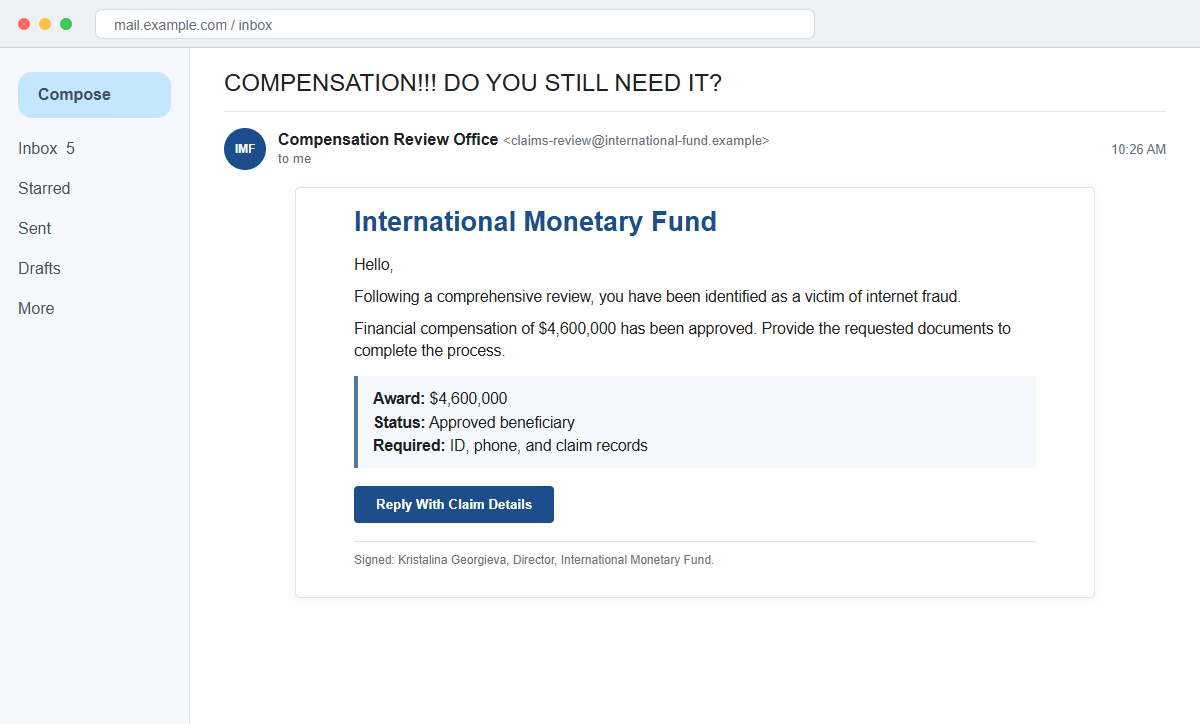
The Internet Fraud Victim Compensation email scam does not offer restitution. It uses the hope of recovering old losses to collect identity documents and begin a conversation that can end in processing fees, release taxes, and repeated payments.
A second version impersonates the FBI's Internet Crime Complaint Center and promises $1,759,910 through a law firm. The names and amounts change, but the recipient is always told that a large fund is waiting unexpectedly.
The IMF and IC3 have warned about impersonation schemes of this kind. Real compensation is not created by replying to a free email address with identification and banking information.
Overview
The email says a secret review found your loss
The sender claims a comprehensive review and verification process identified the recipient as an internet-fraud victim. No complaint number, court, prosecuted case, original loss, or verifiable administrator is connected to the offer.
The story can still feel personal to someone who previously reported a scam or lost money. Criminal groups sometimes reuse exposed victim information to make a later recovery approach more convincing.
A life-changing payout keeps the conversation alive
One version promises $4,600,000 under the IMF name. Another claims an IC3-related law firm will distribute $1,759,910 and supplies reference GBV-IP/2785-IRL142/064.
An extraordinary amount encourages the recipient to tolerate unusual steps. A copy of identification, full name, phone number, address, and claim documents may be requested before the first fee appears.
The compensation becomes an advance-fee chain
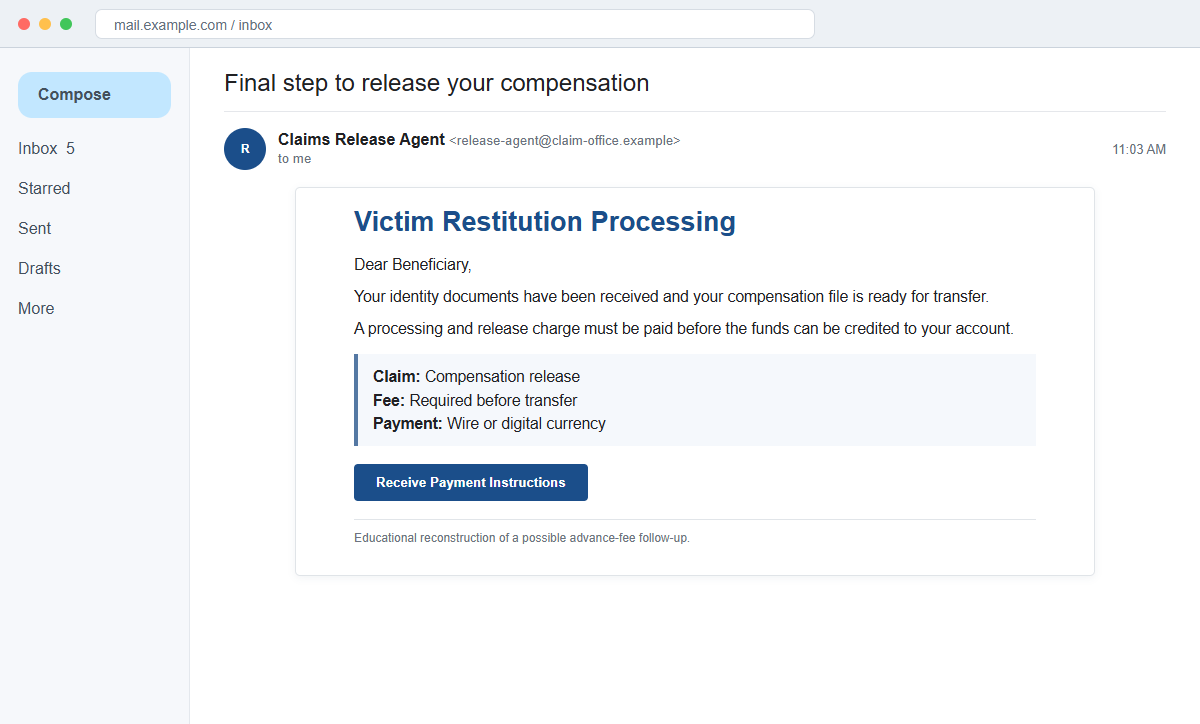
After the victim replies, the operator can invent processing fees, release charges, taxes, legal certificates, insurance, courier costs, or bank-transfer expenses. Paying one does not unlock the fund; it signals that another demand may work.
Identity documents and bank details have value even if no payment is made. They can support identity theft, account attacks, forged applications, or a more targeted follow-up scam.
- The subject may say COMPENSATION!!! DO YOU STILL NEED IT?
- The message impersonates the IMF director.
- A supposed review identifies the recipient as a fraud victim.
- The promised compensation is $4,600,000.
- Full name, ID, phone number, and claim documents are requested.
- Another version impersonates IC3 and promises $1,759,910.
- A free mail.ee address is supplied for the alleged law firm.
- Processing fees and release charges can follow after a reply.
Why Recovery Scams Often Target People Who Already Lost Money
A previous scam can leave someone angry, embarrassed, and determined to recover what was taken. The promise of official restitution speaks directly to that unresolved loss.
Scammers may buy or exchange lists containing names, contact details, the type of fraud, and amounts paid. Even a few correct details can make an invented compensation program feel researched.
Government and international names supply distance and authority. A recipient may not know how the IMF, a court, IC3, or a victim fund normally communicates, so formal language can fill that gap.
The huge award changes the victim's calculation. A small processing charge can appear reasonable compared with $4,600,000, even though legitimate compensation is never verified by paying an unexpected correspondent.
Secrecy also keeps the story intact. The sender may discourage outside contact, claim the case is confidential, or warn that delays will cancel the award. A trusted third party would likely recognize the contradiction.
What the IMF, IC3, and FTC Say About These Offers
The IMF warns that its name and officials are misused in unsolicited emails, advance-fee fraud, and phishing. It states that it conducts financial transactions with member countries, not unexpected compensation business with individuals.
The FBI's IC3 has documented impersonation emails that tell victims they qualify for restitution and must contact a supposed law firm. Some versions requested personal information or distributed malicious files.
The FTC describes refund and recovery scams as second-stage fraud. Someone unexpectedly promises to recover money, then requests an upfront fee or personal and financial information.
A real restitution program identifies the case, administrator, eligibility process, court or agency record, and official contact channel. The recipient can confirm those details without replying to the original sender.
No malware attachment was established in the main $4,600,000 example. The immediate verified risks are identity-data collection and advance fees, while any later file should be evaluated separately before opening.
How the Internet Fraud Victim Compensation Email Scam Works
Step 1: A surprising compensation notice arrives
The subject announces compensation or asks whether the recipient still needs it. The sender uses the IMF, IC3, or another official-sounding victim program.
No application is required before the award appears. The victim is told that a review found them automatically.
Step 2: Famous institutions create authority
The message may use Kristalina Georgieva's name and IMF title. Another version invents an IC3 department director and prosecuting law firm.
Names copied from public sources do not prove that the email came from the person or institution. The reply domain often contradicts the claimed organization.
Step 3: A huge amount changes the reader's expectations
The promised award is $4,600,000 in one campaign and $1,759,910 in another. A reference number and legal story make it feel allocated rather than hypothetical.
The size is a persuasion tool. It makes every later inconvenience or fee look small by comparison.
Step 4: The recipient is asked to reply with documents
The sender requests a full name, valid identification, telephone number, bank details, address, or records from the alleged earlier fraud.
This information can be exploited even before money is requested. A passport or driver's license copy should not be sent to an unverified email address.
Step 5: A helpful agent continues the story
After a reply, a supposed lawyer, bank officer, courier, or claims administrator may provide forms and official-looking certificates. Each document keeps the victim invested.
The operator may move the conversation to another address or messaging application, separating the victim from the original evidence.
Step 6: Fees appear before release
Processing, tax, insurance, anti-money-laundering, transfer, notarization, or courier charges are invented. Payment may be demanded by wire transfer, cryptocurrency, gift card, or payment app.
There is no fund behind the request. Paying one charge usually produces another explanation for why the transfer remains blocked.
Step 7: Losses and identity exposure grow
The victim may send several payments while waiting for a transfer that never arrives. The operator can sell the contact as someone responsive to recovery offers.
Submitted documents and banking details can enable identity theft or new account attacks. Later recovery callers may claim they can fix this second loss for another fee.
Company and Checkout Checks
Search for the official case
A legitimate award should connect to a court, enforcement action, administrator, and public eligibility notice. Search the official agency website using the case and program name.
Do not rely on a document or search link supplied by the sender. Contact the agency through a number or form found independently.
Check the email domain and job title
An IMF or FBI official would not conduct a restitution case from mail.ee, Gmail, or another free mailbox. Compare the complete address with the organization's official domain.
A real person's name can be copied. Verify the role and communication through the institution, not through the signature block.
Reject every upfront payment
Do not pay processing, tax, release, insurance, courier, or certificate charges to receive compensation. A fee demanded by an unexpected recovery contact is a defining warning sign.
Never use cryptocurrency, gift cards, or wire transfers because a supposed official says the claim will expire.
Protect identity documents
Do not send a passport, driver's license, bank statement, or claim record until a program has been independently authenticated and its privacy process is understood.
If documents were already shared, use IdentityTheft.gov, monitor credit, and consider a fraud alert or credit freeze according to local options.
Warning Signs to Check Before You Act
- Compensation appears without an application or known case.
- The IMF supposedly contacts an individual about a cash award.
- The amount is an extraordinary $4,600,000.
- Another version promises $1,759,910 through IC3.
- The sender uses the name of a real public official.
- A free email address represents a supposed law firm or agency.
- Reference numbers cannot be confirmed on an official site.
- Identification and bank details are requested by reply.
- The recipient is told to keep the case confidential.
- Processing fees or release taxes appear before payment.
- Wire transfer, cryptocurrency, or gift card payment is requested.
- Every paid fee leads to another delay.
Real restitution starts with a verifiable case, not an unexpected promise. A stranger who offers millions and then asks for identity documents or an upfront fee is extending the fraud, not correcting it.
What to Do if You Have Fallen Victim to This Scam
- Change the exposed password immediately. Open the IMF, IC3, court, or agency website located independently from the message through a saved bookmark or its official application, not through the internet-fraud compensation message. The password entered during that internet-fraud message should never be used again. Give every affected service a different replacement.
- Stop communicating with the supposed compensation agent. Save the IMF-themed email, headers, attachments, telephone numbers, payment instructions, and every identity document already sent so investigators can reconstruct the approach.
- Contact the bank or payment service immediately if any fee was paid. Ask whether the transfer can be recalled, the receiving account flagged, or the card replaced. Speed matters, but no bank can guarantee that an irreversible payment will return.
- Treat passports, licenses, tax numbers, and bank statements sent for the fake $4.6 million claim as exposed. Follow the identity-theft process in your country and place fraud alerts or credit freezes where available.
- Secure the email account used in the exchange. Change the password, enable a passkey or authenticator app, end other sessions, and remove unknown forwarding rules that could let the criminal monitor replies from banks or authorities.
- Protect the service impersonated by the email. Review identity documents, bank information, telephone details, claim records, and any payment already sent through its official account and contact support through a verified channel. After this internet-fraud phishing attempt, compare the genuine profile with your records. Reverse unexplained changes to devices, addresses, documents, and payment methods.
- Scan any device that opened an attachment or downloaded a form. Run a complete Malwarebytes scan, delete untrusted files, and install operating-system and browser updates before accessing financial accounts again.
- AdGuard or another reputable DNS and content blocker can prevent some known advance-fee and phishing pages from loading. Continue checking domains manually because a new compensation site may appear before filters recognize it.
- Report the phishing message. Use the mail provider's Report Phishing control and notify the FTC at ReportFraud.ftc.gov, the FBI's IC3, local police, and the organization being impersonated. The raw headers from this internet-fraud case should be preserved before reporting. They are especially valuable when the campaign reached multiple inboxes.
- Warn relatives or business contacts if the fraudster saw an address book, signature, or company details. A second message may impersonate you, a bank, or an investigator and reuse facts from the compensation story.
- Ignore paid recovery offers. A person claiming to trace the $4.6 million fund or recover a fee for taxes, insurance, or legal costs is likely beginning another advance-fee scam. Report the incident only through official police, bank, and fraud-reporting channels.
Frequently Asked Questions
Is the $4,600,000 IMF compensation email real?
No. The IMF does not unexpectedly award compensation to individuals by email, and it has warned that its name is used in advance-fee and phishing schemes.
Why does the message know I was scammed?
It may be a mass message or use information from a victim list, data breach, complaint exposure, or earlier fraud. Correct details do not authenticate the offer.
Does IC3 pay restitution through outside law firms?
The FBI has warned about emails impersonating IC3 and claiming victims must contact a law firm for restitution. Verify any case directly with official channels.
Why do scammers ask for identification first?
Documents make the process look official and can be used for identity theft. They also deepen the victim's commitment before fees appear.
What if I already paid a processing fee?
Contact the payment provider immediately, request reversal if possible, preserve every message and receipt, and report the fraud. Do not pay a recovery service.
What if I sent a copy of my ID?
Report identity exposure, monitor financial and credit records, replace the document if advised, and follow the personalized recovery steps at IdentityTheft.gov.
The Bottom Line
The Internet Fraud Victim Compensation email scam promises $4,600,000 under the IMF name or a smaller restitution award under an IC3 story. Neither offer begins with a verifiable case.
Do not reply with identity documents or bank details, and never pay an upfront charge to receive compensation. Confirm every program through its independently located official website.
If money or documents were sent, move quickly with the payment provider, identity-protection steps, and reports to the FTC and IC3. Ignore anyone who later promises guaranteed recovery for another fee.








