

A Kinetiq proposal promises something unusually generous for a simple vote: every active voter will receive a 1.25x multiplier on current staking positions. Vote, connect, and the bonus appears to be yours.
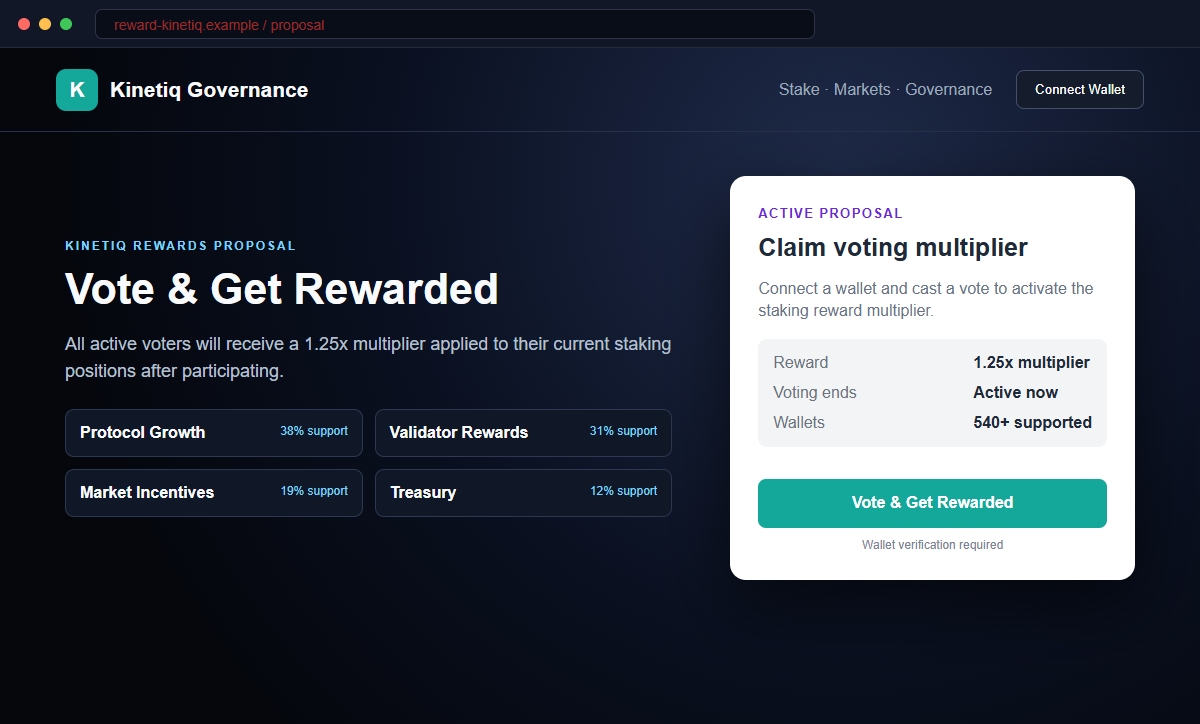
The Kinetiq Vote Rewards Scam is a wallet-draining scheme. The pages at reward-kinetiq[.]xyz and multipliers-kinetiq[.]xyz impersonate the real Kinetiq platform and use the multiplier story to obtain a dangerous wallet approval.
The offer sounds technical rather than extravagant. Existing staking language, governance choices, and a precise multiplier can make the page feel like a specialized reward program for current users.
Do not connect or approve anything through those domains. Open kinetiq.xyz independently and verify every proposal, reward, and contract through the project's official resources.
Overview
A fake proposal promises a 1.25x staking multiplier
The fraudulent page displays a “Kinetiq Rewards Proposal” and says all active voters will receive a multiplier applied to current staking positions. A Vote & Get Rewarded button links participation directly to the supposed bonus.
A precise 1.25x figure makes the claim look calculated and protocol-specific. The page does not prove that Kinetiq created the proposal or that a multiplier contract exists for any current staking position or connected wallet.
The lookalike domains are outside kinetiq.xyz
The campaign uses reward-kinetiq[.]xyz and multipliers-kinetiq[.]xyz. Neither domain is kinetiq.xyz, and neither becomes official merely because it contains the project name and a rewards keyword.
Copied colors, staking terms, voting cards, and wallet logos can reproduce the visual language of a DeFi application without any access to the genuine platform.
The reward button leads to a wallet-drainer flow
The connector lists MetaMask, Trust Wallet, Zerion, Base, OKX Wallet, Uniswap Wallet, Rainbow, Binance Wallet, SafePal, and hundreds of other options.
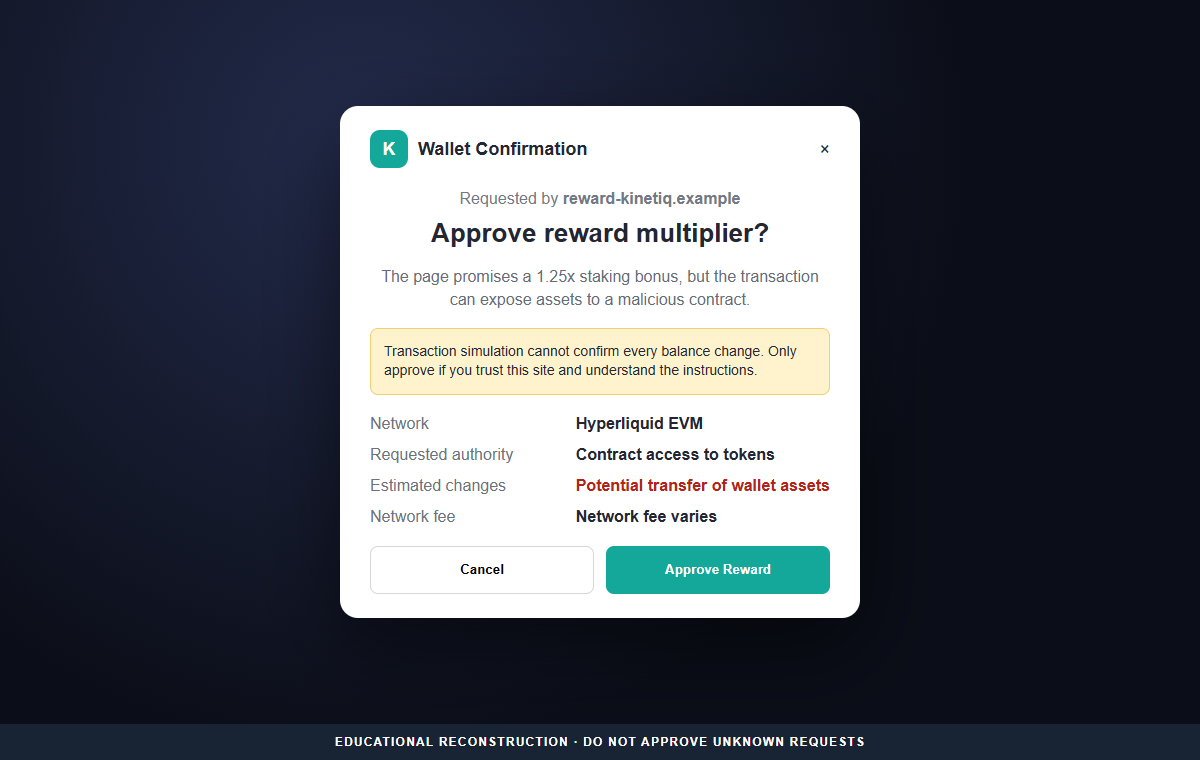
After connection, the site can request contract authority or a transfer while describing the action as voting or activating the multiplier. If approved, exposed assets can be moved to an attacker-controlled address.
- The page impersonates the Kinetiq liquid staking and trading platform.
- A Kinetiq Rewards Proposal is presented as active.
- Every voter is promised a 1.25x staking-position multiplier.
- Vote & Get Rewarded combines governance with a financial bonus.
- The domains differ from the official kinetiq.xyz address.
- More than 540 wallet choices are displayed as technical credibility.
- The connection occurs before the proposal is independently verified.
- The wallet request can expose tokens to a malicious contract.
- A drainer may transfer assets immediately or use a lasting approval.
- Blockchain transfers usually offer no chargeback or simple reversal.
What the Real Kinetiq Platform Actually Offers
Kinetiq is a real platform built around the Hyperliquid ecosystem. Its published material describes liquid staking, markets, and token-based participation, which gives scammers authentic terminology to copy.
The official site explains that users can stake HYPE and receive kHYPE, a liquid staking token designed to remain usable while the underlying position earns staking rewards.
Kinetiq also describes KNTQ as its governance token and sKNTQ as a staked form associated with protocol rewards and ecosystem alignment. The project publishes tokenomics and value-accrual information on kinetiq.xyz.
Those real reward and staking mechanisms do not authenticate a third-party voting page. A legitimate event should be announced through kinetiq.xyz and verified project channels, with the same contract and destination throughout.
A reward multiplier affecting current positions would be a material protocol action. Users should expect public documentation explaining eligibility, calculation, start and end times, contract behavior, and how the result appears on-chain before voting begins.
The absence of that traceable documentation matters more than how professional the proposal looks. A precise multiplier can be typed into a fraudulent card as easily as a vague bonus.
Why the Kinetiq 1.25x Multiplier Offer Is Fraudulent
The registered domains are wrong. reward-kinetiq[.]xyz and multipliers-kinetiq[.]xyz are separate from kinetiq.xyz. A project keyword to the left of a hyphen does not show who controls the domain.
The page promises the same multiplier to all active voters without presenting a recognized proposal, calculation method, eligibility snapshot, contract address, or official announcement.
The reward is tied to urgency. Visitors are encouraged to vote while the proposal is active instead of checking whether their current position and the proposed multiplier appear in the genuine application.
The hundreds of wallet choices come from a connection interface, not from individual endorsements. Wallet providers do not approve every site capable of displaying their names.
The transaction can contradict the page. Contract access to tokens, a spending allowance, an unexplained call, or predicted outgoing assets are not required merely to record a governance preference.
A real wallet and a small network fee do not neutralize the risk. The user can still authorize a malicious contract with a genuine signature.
Cancel whenever the wallet cannot clearly explain what the contract will be allowed to do.
How the Kinetiq Vote Rewards Scam Works
Step 1: Fake announcements target Kinetiq and Hyperliquid users
Links can spread through impersonator accounts, compromised profiles, X replies, Discord or Telegram groups, direct messages, search ads, malicious notifications, and comments under legitimate project updates.
People already discussing HYPE, kHYPE, KNTQ, staking, or rewards are likely to understand the vocabulary and may click before checking the domain.
Step 2: The page copies staking and governance language
The interface combines a proposal, voting choices, reward terminology, and a familiar DeFi layout. The visitor is made to feel they have reached a temporary feature of the normal platform.
All of those elements can be static. The site does not need to query the visitor's real Kinetiq position to display them.
Step 3: The multiplier creates a measurable temptation
A 1.25x bonus sounds modest enough to be credible but valuable enough to act on. Existing stakers may mentally calculate the benefit before verifying whether the program exists.
The promise also creates a penalty for caution: anyone who fails to vote appears to miss a boost applied to current holdings.
Step 4: Vote & Get Rewarded requests a wallet
The page offers a long menu of well-known wallets. Selecting one can invoke the visitor's authentic extension or mobile application and show the selected account.
That connection is only a communication channel between the wallet and website. It does not establish that Kinetiq owns the website.
Step 5: The site disguises contract access as multiplier activation
The next request may say approve reward, cast vote, verify stake, or activate multiplier. The actual instructions can grant token permission, call a malicious contract, or transfer assets.
The correct question is not what the green button says. It is what authority the wallet says will exist after confirmation.
Step 6: The drainer removes valuable assets
A confirmed transfer can move funds at once. A broad token approval can remain active and let the attacker pull the approved balance later, including assets deposited after the original visit.
Automated drainers can inspect balances and prioritize valuable tokens. The victim may see several rapid transactions rather than one obvious withdrawal.
Step 7: Fake support attempts a second theft
After the loss becomes public, supposed Kinetiq administrators, wallet technicians, blockchain investigators, or recovery lawyers may offer assistance in direct messages.
Requests for an advance fee, remote-control session, new wallet connection, private key, or recovery phrase are continuation scams, not recovery.
Company and Checkout Checks
Use kinetiq.xyz as the starting point
Type the official domain or use a previously verified bookmark. Find the same proposal or reward in the authenticated application, documentation, and verified community announcements.
Do not treat an X reply, Telegram admin account, or sponsored result as the authoritative link.
Demand complete multiplier rules
A genuine 1.25x program should explain which positions qualify, when the snapshot occurs, how the multiplier is calculated, when rewards accrue, which contract performs the action, and how users can audit the result.
Vague voting language plus a wallet button is not enough to verify a material staking benefit.
Compare the contract with official documentation
Expand the wallet prompt and verify the network, contract, method, spending limit, and simulated balance changes. Search for the contract only through official Kinetiq resources and trusted explorers.
Cancel when the transaction grants authority that the documented proposal does not require.
Separate voting from custody of assets
A governance action should not unexpectedly expose an entire wallet balance. Treat any unlimited allowance or outgoing transfer as a separate financial decision, regardless of the proposal narrative.
Use a low-value wallet for unfamiliar applications, but never assume a testing address makes a malicious request legitimate.
Warning Signs to Check Before You Act
- The offer is promoted outside Kinetiq's verified channels.
- The domain ends in reward-kinetiq[.]xyz or multipliers-kinetiq[.]xyz.
- Every active voter is promised the same 1.25x multiplier.
- No official proposal identifier or discussion is supplied.
- Eligibility and snapshot rules are absent.
- The multiplier contract is not documented on kinetiq.xyz.
- More than 540 wallet choices are presented as validation.
- The site connects a wallet before showing account-specific evidence.
- The approval grants token or contract authority unrelated to voting.
- The simulation predicts outgoing assets.
- The page applies time pressure to current staking positions.
- An unsolicited recovery account asks for fees or wallet secrets.
A precise multiplier is still only a claim until it appears in Kinetiq's official documentation and uses a verified contract. Judge the domain, proposal record, and wallet authority together.
What to Do if You Have Fallen Victim to This Scam
- Disconnect the fake Kinetiq application. Remove reward-kinetiq[.]xyz, multipliers-kinetiq[.]xyz, and unknown connections from the wallet's settings. Remember that disconnection does not remove an on-chain token approval.
- Revoke contract and token permissions. Open the wallet's official approval manager or a reputable explorer from a trusted route. Revoke unfamiliar and unlimited allowances across every network involved, then confirm the revocation on-chain.
- Transfer remaining assets to a fresh wallet if needed. When a malicious transaction was signed or authority remains unclear, create a new wallet on a clean device. Protect the new recovery phrase offline, send a small test, and then move valuable assets.
- Permanently retire a wallet with an exposed phrase. A recovery phrase or private key cannot be replaced. Anyone who copied it can regain access later, so never deposit into that wallet again after moving the assets.
- Capture the fraud evidence. Save the proposal page, referral account, transaction hash, network, contract, approvals, destination addresses, timestamps, wallet warnings, and value lost. Keep secret credentials out of screenshots and reports.
- Notify Kinetiq and infrastructure providers. Report the impersonation to Kinetiq through verified support, the wallet provider, domain registrar or host, relevant explorers, and local cybercrime authorities. Include public identifiers, not private keys.
- Contact exchanges visible in the transaction trail. If assets reach a centralized exchange, send its compliance team the hashes and police report promptly. It may preserve customer records or freeze remaining funds, but no recovery outcome is guaranteed.
- Scan for malicious extensions and downloads. Run a full Malwarebytes scan or another trusted security product if the site installed a wallet extension, update, file, or remote-access app. Remove unknown software and patch the browser and operating system.
- Block known scam infrastructure as a backup. AdGuard or another reputable DNS and content blocker may stop some malicious ads and reported domains. New lookalikes can appear quickly, so manual domain and transaction checks remain necessary.
- Warn other users through official communities. Share the malicious domains and public wallet information with verified moderators. Do not post your phrase, key, authentication code, or identity documents while seeking help.
- Refuse guaranteed recovery services. A private agent cannot promise to reverse a confirmed blockchain transfer. Do not pay upfront, grant remote access, connect to a recovery application, or disclose wallet secrets.
Frequently Asked Questions
Is the Kinetiq 1.25x voting multiplier real?
The reward-kinetiq[.]xyz and multipliers-kinetiq[.]xyz pages reviewed here are scams. Verify any real Kinetiq reward through kinetiq.xyz and its documented contracts.
What is Kinetiq?
Kinetiq is a real Hyperliquid ecosystem platform associated with liquid staking, markets, kHYPE, and KNTQ. The scam abuses those genuine concepts without being part of the official platform.
Can a vote require a wallet connection?
Yes, legitimate governance can involve a wallet. The official proposal, destination, network, contract, and requested authority must still be verified before signing.
What if I connected but rejected the transaction?
Disconnect the site and inspect recent activity and approvals. Risk is lower when no signature, approval, transaction, recovery phrase, or private key was provided.
Does removing the site from connected apps revoke token access?
No. Connection state and on-chain allowances are separate. Use a verified approval manager and submit a revocation transaction for suspicious permissions.
Can a hardware wallet prevent this scam?
It keeps the private key on the device, but it cannot stop the owner from authorizing a malicious contract. Read the device prompt and cancel unexplained actions.
The Bottom Line
The Kinetiq Vote Rewards Scam packages a wallet drainer as a credible 1.25x staking multiplier. Real project terminology and hundreds of wallet choices are used to make unofficial domains feel routine.
Verify the proposal through kinetiq.xyz, demand complete reward rules, and compare every contract and balance change with official documentation. A genuine wallet cannot make a fraudulent request safe.
If you interacted, disconnect the page, revoke permissions, secure remaining assets, preserve evidence, scan installed content, report the domains and addresses, warn the community, and reject unsolicited recovery help.








