

An unexpected personal message says your email address was chosen for a $2,000,000 grant. The supposed donor is wealthy, internationally known, and committed to “giving while living,” so the offer sounds both generous and private.
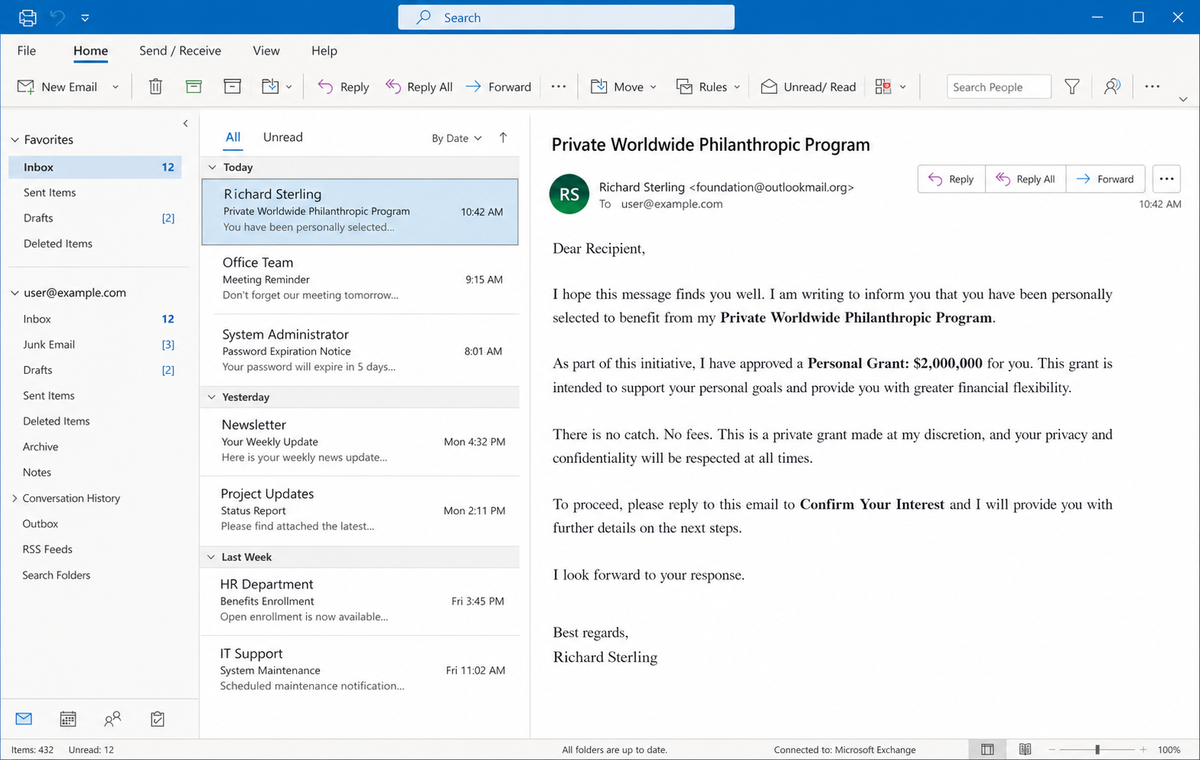
The Private Worldwide Philanthropic Program Scam is an advance-fee fraud. There is no grant waiting, and replying begins a longer conversation designed to extract payments, identity documents, and bank information.
The first email may not ask for money at all. That delay is intentional, because a simple request to confirm interest feels safer than an immediate demand for gift cards or a wire transfer.
Do not reply. Preserve the message, verify any claimed charity through independently located records, and remember that an unsolicited award requiring fees is not philanthropy.
Overview
The message impersonates a real and recognizable business figure
The reviewed campaign claimed to come from Philip Hampson Knight, Nike's co-founder and Chairman Emeritus. Nike's official biography confirms that Phil Knight is a real company co-founder, but neither he nor Nike is connected to this email.
Borrowing an accurate public biography makes the invented private program feel researchable. The criminal expects a search for the famous name to return genuine achievements, even though no official source supports the personal grant offer.
A $2,000,000 award appears to require only a reply
The email says the recipient was selected for financial assistance through a limited worldwide initiative. It asks for a response confirming interest so verification and disbursement instructions can follow.
That small first commitment begins the relationship. Once the recipient replies, the scammer knows the mailbox is active and can tailor the next message to the victim's questions, location, and financial situation.
Fees and identity collection arrive after trust has formed
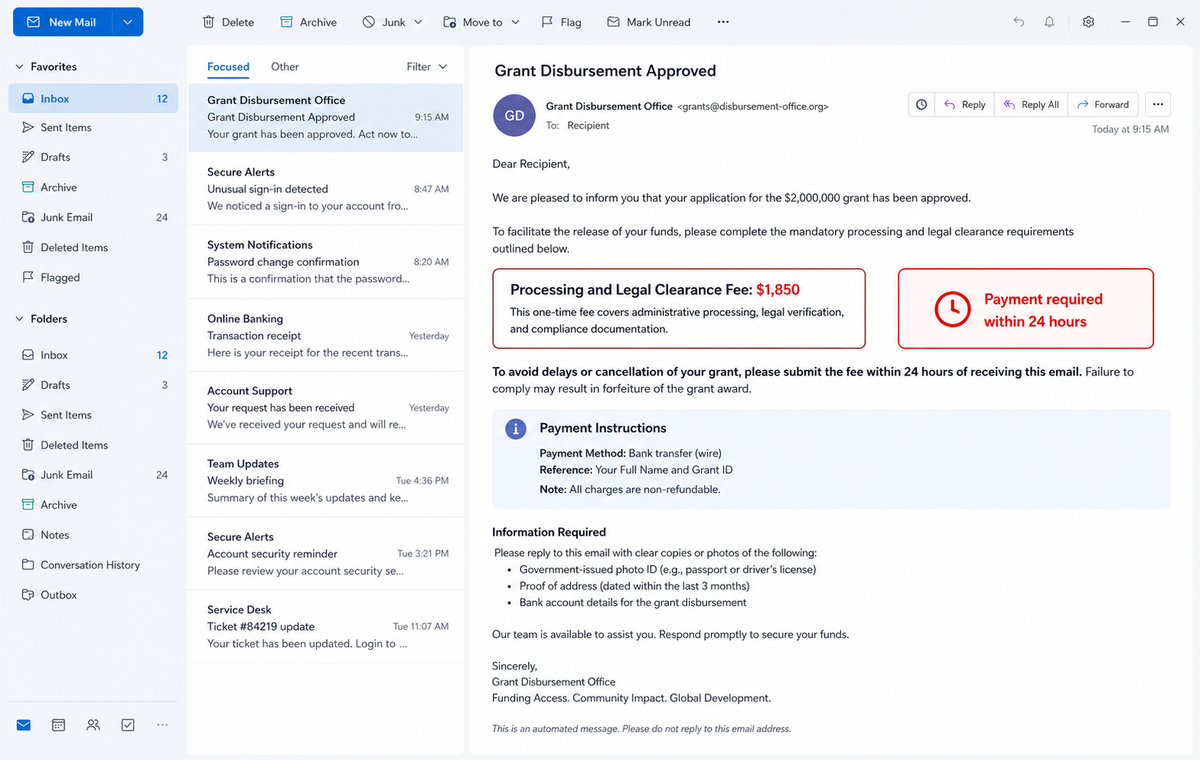
Follow-up messages can introduce processing charges, legal clearance, tax certificates, courier costs, insurance, currency conversion, or bank-release fees. Each payment is described as the last obstacle before the grant arrives.
The supposed verification can also request a passport, driver's license, proof of address, bank statement, telephone number, signature, or account details. Those records create identity-theft risk even when the victim refuses to pay.
- The email arrives without any grant application from the recipient.
- A real famous businessperson is impersonated to create authority.
- The message claims a private worldwide philanthropic initiative exists.
- The recipient's email address is supposedly selected at random.
- A personal grant of $2,000,000 is promised.
- The first requested action is only to confirm interest by reply.
- Public biography links may be used to validate the impersonated name.
- Later messages introduce processing, legal, tax, or release fees.
- Identity and bank documents may be demanded for verification.
- Every payment creates another excuse rather than releasing a grant.
What Real Philanthropy and Grant Programs Look Like
Wealthy individuals and foundations do make major charitable gifts, but structured philanthropy normally works through established organizations, documented programs, due diligence, and defined beneficiaries. It is not a random inbox lottery.
Phil Knight is genuinely Nike's co-founder and Chairman Emeritus, as Nike's official leadership page states. That real identity provides no support for a secret personal grant selected by email.
A legitimate program should have an official website, eligibility rules, application process, responsible legal entity, privacy notice, contact channels, and records that can be reached without replying to the announcement.
Real grant administrators do not need a recipient to prove legitimacy by paying first. Administrative expenses are managed through the program, while applicants are told clearly what information is collected and why.
The FTC warns that free-money and grant offers are common scam themes. Upfront fees described as processing, redemption, paperwork, or verification are a decisive reason to walk away.
Private philanthropy is not identical to a government grant, but the fraud pattern is the same: an unexpected award, an official-sounding authority, personal-data collection, and a payment barrier before imaginary funds can be released.
Why the $2,000,000 Grant Story Is Not Credible
The recipient never applied, submitted a proposal, or established an eligible project. Selection by email address gives the supposed donor no basis for awarding a large sum or completing meaningful due diligence.
The phrase private worldwide philanthropic program is grand but unverifiable. The message provides no legal entity, board, published criteria, audited program record, application portal, or independently reachable grant office.
The impersonated name is a credibility shortcut. Linking to a genuine public profile proves only that Phil Knight exists, not that the sender controls an authorized address or represents him.
The reply-first structure keeps security tools from evaluating a malicious landing page and lets the criminal move the conversation to another address, telephone number, messaging application, or fake official.
A $2,000,000 grant would require careful identity, legal, and financial administration. The campaign replaces that accountable process with secrecy, generic greetings, urgency, and improvised documents supplied only after contact.
Any upfront fee destroys the story. A criminal may promise that the charge is refundable or will be added to the grant, but the payment leaves the victim while no independently verifiable fund ever arrives.
How the Private Worldwide Philanthropic Program Scam Works
Step 1: A mass email is framed as a private personal selection
Scammers send the message to addresses gathered from breaches, directories, subscription lists, and public websites. “Dear Recipient” works across the entire list while the celebrity signature supplies false personalization.
No evidence shows that the sender evaluated the recipient or knew anything beyond an email address.
Step 2: A famous philanthropist's real history supports a fake program
The message describes Phil Knight's career and charitable interests, then may link to a genuine biography or news result. Accurate public facts make the invented initiative harder to separate from reality.
The attacker does not need to forge every detail, only the connection between the real person and the recipient's supposed award.
Step 3: The $2,000,000 promise overwhelms ordinary skepticism
The sum is life-changing but presented as one part of a worldwide effort, making extreme generosity sound affordable to the impersonated billionaire. Hope can temporarily outweigh the absence of an application.
The message may emphasize privacy so the recipient does not ask family, an employer, or a financial adviser for a second opinion.
Step 4: A harmless-looking reply confirms a responsive target
The victim is asked only to confirm interest. That response reveals that the address is monitored and that the recipient is emotionally invested enough to continue.
The scammer can now answer doubts personally and adjust the story to local banks, taxes, identity documents, or transfer methods.
Step 5: Fake officials and documents create a disbursement process
A grant officer, lawyer, banker, courier, or government representative may join the conversation. Letterheads, certificates, application forms, and identification cards are supplied to make the expanding cast look legitimate.
All of those identities can be controlled by one person or criminal group using several email addresses and telephone numbers.
Step 6: Advance fees and personal documents are collected
The victim is told to pay for processing, legal clearance, tax, insurance, conversion, or release. Payment may be requested by wire, cryptocurrency, gift card, cash-transfer service, or another method that is difficult to reverse.
Passport copies, signatures, bank details, and proof of address can be reused for identity fraud or sold even if the fee scheme stops.
Step 7: New obstacles continue until the victim stops paying
After one fee, another authority supposedly discovers a missing stamp, certificate, anti-money-laundering deposit, or delivery charge. The promised grant remains one payment away at every stage.
When the victim refuses, recovery impostors may offer to trace the money for another advance fee, extending the same loss under a new name.
Company and Checkout Checks
Begin with the person's verified official channels
Use Nike's official leadership page and independently located corporate or foundation contacts. Do not rely on the sender's profile link, reply address, telephone number, or attached certificate.
A genuine public program should be acknowledged through an established organization, not only by the person who announced the award.
Demand a documented program and application record
Look for eligibility rules, legal operator, application portal, privacy policy, selection process, award history, and responsible staff. A recipient who never applied should not accept random email selection as due diligence.
Search the exact program name separately and confirm records from authoritative sources.
Reject every fee before grant release
Processing, legal, tax, insurance, courier, and verification charges are common advance-fee labels. Do not send money merely because a document calls the charge refundable or mandatory.
Ask your bank's fraud team before attempting any transfer connected to an unsolicited award.
Protect identity documents as carefully as money
A passport, driver's license, bank statement, utility bill, signature, and selfie can support account opening or impersonation. Do not email them to an unverified grant contact.
Legitimate collection should have a clear legal basis, secure portal, retention policy, and independently confirmed organization behind it.
Warning Signs to Check Before You Act
- The recipient never applied for the promised grant.
- Selection is supposedly based on an email address alone.
- A famous person's public biography is used as sender proof.
- The private worldwide program has no authoritative public record.
- A life-changing $2,000,000 award begins with a generic greeting.
- The recipient is encouraged to keep the communication confidential.
- Replying is required before any verifiable program details appear.
- New lawyers, banks, couriers, or officials join only by email.
- Processing, tax, insurance, or legal fees precede the payment.
- Wire transfer, cryptocurrency, gift cards, or cash services are requested.
- Identity documents and bank details are demanded by ordinary email.
- Each paid charge produces another obstacle instead of the grant.
A real person's wealth and charitable history cannot authenticate a private email. The grant must be verifiable through an established organization before any reply, document, or payment is considered.
What to Do if You Have Fallen Victim to This Scam
- Stop every payment and conversation. Do not send another fee, document, code, or reply. Block the addresses and telephone numbers after preserving the complete exchange, because continued contact gives the criminal more opportunities to pressure or redirect you.
- Contact the payment provider immediately. Tell the bank, card issuer, wire service, cryptocurrency exchange, gift-card company, or cash-transfer provider that the transaction funded an advance-fee scam. Ask about a recall, dispute, freeze, or fraud investigation, although reversal is not guaranteed.
- Protect bank and payment accounts. Change online-banking credentials from a clean device, enable strong multi-factor authentication, review beneficiaries and scheduled transfers, and ask the institution whether account numbers or cards should be replaced.
- Respond to exposed identity documents. If a passport, driver's license, tax number, signature, bank statement, or proof of address was shared, contact the issuing authority and follow its identity-theft guidance. Consider a fraud alert or credit freeze where available.
- Secure the email and messaging accounts used. Replace exposed or reused passwords, sign out other sessions, review recovery methods, remove forwarding rules, and inspect sent and deleted messages. Warn contacts if the scammer could impersonate you.
- Preserve the full evidence trail. Save original emails with headers, attachments, telephone numbers, chat logs, payment receipts, wallet addresses, transaction hashes, account names, documents, and timestamps. Keep unedited copies for the bank and investigators.
- Report the impersonation and fraud. Notify Nike through verified channels, the email providers, financial institutions, and appropriate national fraud or cybercrime reporting services. In the U.S., reports can be filed with the FTC and FBI IC3.
- Scan devices if any file or software was opened. Run a complete Malwarebytes scan or another trusted security product if you opened an attachment, installed a remote-support tool, or followed instructions to download software. Remove unknown programs and update the operating system and browser.
- Use blocking as a secondary protection layer. AdGuard or another reputable DNS and content blocker can stop some known malicious links and advertisements. It cannot judge every private reply or newly created domain, so continue verifying identities independently.
- Tell trusted people what happened. A family member, adviser, employer, or bank fraud specialist can help interrupt the pressure and review the evidence. Secrecy protects the scammer, not the recipient.
- Reject recovery agents and refund guarantees. Anyone who unexpectedly promises to recover the payment for an upfront charge may be using victim information shared by the original criminals. Do not provide remote access, wallet secrets, codes, or additional fees.
Frequently Asked Questions
Is the Private Worldwide Philanthropic Program real?
The email campaign reviewed here is not a real grant program. It impersonates Phil Knight and uses a $2,000,000 promise to begin an advance-fee and identity-theft scheme.
Did Phil Knight or Nike send this grant email?
No. Phil Knight is genuinely Nike's co-founder and Chairman Emeritus, but neither he nor Nike is connected to the unsolicited award described in this campaign.
Why does the first email ask only for a reply?
A low-risk response confirms that the address is active and the recipient is interested. The criminal can introduce documents, personal-data requests, and fees gradually after building trust.
Can a legitimate grant charge processing fees?
Applicants may encounter documented costs in some contexts, but an unsolicited personal award that requires payment before release is an advance-fee warning. Verify through the official organization and bank.
What if the sender provides certificates and identification?
Images of passports, badges, letters, checks, and certificates can be fabricated, stolen, or altered. Verify the program and official independently rather than through contact details printed on those documents.
Can a bank recover money already sent?
Sometimes a fast report allows a wire recall, card dispute, account freeze, or transfer review, but recovery is not guaranteed. Contact the payment provider immediately and preserve every receipt.
The Bottom Line
The Private Worldwide Philanthropic Program Scam uses a real business figure's reputation to make a nonexistent $2,000,000 grant feel personal, private, and plausible.
No reply can unlock the promised money. The conversation exists to introduce fees, collect documents, and keep the victim paying through a sequence of invented officials and release problems.
If you engaged, stop contact, call every payment provider, protect banking and identity records, secure the mailbox, preserve evidence, report the impersonation, scan opened files, and ignore anyone offering paid recovery.

Join the discussion
0 commentsShare your experience or ask a question about this article.
Discussion
Start the conversation
Have a question or something useful to share? Add the first comment.