

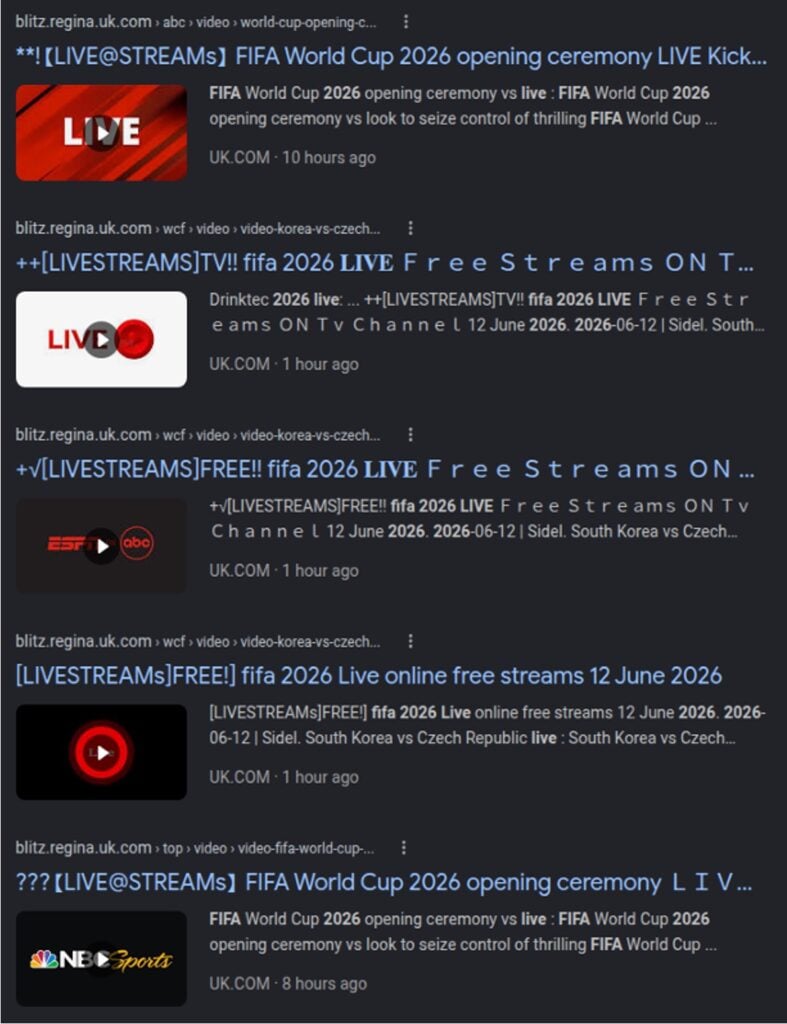
A search result behind the free FIFA stream scam promises a World Cup match just as the game or opening ceremony is about to begin. The headline is loud, current, and packed with words such as LIVE and FREE.
The page may even sit on a website that has existed for years. That familiar-looking result makes the click feel safer than an unsolicited message from a stranger.
Then the play button leads somewhere else. Before creating an account or allowing notifications, notice what never appears on the screen.
Overview
The campaign plants streaming pages inside unrelated websites
The free FIFA stream scam begins with search engine poisoning. Criminal operators inject tournament-themed pages into compromised websites that already have history and search visibility.
One observed result appeared under a European household-paper domain. Another used a site belonging to an academic researcher. The legitimate owners were not offering football coverage and may not have known that fraudulent pages had been planted on their sites.
The click moves through rotating streaming fronts
The compromised page is only an entry point. A click can pass through tracking links and open a separate streaming-themed domain, including names designed to resemble a familiar streaming word.
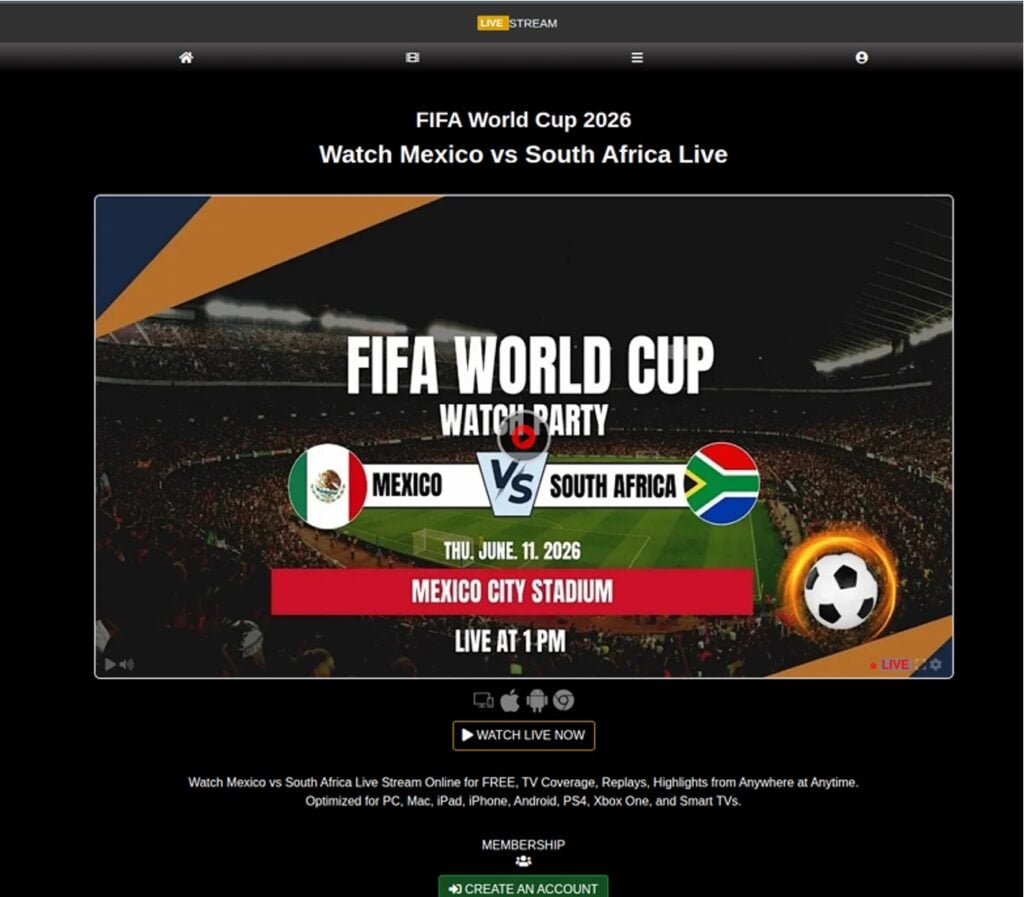
The destination displays match details, a video-player image, device icons, and a “Watch Live Now” button. Those elements create anticipation, but none proves that the site has video rights or a functioning stream.
The account form is the destination, not a gateway
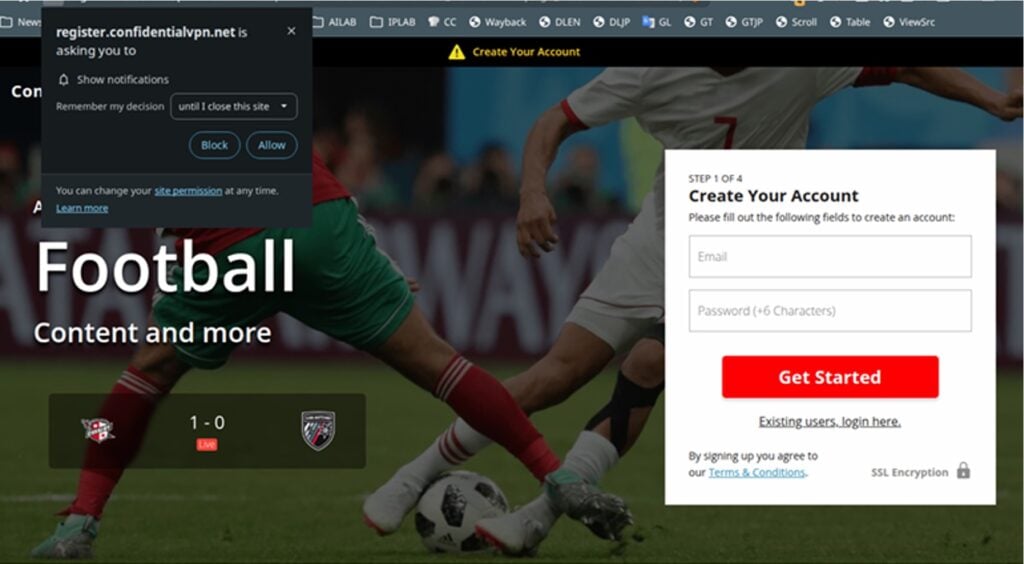
No observed path delivered the promised match. The button led to registration pages collecting names, email addresses, and passwords. One route also requested permission to send browser notifications.
The fan thinks an account unlocks the video. In reality, the credential form and notification permission can be the operator’s entire objective.
- The search result is hosted by an organization unrelated to sports.
- The headline uses heavy symbol padding to attract attention.
- The click redirects away from the domain shown in search.
- The supposed player never starts a live match.
- An unfamiliar site requires a new email and password.
- A notification prompt appears before any content is available.
- The same templates can rotate through several domains and languages.
How a Real Website Can Appear in a Fraudulent Result
A search result is not automatically safe because the visible domain belongs to a real organization. Websites can be compromised, misconfigured, or abused through vulnerable publishing tools.
Criminal operators may add hidden pages stuffed with popular match names, tournament dates, broadcaster terms, and “watch free” phrases. Search engines index those pages under the reputation of the compromised host.
The new page may have nothing to do with the site’s normal purpose. A research profile, manufacturer, school, community organization, or small business can suddenly appear to offer live international football.
That contradiction is one of the strongest clues. The result is not evidence that the owner launched a streaming service. It may show that someone planted unauthorized content on the owner’s server.
Search reputation can be borrowed without permission
New scam domains often struggle to rank. A compromised older site may already have inbound links, indexed pages, and a history that makes its injected content easier to discover.
This technique is called SEO poisoning. The goal is to place a malicious or deceptive result in front of people searching during a narrow, high-interest window.
The visible result and final destination can be different
A person clicks the reputable-looking host but is redirected through an affiliate or tracking address. Several hops later, the browser lands on a fake streaming page under another domain.
Checking only the original result is not enough. Watch the address bar after every redirect, especially before entering a password, payment detail, or notification permission.
The Search Headlines Are Designed for Match-Day Panic
Observed listings used titles such as “[LIVE@STREAMs]” and “++[LIVESTREAMS]FREE!!” with brackets, plus signs, and unusual spacing. The visual noise is intentional.
A fan who believes kickoff has already started is less likely to compare broadcaster rights or inspect a hostname. The result promises immediate access and makes any verification feel like lost viewing time.
Some listings insert current teams, ceremony names, dates, and words associated with major broadcasters. Accurate match information is easy to copy from public schedules. It does not demonstrate a license to show the event.
Thumbnails can also borrow television logos or red LIVE badges. Those images are decorative. A search result can display them without connecting to the broadcaster shown.
Strange punctuation is a visibility tactic
Legitimate broadcasters do not need to surround match titles with repeated symbols. The clutter is used to stand out among ordinary results and suggest a fresh, unofficial stream.
The technique also lets operators publish many keyword variations. Each injected page can target a different match, language, team, or phrase while sending visitors into the same funnel.
The tournament theme can change overnight
The underlying system is not limited to FIFA. Operators can replace football terms with boxing, basketball, motorsport, award shows, or another high-demand live event.
Compromised hosts and redirect infrastructure can remain the same while headlines, player images, and account pages rotate around the next search spike.
The Fake Player Is a Doorway to Credential Theft
The streaming page looks more complete than a simple phishing form. It may show a stadium, team flags, a score graphic, device compatibility icons, and a large play button.
Clicking the button does not start video. Instead, the page says an account is required. The visitor is asked to provide an email address and create a password before viewing.
The requested password is particularly valuable when people reuse credentials. Operators can test the email and password combination against email, shopping, social media, streaming, or business accounts.
A password created specifically for the fake site is less useful elsewhere, but the email address still confirms an active target. Follow-up phishing can reference the match, supposed membership, or account problem.
A fake VPN page adds another layer of legitimacy
One observed redirect led to register.confidentialvpn[.]net. The page framed registration as access to football content and requested an email and password.
A VPN theme fits the story because broadcasting rights vary by country. The page can claim the service is needed to bypass a regional restriction, even though no verified stream waits behind the form.
Notification permission creates a channel that survives the tab
The browser may ask whether the site can “Show notifications.” If the user selects Allow, the domain can send alerts through the browser after the original page closes.
Those alerts may advertise fake virus warnings, giveaways, investment offers, adult pages, downloads, or additional phishing sites. They can look like operating-system messages even though they originate from browser permission.
How the Free FIFA Stream Scam Works
Step 1: Operators compromise a website with search reputation
Unauthorized pages are added to a legitimate but unrelated host. The normal website may continue working, so the owner and regular visitors do not immediately notice the injected content.
The compromised organization should not automatically be treated as part of the scam. Its server is being used as the first stage.
Step 2: Injected pages target live-event searches
Each page is loaded with tournament names, teams, dates, ceremony terms, and “free live stream” phrases. The content is timed for moments when search demand rises sharply.
Multiple languages and match variations help the operation reach fans in several countries.
Step 3: Padded headlines win the rushed click
Symbols, capital letters, LIVE badges, and familiar broadcaster names make a result visually aggressive. The user notices promised access before noticing the unrelated domain.
Kickoff pressure reduces the time available for verification, which is exactly what the headline exploits.
Step 4: Redirects separate the lure from the collection page
The compromised host forwards the visitor through tracking infrastructure to another site. This separation protects the collection page and makes the full route harder to understand.
Closing one domain does not remove every entry point. Other injected pages can redirect to a replacement destination.
Step 5: A fake player promises immediate access
The destination displays a match image and play controls. It may list phones, computers, consoles, or smart televisions to imitate a commercial streaming service.
The visual suggests that video is ready, but the play button only advances the funnel.
Step 6: Registration collects an email and password
The site says a free account, membership, or VPN profile is required. The fan provides credentials believing this is the final step before the stream begins.
No video follows. The form has already collected the information the operator wanted.
Step 7: Browser permission enables persistent push spam
A notification request may appear beside or above the registration form. Allowing it gives the site permission to send future alerts directly through the browser.
The original stream page can close while the advertisements and scam notifications continue.
Step 8: Credentials and traffic feed other fraud
Reused passwords can be tested against other services. Active email addresses can receive targeted phishing, and notification access can promote new scams.
The operator replaces domains and event graphics when reputation drops or the tournament ends.
Company, Address, and Fulfillment Checks
The website shown in search may be another victim
An academic, manufacturer, or community site hosting an injected page is not necessarily the operator. The abrupt appearance of sports-streaming content on an unrelated domain can indicate compromise.
Report the malicious path to the site owner or hosting provider without accusing the legitimate organization of running the fraud.
The streaming brand does not identify a legal operator
Generic names such as Live Stream, membership, or confidential VPN do not reveal a registered company, licensed broadcaster, or rights holder.
A logo and terms link can be copied. Look for an operator that can be verified outside the page and a broadcaster relationship confirmed through official channels.
The notification prompt is control, not customer support
Permission to send browser alerts is not required to play video. It gives the domain an ongoing delivery channel rather than providing help with the match.
A site asking for notifications before offering content is requesting more access than the viewing task requires.
The credential destination has no trustworthy chain
The form does not connect the entered email and password to an official broadcaster account. The visitor cannot verify who stores the data, how long it remains, or which other parties receive it.
That missing chain matters more than the player artwork. A legitimate subscription identifies the service, operator, billing terms, privacy policy, and account-management route.
Warning Signs in a Fake FIFA Streaming Result
- The visible domain belongs to an organization unrelated to sport or broadcasting.
- The title is packed with brackets, symbols, repeated punctuation, and spaced-out letters.
- The page redirects through several different domains.
- The final hostname contains a typo or generic streaming phrase.
- The play button leads to registration instead of video.
- An unfamiliar account asks for a password you use elsewhere.
- The site asks to send notifications before playing anything.
- No official broadcaster confirms the service or domain.
The broader FIFA 2026 World Cup scams guide covers other tournament lures involving tickets, stores, hospitality, careers, and payment forms.
If browser alerts continue after the page closes, MalwareTips’ “Please Allow to Watch the Video” guide explains how notification permission is abused and how to remove it.
How to Find a Legitimate World Cup Stream
Start with FIFA’s official site and your country’s established television or streaming providers. Broadcasting rights differ by location, so a service that is genuine in one country may not be authorized in another.
Open the broadcaster’s app or type its known address directly. Do not use a last-minute search result as proof that a page belongs to the broadcaster shown in its thumbnail.
A legitimate service may require an account or subscription, but the domain, operator, terms, and support route should be clear before registration. It should not bounce through unrelated hosts or require browser notifications to unlock video.
The FBI’s World Cup spoofing warning advises typing fifa.com directly and treating sponsored or look-alike results cautiously. The same habit helps when tournament searches are crowded with unofficial pages.
What to Do if You Have Fallen Victim to This Scam
- Close the page and stop every download. Do not keep clicking player buttons, install a codec, add an extension, or create another account to make the stream work.
- Change the submitted password immediately. Replace it on every account where it was reused. Begin with the associated email account and enable multifactor authentication.
- Revoke browser notifications. Open the browser’s site settings, find the unfamiliar domain under allowed notifications, and remove or block its permission.
- Check extensions and recent downloads. Remove anything installed through the funnel. Delete unopened installers, archives, mobile apps, profiles, or browser add-ons.
- Run a full device scan. Use Malwarebytes to look for malware and potentially unwanted programs if a file, extension, or app was downloaded.
- Block future malicious pages and ads. AdGuard can help stop known scam domains, intrusive redirects, and malicious advertising before another page loads.
- Review important accounts. Check email, social media, shopping, streaming, and financial services for unfamiliar sign-ins, password resets, forwarding rules, or recovery-address changes.
- Contact the card issuer if payment data was entered. The observed campaign focused on credentials and notifications, but some rotating pages may add payment steps. Replace an exposed card and dispute unauthorized charges.
- Save and report the route. Record the search query, visible result, redirect domains, screenshots, and final page. Report fraud to ReportFraud.ftc.gov and cybercrime to IC3.
- Expect targeted follow-up scams. Messages may claim your membership failed, your VPN expired, or your account was hacked. Use independently located contact details and never trust the follow-up link.
Frequently Asked Questions
Does the free FIFA stream scam show a real match?
No stream was delivered in the observed funnel. The player and match graphics led to account registration, credential collection, and notification permission.
Why did Google show a page from a real website?
Criminal operators can inject unauthorized pages into a compromised site and borrow its search reputation. The legitimate owner may have no connection to the fraudulent content.
What is SEO poisoning?
SEO poisoning uses manipulated or injected pages to place deceptive links in search results. Popular events and urgent searches give those pages a temporary supply of clicks.
What if I used a brand-new password?
A unique password limits reuse attacks, but the operator still has an active email address and may send targeted phishing. Delete the account if possible and watch for follow-up messages.
Why does the site ask to show notifications?
The permission lets the domain send browser alerts after the tab closes. It is not needed for streaming and can become a channel for persistent scam advertising.
Is every unofficial World Cup stream malicious?
No single article can classify every site. The campaign described here used compromised search pages, redirects, fake players, credential forms, and notification requests. Verify viewing options through established broadcasters.
The Bottom Line
The free FIFA stream scam exploits the moment when a fan cares more about kickoff than the address bar. A real-looking search result leads through redirects to a player that never plays and an account form that should never receive your password.
Use FIFA and established broadcasters to locate legitimate coverage. Decline notification requests, avoid unfamiliar registration pages, and treat any result on an unrelated domain as a reason to stop.
If you already entered credentials or allowed alerts, change reused passwords, revoke permissions, scan the device, and review your accounts. The missing stream may be disappointing, but a fast response can keep the loss from spreading.








