

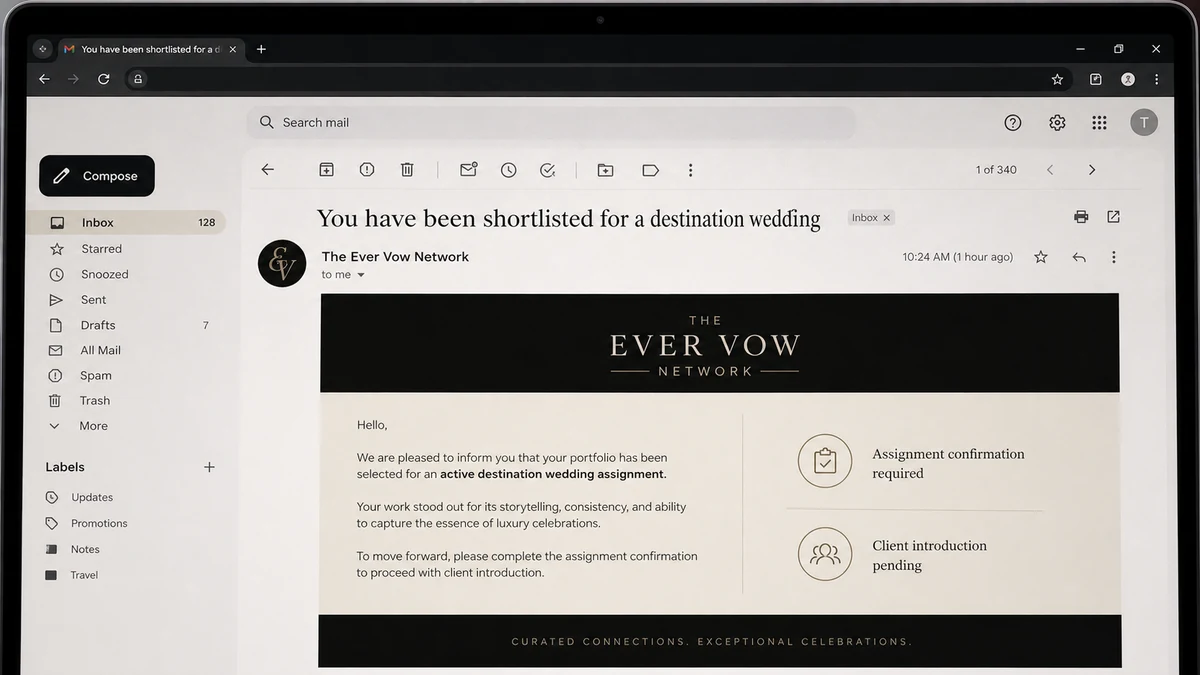
A message tells a wedding photographer that their portfolio has been selected for a prestigious destination assignment. The network looks established, the website names a real director, and a video call seems to confirm that a genuine opportunity is waiting.
Then one unusual condition appears before the photographer is allowed to meet the planner or client.
Overview
The offer borrows trust from the wedding industry
A recent photographer’s report described an approach from a site called The Ever Vow. The website presented itself as a UK network that connects wedding planners with destination photographers and other creative professionals.
The reported contact did not begin with an obviously crude payment demand. A representative held a video call, discussed the photographer’s work, and framed the opportunity as a real assignment. Only afterward did the representative allegedly request an upfront “assignment confirmation” fee before any client contact.
That sequence matters. Creative professionals are used to proposals, retainers, commissions, referrals, and onboarding calls. A polished site and an industry-specific conversation can make an advance fee look like an unusual contract term rather than the point of the approach.
The website and the reported payment request contradict each other
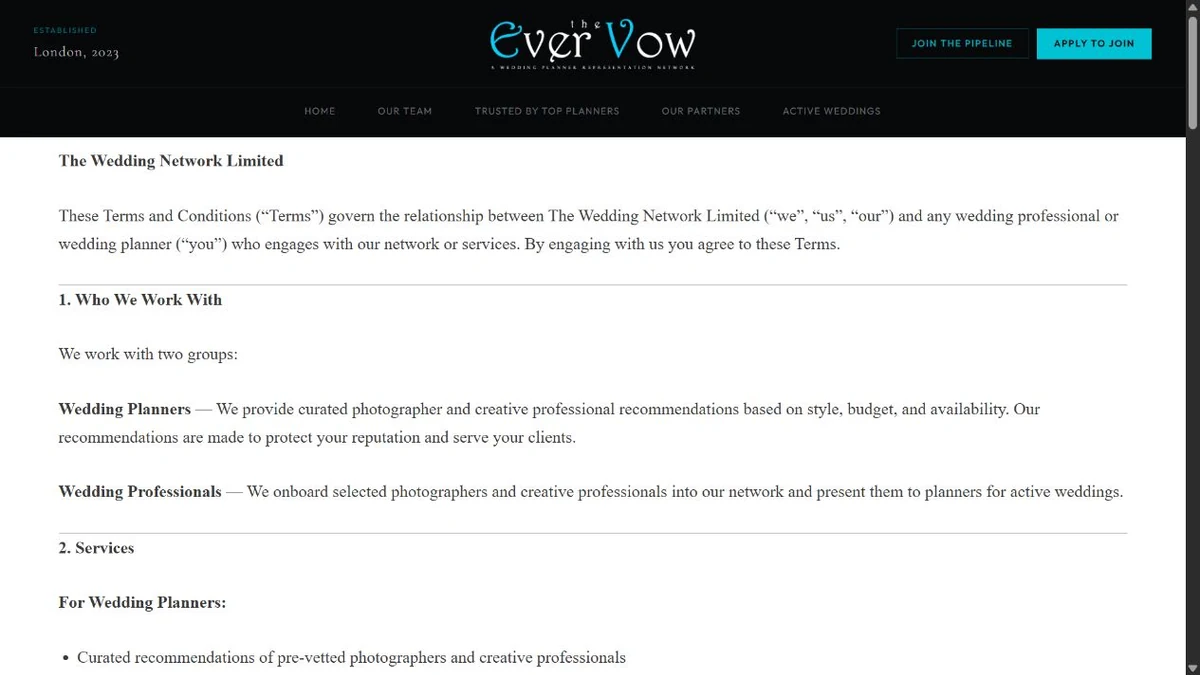
The live terms and conditions state that wedding professionals pay no fees, charges, or commissions. They say the network earns money from planners after successful bookings and that any appreciation for presentation work is voluntary.
An “assignment confirmation” payment required before a client introduction would conflict directly with those published terms. The contradiction is more important than elegant branding, a video call, or a plausible explanation about protecting an exclusive opportunity.
The same terms identify “The Wedding Network Limited,” while the website prominently displays company number 11928418. Companies House assigns that number to a different legal name, The Wedding Business Hub Limited. A company number is checkable data, but displaying real data does not prove authorization to use it.
The identity behind the site is the critical question
The Reddit reporter said they contacted the real Katie Jane Lyth directly and were told that she had no connection to the site, that her identity was being used without authorization, and that the matter had been reported. MalwareTips could not independently verify that private exchange.
Public records do confirm that Katie Jane Lyth is a director of The Wedding Business Hub Limited. They also show that company number 11928418 is active and uses the same Covent Garden registered-office address displayed on the website.
Those public facts make the impersonation concern more serious, not less. They show how a site can copy accurate registry details to create a false bridge between an online operation and a real person or company.
Before paying a referral network, check:
- Does the legal name on the invoice exactly match the registry record?
- Does the real company confirm the domain through an independently found channel?
- Do the site’s terms permit the fee being requested?
- Is a named planner or couple available for a verifiable introduction?
- Will the representative provide the opportunity in writing before payment?
- Is the payee the same legal entity named in the agreement?
- Does the salesperson resist a call to the registered company?
- Is the “exclusive assignment” used to create a same-day deadline?
A professional opportunity should become clearer as due diligence increases. If every question produces more secrecy, urgency, or reasons to pay first, step away.
The Published No-Fee Promise Changes the Whole Story
Advance-fee schemes often depend on a believable reason for a small payment. A network may call it onboarding, portfolio refinement, insurance, exclusivity, assignment confirmation, verification, or a refundable commitment. The label changes, but the sequence remains the same: money leaves before the promised opportunity can be checked.
The Ever Vow’s own terms remove much of that ambiguity. They say professionals are included and presented to planners without a fee. They also say presentation refinement is provided at no cost.
If a representative requests a mandatory payment anyway, there are only a few possible explanations. The person may be acting outside the stated terms, the website may have changed its model without updating legal documents, or the representative may not control the legitimate business they claim to represent.
None of those explanations justifies an immediate transfer. A professional should pause until the legal entity confirms the request in writing and explains the contradiction.
Do not let the word “refundable” solve the problem. A refund promise is only valuable when the seller can be identified, the agreement names the payee, and a practical dispute route exists.
Likewise, a video call is not corporate verification. It proves that a person appeared on camera. It does not prove their name, employer, ownership of the domain, authority to sign contracts, or right to use someone else’s company number.
How the Fake Wedding Network Scam Works
Step 1: The photographer is selected, not recruited
The approach flatters the target by saying their portfolio was reviewed and chosen. Selection feels more exclusive than an ordinary sales message, so the photographer may worry that skepticism will cost them a rare assignment.
The message can mention a luxury destination, a planner pipeline, or a couple with a matching aesthetic. Specific industry language makes the opportunity sound researched even when no verifiable client has been presented.
Step 2: A polished website supplies borrowed authority
The target searches the name and finds a professional site with testimonials, destination markets, statistics, a London address, and a UK company number. Each element reduces the chance that the photographer will search beyond the page.
Numbers such as placement rates, planner counts, and bookings are difficult for an outsider to verify. They can look precise without linking to independently identifiable clients or public case studies.
Step 3: A call turns the page into a relationship
A live conversation makes the operation feel expensive and personal. The representative can discuss portfolio style, availability, pricing, or travel and then mirror the photographer’s answers back as evidence of a good match.
The call also creates momentum. Once someone has spent time preparing and imagining the booking, rejecting a final condition feels harder than rejecting the first email.
Step 4: The client stays just out of reach
The planner, couple, contract, venue, and full brief remain unavailable until the photographer completes one more step. That separation prevents the target from asking the supposed buyer whether the assignment exists.
A genuine intermediary may protect client privacy, but it can still provide a redacted brief, clear commercial terms, its own verified identity, and a contract that does not contradict its public promises.
Step 5: The fee is reframed as commitment
The payment may be described as proof that the photographer is serious, a reservation of territory, a presentation cost, or confirmation of an assignment. The language makes the target feel responsible for unlocking the opportunity.
That reverses a normal commercial relationship. A buyer or authorized agent seeking a professional service should be able to establish the assignment before demanding money from the supplier.
Step 6: Urgency blocks independent verification
The target may be told the planner needs an answer today, another photographer is waiting, or a second call is unnecessary. Scarcity makes calling the real company feel like a delay that could lose the booking.
A legitimate opportunity can tolerate basic identity checks. An honest intermediary benefits when both sides understand who is involved.
Step 7: Payment creates a path to more payments
After the first transfer, another obstacle may appear: insurance, taxes, travel documents, client verification, upgraded membership, or a release fee. The victim keeps paying because the original amount now feels recoverable only by completing the process.
If the target refuses, the representative can disappear, blame the photographer for breaching terms, or move the website to another domain while keeping the same copied company details.
Why a Real Company Number Is Not Enough
Companies House is a public register. Anyone can search it and copy a company’s name, number, officers, filing dates, and registered address. That transparency helps verification, but it also supplies convincing material to impersonators.
Company number 11928418 belongs to The Wedding Business Hub Limited. Its official record shows an active private company incorporated in 2019 and a registered address at 71-75 Shelton Street, Covent Garden.
The site terms instead name The Wedding Network Limited. Companies House lists a company with that exact name under number 15629877, but its record says it was dissolved on June 2, 2026 and has a different address and director.
This mismatch does not, by itself, prove who built or operates the site. It does mean visitors cannot safely assume that the legal identity has been presented consistently.
The correct verification step is not asking the site’s salesperson to explain the registry. Contact the registered business through a channel found independently of the disputed site and ask whether it owns the domain and authorized the representative.
Also compare the name on the bank account or payment request. A transfer to an unrelated person, crypto wallet, payment app handle, or different company is a major warning even when the invoice displays genuine registry data.
Red Flags Photographers Should Treat as Deal Breakers
- An unsolicited network says a high-value assignment is already waiting.
- The planner or couple cannot be contacted before payment.
- The representative asks for a mandatory fee that the site’s terms prohibit.
- The legal name, company number, and website branding do not align.
- A real person’s biography appears without independent confirmation.
- Testimonials cannot be connected to identifiable businesses.
- Placement statistics have no methodology or supporting record.
- The representative discourages another call or outside verification.
- The payee differs from the entity named in the agreement.
- The offer expires before a solicitor, accountant, or colleague can review it.
- A refund is promised verbally but not explained in the contract.
- More fees appear after the first payment.
None of these checks requires proving who the operator is. They answer the practical question: is there enough verified information to risk money, identity documents, client data, or professional reputation?
MalwareTips has documented the same trust-transfer technique in fake recruitment messages, where a real platform or company name is used to make an unrelated contact appear legitimate.
Why Testimonials and Placement Figures Are Weak Proof
The site presents named testimonials and precise performance claims, including a placement rate and counts of planners and markets. Specific numbers feel auditable, but the pages do not explain the sample, period, or method behind them.
A testimonial is stronger when the person has an independently verifiable business, a history of wedding work, and a public channel that confirms the relationship. A name and job title printed by the same site are not independent evidence.
Search testimonial names with the claimed profession and destination. Compare portfolio images, business addresses, social histories, and contact details. Do not ask the disputed site to supply the only proof.
Images also deserve review. Reverse-search prominent venue, ceremony, and portfolio photographs. A network should be able to identify whether it owns, licensed, or received permission to use commercial wedding images.
Even real testimonials may describe an earlier service, different company, or unpaid trial. Ask the professional whether they paid any fee, received a real client introduction, and would confirm the current domain.
Placement claims should separate inquiries, introductions, contracts, deposits, and completed weddings. Calling every email a placement can transform a weak pipeline into an impressive headline.
Ask for two recent professionals who consent to being contacted and verify their experience through public business channels before accepting any claimed success rate.
Finally, inspect timing. A domain registered weeks ago cannot demonstrate years of results through its own web history. The operator may have prior experience elsewhere, but that history should be named and verifiable.
Company, Address, and Fulfillment Checks
Check the legal name against the company number
The website displays number 11928418, which Companies House assigns to The Wedding Business Hub Limited. Its terms name The Wedding Network Limited. These are not interchangeable descriptions in a contract.
Ask which entity will invoice, contract, introduce the client, process refunds, and accept legal notices. The answers should match the official record and payment account.
Verify the address through an independent channel
The Covent Garden address is a registered office shown on the public record. A registered office proves where formal correspondence can be sent; it does not prove that a sales team occupies the location or operates a particular domain.
Contact the real company using details obtained independently and ask whether theevervow.com is authorized.
Inspect the domain and published terms
Public RDAP data shows theevervow.com was registered on July 29, 2026. The site describes itself as established in London in 2023, so the online footprint is much newer than the branding suggests.
The terms explicitly say professionals pay no fees. Save a copy before responding because pages can change after questions are raised.
Define what fulfillment would look like
The promised deliverable is not “network access.” It is a verifiable introduction to a real planner and client, followed by a legitimate booking opportunity. Demand a written brief, clear intermediary role, refund terms, and the identity of the contracting parties.
Do not pay merely to learn whether the assignment exists.
What to Do if You Have Fallen Victim to This Scam
- Stop further payments. Do not pay a release, refund, insurance, or verification fee.
- Preserve the full trail. Save emails, messages, call details, invoices, account names, domain pages, and payment receipts.
- Contact your bank or payment provider. Explain that the transfer followed an allegedly deceptive business opportunity and request an immediate recall or dispute.
- Notify the impersonated company. Use independently verified contact information, not the details supplied by the representative.
- Report the domain and account. Send the evidence to the registrar, hosting provider, email provider, and social platform used for contact.
- Report in the UK. File a report with Action Fraud and include the company-number mismatch and payment destination.
- Warn affected clients or partners. If you shared private wedding details, tell the people whose information may have been exposed.
- Change reused passwords. Start with email, cloud storage, portfolio hosting, and payment accounts.
- Review email sessions and forwarding. Remove unknown devices, application passwords, recovery addresses, and forwarding rules.
- Scan affected devices. Run Malwarebytes if you opened a file, installed software, or allowed remote access during onboarding.
- Reduce malicious redirects. AdGuard can block many known phishing and malware destinations, but it cannot validate a business representative or contract.
- Watch for recovery scams. Anyone promising guaranteed recovery for another upfront fee may be starting a second fraud.
Frequently Asked Questions
Is The Ever Vow definitely connected to the real company?
That connection is not established by the website alone. The displayed company number belongs to a real active company, but the terms use a different legal name and the reporter says the named director denied involvement.
Does a video call prove the representative is legitimate?
No. A video call proves only that someone appeared on camera. Verify their employment and authority through the legal entity using an independent channel.
Can a legitimate referral network charge photographers?
Some legitimate businesses charge membership, marketing, or referral fees. The problem here is the reported mandatory advance payment conflicting with the site’s published no-fee terms and the unresolved identity questions.
Why would a site use a real company number?
Real registry data is public and makes a page look verifiable. Copying accurate data is easier than creating a company with a filing history.
Should I contact the supposed planner or couple?
Yes, but obtain contact details independently where possible. Do not rely on a new email address supplied by the same representative because that can be another controlled identity.
What if the fee is described as refundable?
Do not rely on the label. Confirm the legal payee, written refund trigger, dispute route, and assignment before transferring anything. A promised refund cannot protect you if the operator disappears.
The Bottom Line
The fake wedding network story works because almost every visible detail can look professional: a luxury site, a London address, a real company number, a named director, and a live call. The decisive warning arrives when those details fail to agree with one another.
A photographer should never have to pay to discover whether the client exists. Verify the domain with the real legal entity, compare the request with the published terms, and walk away when an “assignment confirmation” fee stands between you and basic proof.








