

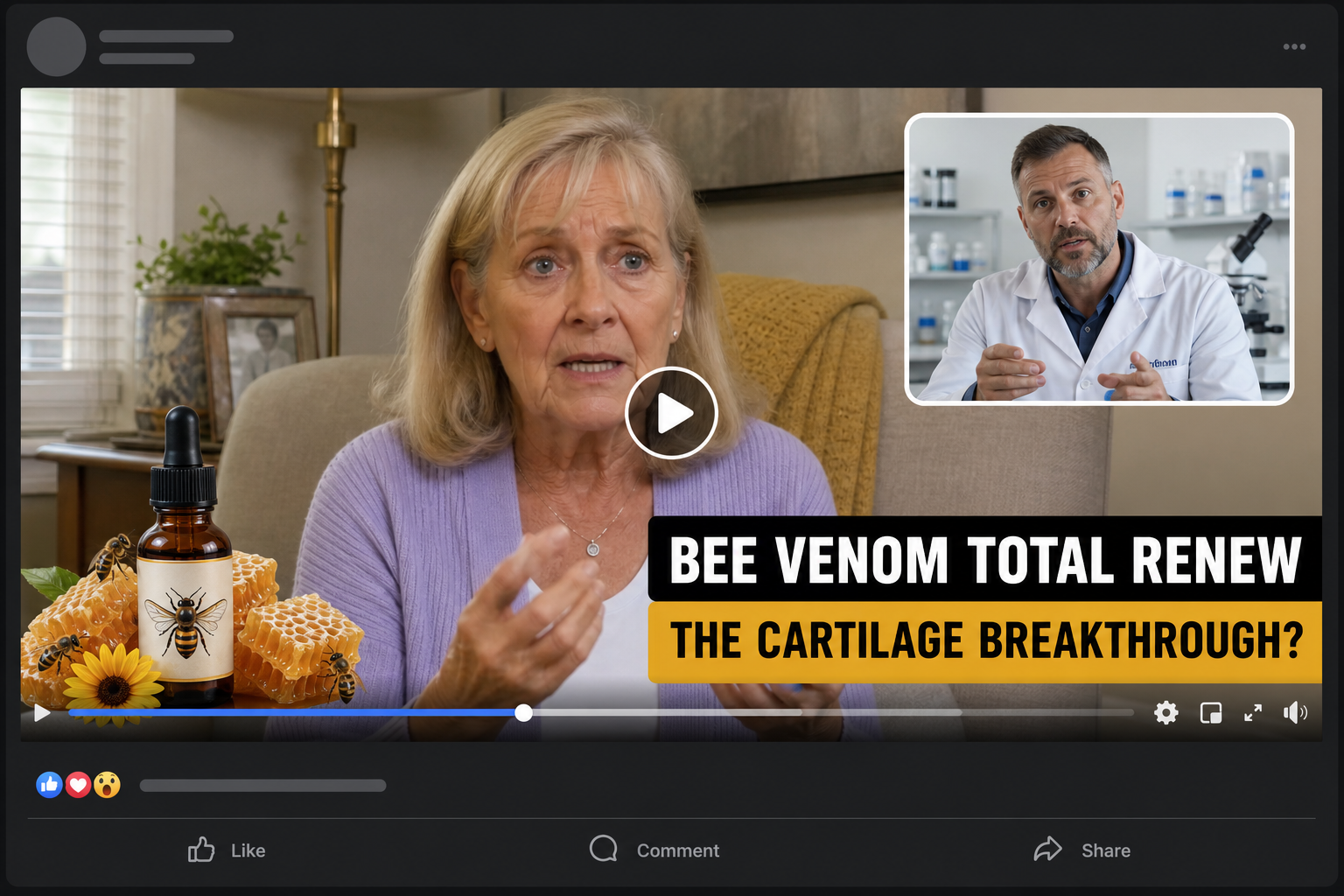
A woman says surgeons had nearly given up on her damaged knee. Then a researcher reveals that the real problem is not aging, inflammation, or ordinary wear, but microscopic “cartilage eaters” that can supposedly be stopped with drops made from bee venom.
The video looks like a personal recovery story mixed with a medical documentary. It promises that even “bone-on-bone” joints can rebuild, and it surrounds the claim with laboratory scenes, media logos, a doctor, and people walking pain-free again.
Our investigation followed the joint-regeneration story, the Nature One Health Bee Venom Total Renew product, the supposed experts and media coverage, the guarantee conflict, the company details, and what bee-venom research actually can and cannot show.
Overview
The campaign uses an emotional surgery-avoidance story
The central character is described as Linda Mitchell, a woman from Charlotte, North Carolina, facing severe joint degeneration and possible knee replacement. Her recovery is presented as proof that a hidden natural treatment can rebuild cartilage.
We could not independently verify the patient, her records, the diagnosis, the claimed recovery, or her relationship to the seller. The story follows a familiar advertorial formula, a relatable patient, a frightening prognosis, a forbidden discovery, and a product reveal.
The doctor and institutional connections could not be verified
A researcher named Dr. David Holloway is associated with claims about the Mayo Clinic, Stanford, or a “Joint Regeneration Program.” We found no reliable institutional profile, research paper, trial registration, or official announcement supporting the role described in the promotion.
White coats, microscopes, university names, and television graphics create authority, but each one must be verified separately. A respected institution’s name on an ad does not mean the institution sponsored the product or the research.
The underlying product is not proven to regrow cartilage
The funnel promoted Nature One Health Bee Venom Total Renew. The original website was unavailable during our latest check, which prevented a live review of the current label, checkout, and policies.
We found no controlled clinical evidence showing that the finished oral-drop product regenerates human cartilage, reverses bone-on-bone osteoarthritis, or allows patients to avoid joint replacement.
- The story centers on a supposed patient named Linda Mitchell.
- A supposed expert named Dr. David Holloway provides medical authority.
- Mayo Clinic and Stanford are invoked without a verified product endorsement.
- The promotion claims bee venom can stop “cartilage eaters.”
- The commercial product is called Bee Venom Total Renew.
- Marketing materials reportedly displayed a 90-day guarantee.
- A separate return policy reportedly limited requests to 30 days.
- We found no proof of an automatic refill program for this offer.
What the Bee Venom Joint Regeneration Story Claims
The pitch begins with severe pain and loss of mobility. Ordinary treatments are described as temporary because they supposedly reduce discomfort without addressing the hidden organisms or processes destroying cartilage.
Bee venom is then introduced as a biological signal that can switch off the damage and activate the body’s repair system. The language moves quickly from inflammation and pain to the much larger promise of restoring missing cartilage.
These are not equivalent outcomes. A reduction in pain does not prove new cartilage formed. Improved walking can result from many factors, including placebo effects, reduced inflammation, activity changes, weight loss, physical therapy, medication, or natural symptom variation.
Claims that a knee moved from “bone-on-bone” to regenerated cartilage would require credible imaging, standardized measurements, independent specialists, a defined timeline, and controlled comparison. A testimonial video cannot supply that evidence.
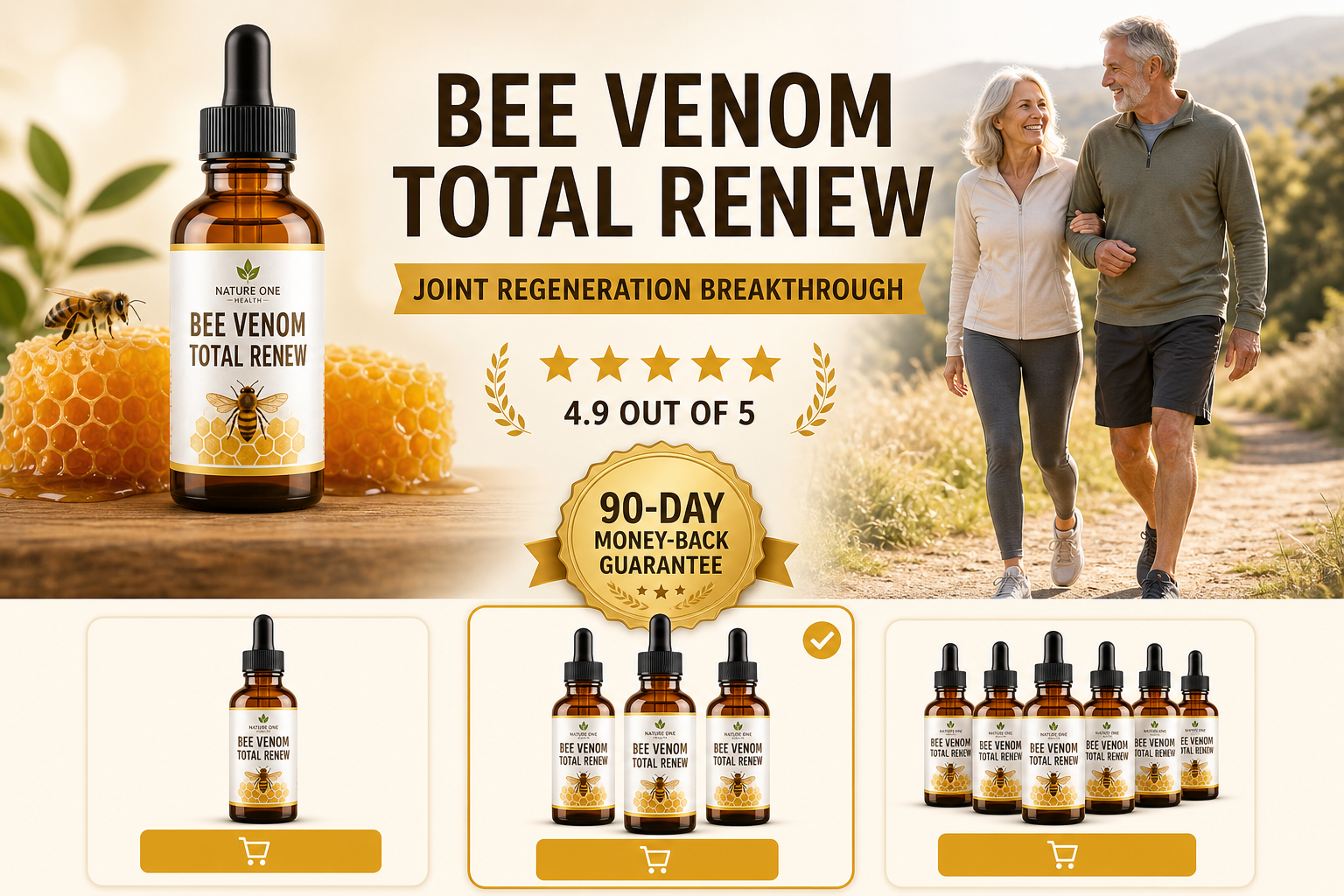
The three campaign images in this article are clearly labeled here as realistic reconstructions. The original sales domain was offline during our review, so the visuals reproduce recorded elements of the ad, landing page, and conflicting return language rather than pretending to be fresh live screenshots.
The promotion has also used or implied attention from Shark Tank, 60 Minutes, Forbes, GQ, Men’s Health, and BuzzFeed. We found no reliable original coverage showing those outlets tested or endorsed the exact product and cartilage claim.
A genuine media feature should be easy to confirm on the publisher’s own domain, with an author, date, original video, and context. A row of logos or a cropped television frame is not equivalent to that evidence.
The same standard applies to the alleged universities and clinics. Search the institution’s official directory and publications, not the biography supplied by the sales page.
What Bee Venom Research Actually Shows
Bee venom has been studied in laboratory research and in some forms of bee-venom acupuncture or injection. Those studies concern specific preparations, routes of administration, doses, conditions, and clinical settings.
They do not automatically support an oral drop sold through a social media funnel. Swallowing a commercial mixture is not the same intervention as a controlled injection or acupuncture procedure administered by a trained practitioner.
Some reviews have explored pain outcomes, but the quality, size, and consistency of evidence vary. Even a finding of temporary pain improvement would not establish cartilage regrowth or reversal of advanced osteoarthritis.
The FTC’s Health Products Compliance Guidance explains that objective health claims need competent and reliable scientific evidence. For claims that a product treats a disease or regenerates tissue, that generally means well-designed human clinical evidence supporting the exact product and claim.
We found no such evidence for Bee Venom Total Renew. References to bee venom as an interesting research subject cannot be stretched into proof that this bottle rebuilds joints.
Bee Venom Safety and Allergy Risks
Bee venom can cause allergic reactions. The risk depends on the actual ingredient, dose, route, purity, and the person’s history. Reactions can range from local irritation to systemic symptoms and, rarely, anaphylaxis.
Because the current product label was unavailable, we could not confirm how much bee venom the bottle contained, whether it used another bee-derived ingredient, or whether the name was mainly marketing. Consumers should not infer composition from the brand name alone.
If a product truly contains bee venom, anyone with a history of sting allergy, asthma, mast-cell disorders, severe allergy, pregnancy, or complex medication use should speak with a qualified clinician before exposure.
Difficulty breathing, facial or throat swelling, widespread hives, faintness, vomiting, or a rapid decline after taking a product can be signs of a severe allergic reaction. Seek emergency help immediately.
How the Bee Venom Joint Regeneration Scam Works
Step 1: A video targets people afraid of surgery
The ad opens with a person whose pain has limited walking, sleep, travel, or family life. Surgery is presented as the only conventional option, which makes a simple non-surgical alternative emotionally powerful.
The story may exaggerate certainty on both sides, portraying doctors as giving up while the secret remedy offers a complete recovery. Real treatment decisions are rarely that simple.
Step 2: AI actors and documentary styling create authenticity
A convincing patient speaks from a home, while a doctor appears in a laboratory or interview window. AI-generated faces, cloned voices, stock footage, and synthetic lip movement can create people who never participated in a real study.
Viewers should verify identity outside the ad. Search licensing boards, hospital directories, trial registries, and published papers. If every reference leads back to the same sales campaign, the authority is circular.
Step 3: A hidden enemy explains every joint problem
The video gives the pain a memorable villain, such as “cartilage eaters.” This makes a complex condition feel easy to understand and suggests that standard care fails because it targets the wrong thing.
Osteoarthritis involves cartilage, bone, inflammation, biomechanics, previous injury, muscle strength, age, and other factors. A catchy enemy is not a diagnosis.
Step 4: Famous institutions and media logos suppress doubt
Mayo Clinic, Stanford, television shows, magazines, or investor programs are displayed or mentioned. The viewer assumes someone respected has already performed the investigation.
The ad rarely links to an official endorsement or product-specific study. Borrowed logos are used to create proximity to authority without providing the underlying evidence.
Step 5: The story reveals a commercial bottle
Only after the viewer accepts the discovery does the product appear. Bee Venom Total Renew is framed as a convenient way to access the breakthrough at home.
This structure makes the bottle feel like a medical solution rather than an unapproved supplement sold through an advertisement. The product name may later change while the patient and doctor story remains almost identical.
Step 6: Bundles and a guarantee reduce purchase resistance
One, three, and six-bottle options encourage a longer commitment, while a 90-day badge suggests there is little financial risk. Testimonials and ratings reassure the buyer that many others already succeeded.
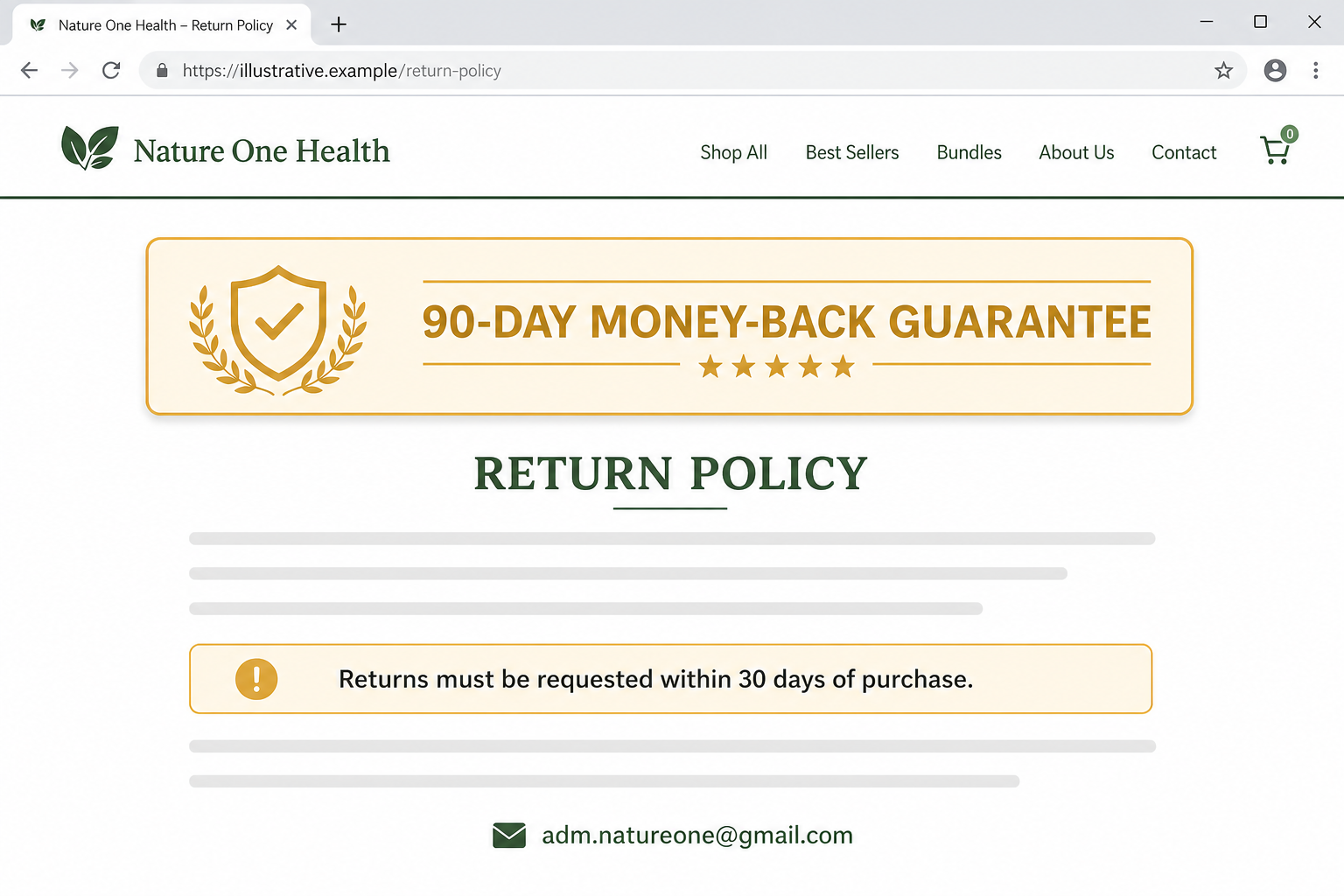
The historic policy record reportedly referred to only 30 days for returns. A 90-day marketing promise and a 30-day policy cannot both be assumed to govern without clarification.
Step 7: An offline site makes later verification harder
The original Nature One Health domain did not resolve during our current check. Websites can go offline for innocent reasons, but disappearance makes it harder to retrieve terms, confirm support, or document what was promised.
That is why buyers should save every page before paying. A guarantee is only useful when the responsible merchant, deadline, return address, and support channel can still be reached.
Guarantee, Billing, and Refund Concerns
Archived descriptions of the campaign referred to a 90-day money-back guarantee. The linked return language reportedly required requests within 30 days of purchase, creating a material mismatch.
A shopper may reasonably interpret a 90-day badge as permission to try the product for up to three months. A 30-day request limit can expire before a multi-bottle buyer has used much of the order.
The support address associated with the campaign was adm.natureone@gmail.com, and a mailing address in Albuquerque, New Mexico, appeared in inconsistent formats. A free email provider and mailing address are not proof of fraud, but they provide limited accountability for strong medical claims.
We found no reliable proof that the exact campaign automatically enrolled buyers in recurring refills. Consumers should still examine statements and receipts because a dead sales site prevents us from confirming whether every historical checkout used the same billing terms.
Company, Address, and Fulfillment Checks
The advertising operation is not automatically the product manufacturer
An affiliate may create the patient story, another party may own Nature One Health, a contract facility may bottle the drops, a warehouse may ship them, and a separate processor may charge the card.
We found no reliable evidence showing that the product owner authorized every AI-style ad. Criticism should focus on the deceptive claims and identify each party only when documents support the connection.
The Albuquerque address does not establish a headquarters
The campaign presented an Albuquerque mailing location, but inconsistent formatting and the unavailable site prevented us from confirming its current function. It may have been a mailbox, office, return point, fulfillment center, or unrelated contact.
A returns warehouse can accept packages for many brands without designing or manufacturing any of them. Search the address and obtain written return authorization before sending a product.
The email and phone trail is weak
The recorded support email used a Gmail address. We did not verify a stable product-specific phone line during the current check. A seller making cartilage-regeneration claims should provide support that can identify the exact order, product, lot, and responsible legal entity.
If support does not answer, contact the payment processor or card issuer using the descriptor on the statement. Never send identity documents to an unverified email simply because it appears in an old ad.
The manufacturing origin remains unproven
We found no reliable documentation proving where Bee Venom Total Renew was made. It would be speculation to claim it was mass-produced in China or in any other country.
The correct concern is missing traceability. Without a current label, legal manufacturer, lot number, exact amounts, contaminant testing, and certificate of analysis, the buyer cannot verify the contents or consistency of the finished drops.
What to Do if You Have Fallen Victim to This Scam
- Do not delay necessary joint care. Contact a clinician if you changed treatment, postponed surgery, or relied on the drops. Sudden inability to bear weight, a hot swollen joint, fever, major trauma, or symptoms of a severe allergy require prompt medical attention.
- Stop the product if you suspect an adverse reaction. Keep the bottle and packaging. Photograph the label, ingredients, lot, expiration date, distributor, shipping label, and any damage or seal problem.
- Save the sales evidence. Preserve the ad, patient and doctor names, media logos, guarantee, checkout, receipt, emails, tracking, and card descriptor. Note that the original domain is now unavailable.
- Request a refund from every documented contact. Email the seller and merchant shown on the receipt. Cite the 90-day promise if that is what you saw, request written return instructions, and use tracked shipping only after authorization.
- Check for additional charges. We did not prove a subscription, but review card statements for refills, memberships, or another merchant name. Dispute unauthorized transactions promptly.
- Report deceptive health claims. Send the video and saved pages to the advertising platform, FTC, and FDA. Report adverse events through the FDA Safety Reporting Portal and tell your clinician.
- Protect the device used to order. Run Malwarebytes if the funnel downloaded a file, installed an extension, or passed through suspicious redirects. AdGuard can reduce deceptive ads and tracking, but it cannot assess supplement safety.
- Talk to the victim without ridicule. The campaign combines pain, fear of surgery, and convincing medical imagery. A supportive approach helps the person disclose symptoms, charges, and other products they may have purchased.
Frequently Asked Questions
Can bee venom regrow knee cartilage?
We found no reliable clinical evidence that Bee Venom Total Renew or an oral bee-venom drop regenerates human knee cartilage or reverses bone-on-bone osteoarthritis.
Is Dr. David Holloway a verified joint researcher?
We could not verify the identity, credentials, institutional role, or product research described in the campaign. Do not rely on the sales video as proof of a medical license or university affiliation.
Did Mayo Clinic or Stanford endorse the product?
We found no reliable official endorsement of Bee Venom Total Renew by Mayo Clinic or Stanford. Institutional names and logos in an ad do not establish participation.
Was Bee Venom Total Renew featured on Shark Tank or 60 Minutes?
We found no verified original feature endorsing the exact product and cartilage claim. Look for coverage on the program or network’s official site, not a seller-controlled logo strip.
Is Bee Venom Total Renew a subscription?
We did not find sufficient evidence to label the exact offer a confirmed automatic-refill plan. Check the receipt and statements because the historical checkout is no longer available for direct review.
Why are the images reconstructions?
The original product domain was offline during our review. We recreated the visual structure from recorded campaign details so readers can recognize the pattern without presenting an invented image as a live screenshot.
The Bottom Line
The bee venom joint-regeneration story uses an unverified patient, an unverified doctor, famous institutions, AI-style video, and a dramatic cartilage promise to sell a supplement that has not been shown to rebuild human joints.
The product name may disappear or change, but the surgery-avoidance story can return with another bottle. Verify the people, research, label, company, guarantee, and checkout before trusting any “bone-on-bone reversal” ad.








