

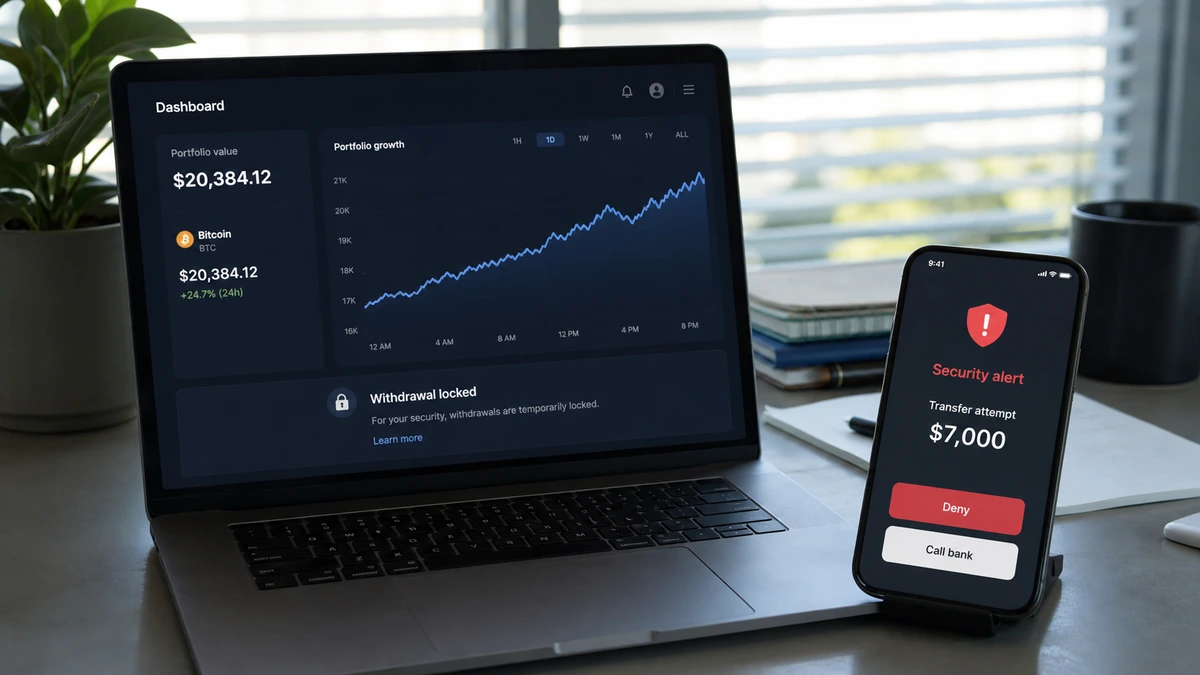
A small Bitcoin investment appeared to be doing extraordinarily well. A private dashboard said $200 had grown into $20,000 in only a few months.
The trouble began when the investor tried to bring those apparent profits home and a helpful account manager asked to connect to the phone.
Overview
The $20,000 existed only on the promoter’s screen
The person at the center of this case had reportedly sent $200 to people promoting a Bitcoin investment. A website then showed the account rising until the displayed value reached about $20,000.
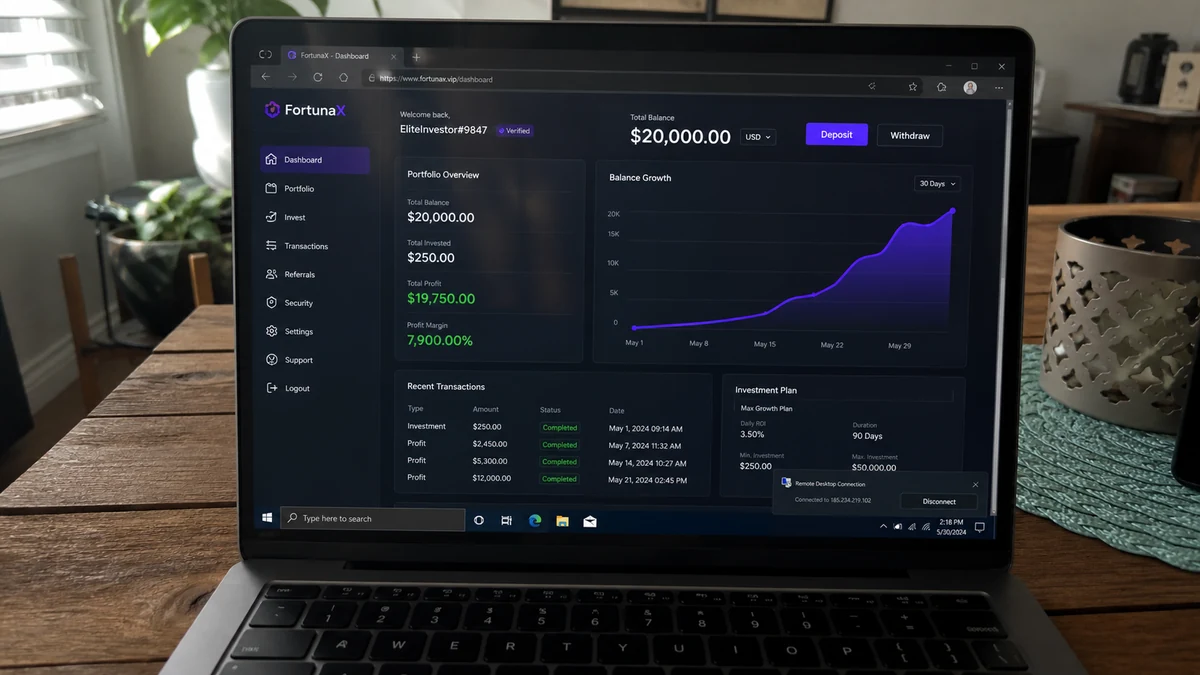
That dramatic number felt like proof that the original decision had worked. Yet there was no independently verified exchange statement, personal wallet, blockchain transaction, or regulated custody record showing that the profit existed.
A private dashboard is easy for its operator to edit. The balance, trade history, and chart can all move without any Bitcoin being purchased. The site needs to look profitable only long enough to make the next request believable.
The withdrawal required access to a real banking phone
When the investor was ready to receive the money, the supposed account managers said they could help transfer it into the bank. They asked for remote access to the phone used for banking.
That request crossed the boundary between the fake investment and real money. Once connected, the operators could see or control the same device that held banking apps, verification messages, email, saved passwords, and linked accounts.
Instead of sending $20,000 into the account, the session created outgoing activity. The victim was watching for a deposit while the people on the phone were reportedly trying to reach money that actually existed.
A linked family account nearly supplied the real payout
The banking relationship also exposed a family member’s savings account containing about $7,000, money reportedly intended for tuition and debt. That person had never agreed to the Bitcoin investment but was drawn into its consequences through the account link.
The bank reportedly stopped the transfer, and the family later separated the accounts. The immediate intervention protected the money, while removing unnecessary access reduced what a future compromise could reach.
The strongest warning signs were:
- An unsolicited contact promoted a cryptocurrency investment.
- A $200 deposit supposedly grew to $20,000 within months.
- The profit could be seen only on a site controlled by the promoters.
- No independent exchange or wallet confirmed the Bitcoin holdings.
- The withdrawal required remote access to a banking device.
- The operator opened or directed activity inside real banking accounts.
- A linked family account became reachable during the session.
- Receiving profit somehow produced an attempted outgoing transfer.
A Dashboard Balance Is Not a Crypto Holding
Fake investment sites borrow the visual language of real exchanges: candlestick charts, account numbers, support chat, verification badges, and lists of profitable trades. Those features prove only that someone built a webpage.
The operator can credit the account without buying Bitcoin, add winning trades after the fact, and hide losses from the chart. The balance may even follow the real Bitcoin price closely enough to feel connected to the market.
The UK’s Financial Conduct Authority warns that crypto investment scams can use professional-looking trading platforms and manipulate displayed prices and returns. The same presentation is used against victims in many countries.
A genuine account should explain who legally holds the asset, where it is custodied, how deposits become cryptocurrency, and how the customer can withdraw without surrendering control of a banking device.
The most revealing test is not how high the dashboard rises. It is whether the customer can withdraw more real money than was deposited, without first paying another fee or installing remote-access software.
How the Fake $20,000 Bitcoin Balance Scam Works
Step 1: A promoter offers an easy entry into Bitcoin
The approach may arrive through a phone call, social-media advertisement, private message, dating conversation, or investment group. The pitch presents cryptocurrency as complicated but says an expert will handle everything.
The first deposit is kept small enough to feel like an experiment. Sending $200 can seem manageable, especially when the promoter promises access to the same gains supposedly enjoyed by other clients.
Step 2: The payment funds a private dashboard
The victim receives a login, account number, and apparent transaction history. A personal account manager may call regularly and explain the market in confident language.
What is missing is proof that the $200 purchased Bitcoin for the customer’s benefit. The dashboard records whatever the operator chooses to display.
Step 3: The apparent profit grows unusually fast
The account shows frequent gains and few meaningful losses. Smooth growth keeps the victim engaged and makes the account manager seem skilled rather than lucky.
Turning $200 into $20,000 means multiplying the original amount by 100. An extraordinary result demands extraordinary evidence, not screenshots supplied by the person asking for money.
Step 4: The victim asks to withdraw
A fake platform can display any balance, but withdrawal is when that number must become real. The operator cannot deliver the fictional profit, so a new condition appears.
Some scams demand taxes, insurance, liquidity deposits, or wallet activation. In this story, the promoters said they would place the profit directly into the victim’s bank account.
Step 5: Remote access is presented as customer support
The victim installs or opens a tool that lets the account manager view or control the phone. The explanation may sound technical: the bank must be linked, a receiving wallet must be verified, or a transfer must be synchronized.
No legitimate investment withdrawal requires a stranger to operate online banking. Support can explain where a customer should find a setting, but it should not take control of the device or watch security codes.
Step 6: The operator reaches for real funds
While the victim expects money to arrive, the remote operator opens banking, adds a recipient, or initiates a transfer. Distraction and unfamiliar screens can hide the fact that the transaction points outward.
Linked accounts widen the available pool. A relative’s savings can become visible through permissions established years earlier, even though that person never spoke with the scammer.
Step 7: A blocked transfer becomes another supposed delay
If the bank intervenes, the scammer may call the block a security formality and arrange a second session. If money leaves, the platform may blame a verification error and demand more to finish the withdrawal.
Later, recovery agents may claim they traced the missing Bitcoin. A guarantee that the money can be returned after another fee is usually the next extraction, not a solution.
Remote Access Can Outlive the Call
Closing a remote-support window does not show what happened while it was open. The operator may have seen passwords, security questions, account numbers, email, saved cards, and verification messages.
Some remote tools support unattended access or run automatically. On a phone, screen-capture, accessibility, notification, VPN, or device-administrator permissions can remain active after the visible session closes.
If access may still be live, place the device in airplane mode and turn off Wi-Fi. Use another trusted device to contact the bank and secure the primary email account before changing anything on the exposed phone.
Document the remote app’s name, installation time, session code, and permissions before removing it. Those details help investigators understand whether the operator could merely watch or had full control.
After removal, inspect installed apps, accessibility settings, device administrators, browser extensions, VPN profiles, email forwarding rules, and active account sessions. A factory reset may be sensible when the extent of access cannot be established.
The FTC’s tech-support scam guidance explains how remote access can expose financial information or allow malware installation. Calling the session an investment withdrawal does not reduce those risks.
Linked Accounts Turn One Compromise Into a Family Problem
Parents and children often link accounts when the child is young. Years later, the same arrangement may retain viewing or transfer powers that neither person thinks about.
A compromise of one phone or login can then expose money belonging to another adult. The untouched family member may not receive the scam call, see the remote app, or know anything is happening until a transfer alert appears.
Ask the bank to explain the exact relationship. A joint account, delegated authority, view-only link, and transfer connection have different consequences for access, ownership, and a fraud claim.
Remove permissions that are no longer needed. Each adult should have separate credentials, recovery information, and multifactor authentication. Alerts should go to the person who owns the funds, not only to the linked account holder.
When possible, keep tuition, emergency savings, and other critical funds separate from day-to-day payment accounts. Segmentation cannot prevent every scam, but it can limit what one compromised session can reach.
How to Test a Crypto Investment Before Trusting It
Begin with the legal company name, not the brand in the advertisement. Search the relevant securities regulator and confirm that the exact domain, phone number, and service match the official record.
Clone operations often copy the name or registration number of a real firm while changing the website and contact details. A nearly identical name is not a match.
Ask where the Bitcoin is held and who owns the wallet or exchange account. The answer should identify the custodian, fees, withdrawal process, and customer’s legal rights in plain language.
Request a small withdrawal before increasing the deposit. Do not count a refund of part of your own money as investment profit, and do not pay a fee to test whether withdrawal works.
Check the domain’s age against claims of a long operating history. Search distinctive phrases from the site, legal pages, staff photos, phone numbers, and addresses. Reused material can connect a new brand to older complaints.
Never share a crypto seed phrase, private key, bank passcode, or one-time code. Anyone with those secrets may be able to move assets without further permission.
Do not allow an account manager to install remote software or operate banking. A legitimate professional does not need to watch a customer log in to receive a withdrawal.
Finally, show the platform to someone who has no emotional stake in the displayed profit. Months of watching a balance rise can make the number feel owned before it has ever been verified.
The MalwareTips investigation of the Puzawin crypto casino shows the same accounting illusion in another form: impressive balances remain trapped while operators create new reasons for the user to pay.
Company, Address, and Fulfillment Checks
The investment company was not independently established
A brand name, account manager, support chat, and login page do not identify a legal company. Check the entity through securities and business registers.
Compare the legal name, registration number, domain, phone number, and permitted activities. A copied license does not authorize a different website.
The operating address and jurisdiction were unclear
Fake investment sites often list prestigious offices or vague international locations. The address must connect to the exact legal entity operating the platform.
Verify through regulators, business records, and independently published building contacts. Do not visit or confront people at a listed address.
The Bitcoin purchase and custody were not documented
The investor needed records showing when Bitcoin was purchased, through which venue, at what price, and where it was held for the customer.
A row on a private dashboard is not an exchange statement or a blockchain transaction. Without custody evidence, the $20,000 claim remained unverified.
The withdrawal did the opposite of what was promised
A withdrawal should send money to an account controlled by the customer. It should not require remote banking control or create an outgoing transfer.
The direction of the transaction is the clearest fulfillment check. If receiving profit means sending more money or surrendering the device, stop.
What to Do if You Have Fallen Victim to This Scam
- Disconnect remote access. Turn off the affected device’s network connections and do not allow the caller to reconnect for a refund or second withdrawal attempt.
- Call every affected bank immediately. Report attempted and completed transfers, remote-control involvement, added recipients, and exposure of linked family accounts.
- Secure the primary email from a clean device. Change its password, sign out unknown sessions, remove forwarding rules, and review recovery addresses.
- Replace exposed cards and credentials. Treat information displayed or typed during the remote session as compromised.
- Review linked-account authority. Ask the bank to remove access that is no longer necessary and place alerts on each remaining relationship.
- Preserve the evidence. Save the platform URL, dashboard, chats, deposit records, wallet addresses, remote-app name, session codes, and bank alerts.
- Check the device thoroughly. Remove unauthorized remote tools and run a full scan with Malwarebytes. Consider a factory reset if access cannot be ruled out.
- Block malicious follow-up pages. AdGuard can reduce exposure to phishing and harmful ads, but it cannot prove that an investment balance is real.
- Report the fraud. Canadian victims can contact the Canadian Anti-Fraud Centre, local police, banks, and the relevant provincial securities regulator.
- Reject paid recovery guarantees. Do not send money to someone who claims a tax, legal fee, or wallet deposit will recover the investment.
Continue monitoring the affected accounts and identity information after the immediate transfer is stopped. Data taken during remote access can support delayed card fraud, password resets, or another investment approach.
Frequently Asked Questions
Was the $20,000 Bitcoin balance real?
No independent exchange, wallet, or custody record confirmed it. A balance visible only on the promoter’s platform should be treated as unverified.
Can $200 really grow into $20,000?
An increase that extreme would involve extraordinary risk and needs strong independent evidence. A smooth dashboard controlled by the promoter is not that evidence.
Why did the scammers want remote phone access?
It gave them visibility and possible control over real banking while the victim was focused on an expected incoming profit.
Is the phone safe after the remote app is closed?
Not necessarily. Review permissions, remove the software, secure accounts from another device, and consider a reset if the access remains uncertain.
How did the linked $7,000 account become exposed?
The banking relationship retained access between accounts. One compromised phone could therefore reach money belonging to another person.
Should I pay a tax or fee to release the profit?
No. Stop sending money and verify the platform with the relevant regulator. New release charges are a common escalation in fake investment schemes.
The Bottom Line
The Fake $20,000 Bitcoin Balance used months of manufactured growth to make remote phone access feel like the final step toward a reward. The number on the site was unproven, but the connected bank accounts held real money.
A genuine withdrawal brings funds in. It does not require a stranger to control online banking or reach a relative’s savings. Disconnect first, call the banks, and separate account access before an invented profit creates a real loss.








