

The clip opens on a tiny acrylic brick glowing on a kitchen counter, while a confident voice says a full Bitcoin block worth roughly three hundred thousand dollars pays out every ten minutes and this USB gadget takes automatic shots at it all day long.
Comments fill with lottery metaphors, family gift ideas, and screenshots of dashboards that never quite show a wallet balance rising. What the feed softens is the distance between a real ESP32 style solo miner and the industrial farms that actually move Bitcoin difficulty.
Hardware can ship, yet the overhype is treating a desk lottery toy like a payday machine because the ads keep stacking block reward dollars next to a seventy nine dollar sticker.
Overview
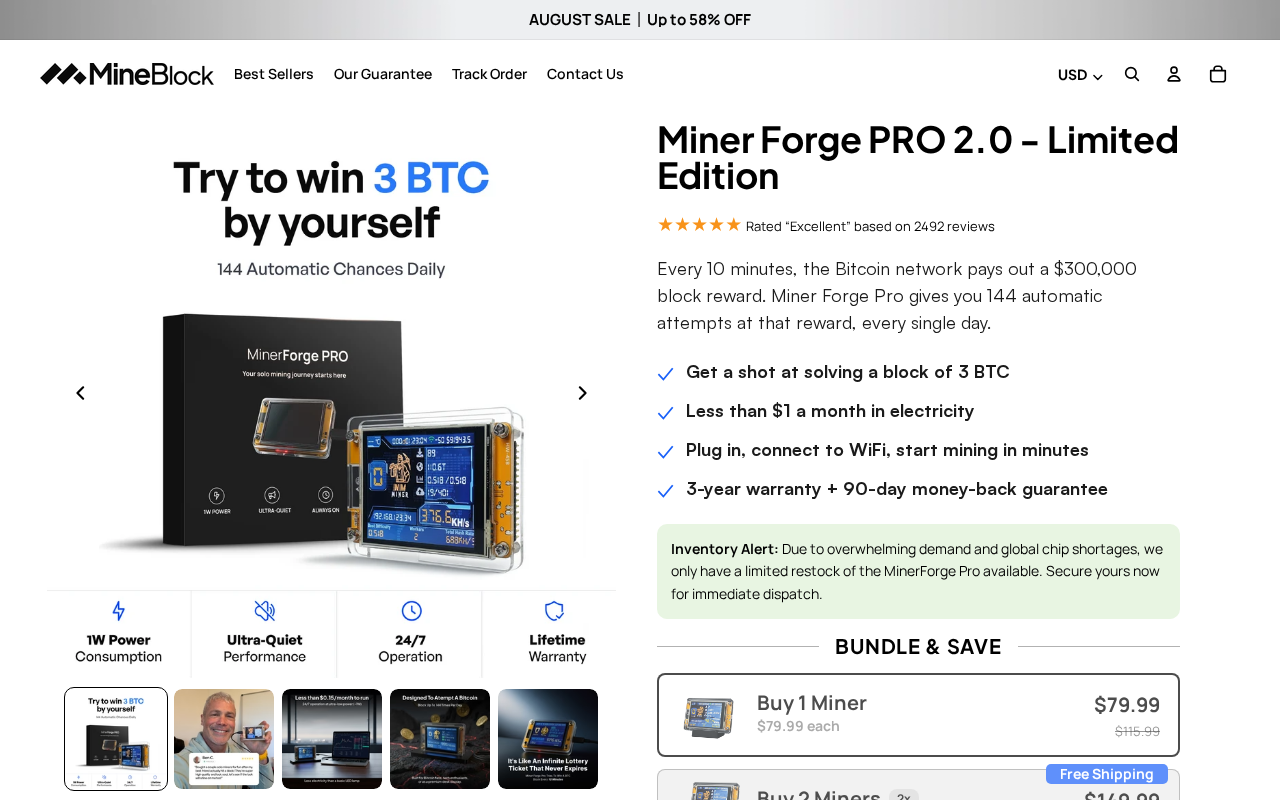
Miner Forge Pro style gadgets sit in a familiar hobbyist category: small Wi Fi boards that hash SHA-256 on an ESP32 class chip, show live stats on a color screen, and ask only for a public Bitcoin address during setup. Sellers market them as silent plug and play solo miners that attempt a new block about every ten minutes, or roughly one hundred forty four attempts each day, while drawing a few cents of electricity through USB-C.
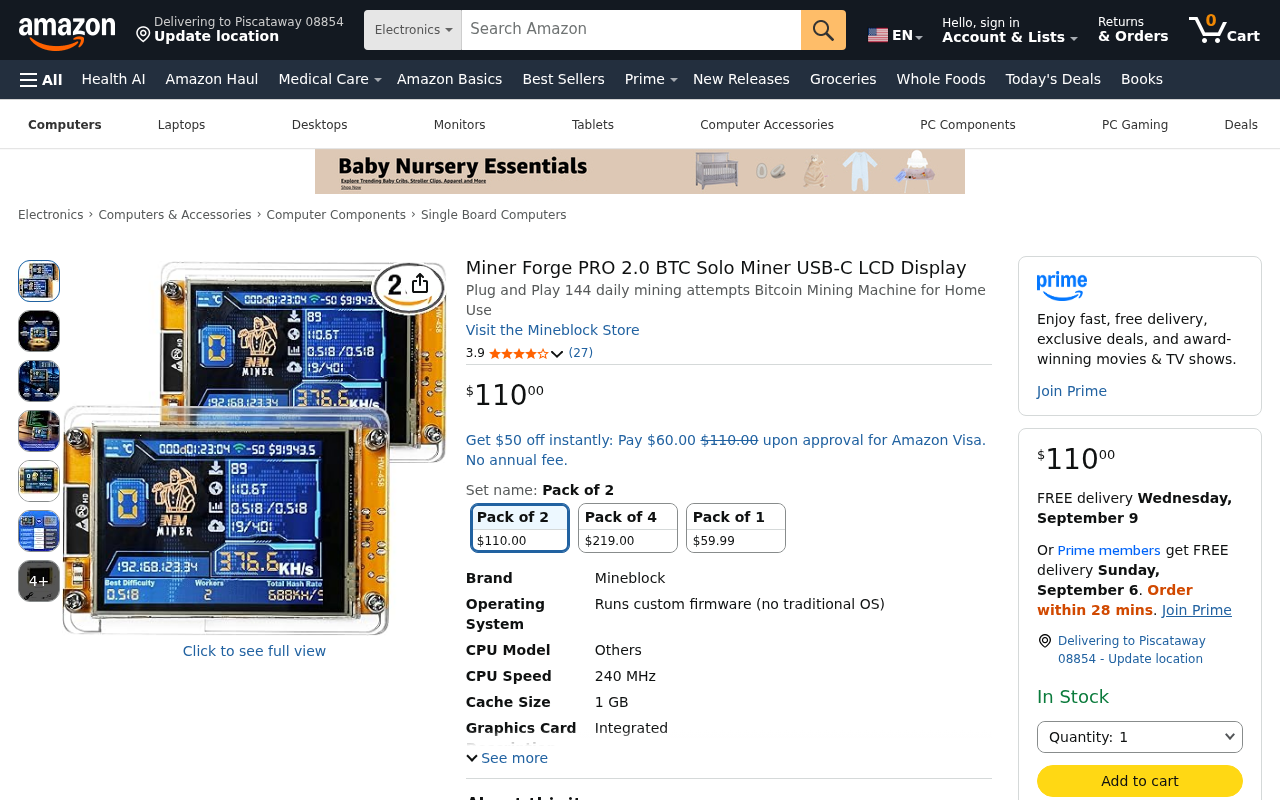
Retail funnels commonly price a single unit near $79.99 after a crossed out comparison price, with multi packs and optional display stands stacked underneath. The brand storefront at the Mineblock shop mirrors marketplace cards on Amazon that reuse the same lottery ticket language.
Technically, solo mining means the device works alone against the network rather than splitting tiny pool payouts. If it ever found a valid block, the subsidy plus fees would land at the address you entered. That sentence is true for any honest solo miner, including open source NerdMiner style boards that enthusiasts already build for education.
The commercial twist is scale. Bitcoin difficulty in 2026 sits in the hundreds of trillions, and total network hashrate runs in the exahash range. An ESP32 board hashing in the tens or hundreds of kilohashes per second contributes a vanishing fraction of that power, so expected time to a block stretches into absurd geological numbers even when every hash is a fair lottery ticket.
Independent creators who leave these devices running for twenty four hours or a full week routinely report zero coin earned, which matches the math rather than proving a shipping scam. Improbable win testimonials on sales pages compress years of statistical fantasy into sixteen day miracle stories that keep the feed emotionally hot.
This review treats Miner Forge Pro marketing as an overhyped lottery gadget funnel, not a fake shop. Buyers can receive a working board that lights up, joins Wi Fi, and submits real hashes. The trap is paying for the feeling of a three hundred thousand dollar payday while the hardware remains a desk ornament that almost never wins.
How These Ads Work
1. A short video turns network payouts into a personal paycheck
Paid clips and affiliate shorts open with the cadence of the Bitcoin clock. Narrators remind you that blocks land about every ten minutes and that each solved block currently carries a subsidy near 3.125 BTC, which converts to a round $300,000 story depending on the spot price that day.
The emotional leap arrives in the next breath. The ad places that network wide payout beside a palm sized USB miner and implies your kitchen outlet is now competing for the same jackpot the industrial farms chase, without slowing down to explain relative hashrate.
2. Lottery ticket language replaces expected value
Copywriters love infinite lottery tickets that never expire. One hundred forty four daily attempts sound generous until you remember each attempt is only as strong as the hashes the chip can grind before the next retargeting window.
A fair lottery can still be a terrible purchase when tickets cost more than their expected return. These ads celebrate the possibility of a full block while burying the expected value near zero for kilohash class hardware under current difficulty.
3. AI chip branding borrows authority from real mining upgrades
Product pages lean on phrases like AI optimized hashing, adaptive algorithms, and thirty times more power than earlier NerdMiner boards. Those words sound like a breakthrough to shoppers who remember ASIC generations leaping from megahashes to terahashes.
In practice, ESP32 class solo miners still live in the kilohash neighborhood even when a seller claims a newer revision. Moving from fifty kilohashes to a few hundred kilohashes can be a real engineering tweak and still leave you millions of times slower than a single modern ASIC chip.
4. Testimonials compress impossible timelines into believable stories
Sales pages showcase named buyers who supposedly solved a block after a few weeks with two, five, or eight devices. The stories include tidy attempt counts and blockchain flavored details that feel specific enough to trust at scrolling speed.
Even generous readers should treat those wins as marketing fiction until independently verified on chain with matching timestamps and addresses. Statistical expectation for ESP32 class solo mining does not produce sixteen day jackpots as a normal outcome, which is why the testimonials do so much emotional work.
5. Bundle math sells more tickets instead of better odds you can feel
Checkout modules push two packs and three packs with modest per unit discounts, explaining that each extra device adds another one hundred forty four daily attempts. The arithmetic is clean and the scarcity banner about chip shortages keeps the cart moving.
Doubling a near-zero probability still leaves a near-zero probability, and buyers who understand that can still enjoy collecting gadgets. Buyers who think three units create a meaningful income plan are responding to bundle theater rather than network physics.
6. Safety talking points calm the wrong fear
Setup guides correctly stress that you only enter a public address and Wi Fi details, never a seed phrase or private key. That reassurance matters because crypto scams often ask for signing permissions that drain wallets.
Here the main financial risk is not a drainer prompt. It is spending money and attention on a lottery whose jackpot graphics dwarf the hashrate you actually purchased, then stacking more units when the first week of zero rewards feels like bad luck instead of expected silence.
7. After delivery, the screen looks busy while the wallet stays quiet
Owners typically see difficulty numbers, attempt counters, and connection status that make the device feel alive. YouTube style endurance tests that run for a day or a week usually end with the honest punchline of $0 earned against current difficulty.
That outcome does not prove the parcel was empty or the store was fake. It proves the ad sold a jackpot fantasy attached to hardware whose honest category label is educational lottery miner, desk toy, or conversation piece, not household income appliance.
What The Lottery Math Actually Says
Bitcoin adjusts difficulty so the network finds a block about every ten minutes no matter how much hardware joins. Your share of that race equals your hashrate divided by the global hashrate. When the globe measures exahashes and your board measures kilohashes, the fraction is so small that polite language fails.
Open source NerdMiner style devices often land around fifty to one hundred twenty kilohashes per second depending on firmware and board. Even if a commercial revision claims several times that speed, it remains many orders of magnitude below a single Bitaxe class home ASIC, and those stronger home units still face expected block times measured in enormous spans under 2026 conditions.
Creators who discuss solo lottery mining honestly frame kilohash boards as teaching tools that visualize difficulty, shares, and the thrill of watching a real protocol. They do not budget rent around the chance of catching 3.125 BTC next month with a USB stick.
Ads invert that framing when they lead with the dollar value of the block, then mention odds only in a soft FAQ line about extremely low chances, then return to lifestyle photos of glowing bricks on coffee tables. The order of information is the persuasion technique, because the dollar fantasy lands before the odds ever get a fair hearing on the page.
Electricity claims are often the most accurate part of the page, which is why a tiny power draw never disproves the income overhype around the device. Drawing roughly a watt through USB-C can cost less than a dollar a month in many regions, which is why power bills never expose the overhype. The money leaves at checkout, not at the meter.
Real Hardware Versus Payday Storytelling
It helps to separate three questions that ads deliberately blend: whether a physical device actually arrives, whether it performs real hashing on the Bitcoin network, and whether it offers a sensible path to meaningful income for a typical buyer.
For Miner Forge Pro style products sold through brand sites and major marketplaces, the first two answers can be yes. Enthusiasts unbox acrylic cases, connect Wi Fi from a phone, and watch attempt counters climb. Support emails and warranty badges further resemble ordinary consumer electronics merchandising rather than a pure advance fee fraud.
The third answer is where the review turns skeptical. Meaningful income implies a realistic expectation of coins or cash relative to purchase price within a human planning horizon. Kilohash solo mining against modern difficulty fails that test so thoroughly that calling the gadget a lottery is almost too kind, because most lotteries publish odds you can read without a calculator.
Some buyers still want the object. They like blinking stats, the feeling of participating in consensus, and the novelty of a conversation piece that is more technical than a plastic Bitcoin ornament. That purchase can be rational when priced like a hobby board and sold without income theater.
Income theater is the problem this article targets. When creative shows $300,000 block language, family gift stacks, inventory alerts, and miracle timelines in the same scroll, the product stops being described as what it is and starts being sold as what buyers wish mining still felt like in 2011.
How To Read A Solo Miner Ad Without Getting Swept Up
Start with hashrate in absolute units, not multipliers against an unnamed older board. Ask whether the listing states kilohashes, megahashes, or terahashes clearly, then compare that number to public network hashrate charts rather than to the dollar value of a block subsidy.
Translate marketing attempts into hashes. One hundred forty four daily attempts sounds active, yet if each attempt window only represents a tiny hash budget, the calendar rhythm is cosmetic. Busy screens are not the same as competitive share.
Search for week long endurance videos from channels that show wallet history, not just a glowing LCD. Consistent $0 outcomes across creators are evidence about difficulty, not a conspiracy against a single brand.
Treat win testimonials as unverified until you can match them to public block explorers with dates that survive scrutiny. Specificity in a story is a writing technique, not automatic proof that the claimed payout happened on a public chain you can verify.
Price the category against ordinary hobby boards before you accept any lifestyle framing attached to the same silicon. Open source and boutique ESP32 miners often sell in a similar hobby range, sometimes lower, without promising a lifestyle reset. If you want the desk toy, buy the desk toy at a clear hobby price and skip the income soundtrack that sold the checkout. If you want income, look at entirely different capital and risk profiles, including the possibility that home mining is simply not your edge.
Finally, keep private keys offline from any shopping flow. Even when a miner only needs a public address, crypto ad ecosystems are dense with lookalike pages that do ask for seeds. Typing the store hostname yourself once, rather than following every sponsored redirect, remains good hygiene.
What To Do If You Already Bought One
1. Decide what you actually purchased. If the board powers on, joins Wi Fi, and shows hashing stats, you likely received the educational lottery gadget the category is known for, even if the ad sounded like a paycheck.
2. Stop stacking units to chase a fix. Adding more kilohash devices multiplies a negligible probability and mainly multiplies spending, packaging waste, and dashboard clutter.
3. Measure expectations in writing. Note the purchase price, claimed daily attempts, and any income language from the ad, then compare that package to a week of observed wallet activity with screenshots dated for your own records.
4. Use the return window if the pitch feels materially different from the hardware. Keep original packaging, photograph the listing claims, and follow the seller or marketplace return path while it remains open rather than waiting for a mythical first payout.
5. Dispute carefully when delivery fails or the item is clearly not as described. Card networks and marketplace guarantees handle nondelivery and misrepresentation better than they handle regret about lottery odds you partly understood.
6. Secure the boring crypto basics. Confirm you never entered a seed phrase into a miner setup screen, rotate Wi Fi passwords if you used a weak guest setup, and keep the receiving address on a wallet you control.
7. Reclaim the hobby framing if you enjoy the object. Leave it on the desk as a live difficulty meter, a teaching prop, or a blinking curiosity, and drop the household income story that the creative department borrowed from industrial mining.
8. Mute the retargeting. Once you understand the odds, continuing to watch jackpot ads mostly reopens an emotional loop that the math already closed.
The Bottom Line
Miner Forge Pro style USB solo miners can be real ESP32 class gadgets that ship, light up, and take honest lottery tickets against the Bitcoin network while sipping tiny amounts of power. That category has existed in open source form for hobbyists who like watching the protocol breathe.
The overhype arrives when ads park a $300,000 block reward next to a $79.99 board, invent compressed win timelines, and sell bundles as if extra plastic meaningfully changes your place in an exahash race. A lottery ticket that never expires is still a terrible income plan when the odds stretch beyond human planning.
Buy it as a gadget if that thrills you. Do not buy it as a payday, and do not let a glowing screen convince you that silence in the wallet is a temporary glitch instead of the expected result.

Join the discussion
0 commentsShare your experience or ask a question about this article.
Discussion
Start the conversation
Have a question or something useful to share? Add the first comment.