

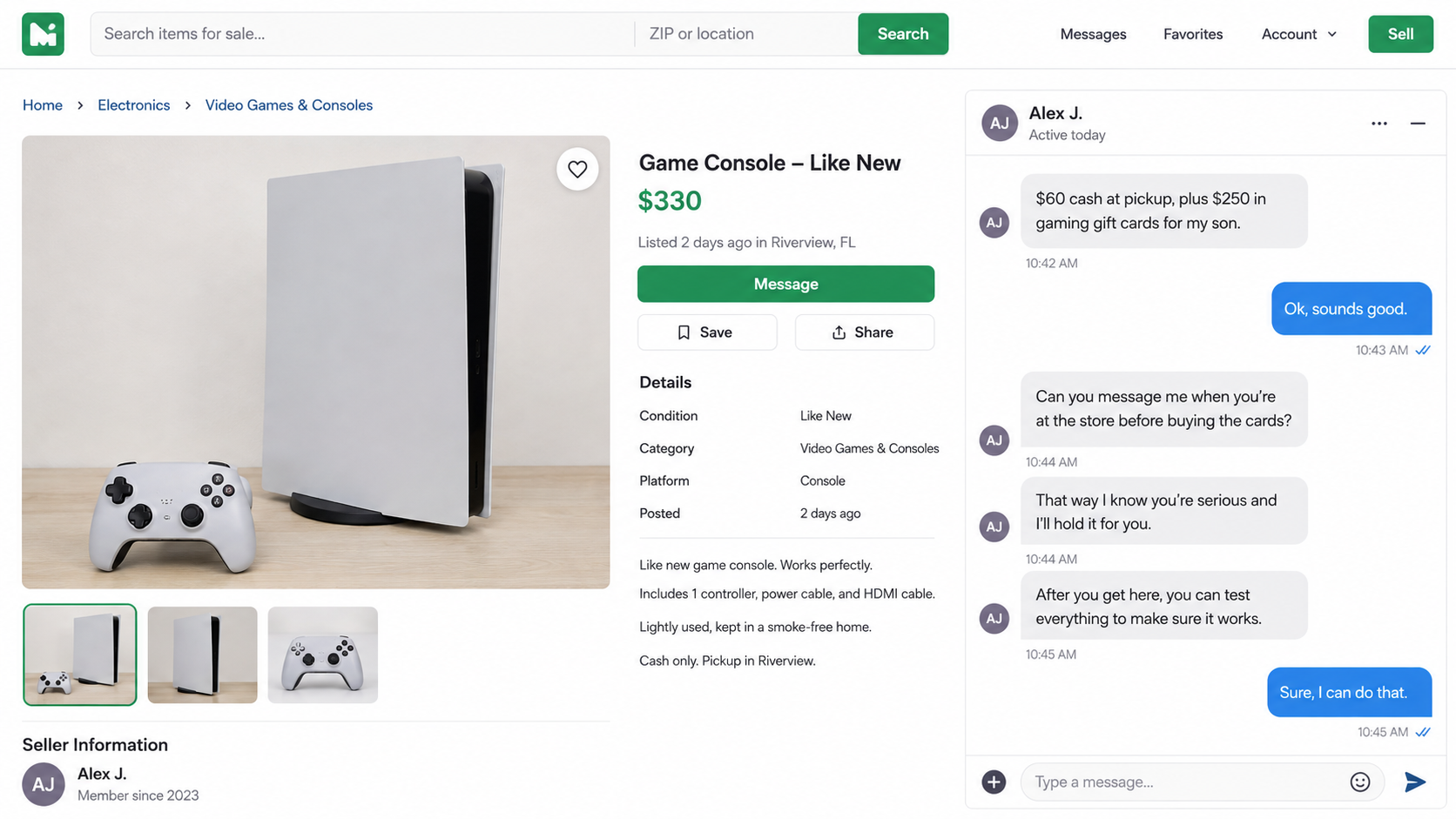
The used console is nearby, the price is believable, and the seller even supplies a home address. They say the buyer can test everything before handing over most of the payment.
The gift card pickup scam adds one unusual condition. Part of the price must be purchased as gaming gift cards for the seller’s child, and the buyer should send a message from the store before the meeting.
The promised pickup is what makes the request feel safe. It is also the part that never needs to happen.
Overview
The listing gives the gift card request a harmless story
A seller advertises a used console, phone, laptop, camera, or other desirable item at a good but not impossible price. They agree to meet locally and may give a residential address, so the deal does not look like a typical shipping scam.
Then the payment is split. A small amount can be cash, while the rest must be loaded onto gift cards for a birthday, family member, or personal purchase. The explanation turns an abnormal payment method into a favor.
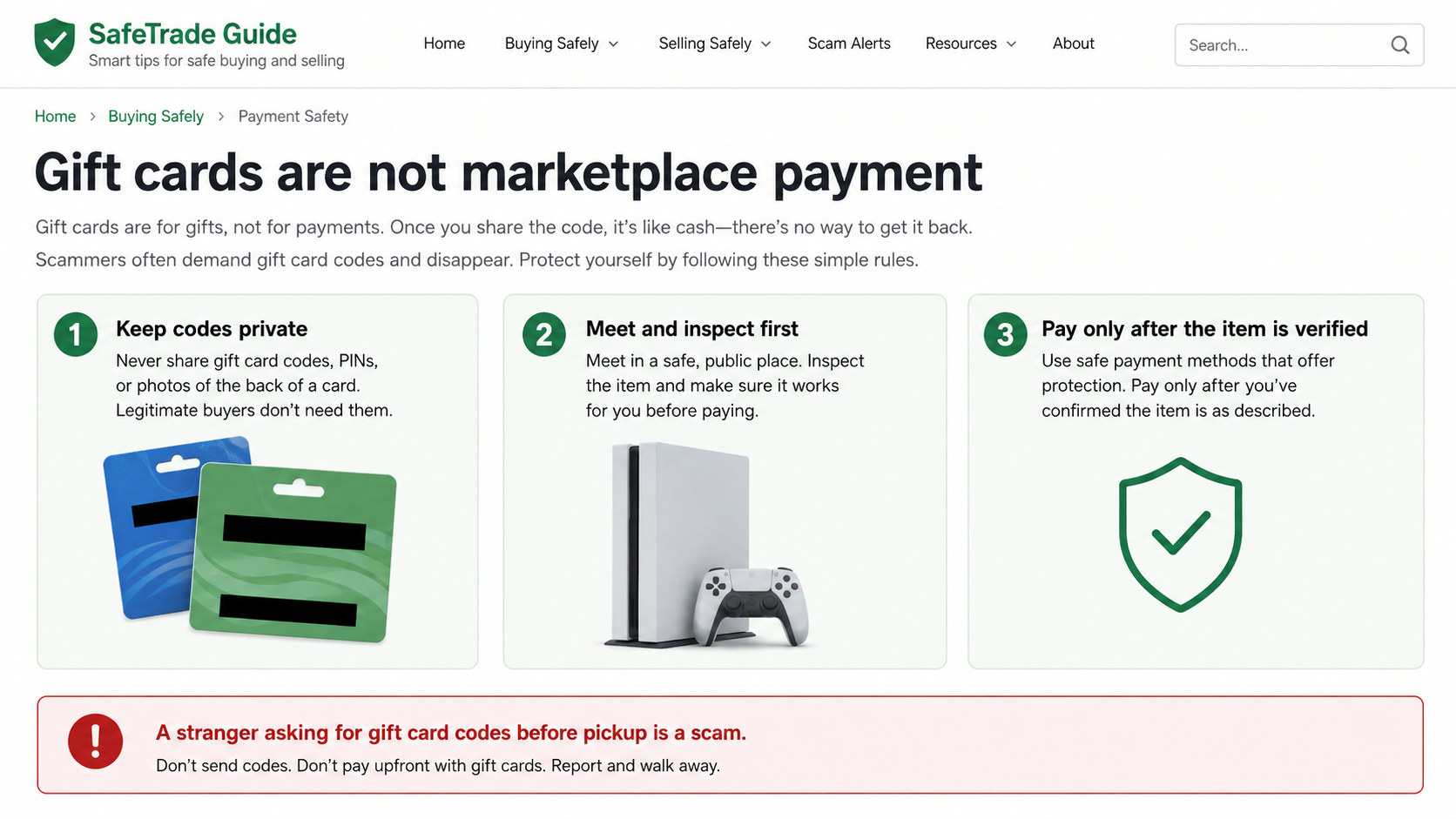
The Craigslist safety guidance is unambiguous: requests to pay with gift cards are scams. It also advises users not to provide payment before meeting in person.
The address and test promise keep the buyer moving
The seller knows a careful buyer wants to inspect the item. They promise the console can be powered on, a serial number can be checked, and payment can be completed only after the test.
That promise costs the criminal nothing. Before the buyer reaches the address, the seller asks them to stop at a store and buy the cards. The buyer has now invested time, travel, and money into a meeting that still exists only in messages.
The address may belong to an unrelated resident, an empty property, a business, or a random location chosen from a map. Providing a real place does not prove the person messaging controls it.
The scam ends when the card codes are exposed
The seller asks for photographs of the card backs, the redemption numbers, or a receipt before revealing the unit number or final pickup detail. They say the images prove the buyer is serious and that the balance will not be used until after the handoff.
Once the numbers are visible, the value can be redeemed or resold remotely. The buyer can still be holding the physical cards inside the store while the balance disappears. There is no need for the seller to own a console or visit the supplied address.
The Federal Trade Commission warns never to send a photograph of a gift card or share its number and PIN. Those details let a scammer take the value even when the buyer retains the card.
Warning signs include:
- The seller wants gift cards as part of an ordinary purchase.
- A child, birthday, disability, or travel story explains the request.
- The buyer must visit a specific retailer before pickup.
- The seller asks for a message from inside the store.
- The cards must be activated before the item is inspected.
- A photograph of the receipt or card back is requested.
- The pickup address is withheld until the cards are purchased.
- The person at the supplied address is supposedly a spouse or relative.
- The seller becomes angry when the buyer arrives without sending codes.
- The listing disappears as soon as the codes are shared.
How the Gift Card Pickup Scam Works
Step 1: A popular item is listed for local collection
The criminal copies photographs and details from a genuine listing. A used console works well because buyers know the retail price, want to test it, and may act quickly when a fair deal appears.
The account may have older posts or marketplace activity. That history can be manufactured, purchased, or stolen. It does not prove the current seller possesses the item.
Step 2: The seller offers a believable price and address
An impossibly cheap listing would attract suspicion. A moderate discount invites conversation without immediately looking fake. The seller agrees to local pickup and sends a plausible nearby address.
Buyers often treat an address as collateral. It is not. Anyone can copy an address from a public listing or map. The occupant may know nothing about the transaction.
Step 3: The payment is divided between cash and gift cards
The seller asks for $60 in cash and $250 in gaming gift cards, or another split that keeps the total close to the advertised price. The cards are supposedly a present for a child or easier for the family to use.
This story makes the request sound eccentric rather than criminal. In practical terms, the buyer is being asked to convert protected or traceable funds into transferable codes.
Step 4: The buyer is sent to a store before the meeting
The seller may specify which retailer and card denomination to use. They ask for a message from the store so they can prepare the item or confirm that the buyer is serious.
Keeping the buyer in live conversation reduces the chance that a cashier, friend, or search result will interrupt the plan. The seller can answer doubts and create new urgency while the cards are being purchased.
Step 5: A photograph replaces the promised inspection
Before giving the final address, apartment number, or door code, the seller requests proof. At first that may mean a photograph of the receipt or front of the cards.
Then the request changes. The codes must be revealed to confirm activation, or a small portion must be sent as a refundable hold. A promise not to redeem them is meaningless once the secret numbers have been shared.
Step 6: The gift card balance is drained remotely
The criminal redeems the cards, uses them to buy digital goods, or sells the codes to another party. This can happen within seconds. The physical plastic has no independent value after its balance is taken.
A delay or error message may be used to make the buyer resend clearer photographs. The scammer wants every character while the buyer still believes the meeting will occur.
Step 7: The pickup story collapses
The seller claims they are delayed, a spouse is home, or the buyer went to the wrong address. Eventually the account blocks the buyer and the listing vanishes.
If the buyer visits the supplied home, an innocent resident may answer. Do not confront that person or assume involvement. Preserve the messages and give the location to the platform and police.
Why the Seller Wants You to Message From the Store
A store visit proves the buyer is close to converting real money into a transferable code. The criminal can maintain pressure during the most important minutes and prevent the conversation from cooling off.
The seller may coach the buyer to describe the cards as gifts if a cashier asks questions. They may say fraud warnings on the display do not apply because the cards are part of a private sale. Those warnings apply precisely because a stranger requested the purchase.
The FTC’s online marketplace guidance advises against paying unknown sellers with gift cards, wire transfers, payment apps, or cryptocurrency. Credit cards and protected platform checkout generally provide stronger dispute options.
A request for front-only photographs is not safe. The conversation can progress to the back, receipt, activation slip, or an alleged verification page. The safest response is not to buy the cards at all.
If the seller truly wants gift cards for personal use, they can buy them after receiving ordinary payment. There is no legitimate reason for an unknown buyer to assume the fraud risk and provide codes before inspecting the item.
How to Buy a Used Console Without Funding the Scam
Keep the conversation on the marketplace or classified service. Ask for a current photograph showing the item with a handwritten date or another harmless, specific detail. This does not prove ownership by itself, but refusal can expose copied listings.
Meet in a safe, monitored public place. Some police departments provide exchange zones. If testing requires power and a display, use a suitable public business or arrange another verifiable method without entering an unknown private home.
Inspect the console, controller, ports, storage, network restrictions, and serial number before payment. Confirm that accounts have been removed and that the device is not activation-locked. Do not let a low price rush the check.
Use a payment method you understand and verify it inside the official service. Do not rely on screenshots, email confirmations, pending notices, or pages supplied by the seller.
Walk away if the terms change. Gift cards, deposits, courier fees, codes, remote verification, and a new address are not small adjustments. They remove the conditions that made the local sale appear safe.
Seller, Address, and Payment Checks
The listing images should survive a reverse search
Search the photographs and distinctive wording. The same console offered in another city or by an older account may reveal that the listing was copied. Ask for new, specific images without exposing your own information.
The seller account must match the transaction
Review account age, previous listings, name changes, and how the person answers practical questions. A long history is useful context, not proof, because established accounts can be stolen.
The pickup address must not be treated as a deposit
A real address can belong to anybody. Do not send money or codes because a seller supplied a map pin. Verify the item first and avoid confronting residents if the story proves false.
The payment should happen after inspection
Do not purchase or activate gift cards for a stranger. Complete an agreed, verifiable payment only after the item is present, tested, and matches the listing. A legitimate seller can accept ordinary funds.
What to Do if You Have Fallen Victim to This Scam
- Contact the gift card issuer immediately. Use the official number on the card or issuer’s website. Report fraud, provide the card and receipt details, and ask whether the balance can be frozen or recovered.
- Keep the physical cards and receipts. Do not discard packaging, activation slips, store receipts, or transaction records. They may be needed for the issuer, retailer, police, or an insurance claim.
- Stop sending clearer images or more codes. A claim that the first photograph failed is an attempt to capture usable details. Do not buy replacement cards.
- Preserve the listing and conversation. Save the seller profile, item photographs, price, timestamps, telephone number, address, and every request made from the store.
- Report the marketplace account. Use the platform’s fraud channel and explain that the seller demanded gift card codes before pickup. Include the listing identifier if available.
- Notify the retailer. The store where the cards were purchased may be able to document the transaction and connect you with the issuer. A retailer cannot always restore a redeemed balance, but the report still matters.
- Contact local police. Provide the false pickup address without accusing its occupant. Let investigators decide how the location relates to the online account.
- Report to the FTC. Submit the loss at ReportFraud.ftc.gov. Include the card brand, amount, payment time, platform, and seller identifiers.
- Secure exposed accounts. If you clicked links, shared a login, or reused a password, change credentials and enable strong multifactor authentication from a clean device.
- Scan suspicious downloads. If a seller sent a verification app, attachment, or unusual file, run a complete Malwarebytes scan and remove unfamiliar browser extensions.
- Add blocking after cleanup. AdGuard can stop many known malicious links and ads, but it cannot restore a redeemed gift card or confirm a marketplace seller.
- Reject recovery services. Anyone promising guaranteed gift-card recovery for another fee, remote access, or cryptocurrency may be starting a second scam.
Frequently Asked Questions
Why would a seller ask for gift cards instead of cash?
The personal story makes the request seem harmless, but exposed card codes can be redeemed remotely and quickly. The seller does not need to possess the advertised item.
Is the deal safe if I keep the physical cards?
No. Anyone with the card number and PIN may be able to take the balance. The plastic can remain in your hand after the value is gone.
Does a real pickup address prove the seller is local?
No. The address may be copied from a map or belong to an unrelated resident. Never use an address as justification for advance payment.
What if the seller says I can test the console first?
That promise matters only when the item is actually present. Do not buy, activate, photograph, or share gift cards before the inspection.
Can a gift card issuer return stolen value?
Sometimes fast reporting helps, but recovery is not guaranteed. Contact the issuer immediately and keep the card and receipt.
Should I visit the address after the seller blocks me?
No. The occupant may be uninvolved, and confrontation can be unsafe. Give the address and message history to the platform and police.
The Bottom Line
The gift card pickup scam uses a believable local listing and a real-looking address to make advance payment feel temporary. The criminal needs only the codes, not the meeting.
Gift cards are not a safe way to pay an unknown seller. Inspect the item first, use a verifiable payment method, and walk away the moment a stranger asks you to buy cards or reveal their numbers.

Join the discussion
0 commentsShare your experience or ask a question about this article.
Discussion
Start the conversation
Have a question or something useful to share? Add the first comment.