

A VA benefits fee scam often sounds less like a threat and more like overdue help. A caller, text, email, or social media message says a veteran is missing money, could receive a 100% disability rating, or can move to the front of the claims line.
Then comes the catch. The supposed adviser wants a processing fee, access to the veteran’s account, or sensitive service and medical information before the claim can begin.
Overview
The message pretends paid help is the only fast route
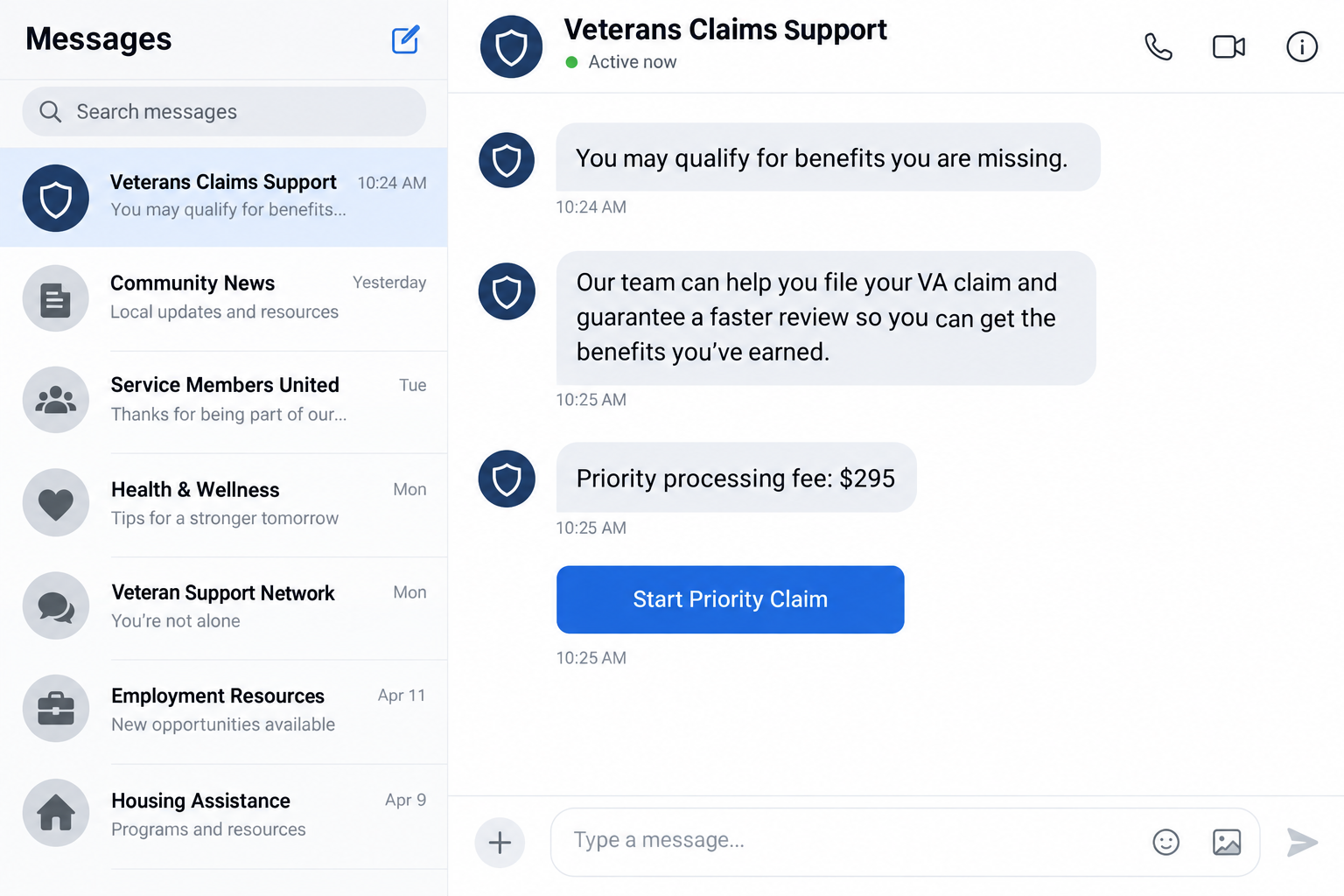
Scammers impersonate the Department of Veterans Affairs or claim to be approved by the VA. They contact veterans unexpectedly and offer to apply for missing benefits, guarantee a disability rating, or speed up a claim in exchange for money.
The FTC warned about this exact scheme in a July 27, 2026 alert. It says unexpected contacts may arrive by call, text, email, or social media message and may falsely claim VA affiliation.
The VA does not charge someone to apply for benefits. The FTC also says accredited representatives and recognized Veterans Service Organizations do not charge veterans to help with an initial application.
The guarantee is something no private contact can deliver
Only the VA can determine eligibility, assign a disability rating, and award benefits. An outside person cannot guarantee 100%, skip the line, or promise a decision date.
A scammer uses certainty because the real process contains uncertainty. The offer replaces forms, medical evidence, and review with a simple promise: pay now and the result is assured.
Some contacts claim to know about benefits the veteran missed. They may reference service history, an approaching separation date, or a common condition. Such details can come from public profiles, marketing lists, data breaches, or information collected by another website.
The fee can lead to identity theft as well as financial loss
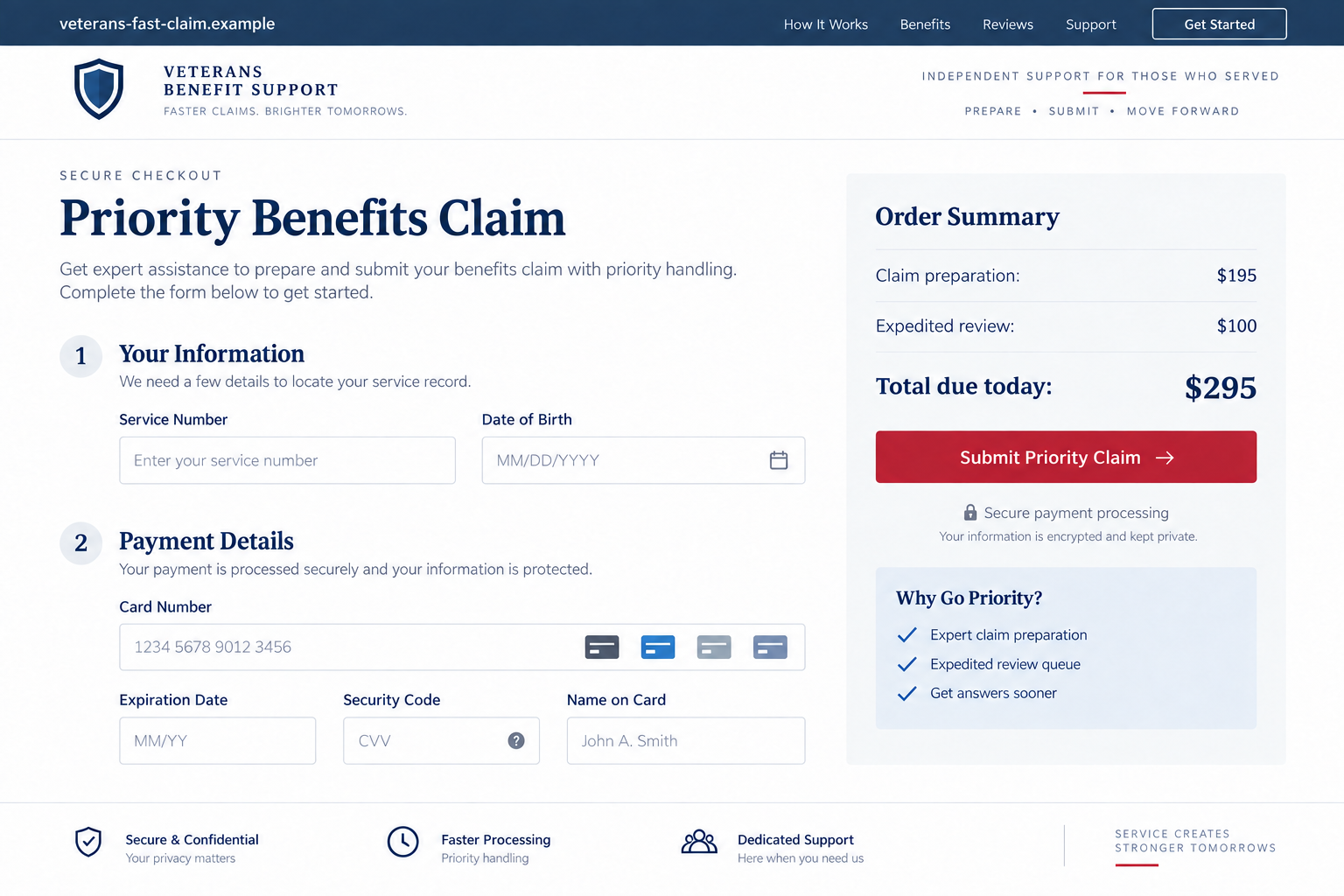
The victim may be directed to a form requesting a service number, Social Security number, date of birth, DD214, medical records, VA.gov login, bank information, and payment card.
That collection is especially dangerous because military, medical, identity, and financial details can support many types of fraud. The criminal may charge the fee, use the information, and still submit nothing.
Warning signs include:
- An unexpected message claiming the sender works for or is approved by the VA.
- A guaranteed benefit amount, 100% rating, or faster place in the review queue.
- A fee to begin, prepare, file, prioritize, or unlock an initial claim.
- A request for a VA.gov password, security code, or remote access to the account.
- A payment page on a domain that is not VA.gov.
- Pressure to sign immediately or lose eligibility for supposedly unclaimed benefits.
Why Veterans Are Targeted With This Pitch
The benefits system can feel complicated, particularly during separation, after a new diagnosis, or when an earlier claim was denied. A person promising to handle everything can sound like a practical solution.
Scammers borrow the language of service. They use words such as advocate, claims support, accredited, priority, disability review, and veteran assistance. A generic shield or flag-themed design creates the impression of official affiliation without stating it clearly.
Timing can be precise. A message may arrive when a service member is preparing to leave active duty or when public posts mention an injury, appointment, or claim.
The offer may begin with a free consultation. During the conversation, the operator says the case is unusually strong and predicts a specific rating or back-payment amount.
That prediction creates a reference point. A $295 or larger fee feels small compared with the promised monthly benefit, even though the promise has no authority behind it.
The criminal may claim the fee is not for applying, but for priority processing, evidence development, claim optimization, or administrative support. Renaming the fee does not make a guaranteed result possible.
Not every private business that assists veterans is automatically fraudulent. The confirmed scam is the combination of false VA affiliation, impossible guarantees, pressure, and payment or data collection through an unverified contact.
The right check is accreditation. The VA maintains a searchable database of people and organizations authorized to represent claimants.
How the VA Benefits Fee Scam Works
Step 1: A veteran receives an unexpected offer
The contact arrives through a call, text, email, direct message, advertisement, or online form. It says benefits are missing, a deadline is approaching, or a free review found a likely claim.
The sender may know a branch of service, approximate discharge date, or condition. That information is used to make the outreach feel authorized.
Step 2: The sender claims VA approval or insider access
The operator says they work with the VA, are approved by the VA, or have a special method for moving claims faster. A copied seal, government-style design, or official-sounding title may reinforce the impression.
Actual accreditation should be verifiable in the VA’s own search tool. A badge on a website is not accreditation.
Step 3: A guaranteed outcome creates urgency
The victim is promised a 100% disability rating, a specific payment, immediate approval, or a shorter review. The operator may say only a limited number of priority claims are available.
No representative can guarantee what only the VA decides.
Step 4: The form collects a complete identity profile
The fake service requests a service number, Social Security number, date of birth, address, medical history, separation documents, and bank information.
A VA.gov username, password, or one-time code may be requested so the operator can supposedly file the claim. Sharing those credentials can expose benefits, direct-deposit settings, records, and messages.
Step 5: A filing or priority fee is charged
The website or caller asks for money before work begins. The fee may be described as claim preparation, expedited review, records retrieval, membership, or a percentage of future benefits.
The FTC’s warning is simple: the VA will help gather and develop evidence for an initial claim for free, and accredited representatives and recognized VSOs will not charge for that initial application help.
Step 6: The victim receives little or no legitimate service
The operator may stop responding, submit incomplete material, or send generic forms the veteran could have accessed free. In some cases nothing is filed at all.
The veteran may not discover the problem until a deadline passes or the real VA account shows no activity.
Step 7: Stolen data supports additional fraud
Identity and medical documents can be used for account takeover, tax fraud, credit applications, health-care fraud, or more targeted scams.
A follow-up caller may pose as VA security and claim the first service compromised the account, then ask for another code or payment.
How to Get Real Help With a VA Claim
Start at VA.gov or visit a VA Regional Office. The VA can explain eligibility, the evidence needed, and the status of an existing claim.
If you want representation, use the VA’s official Accreditation Search. Search the person’s name and organization before signing anything or sharing records.
Recognized Veterans Service Organizations can help with initial claims without charging a fee. Ask exactly who will represent you, what accreditation they hold, and how your information will be handled.
Do not give anyone your VA.gov password or a one-time security code. A legitimate representative can use authorized processes without logging in as you.
Read every agreement. Watch for broad powers of attorney, access to future benefits, recurring charges, credit agreements, or permission to change direct-deposit information.
Verify promises against the official record. If someone says a claim was filed, sign in to VA.gov through an address you entered yourself and check the claim status.
Be cautious with sponsored search results and social advertisements. Placement beside official information does not mean the VA endorsed the advertiser.
Never let a short sales deadline replace an accreditation check. Benefits do not become legitimate because a timer says the offer will disappear.
What a Legitimate Representative Can and Cannot Do
An accredited representative can explain the claims process, help organize evidence, prepare forms, and communicate in an authorized role. Accreditation does not give anyone control over the VA’s decision.
A representative cannot guarantee a rating, invent a priority queue, or promise that a particular diagnosis will produce a fixed payment. Those outcomes depend on the record and the VA’s review.
The veteran should know who holds the accreditation and which organization receives the records. A sales agent should not borrow another person’s accreditation without that representative actually handling the case.
Authorization should be documented through the correct VA process. It should not require giving away the veteran’s personal login, one-time codes, or unrestricted access to email and banking.
If a service refuses to identify the accredited individual before payment, stop. Verification should come before a contract, fee, or upload of sensitive documents.
Company, Address, and Fulfillment Checks
The VA label is not proof of affiliation
A business can place veteran, benefit, claim, or VA-related words in a name. Logos, patriotic colors, and government language can also be copied.
Use the official accreditation database rather than trusting a badge or statement on the seller’s own page.
The contact must be separately verified
Do not use the telephone number or link in an unexpected message. Open VA.gov yourself and contact the VA or an accredited representative through published information.
A social media profile with testimonials and many followers is not an official directory.
Guaranteed results are impossible
Only the VA decides eligibility and ratings. A representative can help present evidence, but cannot promise 100%, skip the queue, or guarantee an award.
Certainty is a sales tactic when the decision belongs to someone else.
The fee and form reveal the risk
A charge for an initial application, combined with a false VA claim or guaranteed outcome, is a major warning. Requests for passwords, codes, and unnecessary identity data increase the danger.
Ask for a written fee agreement, accreditation details, legal company name, address, privacy policy, and complaint process before sharing any record.
What to Do if You Have Fallen Victim to This Scam
- Stop contact and preserve evidence. Save messages, advertisements, agreements, receipts, domains, telephone numbers, and the name the operator used.
- Check the real VA account. Sign in through VA.gov, review claims, messages, direct-deposit details, representatives, and recent changes.
- Contact the bank or card issuer. Report any fee obtained through false VA affiliation or impossible guarantees and ask about disputes, card replacement, and account monitoring.
- Change exposed credentials. If a VA.gov, Login.gov, ID.me, email, or banking password was shared, change it from a trusted device and end unfamiliar sessions.
- Report stolen identity data. If a Social Security number, DD214, medical record, or identity document was exposed, follow a recovery plan at IdentityTheft.gov.
- Contact the VA directly. Explain what was shared and ask how to secure the benefits account, replace a representative, or correct an unauthorized claim change.
- Report the scam. File at ReportFraud.ftc.gov and notify the state attorney general, as recommended by the FTC.
- Scan the device if software was installed. Use Malwarebytes to look for remote-access tools, credential stealers, or malicious files supplied by the operator.
- Reduce exposure to malicious promotions. AdGuard can block many known scam pages and deceptive ads, though it cannot fix a compromised benefits account.
- Reject guaranteed recovery offers. A second stranger who promises to restore benefits or recover the fee may be targeting the same victim data.
Do not wait for an unauthorized payment before acting. Access to a benefits account or identity document can be valuable even when the first card charge appears small.
If a real claim was affected, ask the VA or an accredited representative what can be corrected and which deadlines apply.
Frequently Asked Questions
Does the VA charge a fee to apply for benefits?
No. The VA does not charge someone to apply, and it provides help gathering and developing evidence for an initial claim.
Can anyone guarantee a 100% disability rating?
No. Only the VA decides eligibility and ratings after reviewing the claim and evidence.
How can I check whether a representative is accredited?
Use the accreditation search on VA.gov. Do not rely on a badge, advertisement, or screenshot sent by the representative.
Should I share my VA.gov password with a claims helper?
No. Do not share passwords or one-time codes. Authorized representatives have proper methods for working on a claim.
Are all paid veterans claims services scams?
No. The warning concerns false VA affiliation, guarantees, unverified outreach, improper initial-claim fees, and unsafe data collection. Verify accreditation, services, and fees before agreeing.
What if I paid but no claim appears in VA.gov?
Contact the VA and the payment provider immediately. Preserve the agreement and messages, report the fraud, and secure any account or identity information you shared.
The Bottom Line
A VA benefits fee scam turns a veteran’s legitimate need for help into a paid shortcut that does not exist. The contact may promise missing benefits, a guaranteed rating, or priority treatment while collecting money and sensitive records.
The VA does not charge to apply, and only the VA can decide the outcome. Verify every helper in the official accreditation database and never hand over a benefits-account password to an unexpected contact.








