

A foreign police video call scam can begin with a message that feels too serious to ignore. Someone claiming to be an overseas officer says your passport, immigration record, or identity has become part of a criminal case.
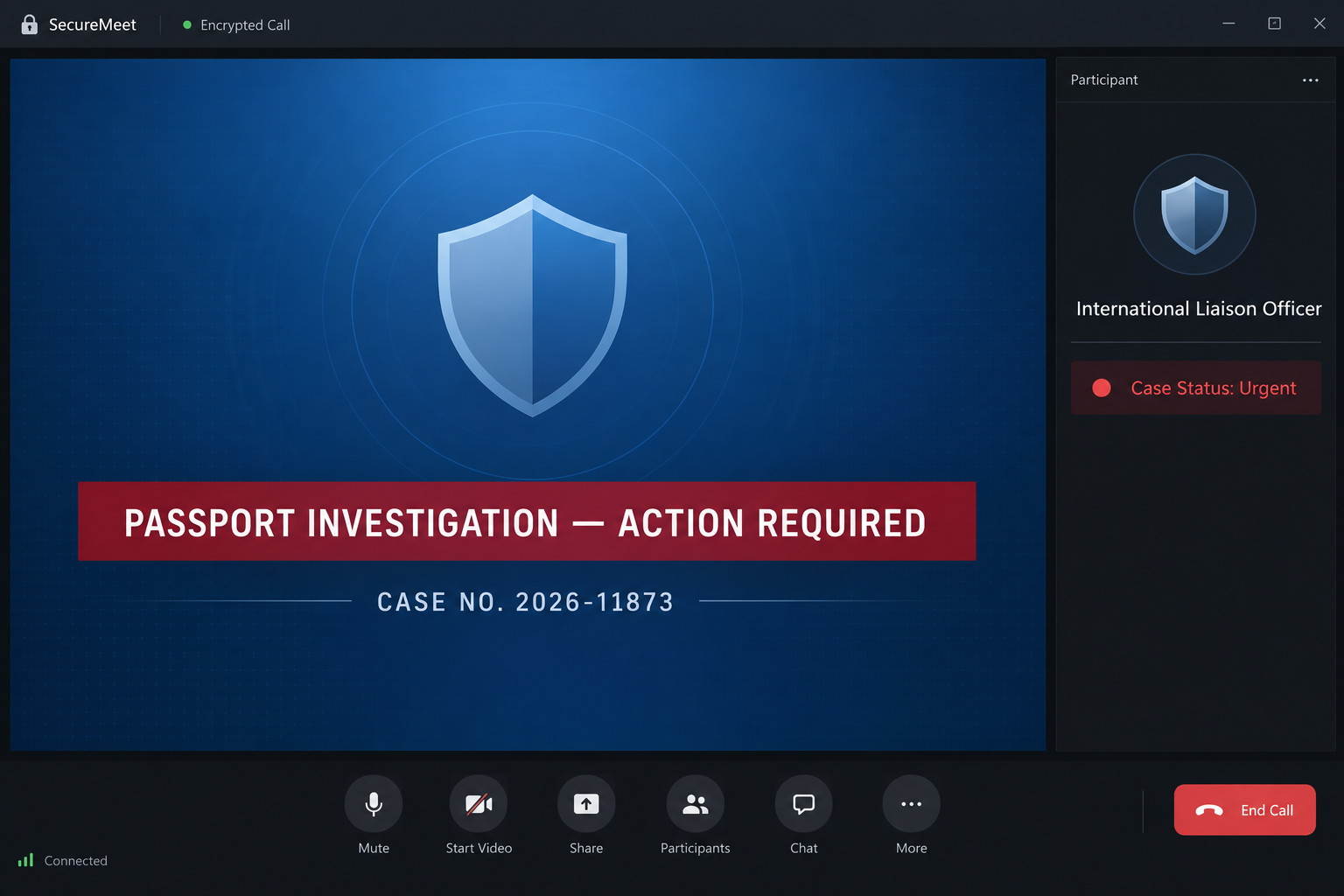
Then the camera turns on. The caller has a case number, official-looking graphics, and a rehearsed explanation for why nobody else can be told. It is designed to make an ordinary person feel suddenly trapped inside an international investigation.
Overview
The threat is tailored to people with ties abroad
Criminals impersonate foreign police, embassy staff, consular officials, or another government authority. They may target immigrants, international students, dual citizens, medical professionals, or anyone whose name and background suggest a connection to another country.
The opening story changes. A passport was used in a crime. A parcel containing illegal goods carries the victim’s name. A bank account is linked to money laundering. A visa is about to be canceled. The purpose is the same: make the recipient believe that a distant authority can arrest, deport, or extradite them.
The FBI says this is a widespread government impersonation scheme. In a September 17, 2026 alert, the agency reported nearly 61,000 complaints involving law enforcement or government impersonators between January 2025 and July 2026, with losses exceeding $1.6 billion.
A video call is staged as proof
The caller may wear a costume, sit in front of a mocked-up office, display a copied seal, or share a screen containing a warrant. Newer operations use AI-generated video, altered voices, and prerecorded clips to create the appearance of a real official interview.
None of those details authenticate the caller. Uniforms can be purchased, documents can be assembled from public templates, and a video background can be produced without access to any government system.
The FBI recorded 1,809 complaints involving foreign law enforcement or diplomatic impersonation during the same period. Reported losses topped $140 million. That is why this story should not be dismissed as an isolated prank or a misunderstanding with a real embassy.
The supposed case ends in money or identity theft
Once fear has taken hold, the caller introduces a way to avoid the threatened consequence. The victim may be told to pay a security bond, transfer money for inspection, buy cryptocurrency, provide banking access, or move savings to an account that can supposedly be monitored.
Some versions ask for passport scans, Social Security or National Insurance numbers, immigration documents, tax records, account statements, or a live video of the victim holding an identity card. Those materials can support identity theft long after the call ends.
Common warning signs include:
- An unexpected call about extradition, passport cancellation, deportation, or a secret criminal case.
- An order to stay on the line and avoid speaking to family, a lawyer, a bank, or local police.
- A demand for cryptocurrency, gift cards, bank wires, cash, or a courier pickup.
- A video background, badge, warrant, or caller ID offered as the main proof of authority.
- A claim that payment will clear your name, protect your passport, or prove that your money is legitimate.
- A request to install an app, share a screen, or keep a camera running while moving funds.
Why the Foreign Police Story Is So Effective
The scam places the victim in unfamiliar territory. Most people know roughly how their local police operate, but far fewer know how a foreign agency, consulate, or international investigation should make contact.
That uncertainty gives the caller room to invent rules. The victim may be told that local police cannot help, that the matter is covered by diplomatic secrecy, or that contacting another person will be treated as obstruction.
The story also exploits distance. A copied overseas telephone number and a caller speaking the expected language can feel difficult to verify quickly. The criminal uses that delay to keep the victim inside the conversation.
Victims are often isolated deliberately. A scammer may demand headphones, ask the victim to move to a private room, or insist that the video call remain active for hours. Every outside interruption could break the spell, so the caller portrays secrecy as a legal obligation.
Personal information makes the performance stronger. A caller may know a former address, school, employer, relative, passport country, or recent trip. Much of that information can come from social media, data leaks, public records, or an earlier phishing form.
Correct details prove that someone gathered information. They do not prove that the person presenting those details is an officer.
The emotional sequence is carefully managed. First comes shock, then a small sign of hope. The caller says the victim may be innocent, but only if they cooperate immediately and follow the officer’s private instructions.
That apparent escape route is where the financial demand enters. The payment is described as refundable, temporary, or necessary to verify that the funds are not criminal proceeds.
How the Foreign Police Video Call Scam Works
Step 1: The criminal chooses a believable authority
The first message may name a police department, embassy, consulate, immigration agency, or international crime unit. The caller often uses a real office name so a quick search appears to confirm that the institution exists.
A real institution can be impersonated. The question is not whether the agency exists, but whether that agency initiated this particular contact.
Step 2: A serious accusation creates panic
The victim is linked to a crime, suspicious parcel, compromised passport, money-laundering account, or missed legal obligation. The caller adds a case number and threatens arrest, extradition, license suspension, or passport cancellation.
The accusation is often vague enough to survive questions. If the victim denies involvement, that denial becomes part of the script: the caller agrees that identity theft may be involved and offers to help prove innocence.
Step 3: A staged video call supplies visual authority
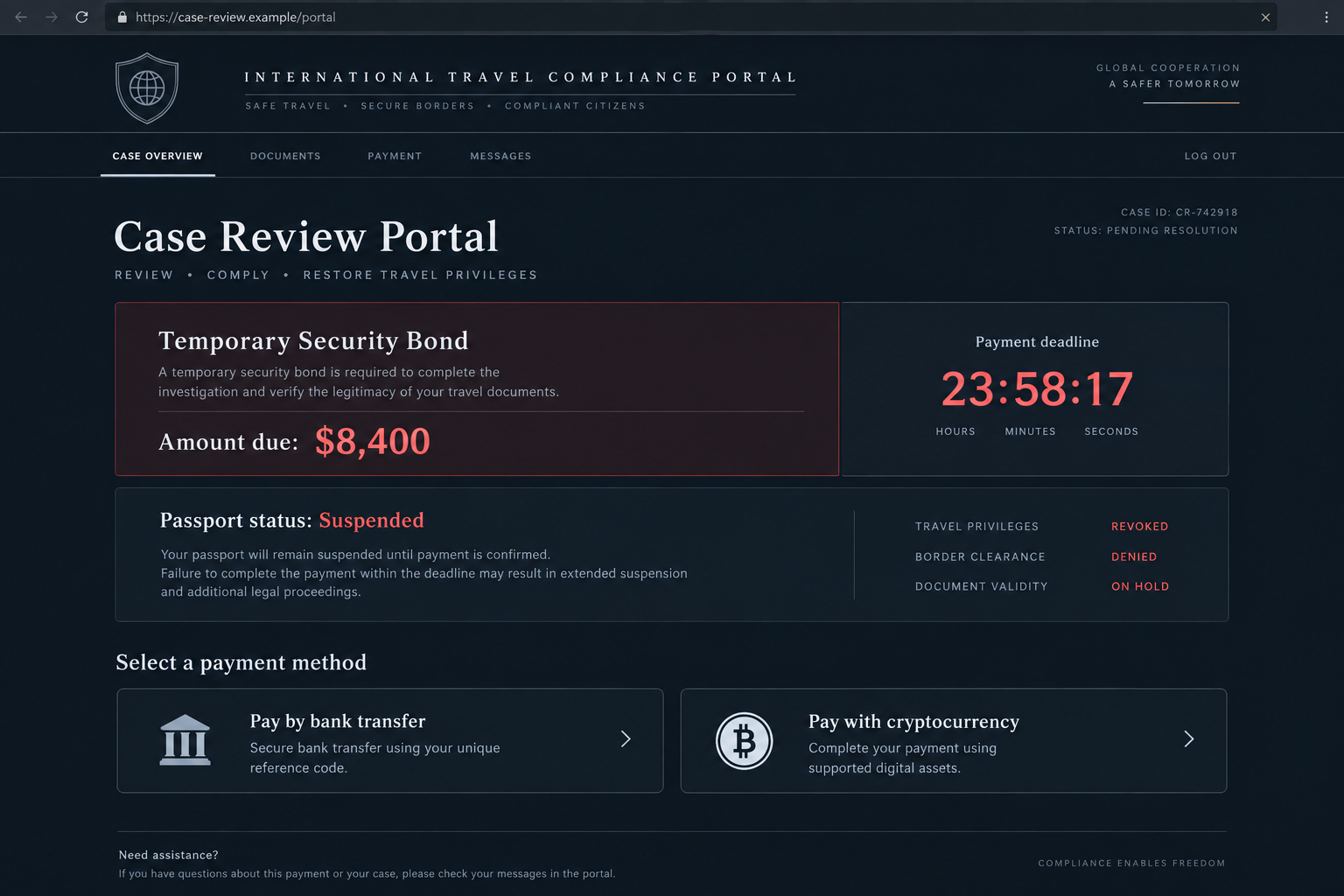
The conversation moves to a video platform. The criminal may display a digital badge, copied warrant, fake case portal, uniform, virtual background, prerecorded official, or AI-generated face and voice.
Video feels stronger than a telephone call because the victim can see something. Yet nothing on the screen establishes who controls the account or whether the case exists in a genuine government system.
Step 4: The victim is cut off from independent advice
The caller says the investigation is confidential. The victim is warned not to hang up, contact local police, tell family, or speak with the bank. A threat of immediate arrest may follow if the instructions are questioned.
This is not normal investigative procedure. It is a containment tactic that prevents a calmer person from recognizing the fraud.
Step 5: Identity and financial records are collected
The fake officer asks for passport images, tax records, bank balances, employment details, immigration documents, account logins, or one-time codes. The requests are presented as evidence gathering or identity verification.
Screen sharing can expose balances and account numbers without the victim sending a document. Remote-access software can give the criminal even greater control.
Step 6: Money is moved for a supposed inspection
The victim is instructed to wire funds, buy cryptocurrency, use a kiosk, purchase gift cards, hand cash to a courier, or transfer savings to a protected account. The caller may call it a bond, audit, escrow, or verification deposit.
Law enforcement does not clear criminal accusations by privately collecting a payment from the accused. A demand for secrecy plus an unusual payment method is decisive evidence of a scam.
Step 7: The operation keeps asking until the victim stops
After one payment, the criminal invents another problem: a transfer was flagged, a tax is due, a second agency must approve the case, or a larger deposit is needed. Fake receipts and case updates keep the victim engaged.
If the victim realizes the truth, a second group may appear offering recovery services. That follow-up is often the same criminal network using the information already collected.
What a Real Government Contact Would Not Do
A real officer may contact someone about a genuine matter, but they will not demand gift cards, cryptocurrency, a secret bank transfer, or cash delivered by courier to prevent arrest.
A genuine agency does not need a civilian to remain on a video call while moving savings. It will not forbid a person from obtaining a lawyer or independently contacting the agency through a published number.
Official caller ID is not reliable evidence. Telephone numbers can be spoofed, display names can be altered, and messaging accounts can use copied profile photographs.
Documents deserve the same skepticism. A warrant or letter sent by the accuser is not independent verification. Search for the agency through an official government directory, then start a new contact using information you found yourself.
If the caller claims to represent a foreign government, contact that country’s embassy or consulate through its verified public website. You can also ask local law enforcement for help.
End the original call before checking. A scammer who keeps listening can interrupt, redirect, or impersonate the next person you think you reached.
Company, Address, and Fulfillment Checks
A badge on camera proves nothing
Badges, seals, uniforms, and case screens are visual props. Compare the claimed official’s name and unit with information obtained from the agency’s own public switchboard, not a number provided during the call.
Do not send a selfie with your passport merely because the caller showed a credential first. A picture of an ID can be copied, altered, or generated.
The number and account can be spoofed
A call can display the real number of an embassy or police office even when it originated elsewhere. Messaging profiles can also copy official names and images.
Hang up and make a fresh call. Do not use redial, a transferred line, or a link sent in the conversation.
The payment method exposes the lie
Cryptocurrency, gift cards, cash kiosks, courier pickups, and transfers to a personal account are not legitimate ways to resolve an international police case. Labels such as security bond or safe account do not change that.
A real fine or fee should be independently visible through an official process, with formal appeal rights and payment instructions published by the responsible agency.
The case must exist outside the call
Ask the verified agency whether the case number, officer, and allegation exist. A criminal will try to make the video call the only place where the case can be seen.
If every piece of proof comes from the same caller, it is not independent proof.
What to Do if You Have Fallen Victim to This Scam
- End the call and stop all contact. Do not announce further plans or argue with the caller. Block the accounts after preserving the evidence.
- Contact the bank or payment provider immediately. Explain that a government impersonator coerced the payment. Ask about recalls, transfer holds, card replacement, account restrictions, and fraud monitoring.
- Report cryptocurrency quickly. Save wallet addresses, transaction hashes, exchange names, and kiosk receipts. Contact the exchange or kiosk operator and provide the fraud details.
- Protect identity documents. If a passport, license, Social Security number, or immigration document was exposed, contact the issuing authority and follow its identity-theft process.
- Secure email and financial accounts. Change reused passwords, end unknown sessions, remove unfamiliar recovery methods, and turn on multifactor authentication.
- Remove remote access. Uninstall any program the caller asked you to install. If the criminal controlled the screen, use a different trusted device to change important passwords.
- Scan the affected device. Run a full Malwarebytes scan to look for remote-access tools, credential stealers, or other malware installed during the call.
- Block future malicious pages. AdGuard can reduce exposure to known scam domains and deceptive ads, but it cannot recover funds or invalidate information already stolen.
- File official reports. In the United States, report to the FBI’s Internet Crime Complaint Center and local police. Also notify the impersonated embassy, consulate, or agency through a verified channel.
- Expect recovery scammers. Do not pay anyone who contacts you unexpectedly and promises to retrieve the money. Share the case only with institutions you contacted yourself.
The FBI advises victims to preserve telephone numbers, email addresses, payment details, cryptocurrency addresses, and all messages. Those records can matter even when a payment cannot be reversed immediately.
Tell someone you trust what happened. Secrecy was part of the scam, and breaking that isolation helps prevent another payment.
Frequently Asked Questions
Can foreign police really contact me by video call?
An authority might use electronic communication in a genuine matter, but a surprise video call demanding secrecy and payment is not legitimate. End it and contact the agency through its official public details.
What if the caller knows my passport number?
That information may have come from a breach, compromised account, copied document, travel record, or earlier phishing form. Accurate personal data does not authenticate the caller.
Can caller ID show a real embassy number?
Yes. Caller ID can be spoofed. Start a separate call using a number found on an official government website.
Is a refundable security bond a real police procedure?
Not in the form used by this scam. Police do not demand a secret crypto, gift card, wire, or courier payment to suspend arrest or prove that your savings are clean.
What if I only sent a passport photo?
Treat it as an identity exposure. Contact the passport authority, secure related accounts, monitor for identity theft, and preserve the message and recipient details.
Should I keep talking to collect evidence?
No. Save what you already have, then disengage. Continued contact gives the criminal more chances to pressure you, gather information, or compromise a device.
The Bottom Line
A foreign police video call scam turns an unfamiliar authority, a frightening accusation, and staged on-screen proof into a demand for money or identity documents.
No badge, warrant, caller ID, or video background replaces independent verification. End the call, contact the agency through a route you found yourself, and never move money to make a secret international case disappear.








