

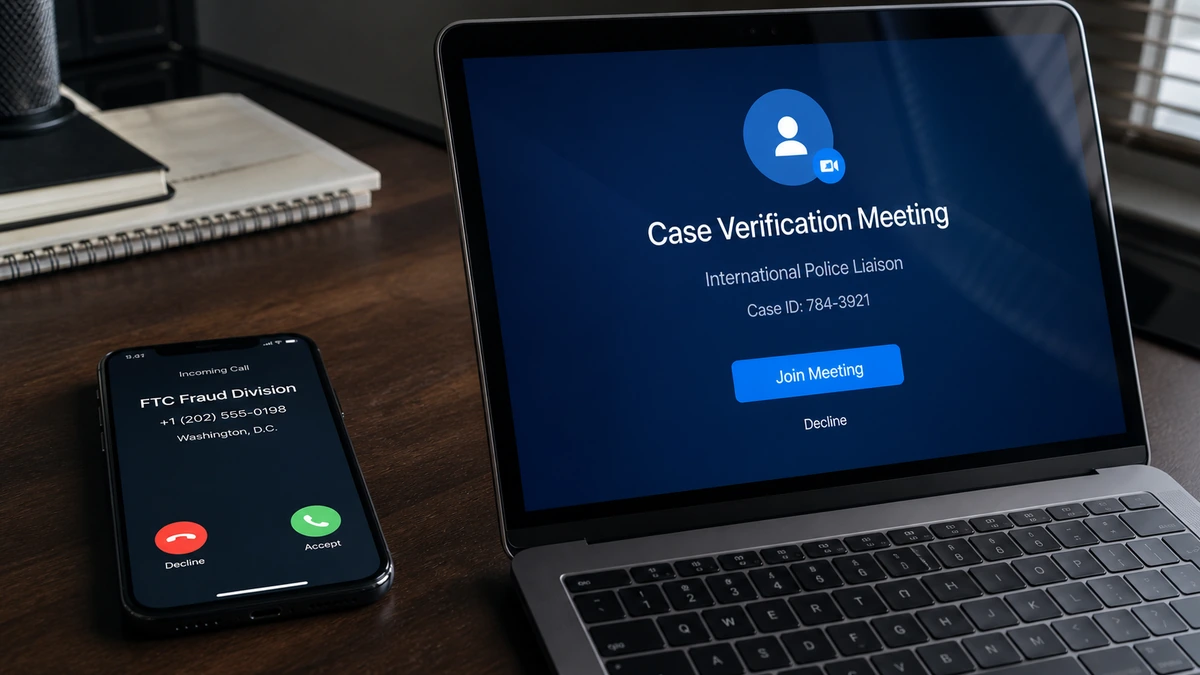
The call sounds serious from the first sentence. Someone claiming to be with the Federal Trade Commission says your identity has been used in a criminal case, and waiting could damage your credit or phone service.
Then the story gets bigger. A second “agency” joins, a Zoom interview is arranged, and you are told to sit alone. It feels elaborate because it is meant to.
Overview
It is a staged handoff, not an investigation
The opening caller claims to represent the FTC and says an earlier notice was ignored. In the case examined here, the alleged problem was a phone line opened under the target’s name at Xiamen Gaoqi International Airport.
That detail is oddly specific on purpose. It gives the target something concrete to picture while also making the situation feel too foreign and complicated to check quickly.
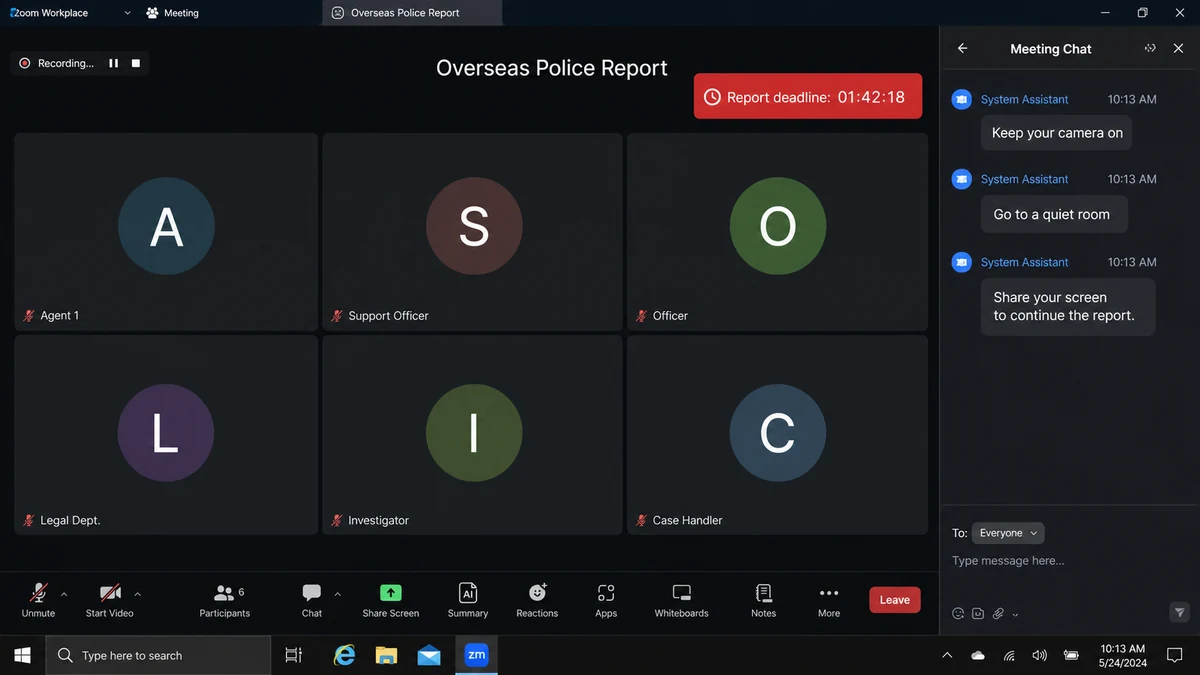
The “FTC supervisor” then says Chinese police must issue a confirmation within two hours. One fake authority passes the victim to another, making the production look larger than a single scammer with a script.
Caller ID supplies the false proof
A follow-up call can display the real name or telephone number of a government office. The number on the screen is not proof of who is calling. Caller ID can be manipulated, just like the sender name on an email.
The caller may also know a real address, phone number, former employer, or part of an identification record. That information can come from public records, data brokers, social media, or an old breach.
Scammers mix those genuine details with an invented accusation. Once the target recognizes two or three facts, the made-up parts can start to feel equally trustworthy.
The Zoom request reveals the real danger
The target is instructed to enter a quiet room, stay on camera, and keep other people out. The supposed officers may hide their own cameras or appear briefly against an official-looking background.
Next comes the request to share the entire computer screen. That is the moment the “interview” can turn into account reconnaissance, credential theft, a remote-access installation, or a guided money transfer.
Watch for this combination of warning signs:
- An unexpected FTC call about a criminal identity-theft case.
- A caller who says an official letter was already ignored.
- Caller ID that appears to show the real agency number.
- A threat involving credit, phone service, or arrest.
- A deadline measured in minutes or hours.
- A handoff to police in another country.
- Instructions to stay alone and keep the case secret.
- A demand to share the screen during a video call.
How the Fake FTC and Chinese Police Zoom Scam Works
Step 1: Repeated calls make the issue feel unavoidable
Several missed calls create the impression that an official matter is following you. When you finally answer, the operator sounds relieved that contact has been made and annoyed that earlier attempts failed.
The claim about a previously mailed notice explains the impatience. It also makes you wonder whether a deadline has already passed before you had a chance to respond.
Step 2: A spoofed number appears to verify the caller
The first operator may arrange another call that displays an FTC number. To someone already worried about identity theft, the official-looking caller ID seems like an independent confirmation.
It is not. The FTC warns that impersonators can falsify caller ID. A familiar number, agency name, or Washington area code should never replace a separate call you start yourself.
Step 3: Leaked information makes the case sound personal
The scammer reads back your name, address, or other accurate details. They may pause and let you correct or complete the record, collecting even more information as the conversation continues.
What matters is the leap they want you to make. Knowing your address does not prove that someone opened a phone account at an airport, and it certainly does not prove the caller works for the government.
Step 4: Ordinary ways to verify are ruled out
If you suggest local police, the operator says the offense happened overseas. If you offer to call the FTC back, the caller says the case is too urgent or the line must remain open.
Every safe exit is turned into a reason to stay. Real agencies do not require a civilian to obtain a foreign police report through a surprise call before a two-hour timer expires.
Step 5: A second team plays the overseas police
A new voice, title, language, uniform, or office background changes the atmosphere. The victim is no longer talking to one caller but appears to have entered an international process.
Those elements are theater until independently confirmed. A uniform can be purchased, a seal copied, a case number invented, and a busy office placed behind someone with a virtual background.
Step 6: Secrecy removes the victim’s reality check
The “officer” says nobody else may hear the interview. A spouse, colleague, or adult child who walks into the room could immediately recognize the absurdity, so the script keeps them outside.
Confidentiality sounds official, but here it protects the scam. Legitimate investigators do not make safety depend on preventing you from speaking with a trusted person or lawyer.
Step 7: Screen sharing opens the accounts
Once the screen is visible, the operator can ask you to open email, banking, credit reports, cloud storage, or identity documents. Notifications may expose login codes without you deliberately reading them aloud.
The next instruction may be called asset verification, evidence preservation, or a protected transfer. The language changes, but the objective is the same: learn what you have and gain a route to it.
Why This Feels More Convincing Than a Typical Robocall
The scammers do not ask for a gift card in the first minute. They build departments, supervisors, jurisdiction, deadlines, and paperwork around the victim. That slower setup makes the eventual demand feel like one step in a procedure.
They also welcome small challenges because the answers are prepared. Local police supposedly lack jurisdiction. Travel is impossible, so Zoom is offered as a helpful alternative. The agency number appears on the phone, so there seems to be nothing left to check.
Accurate personal information adds weight. A target may think only a government file could contain it, even though much of the same data is sold commercially or exposed in breaches.
The handoffs matter too. One caller sounds administrative, another supervisory, and a third authoritative. Each role borrows credibility from the last and keeps the victim too busy to step outside the story.
Finally, the two-hour clock narrows attention. When someone believes their credit or phone service may disappear today, stopping to find an official website can feel reckless. In reality, stopping is the safest move.
What Screen Sharing Can Expose
A shared screen can reveal email subjects, text previews, authentication codes, contact names, recent documents, account balances, and browser tabs. The victim does not need to type a password for useful information to appear.
If the caller asks you to sign in, they can see which bank you use, how transfers are approved, and how much is available. That lets them tailor the next demand to the exact account.
The operator may trigger a password reset while watching. A legitimate security code arrives, and the “officer” describes it as a case number or verification step.
Desktop folders and recent-file menus can expose tax forms, passport scans, client records, invoices, or recovery keys. Opening only one requested document can disclose the location of many others.
If remote control is enabled, the danger grows sharply. The operator can click, type, hide windows, install software, or prepare a transfer while pretending to run a security check.
Closing Zoom does not remove a separate remote-access tool. If anything was installed, disconnect the computer from the internet and check it from a clean device.
How to Verify the Call Without Following the Script
Hang up completely. Do not ask the caller for a website, callback number, badge lookup, or supervisor. The same group can control all of those answers.
Type ftc.gov yourself and use the contact information published there. The FTC’s government impersonation guidance says scammers can fake caller ID and that government agencies will not demand money or sensitive data this way.
If the story involves identity theft, go directly to IdentityTheft.gov. It provides a recovery plan without a private Zoom interview or foreign police handoff.
Call local police through the number on the department’s official website if a crime is alleged. Explain that an unknown caller claimed to represent both a U.S. agency and overseas police.
Tell someone you trust what happened. A real case can survive an independent conversation. A scam depends on keeping the victim alone long enough to act.
The Likely Endgame
The setup creates several paths to a loss. One is the “safe account” transfer, where money must supposedly be moved so criminals or investigators cannot touch it.
Another is asset verification. The victim displays balances and credit limits so police can separate legitimate property from criminal funds. In practice, this tells the scammers exactly what to target.
Account takeover is possible even without a transfer. The group can collect passwords, watch verification codes arrive, and change recovery details while the victim believes the case is being secured.
Identity documents are another prize. A license or passport may be requested to prove the person on the call is not the suspect at the airport, then reused in fraud against someone else.
Even if no money moves, the call can produce a detailed profile. A later scammer may know the bank, device, balance, family contacts, and fear created during the first session.
Recovery must therefore match what was exposed, not only what was paid. A person who lost no money may still need password changes, session revocation, credit freezes, and a device review.
Company, Address, and Fulfillment Checks
The FTC name does not authenticate the call
The Federal Trade Commission is real, but the contact was not verified through an independently initiated FTC channel. A displayed number and employee title are easy to imitate.
The threats, secrecy, and private handoff conflict with safe government contact. Verification must begin after the call ends.
The police role exists only inside the Zoom room
A masked person, uniform, case file, or office background does not establish police authority. No independently verified department email or official case portal supported the presentation.
If a foreign agency genuinely needs contact, the process can be checked through official government and diplomatic routes.
The airport is a borrowed real-world detail
Naming Xiamen Gaoqi International Airport makes the accusation searchable and specific. It does not connect the caller to the airport, a carrier, a police station, or a real investigation.
Scammers routinely borrow real places because the target can confirm the location exists and mistake that for confirmation of the story.
The promised report never leaves the scammers’ system
A genuine report should be verifiable through the agency that issued it. It should not depend on remaining alone, sharing a personal screen, or obeying a private timer.
If only the caller can confirm that the document or case is real, nothing has actually been fulfilled.
What to Do if You Have Fallen Victim to This Scam
- End every call and meeting. Leave Zoom and stop answering numbers connected to the story.
- Disconnect remote access. If software was installed, take the computer offline until it can be checked.
- List what was visible. Record the accounts, codes, documents, balances, and personal details shown on screen.
- Secure email first. From a clean device, change the password, end unknown sessions, and inspect forwarding and recovery settings.
- Protect financial accounts. Call each bank through a trusted number and report any transfer, new payee, or exposed login.
- Change exposed passwords. Use unique credentials and strong multi-factor authentication.
- Contact the mobile carrier. Add an account PIN and port-out lock if phone details or codes were exposed.
- Run a full Malwarebytes scan. Do this if you opened a file, installer, extension, or remote-control program.
- Use AdGuard as preventive support. It can block many malicious domains, but it cannot identify a spoofed caller.
- Freeze your credit if needed. This is appropriate when identity documents or Social Security information were shown.
- File reports. Use ReportFraud.ftc.gov, IdentityTheft.gov, IC3.gov, and the appropriate local police channel.
- Ignore recovery callers. Anyone demanding a fee to trace the group or unlock money may be running the next scam.
Frequently Asked Questions
Can a call really display the FTC’s number?
Yes. Caller ID can be spoofed. End the call and contact the FTC using information you find independently on its official website.
Would police interview me over Zoom?
The secrecy, foreign handoff, unequal camera rules, and screen-share demand described here are not reliable verification. Contact the named agency yourself.
How did the caller know my personal information?
Data can come from public records, brokers, social profiles, or breaches. Correct personal details do not authenticate the caller or accusation.
Is screen sharing dangerous if I never typed a password?
Yes. Notifications, codes, balances, documents, contacts, and recovery information can appear without a password being entered.
What if I only pressed a number on the robocall?
That alone does not provide account access, but it confirms that you engage. Expect more calls and do not follow later instructions.
Should I call the number in my recent-call list?
No. Find the agency’s official number separately and place a new call only after the original connection has ended.
The Bottom Line
This scam turns spoofed caller ID, leaked personal data, a foreign crime story, and video-call theater into one continuous emergency. Its most revealing instructions are the ones that isolate you and expose your screen.
Hang up before trying to solve the story. Verify every agency through an official channel you find yourself, and secure anything the callers may already have seen.








