

A fake FTC agent ID scam often finds someone who has already lost money. A stranger sends a message saying investigators traced the payment, located recovered funds, or opened a case that can finally make things right.
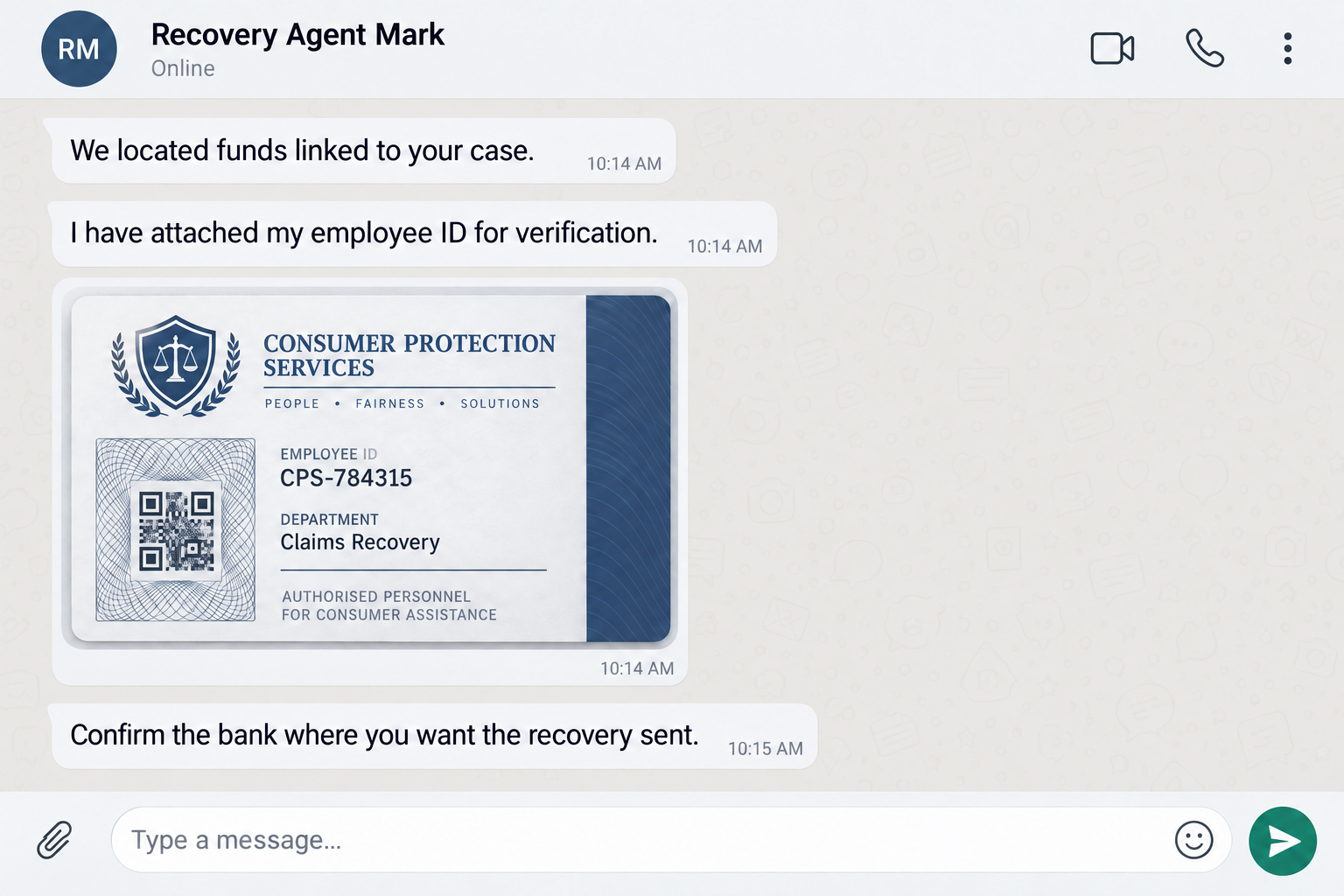
Before the recipient can question the story, the sender produces what looks like proof: a photo of an employee card, a badge, a case reference, and an official-sounding title. The relief can feel real, especially after weeks of frustration.
Overview
The scam targets people who are already vulnerable
The criminal claims to work for the Federal Trade Commission or another consumer protection body. They say money from an earlier fraud has been recovered and can now be returned.
Previous victims are valuable targets because the first loss reveals both a desire for recovery and a willingness to engage with a convincing authority. Contact details and payment information may be shared or sold between criminal groups.
The FTC confirmed this specific twist in a June 3, 2026 consumer alert. The agency warned that impersonators were contacting people unexpectedly, offering to recover scam losses, and sending fake employee IDs and badges to gain trust.
The photo ID is part of the performance
A legitimate-looking credential is easy to build from public logos, staff names, stock templates, stolen photographs, and image-generation tools. The criminal controls the image, so every detail on it was chosen to support the story.
The badge may include a seal, serial number, expiration date, signature, and department name. A case letter can carry the same visual identity. Matching documents only show that one person prepared a matching set.
The FTC says its employees will not text a photo of an employee ID to verify themselves. A stranger who sends one is not following a hidden government procedure. They are using a visual prop the agency specifically warns about.
The recovery claim leads to a second theft
After trust is established, the supposed agent asks where the recovered money should be sent. The victim may be asked for bank account details, a copy of an identity document, card information, a tax payment, or a release fee.
Other versions tell the victim to move money to a protected account or install an application so the agent can complete a secure transfer. The recovered balance exists only on a document or fake portal controlled by the criminal.
Warning signs include:
- An unexpected text, WhatsApp message, direct message, email, or call from an FTC agent.
- A photograph of an employee ID or badge offered as proof.
- A promise that lost funds have already been located.
- A request for bank routing details, account logins, one-time codes, or remote access.
- An upfront release, insurance, tax, legal, or processing fee.
- Pressure to keep the recovery confidential or complete it before a deadline.
Why Recovery Scams Are So Persuasive
A previous victim is not foolish. Many scams are designed professionally, use real payment systems, and apply pressure at exactly the right moment. The recovery operation weaponizes the embarrassment and urgency left by that first experience.
The new caller appears to be on the victim’s side. Instead of promising an investment or prize, they acknowledge the earlier harm and speak the language of investigations, cases, and restitution.
The criminal may know the amount lost, payment method, website name, or date. That information can come from the original scammers, public complaints, compromised email, data brokers, or a fake recovery form completed elsewhere.
A correct loss amount does not prove government access. It may prove that the victim’s case data has circulated.
The ID photograph lowers resistance because people are trained to respect credentials. Yet the victim cannot inspect the physical card, verify its security features, or know who created the image.
The scammer may also use the name of a real FTC employee found online. Impersonating a real person does not create a real connection to that person.
Small requests often come first. The alleged agent may ask the victim to confirm a telephone number, send the original complaint, or verify the last four digits of an account.
Once that cooperation feels normal, the requests become more sensitive. The criminal presents each new step as routine paperwork needed to release the funds.
How the Fake FTC Agent ID Scam Works
Step 1: The criminal identifies a previous victim
The target may have posted about a scam, filed a complaint through an unverified site, responded to a recovery advertisement, or dealt with a criminal group that retained the contact information.
Some messages are sent in bulk and simply ask whether the recipient recently lost money. A response tells the scammer which story to develop.
Step 2: An agent announces a recovery case
The sender claims to represent the FTC, a task force, a bank fraud unit, or a government restitution program. They say assets connected to the earlier scheme have been seized or traced.
A case reference and recovered amount make the message feel specific. Neither can be verified inside the conversation.
Step 3: A counterfeit ID closes the trust gap
When the victim asks for proof, the sender shares a badge, employee card, certificate, or letter. The image may include a real employee name and a copied government seal.
The FTC’s guidance is direct: a real employee will not text a photograph of an ID to prove identity. The very act presented as proof is a known sign of the scam.
Step 4: A portal displays money that does not exist
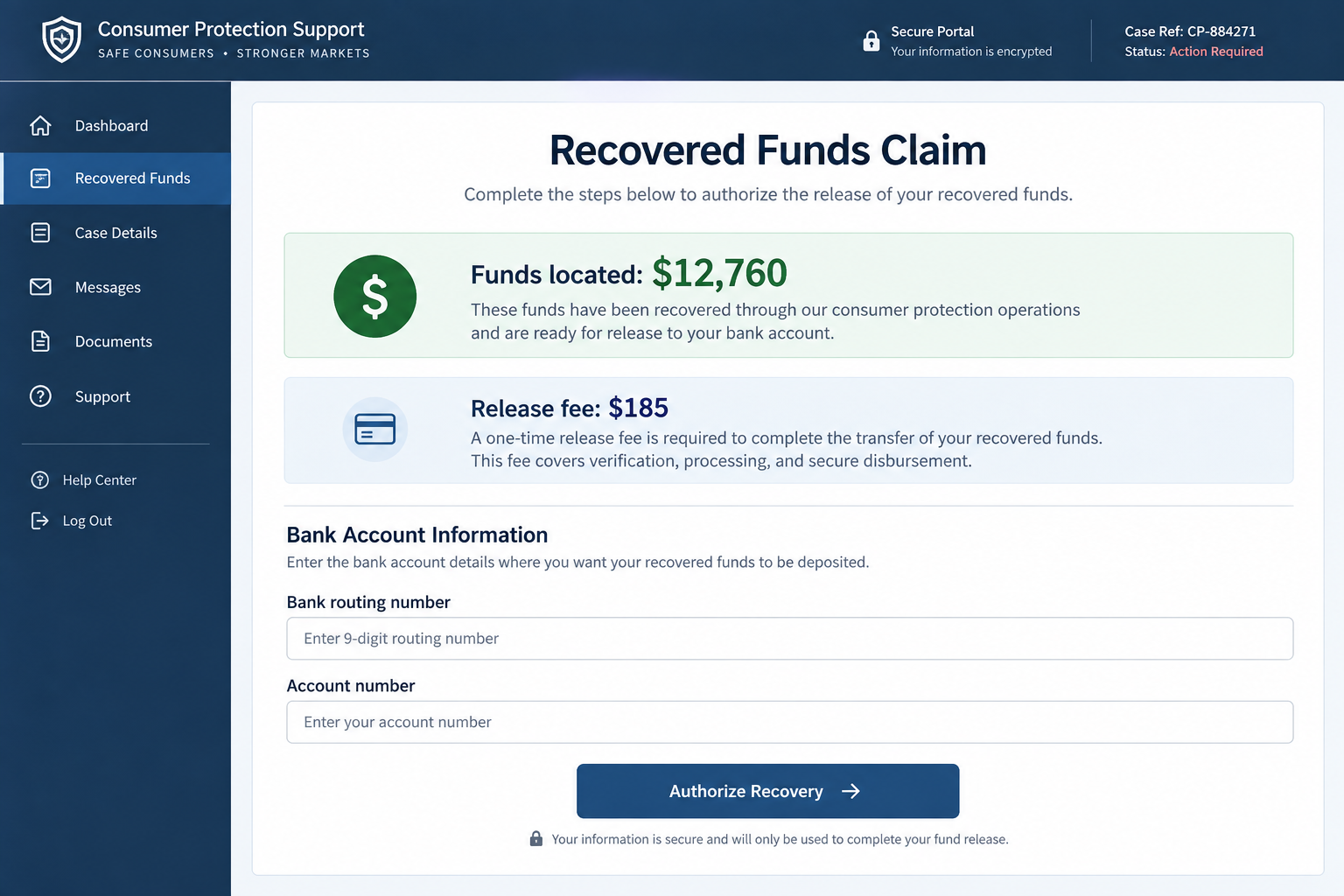
The victim receives a link to a case page. It may show the original loss, interest, a green approved status, and a large balance available for withdrawal.
The numbers are controlled by the person who built the page. They are not bank funds, escrow, or a government award.
Step 5: Banking and identity data are requested
The form asks for a routing number, account number, card, identity document, Social Security number, or online banking login. The explanation is that the agency must confirm ownership before sending restitution.
That information can be used for account takeover, unauthorized debits, identity theft, or a more convincing telephone attack.
Step 6: A fee appears before the release
The recovered money is suddenly subject to a tax, insurance deposit, processing charge, attorney fee, or verification payment. The victim is told the fee cannot be deducted from the balance.
Payment may be demanded through crypto, gift card, wire, payment app, or bank transfer. After one fee, another obstacle appears.
Step 7: The scam expands or disappears
If the victim keeps paying, the criminal invents compliance reviews, exchange charges, or additional recovered accounts. If the victim refuses, the profile, portal, and telephone number may vanish.
A second supposed investigator can arrive later and claim the first recovery agent was fake. That new approach may be another layer of the same operation.
How to Verify a Real FTC Contact
Leave the conversation. Do not use the sender’s link, telephone number, email footer, or transferred call.
Navigate to FTC.gov yourself. The FTC says its employees do not initiate contact through text messages or messaging applications such as WhatsApp to offer recovery.
A real FTC employee will not ask you to pay to receive a refund, move money to an account they choose, share online banking credentials, or provide a one-time security code.
If a federal refund is genuinely available, confirm it through the official process described on the agency’s website. Do not rely on a case portal supplied by the person claiming to release it.
Search the sender’s name only as a clue. A criminal can adopt the identity of a real employee, lawyer, investigator, or contractor.
Call the agency through a public number and ask whether the case reference and contact method are genuine. A legitimate official will not object to independent verification.
Do not send another identity document in order to verify a suspicious message. That gives the sender more material to misuse.
Why the ID Photograph Cannot Be Authenticated in Chat
A photograph removes the security features that might exist on a physical credential. The recipient cannot inspect materials, compare a live holder, or know whether the image came from an old post or an editing tool.
A QR code or employee number on the card does not solve the problem. The scammer can make the code open another controlled page and can invent a searchable staff directory.
Reverse-image searches may expose a stolen template, but no result does not make the card genuine. A newly generated credential may never have appeared online before.
The meaningful check happens outside the chat. The agency must confirm the person, case, and communication through contact information published on its own government domain.
Company, Address, and Fulfillment Checks
The employee card is not independent evidence
The sender supplied the ID, so the sender controls every name, photograph, number, and seal on it. Verification must come from the agency through a channel you started separately.
Even a genuine employee’s name can be copied onto a counterfeit credential.
The message channel contradicts the claim
The FTC states that its employees will not contact people by text or WhatsApp to offer loss recovery. A government title does not override the agency’s published communication rules.
Save the profile name, handle, telephone number, and email address for reporting.
Support cannot be verified inside the portal
Telephone numbers, live chat, and help links on the recovery page lead back to the same operation. Find contact information at FTC.gov instead.
A copied privacy policy or secure-portal message does not connect a page to the government.
Refunds do not require a secret release payment
The FTC will not demand gift cards, cryptocurrency, a wire, or a transfer to receive recovered money. It will not instruct someone to move savings into a protected account.
A fee that cannot be deducted from a large displayed balance is a classic advance-fee contradiction.
What to Do if You Have Fallen Victim to This Scam
- Stop communicating with the impersonator. Preserve the chat, fake ID, email headers, portal address, telephone numbers, and case references before blocking the account.
- Contact the payment provider immediately. Ask a bank, card issuer, wire company, payment app, crypto exchange, or gift card issuer whether the transaction can be stopped or flagged.
- Protect the receiving bank account. If routing or account numbers were shared, ask the bank about unauthorized debit blocks, new account numbers, and monitoring.
- Secure online accounts. Change exposed or reused passwords from a trusted device, end unfamiliar sessions, and enable multifactor authentication.
- Respond to identity theft. If an identity document or Social Security number was sent, create a recovery plan at IdentityTheft.gov and follow the document issuer’s instructions.
- Remove remote-access tools. Uninstall any application the sender asked you to install and tell the bank if the criminal viewed your financial screen.
- Run a Malwarebytes scan. A full scan can help detect remote-access software, credential stealers, or other malware delivered through the fake portal.
- Reduce future scam exposure. AdGuard can block many known phishing domains and malicious ads, but it cannot reverse a payment or make a stolen password safe again.
- Report the impersonation. File the details at ReportFraud.ftc.gov. If money or account access was lost, also report to local police and the FBI’s IC3.
- Reject further recovery offers. Real help begins with a bank, official agency, or lawyer you selected. Do not pay another stranger who says they found your case.
Act even if the transaction is already complete. A fast report can help protect accounts, preserve evidence, and connect the incident to a broader campaign.
If the fake agent knew private details about the earlier scam, include that fact in the report. It may help investigators understand how victim data is being reused.
Frequently Asked Questions
Will an FTC employee text a photo of an ID?
No. The FTC specifically warns that its employees do not text ID photos to verify themselves.
Can the FTC recover money lost to a scam?
FTC enforcement can sometimes lead to official refunds, but the process is announced through verified government channels. An unexpected agent does not charge a private release fee.
What if the badge uses a real employee’s name?
A criminal can copy a real name and public photograph. Contact the FTC independently and verify the case, not the image.
Is it safe to share only my bank routing number?
No. Account and routing details can support unauthorized debits and more targeted fraud. Tell the bank what was exposed.
Why does the portal show my exact loss amount?
The number may come from the original scam, a public complaint, compromised messages, or information you supplied earlier. A correct amount does not mean funds were recovered.
Should I pay a fee that will supposedly be refunded?
No. A refundable label does not protect the payment. Government recovery does not require a secret advance fee sent to an unexpected contact.
The Bottom Line
A fake FTC agent ID scam uses the appearance of official help to victimize someone a second time. The badge, case number, and recovered balance are parts of one controlled story.
A real FTC employee will not verify identity by texting an ID photo or ask for money to release recovered funds. Leave the conversation and verify any claim directly at FTC.gov.








