

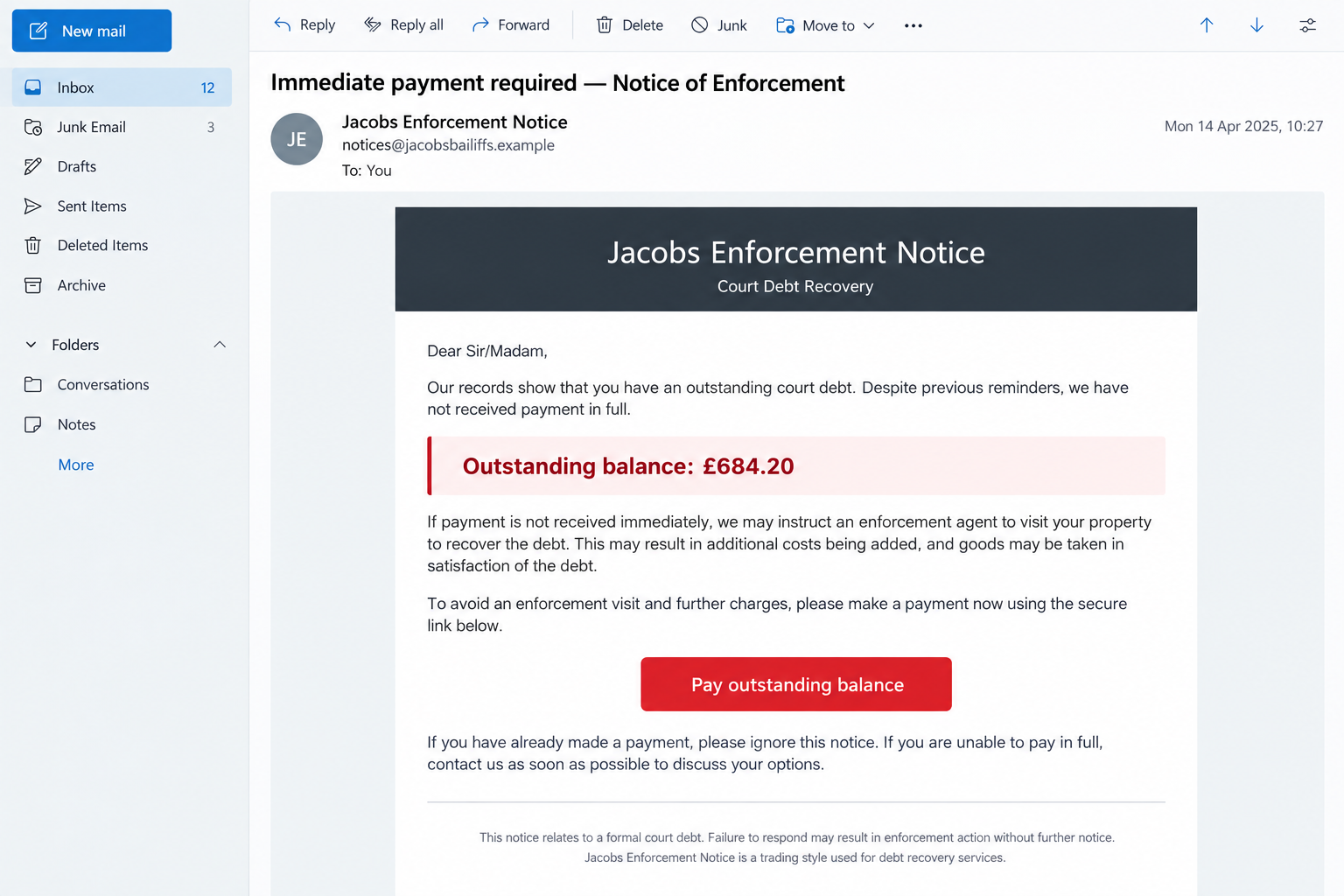
A Jacobs bailiff email scam can make an ordinary inbox feel like the start of an enforcement visit. The message says a court debt is overdue, extra charges are building, and an agent may come to the recipient’s home if payment is not made now.
The name in the header sounds established. The notice may include a case number, legal language, and a button that promises to stop enforcement. The pressure is meant to leave no time to ask whether the debt exists at all.
Overview
The email impersonates a real enforcement name
Scammers are sending emails that claim to come from Jacobs Enforcement and say the recipient owes a debt. The messages may threaten a visit, property seizure, extra fees, or court consequences.
The United Kingdom’s HM Courts & Tribunals Service added a specific warning on September 17, 2026. Its official guidance says scam emails purporting to be from Jacobs Enforcement were sent from addresses using @jacobsbailiffs.com.
HMCTS states that this domain is not associated with Jacobs Enforcement. That confirmation makes the campaign a clear impersonation scam, not a customer dispute with a legitimate firm.
The notice creates a debt inside the message
A recipient may see an outstanding balance, court reference, creditor name, deadline, and threat of an enforcement visit. Those fields make the demand appear traceable, but they are controlled by the sender.
The email may claim that earlier notices were ignored even when no letter, judgment, or verified account exists. A fake history is useful because it makes the recipient feel late and less entitled to question the demand.
A genuine debt should be independently verifiable through the creditor, court, or enforcement company using contact details found outside the message.
The payment page collects money and card details
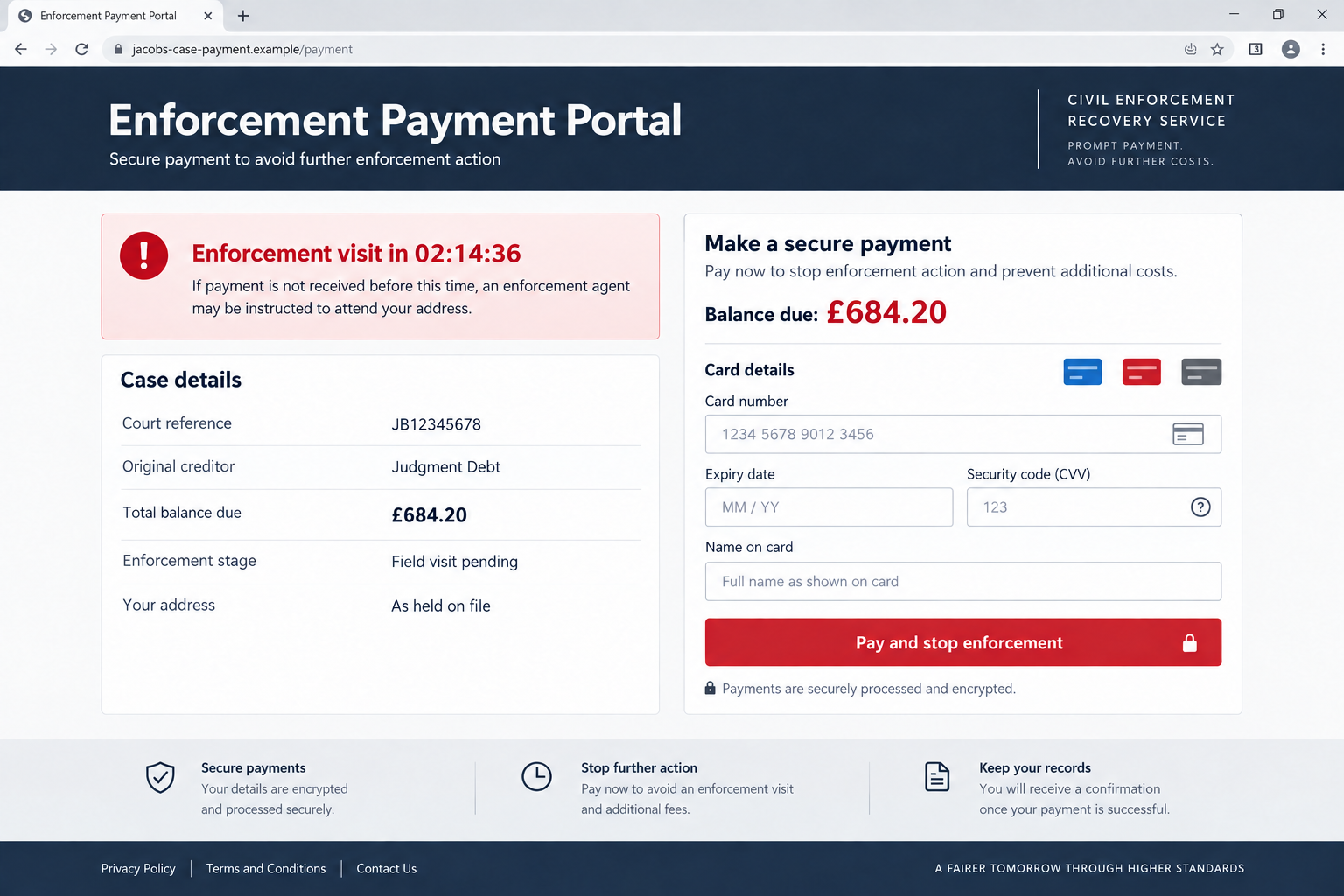
The button can open a lookalike portal that requests a card number, security code, home address, telephone number, and other personal information. Some versions may instruct the recipient to call a number or make a bank transfer instead.
The countdown and threat of a visit are there to rush the payment. Paying the page does not settle a real court debt because the money goes to whoever controls the fraudulent destination.
Warning signs include:
- An email from
@jacobsbailiffs.com, the domain named by HMCTS as a known scam domain. - A debt demand that arrives without a verifiable creditor history or court paperwork.
- A deadline measured in hours and an immediate threat of an enforcement visit.
- A link to a payment domain that does not match a company address you verified independently.
- A demand for a bank transfer, card payment, or personal data through an unsolicited email.
- A sender who discourages contact with the court, creditor, or company through public channels.
Why the Fake Bailiff Threat Works
Debt and enforcement language carries authority. Terms such as Notice of Enforcement, warrant, judgment, attendance, control of goods, and additional fees can frighten someone who has never dealt with a bailiff.
The criminal benefits from that unfamiliarity. Many recipients do not know what documents should exist before enforcement begins or which organization would be responsible for the debt.
The message also creates social fear. A threatened visit suggests that family, neighbours, or an employer could learn about the problem. Paying quietly can feel easier than asking for help.
A specific amount makes the demand appear genuine. It may be small enough to pay impulsively but large enough to feel like a real court balance.
The sender can use public information, breached data, or a common surname to personalize the email. A correct address or old account detail does not prove that the balance is real.
The use of a recognizable company name is deliberate. A quick search confirms that a similarly named legitimate business exists, but that does not validate the sender’s domain or the individual case.
Criminals often rely on display names. An inbox may show Jacobs Enforcement Notice while hiding the complete email address. The visible name can be entered freely by the sender.
The safest response is not to debate the amount inside the email. It is to verify the alleged debt through a separate route.
How the Jacobs Bailiff Email Scam Works
Step 1: A bulk email announces an overdue debt
The campaign sends formal-looking notices to many addresses. The message may call itself a final demand, notice of enforcement, court balance, warrant notice, or pre-visit warning.
It can name a creditor or keep the origin vague. A vague demand encourages the recipient to click for details.
Step 2: The sender borrows a trusted identity
The email uses the Jacobs name, legal terminology, a copied address, and professional design. It may place a case reference and supposed agent signature in the footer.
HMCTS has explicitly warned that @jacobsbailiffs.com is not associated with Jacobs Enforcement. Similar-looking domains should be checked just as carefully.
Step 3: A short deadline suppresses verification
The recipient is told that payment must arrive within hours to prevent a home visit, added fees, or seizure of goods. A countdown may continue on the payment page.
Real verification takes time, so the scam defines any delay as dangerous.
Step 4: The link opens a copied payment portal
The destination displays the same balance, case number, and colors as the email. It may show a secure-payment lock and familiar card icons.
The page is not evidence of a court record. It simply repeats information chosen by the person operating the site.
Step 5: Card and identity information are captured
The victim enters a card number, expiry date, security code, name, address, email, and telephone number. The form may later request an online banking login or one-time code.
Those details can be used for unauthorized charges and account takeover even if the displayed payment later appears to fail.
Step 6: A second demand may follow
The page may claim that the card was declined or that an additional enforcement fee has been added. A caller may then pose as an agent and ask for a bank transfer.
Providing one set of details makes the next approach more convincing because the criminal can refer to the supposed case and attempted payment.
Step 7: The domain can disappear
Once reports grow, the operator can abandon the domain and move the same template to another address. The brand, balance, and payment route may change while the threat remains the same.
That is why victims should report both the sender and the destination, not only delete the message.
How to Verify a Bailiff or Court Debt
Do not click the email link and do not call the number in the message. Search for the claimed organization through GOV.UK or another verified public directory.
If the sender claims to be an HMCTS bailiff, HMCTS advises contacting the local county court through details found on GOV.UK. If the caller claims to be a High Court Enforcement Officer or Certificated Enforcement Agent, verify the company through the relevant professional association.
Ask for the creditor name, original account, judgment or order, court reference, date, and written breakdown of the balance. Then confirm those details with the creditor or court independently.
Do not assume that every debt-related email is fraudulent. The goal is to separate a real account from the unverified channel that delivered the demand.
A real company should have a published domain and contact process. Type that address yourself rather than following a button.
Be cautious with search advertisements when looking for support. A sponsored result can lead to another impersonator. Use an official directory or verified statement.
HMCTS says it will not call from its inbound-only number 0300 0132 088 to request payment. It also warns that genuine staff will not telephone and ask for bank details or instruct someone to make a bank transfer using a sort code and account number.
If the person demands secrecy or refuses independent verification, end the contact.
What the Threatening Email Cannot Prove
A case number proves only that the sender typed a case number. Until a court, creditor, or verified enforcement company recognizes it, the reference has no independent value.
A correct address does not prove a visit is scheduled. Names and addresses can be obtained from public records, old accounts, marketing data, or breaches.
A payment countdown does not create a legal deadline. It is code on a webpage and can restart for every visitor.
A downloadable notice is no stronger than the page that delivered it. Logos, signatures, letterheads, and statutory language can be copied into a PDF.
The email also cannot prove that paying its portal will reach the alleged creditor. Verify the beneficiary and payment route with the real organization before sending anything.
If the sender says verification itself will trigger extra fees or an immediate visit, treat that pressure as another reason to stop and check independently.
Company, Address, and Fulfillment Checks
The sender domain is not the real firm
HMCTS identifies @jacobsbailiffs.com as a known scam domain and says it is not associated with Jacobs Enforcement. The display name above it cannot change that fact.
Check the complete address, including every letter after the @ symbol.
The debt must exist outside the email
A balance, reference number, and creditor label inside one message are not independent records. Confirm the obligation with the court, creditor, or verified company.
Do not pay merely to stop a threat while planning to investigate later.
Support details can route back to the scammer
The telephone number, chat box, and reply address in the notice may all be controlled by the same operation. Find a fresh route through GOV.UK or the company’s verified public site.
A person answering professionally does not prove that the call reached the real organization.
The payment destination reveals the operator
Check the domain, merchant name, bank beneficiary, and card descriptor before paying. A mismatch with the verified creditor or enforcement company is a serious warning.
A genuine debt process should produce records and rights that remain available after independent contact.
What to Do if You Have Fallen Victim to This Scam
- Stop using the email and payment page. Save the sender address, headers, full link, screenshots, telephone numbers, reference, and payment instructions.
- Call the bank or card issuer now. Explain that card details were entered on an enforcement impersonation site. Ask about blocking the payment, replacing the card, and monitoring the account.
- Contact the real organization separately. Use GOV.UK, the local county court, the verified creditor, or the enforcement company’s published site to confirm whether any debt exists.
- Change exposed credentials. If the page requested online banking, email, or reused passwords, change them from a trusted device and end unfamiliar sessions.
- Protect identity information. Monitor accounts and credit records if the form collected a date of birth, address, identity number, or document.
- Report the email. Forward suspicious UK emails to
report@phishing.gov.uk. HMCTS asks that related incidents also be reported through the official UK fraud reporting service. - Report suspicious texts and calls. Forward scam texts to 7726. Preserve call details and report the incident, especially if money was lost.
- Scan the device if anything was downloaded. Run a full Malwarebytes scan for malicious attachments, remote-access tools, or credential-stealing software.
- Block known malicious pages. AdGuard can reduce exposure to reported phishing domains and deceptive ads, but it cannot reverse a card payment or replace stolen credentials.
- Watch for follow-up threats. The same data may be used by a caller posing as the court, bank fraud team, or recovery service.
Do not ignore a separately verified debt because the email was fake. If a genuine balance exists, resolve it only through the real creditor or enforcement process.
If the supposed creditor cannot be verified, do not let the threat of a visit pressure you into another payment.
Frequently Asked Questions
Is jacobsbailiffs.com connected to Jacobs Enforcement?
No. HMCTS says the domain is not associated with Jacobs Enforcement and identifies emails from it as a known scam.
Can a real bailiff contact me by email?
Legitimate organizations can use email, but the debt and sender must be verified independently. Do not pay through an unsolicited message merely because it looks formal.
What if the email includes my correct address?
Addresses can come from public records, breached data, previous orders, or data brokers. Correct personal information does not prove the debt.
Should I call the telephone number in the notice?
No. Locate the court, creditor, or company through GOV.UK or a verified official website and start a separate call.
What if I entered my card but saw an error?
Treat the card as exposed. The form may have captured the details before showing the error. Contact the issuer immediately.
Could there still be a real debt?
Possibly, but a real debt would be independently verifiable. Confirm it through the creditor or court and pay only through a verified route.
The Bottom Line
A Jacobs bailiff email scam uses a real enforcement name, a fabricated balance, and fear of a home visit to rush recipients into a fraudulent payment page.
HMCTS has confirmed that @jacobsbailiffs.com is not associated with Jacobs Enforcement. Do not use that email’s links or numbers. Verify any debt separately before sharing information or paying.








