

The caller says they’re from TWINT support and spotted suspicious activity. They sound calm, know some details, and offer to stop the problem.
Then a request appears inside your real TWINT app. The caller tells you what it means, but the wording on your screen deserves a closer look.
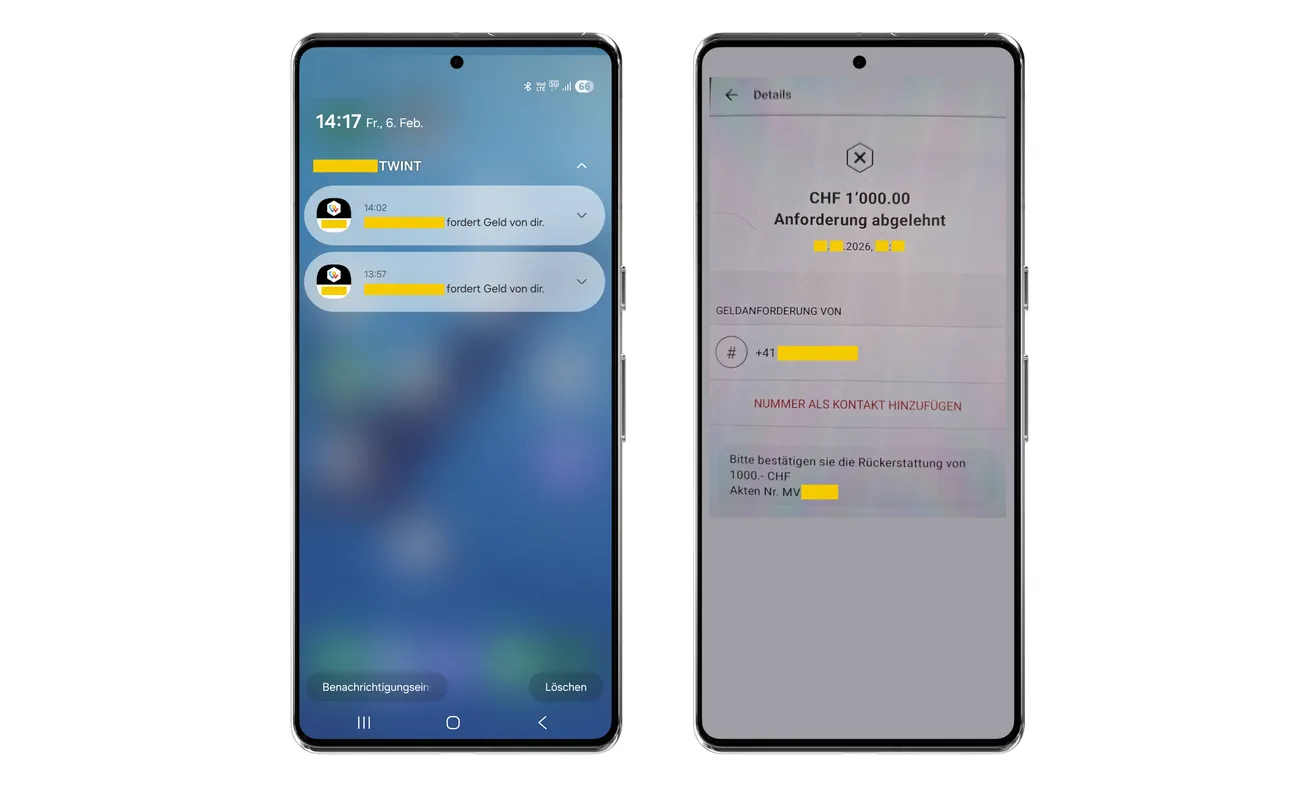
Overview
The app can be genuine while the caller is an impostor
The fake TWINT support call scam doesn’t need to move you onto a counterfeit website. It can persuade you to authorize money inside the genuine app.
Swiss police describe callers impersonating TWINT support, reporting suspicious transactions and presenting payment requests as protective checks or refunds.
TWINT is legitimate. The fake caller is misusing its payment features to obtain money; this isn’t a TWINT support procedure.
The important distinction is receiving money versus sending it
A request for money asks you to make a payment. A note claiming the request concerns a refund doesn’t change that action.
The police-published example above includes a CHF 1,000 request marked rejected. It illustrates the demand and refusal, not proof that this amount was lost.
You don’t need to approve an unfamiliar request to stop a supposed theft. End the call and ask verified support about your account separately.
A recognized number and personal details aren’t enough
Caller-ID spoofing can make an incoming call look official. Information gathered earlier can also make a stranger sound familiar with your situation.
- Don’t let an incoming caller narrate a payment approval for you.
- Read whether the app describes money leaving or arriving.
- Reject a request you didn’t intend to pay.
- Reach support through your actual app provider’s verified contact.
- Report an approved fraudulent request promptly, with its transaction details.
Why Opening the Real App Doesn’t Settle the Question
People are often told to avoid links and open the genuine app instead. That’s good advice, but it answers only part of this situation.
It helps establish where you’re acting. It doesn’t establish why you’re acting or whether the person telling you to send money is trustworthy.
A stranger can send a real request for payment. The app may display it accurately while the caller gives you a dishonest explanation of its purpose.
That is why this scam feels different from a badly copied login page. There may be no unfamiliar website, broken logo, or strange browser address.
The false element is the conversation. The caller’s story asks you to reinterpret a normal payment feature as a security procedure.
The app can correctly show a request from a stranger. What it can’t do is make that stranger’s story about a refund true.
If you’re unsure what an action does, leave it unapproved. You can clarify the question after ending the incoming call, without anyone rushing you.
How the Fake TWINT Support Call Scam Works
Step 1: Personal information makes the approach feel credible
Police explain that earlier phishing, data leaks, or other fraud can supply information for the call. That doesn’t identify the source of every person’s exposure.
Don’t assume the caller works for TWINT because they know your name or phone number. Those details establish familiarity, not employment or account authority.
Nor does their knowledge automatically prove that your bank was breached. Protect the account without making an unsupported conclusion about where the information came from.
If you later report the incident, mention the details they knew. Let the provider assess those facts alongside its own records.
Step 2: A support identity introduces suspicious transactions
The caller claims something is wrong with your TWINT account. Police describe examples involving supposed crypto gift-card purchases and convincing reference numbers.
That story gives the conversation urgency without requiring shouting or threats. A composed person offering assistance can still be directing a fraudulent operation.
Ask yourself whether you independently initiated this support contact. If not, end it and use a verified route to ask about the claimed problem.
Don’t rely on a callback number the caller dictates. The displayed number may also have been manipulated, so returning the recent call isn’t an independent check.
Step 3: A real money request appears during the conversation
You are told to open TWINT and confirm a supposed verification or recovery message. The timing makes the app notification feel connected to official assistance.
But a caller can arrange a request and then predict its arrival. That coordination doesn’t establish that the service sent it for your protection.
Read the action and amount for yourself. A payment request from another number is not automatically a security alert because it appeared during a support conversation.
Step 4: The caller labels outgoing money as a refund or cancellation
This is the central trick. A description supplied with the request talks about money coming back, while accepting the request authorizes money going out.
Words in a note cannot reverse the function of a button. Read the app’s transaction meaning separately from any explanation entered by the requester.
If you refuse, the caller may sound understanding before warning that you risk a financial loss. That warning is pressure, not evidence that refusal causes theft.
Step 5: Approval creates the payment the caller claimed to prevent
If you authorize the request, report it as a payment made under deception. Explain what the caller said and what the app recorded.
Don’t let the same person guide a second operation to undo it. A correction story can simply lead to another transfer.
Also don’t spend precious time arguing with the caller about whether they’re genuine. End contact and reach the financial provider that can assess the transaction.
Keep the original request and completed-payment record, if there is one. A rejected request and an approved transfer should not be reported as the same event.
TWINT’s Warning Matches the Critical Moment
TWINT’s security guidance warns about callers posing as its staff or a bank and directing payment actions.
It advises ending a call when a supposed support employee asks for sensitive information or tells you to block or authorize a payment inside TWINT.
That is a useful boundary because it doesn’t depend on the caller’s accent, confidence, or knowledge of your name. It focuses on the requested action.
A caller may also invoke safety to discourage independent verification. You don’t need their permission to hang up and contact the institution yourself.
If you were already waiting for genuine support, verify through the case you opened. An expected conversation still doesn’t justify approving an unrelated money request.
Read the Request Without the Caller’s Explanation
TWINT’s transfer instructions distinguish sending, receiving, and requesting money. Accepting a request leads to a payment being sent.
Start with three questions: who is asking, how much is involved, and which direction will the money travel? Answer those before reading any accompanying story.
A note can reference a refund, case number, or suspicious purchase. Those are claims made by the requester, not a separate certification from the payment service.
Compare an incoming payment with a demand for your approval. They aren’t interchangeable just because the same app displays both.
Don’t experiment with a small approval to learn how the feature works. Use the provider’s explanation or verified support rather than paying an unknown requester.
If someone is helping a relative, ask them to read the action aloud, not their PIN. You can explain the risk without taking control of their credentials.
The simplest protective move is to stop the conversation before interpreting another screen. Removing the caller’s narration makes the transaction easier to evaluate.
Which Support Team Can Actually Help?
TWINT appears in several apps. The provider responsible for your particular version matters when account blocking, access review, or payment investigation is needed.
A bank-issued TWINT app should be taken to that provider’s support. TWINT Prepaid has its own assistance and blocking route.
Don’t assume a phishing-report inbox starts an urgent recovery case. Reporting an abusive number and securing your own account are different tasks.
When contacting support, begin with the payment rather than the caller’s claimed department. Give the transaction date, amount, currency, and recipient shown in the genuine app.
Then explain that the approval was obtained through a false support story. Include any other credentials or codes you supplied during the conversation.
Ask what can still be stopped or investigated and which deadlines apply. No article or unexpected recovery caller can guarantee the outcome.
How to Interrupt the Call When Someone Else Is Being Guided
If a relative asks whether to approve the request, don’t get drawn into debating the caller’s identity while they’re still listening.
Ask the relative to leave the action unapproved and end the call. Then look at the request together, without the caller supplying its interpretation.
Point to the direction of payment. A concrete explanation, such as accepting this sends money, is easier to follow than a broad warning about online fraud.
Don’t criticize them for believing the support story. Feeling embarrassed can make someone reluctant to describe a code or earlier approval that matters to recovery.
Help them locate the verified support route for their app. They should remain involved in the account discussion and avoid sharing live authentication secrets with helpers.
If the caller rings again, let that interruption wait while the real provider assesses the account. A repeated call doesn’t make the first request more legitimate.
Write down the difference between requests refused and payments approved. That gives support a clearer picture than saying the caller tried several times.
Afterward, agree on a simple household rule: unexpected payment-protection calls are checked independently before anyone approves money movement.
What to Do if You Have Fallen Victim to This Scam
-
End the call and refuse further requests. Don’t accept a payment to prevent a threatened loss, validate your identity, or prove you still control the account.
Keep an already rejected request rejected. You don’t need to approve it later because the caller says the first refusal interrupted a refund.
-
Contact your genuine TWINT provider immediately after an approval. Identify the app you use before choosing the support route.
The official blocking guidance separates TWINT Prepaid from other providers. Follow the route appropriate to your account.
Explain that you authorized a money request because a caller misrepresented it as support or repayment. Ask about securing access and investigating the transfer.
-
Preserve the actual transaction information. Record the amount, recipient number, date, time, and any reference visible in the payment history.
Keep the request’s note too. It may show the difference between what the person claimed and what the app actually authorized.
-
Disclose any separate account-secret exposure. Tell support if you also provided a PIN, password, SMS code, or another authentication approval.
A fraudulent payment doesn’t necessarily mean the caller obtained your login. Equally, an exposed login needs attention even if you refused the request.
-
Ask about recovery without making another transfer. Use the financial provider’s established investigation process and retain its case reference.
Don’t send money to a supposed holding account or pay a fee to reverse the first transaction. Ask support to explain any real next action.
-
Save call evidence as well as app evidence. Keep the displayed caller number, call time, messages, and a short account of the conversation.
Record the number as displayed, not as a proven identity. Spoofing can involve numbers belonging to people or organizations unrelated to the fraud.
-
Report financial loss to the appropriate police channel. Provide the transaction record and provider case details through an official reporting route.
Keep full financial identifiers private. A public warning can explain the fake-support request without exposing another person’s phone number or your account information.
-
Warn anyone who may receive the same approach. Explain the payment-request trick in plain language, particularly if the caller contacted a shared household number.
A later promise of recovery deserves the same independent check. Don’t trust it merely because the person knows the amount you lost.
Frequently Asked Questions
Can the scam happen entirely inside the genuine TWINT app?
The deceptive call can direct you to a real money request. The app’s authenticity doesn’t make the caller’s explanation or the requested payment legitimate.
Does rejecting the request make me lose money?
Rejecting the unfamiliar request doesn’t authorize its payment. The caller’s claim that refusal causes the supposed loss is part of the pressure.
Why does the note call it a refund?
The requester can supply misleading wording. A note describing repayment doesn’t change a money request into an incoming credit.
Can the incoming call show an official number?
Yes. Police describe spoofed caller information. Verify through an independently obtained contact rather than trusting the displayed name or recent-call entry.
Must I replace every password after receiving the call?
Not simply because it rang. Match protection to what happened: a disclosed secret, an approved payment, or an unexpected account change.
Can TWINT guarantee that my payment will be recovered?
Recovery depends on the transaction and circumstances. Report promptly to the responsible provider and don’t pay outsiders promising a guaranteed reversal.
The Bottom Line
Hang up on a fake TWINT support call asking you to approve a money request. Calling it a refund doesn’t stop it from sending money away.
If you already accepted, contact your actual TWINT provider with the payment record. Refuse further requests and follow the verified recovery case you initiated.

Join the discussion
0 commentsShare your experience or ask a question about this article.
Discussion
Start the conversation
Have a question or something useful to share? Add the first comment.