

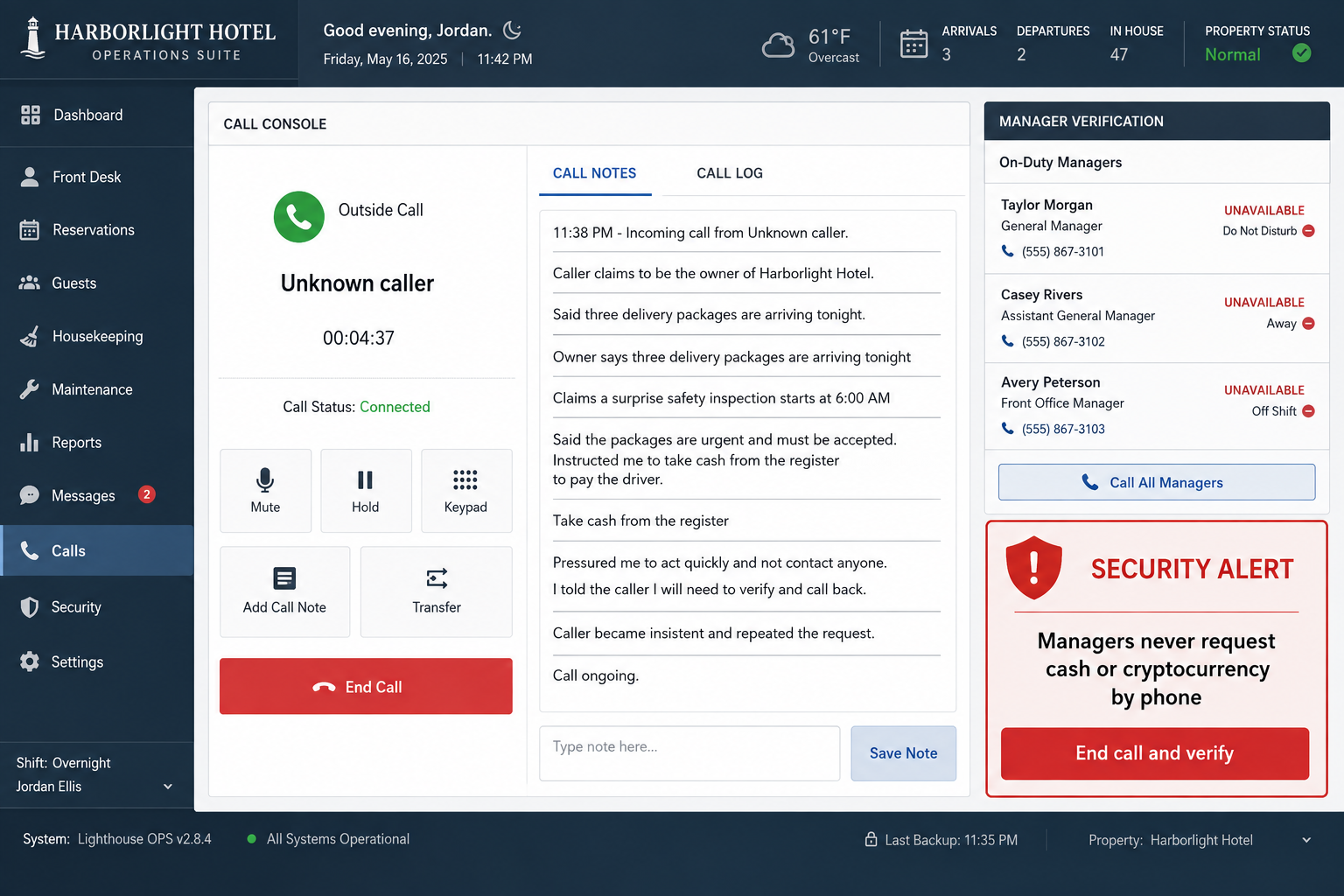
The night shift is quiet when an outside caller asks for the manager. Moments later, the story becomes urgent: several packages are arriving for a surprise inspection, the owner already approved them, and the courier needs payment before morning.
The caller seems to know the hotel, keeps another “delivery representative” ready on a second line, and treats every question as a problem that has already been solved.
The hotel package call scam becomes clear when the employee is told where to take the cash.
Overview
The call targets employees who are alone and responsible
The hotel package call scam is a business impersonation scheme aimed at front-desk staff, night auditors, restaurant workers, and retail employees. A caller poses as the owner, manager, courier, inspector, or vendor and invents an urgent payment that supposedly protects the business.
Hotels are attractive because somebody answers the telephone around the clock. Overnight employees may be working alone, have access to a cash drawer, and feel personally responsible for guest service or a failed inspection.
The story sounds operational rather than criminal. Packages, permits, fire equipment, sanitary checks, and emergency repairs are all things a real property might handle. The fraud begins when an unknown caller tries to bypass purchasing records and management approval.
A fake owner and fake courier reinforce each other
The first caller may claim to be the owner and say a courier will call with a confirmation number. A second voice then poses as the delivery company. Each identity appears to verify the other, but both calls can come from the same group.
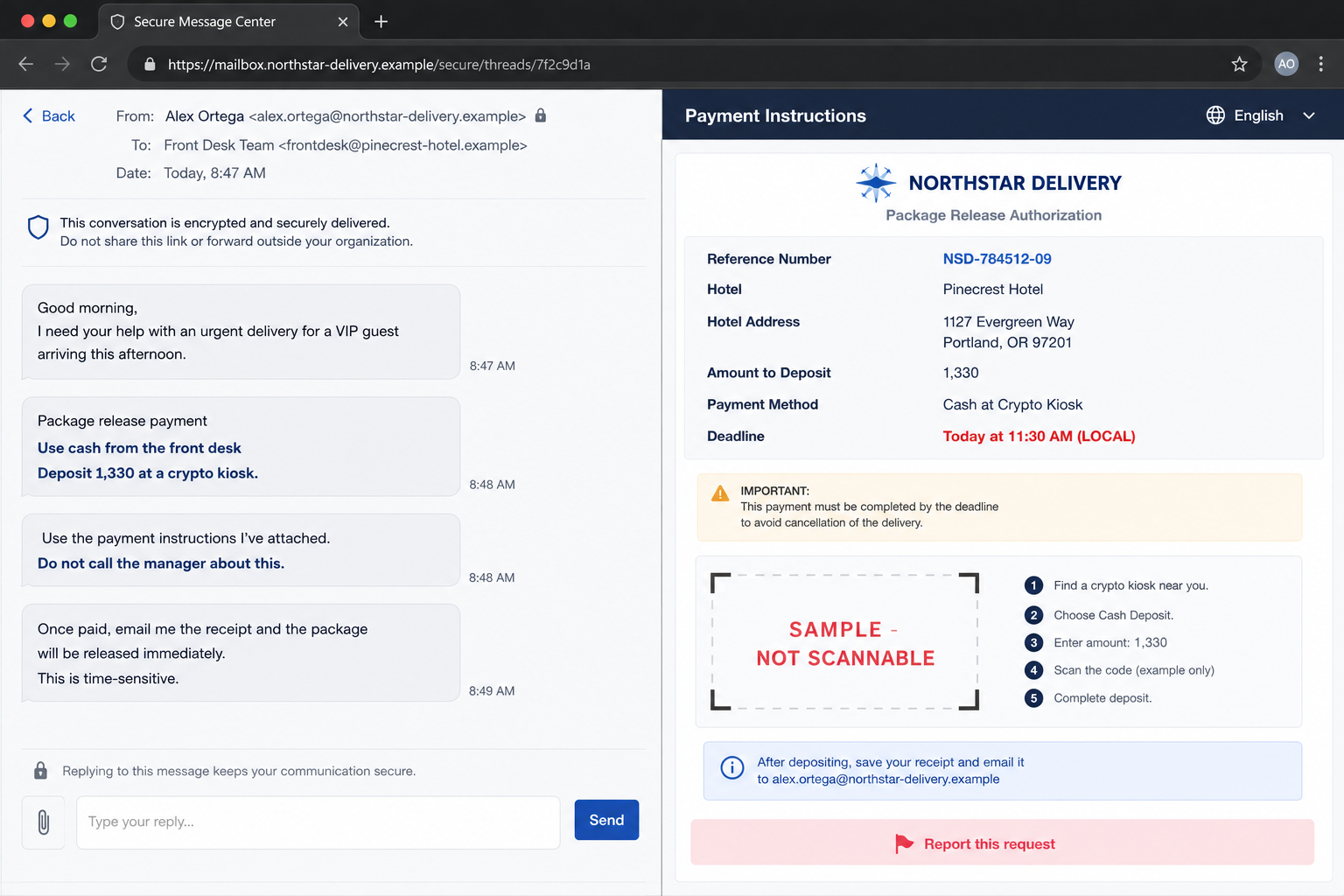
The employee may receive an email, text, QR code, or payment reference while still on the telephone. Those details turn a spoken story into something that looks documented. They do not show that the hotel ordered anything.
A business scam alert distributed by Eden Prairie authorities describes callers impersonating FedEx or UPS and directing hotel or store employees to take business cash to a Bitcoin ATM. It identifies the method as a form of CEO scam.
The Bitcoin ATM is the point of no return
The caller instructs the employee to remove cash from the register or safe, drive to a cryptocurrency kiosk, scan a supplied code, and deposit the money. The code sends cryptocurrency to the criminal’s wallet, not to a courier account.
If business cash is insufficient, the employee may be pressured to add personal funds with a promise of reimbursement. Secrecy prevents a manager, coworker, bank employee, or kiosk warning from interrupting the script.
Common warning signs include:
- An owner or manager makes first contact from an unfamiliar number.
- Packages are supposedly arriving without a purchase order.
- A surprise inspection is used to explain the urgency.
- The employee is told not to contact normal management.
- A second caller pretends to confirm the first caller’s story.
- The payment must come from a register, safe, or petty cash.
- Personal money is requested when business cash is not enough.
- The caller stays connected while the employee leaves the property.
- A QR code leads to a cryptocurrency kiosk deposit.
- The caller wants a receipt or transaction ID immediately.
How the Hotel Package Call Scam Works
Step 1: The criminal learns enough about the property
Hotel names, addresses, telephone numbers, owners, and managers can appear on booking pages, business records, professional profiles, and social media. A caller can collect enough public information to sound familiar without accessing an internal system.
Shift patterns are predictable too. Late-night and early-morning calls have a better chance of reaching one employee with fewer people available for verification.
Step 2: The employee is given a role in an urgent operation
The caller says the hotel is expecting equipment, legal documents, safety supplies, or materials needed for an inspection. The employee is praised for helping the owner solve a sensitive problem.
This approach turns obedience into loyalty. Refusing no longer feels like rejecting a stranger. It feels like letting the property fail, disappointing the owner, or causing a delivery to be returned.
Step 3: A manager’s identity is borrowed
The impersonator may use the real owner’s name, claim the general manager is asleep, or say senior staff already signed off. Caller ID can display a local number or a label chosen by the criminal.
If the employee asks to call back, the scammer may say the number is private or that the manager cannot be disturbed. A legitimate purchase can survive verification. A fraud script needs the employee to remain inside the call.
Step 4: Another caller creates false confirmation
A supposed courier, inspector, lawyer, or accountant joins the process. The employee receives a tracking reference and repeats it to the second person. Matching details make two unverified contacts feel like independent sources.
They are not independent. The criminals coordinate the same invented order. Real confirmation must come from the hotel’s purchasing system, known manager, approved vendor list, or accounting records.
Step 5: Business cash becomes an emergency payment
The caller explains that an account failed, a deposit is missing, or the courier cannot release the packages. The employee is told to count the register, open a safe, or combine funds from several departments.
Normal controls are framed as obstacles. The fraudster may coach the employee around a locked office, alarm, withdrawal limit, or supervisor question. That persistence is a warning, not evidence of authority.
Step 6: The money is converted at a crypto kiosk
A QR code or wallet is sent by text. At the kiosk, the employee feeds in cash and scans the code. The machine converts the deposit and sends it to the chosen wallet.
The FTC warns that a caller sending someone to a Bitcoin ATM is a scammer. A courier, owner, inspector, or government office does not need business cash converted through a stranger’s wallet.
Step 7: The caller asks for more and then disappears
The first payment may trigger a new fee, incorrect amount, second package, or tax. A cooperative employee can be pressured to use personal savings, another register, or a second kiosk.
Once the victim contacts a real manager, the invented inspection and delivery collapse. The wallet remains under the criminal’s control, and the hotel must determine both the financial loss and the employee’s exposure.
Why Good Employees Can Fall for the Call
The scam does not require carelessness. It creates a temporary workplace where every normal instinct points in the wrong direction. Being helpful, protecting the business, following authority, and solving a guest problem are turned into pressure points.
Isolation matters. A night auditor cannot lean over to an accounting colleague. The caller fills that gap by sounding patient, keeping the line open, and supplying an answer to every objection.
Multiple roles create social proof. The fake courier confirms the fake owner. A text confirms the fake tracking number. A professional-looking QR page confirms the fake payment. All evidence still comes from one unverified chain.
Training should avoid ridiculing victims. Employees who fear punishment may hide the call longer, reducing the chance of stopping a transfer. A clear rule and a safe escalation path work better than expecting every worker to improvise under pressure.
Controls That Stop the Scam Before Cash Moves
Hotels should have a written rule: no employee removes cash or buys cryptocurrency, gift cards, or money orders because of an incoming call. No owner or manager can waive that rule verbally.
Maintain a printed emergency contact list behind the desk. It should contain numbers verified internally, not numbers found in an unexpected email. Employees need permission to wake a manager when a caller mentions cash, inspections, authorities, or secret instructions.
Every delivery should connect to a purchase order, vendor record, or expected-arrivals log. A tracking number supplied by the caller is not enough. The employee should contact the vendor through the approved account and verify the order separately.
Cash access needs dual approval where practical. A locked safe, shift limit, and second-person check can stop a high-pressure call from becoming an irreversible transfer. The control protects the employee as much as the property.
Post a short warning near the business telephone and cash area. “No manager will ask you to take cash to a crypto kiosk” is memorable at 2:00 AM, when a long policy manual is not.
Run short scenario exercises with every shift. Let an employee practice ending the call, locating the internal contact list, and documenting the request. Rehearsal makes the safe response feel like normal work instead of insubordination.
Managers should also close the information gaps that scammers exploit. Staff need to know how real inspections are scheduled, how urgent deliveries are approved, and which vendors may collect payment. Mystery creates room for an impersonator to invent procedure.
After an attempt, review the call as a system event. Check whether the criminal knew an employee name, schedule, manager absence, or safe location. Remove unnecessary public details and warn other properties before the same script reaches them.
Company, Address, and Fulfillment Checks
The company order must exist internally
Search the purchasing, maintenance, and accounting records for the vendor and order. If the business has no approved purchase, the caller cannot create one by reciting a confirmation number.
The hotel manager must be reached separately
Use the internal directory or a number saved before the call. Do not accept a transfer, conference participant, or callback number supplied by the impersonator as verification.
The caller’s knowledge is not authentication
A real owner’s name, employee schedule, property address, or inspection date may be public or stolen. Verification depends on an approved channel and record, not on trivia the caller knows.
The payment method must match company policy
A legitimate courier invoice belongs in the normal accounts-payable process. Cash from a register, personal funds, gift cards, or a cryptocurrency kiosk are not emergency substitutes for a missing purchase order.
What to Do if You Have Fallen Victim to This Scam
- Stop the transaction and end contact. Do not make a second deposit, send the receipt, or call a number supplied by the scammer.
- Tell the real manager immediately. Early reporting gives the hotel a chance to contact the kiosk operator, preserve records, warn other locations, and support the employee.
- Contact the kiosk operator. Use the company name and support number printed on the real machine or receipt. Report fraud with the transaction ID and wallet, and ask whether any transfer can still be held.
- Notify the business bank and insurer. Explain whether cash came from a register, safe, or withdrawal. Preserve case numbers and follow the hotel’s incident process.
- Call law enforcement promptly. Provide the call time, numbers, recordings where lawful, messages, wallet, QR image, receipt, camera footage, and names used by the impersonators.
- Do not delete the communications. Export messages and emails, photograph the call console, and preserve the full sequence. The handoff between fake roles can identify a larger campaign.
- Secure any exposed accounts. Change passwords if the employee used a login supplied during the call. Review email and business systems for unknown sessions, forwarding rules, or remote access.
- Inspect devices if software was installed. Disconnect affected systems from sensitive operations and run a full Malwarebytes scan before returning them to use.
- Add web protection after containment. AdGuard can block many known phishing pages and malicious ads. It cannot identify an authorized company purchase, so internal approval remains essential.
- Alert nearby properties and shifts. Share the script without exposing private employee information. Criminals often call several businesses in the same area or brand.
- Reject recovery agents. Anyone asking for another crypto payment to trace, unlock, or reverse the first transfer is attempting a second loss.
Frequently Asked Questions
Would a hotel owner ever call the front desk about a package?
Possibly, but a real order should have internal records and survive a separate callback. The owner should never require cash conversion at a cryptocurrency kiosk.
Why do scammers call overnight?
Fewer managers and coworkers are available, while the front desk still answers. Isolation makes it easier to keep one employee inside the script.
Can caller ID prove the manager is calling?
No. Caller ID can be spoofed or mislabeled. Use an internal number and call the manager independently.
What if the courier provides a real-looking tracking number?
A number supplied by the caller proves nothing. Verify the order in hotel records and contact the courier through its independently reached official site.
Can a crypto kiosk payment be reversed?
Often it cannot, but report it immediately to the kiosk operator and law enforcement. A transfer that has not completed may offer a narrow chance for intervention.
Should the employee be blamed?
The incident needs an honest review, but shame delays reporting. Improve cash controls, training, escalation, and management availability so one persuasive call cannot bypass policy.
The Bottom Line
The hotel package call scam creates an owner, courier, inspection, deadline, and payment problem entirely over the telephone. It succeeds when several unverified voices are mistaken for an approved business process.
No hotel delivery requires an employee to empty a register and feed the cash into a cryptocurrency kiosk. End the call, contact a real manager, and look for the purchase order before one cent leaves the property.

Join the discussion
0 commentsShare your experience or ask a question about this article.
Discussion
Start the conversation
Have a question or something useful to share? Add the first comment.