

A spoonful of powder in a morning coffee sounds easier than changing an entire routine. That simple promise is what makes the Slim Coffee Booster offer so tempting, especially when an advertisement adds dramatic results, a steep discount, and a clock that appears to be running out.
The harder questions begin after the sales page: what is actually proven, what will the order really cost, and is the customer agreeing to more than one shipment?
Overview
The offer relies on a dramatic weight-loss story
Slim Coffee Booster, sometimes promoted under changing product or seller names, is presented as a powder that can be mixed into coffee. Ads may say it supports metabolism, controls cravings, increases energy, or produces visible weight loss with little disruption to daily life.
Those are powerful claims. They also deserve more scrutiny than a before-and-after image, an enthusiastic testimonial, or a vague reference to a scientific breakthrough.
The Federal Trade Commission warns that fast, effortless, and universal weight-loss promises are common signs of deceptive advertising. A product should not be treated as proven merely because individual ingredients have appeared in unrelated research.
The lowest price may not be the final price
A sales funnel can emphasize an introductory deal while placing recurring shipment terms near the order button, inside a pop-up, or in a longer terms page. A customer who believes they made a one-time purchase may later see another charge or another package.
Complaints around offers of this type often focus on billing rather than the taste of the product. The recurring plan, cancellation window, return conditions, and full price matter as much as the advertised discount.
Before entering a card number, shoppers should know the exact amount charged today, the amount of every future charge, how often it occurs, and the precise way to cancel.
The safest conclusion is based on evidence, not hype
Calling every dietary supplement fraudulent would be inaccurate. The fair question is whether the specific finished product has reliable evidence for the promises in its advertising and whether the seller clearly discloses the full transaction.
A lack of published clinical testing does not automatically prove a criminal scam. It does mean that confident claims such as effortless fat loss, guaranteed results, or dramatic changes should not be accepted at face value.
Key issues to check include:
- Whether the finished formula has credible, published human research.
- Whether ingredient amounts are disclosed rather than hidden behind a blend.
- Whether the checkout clearly identifies a subscription or auto-renewal.
- Whether the seller provides a verifiable company name and working support.
- Whether testimonials explain typical results and paid relationships.
- Whether refund and cancellation rules are available before payment.
- Whether the same product appears under several unrelated storefront names.
What Slim Coffee Booster Ads Commonly Promise
The exact promotion can change, but the story is familiar. A video, sponsored post, or article-style advertisement introduces a supposed discovery that turns ordinary coffee into a weight-loss drink. The page may frame the formula as new, scarce, or overlooked by the medical establishment.
Some versions lean on green coffee, green tea, chromium, vitamins, or plant extracts. The presence of familiar ingredients can make the offer feel scientific, but a list of ingredients is not the same as evidence that the final combination produces the advertised outcome.
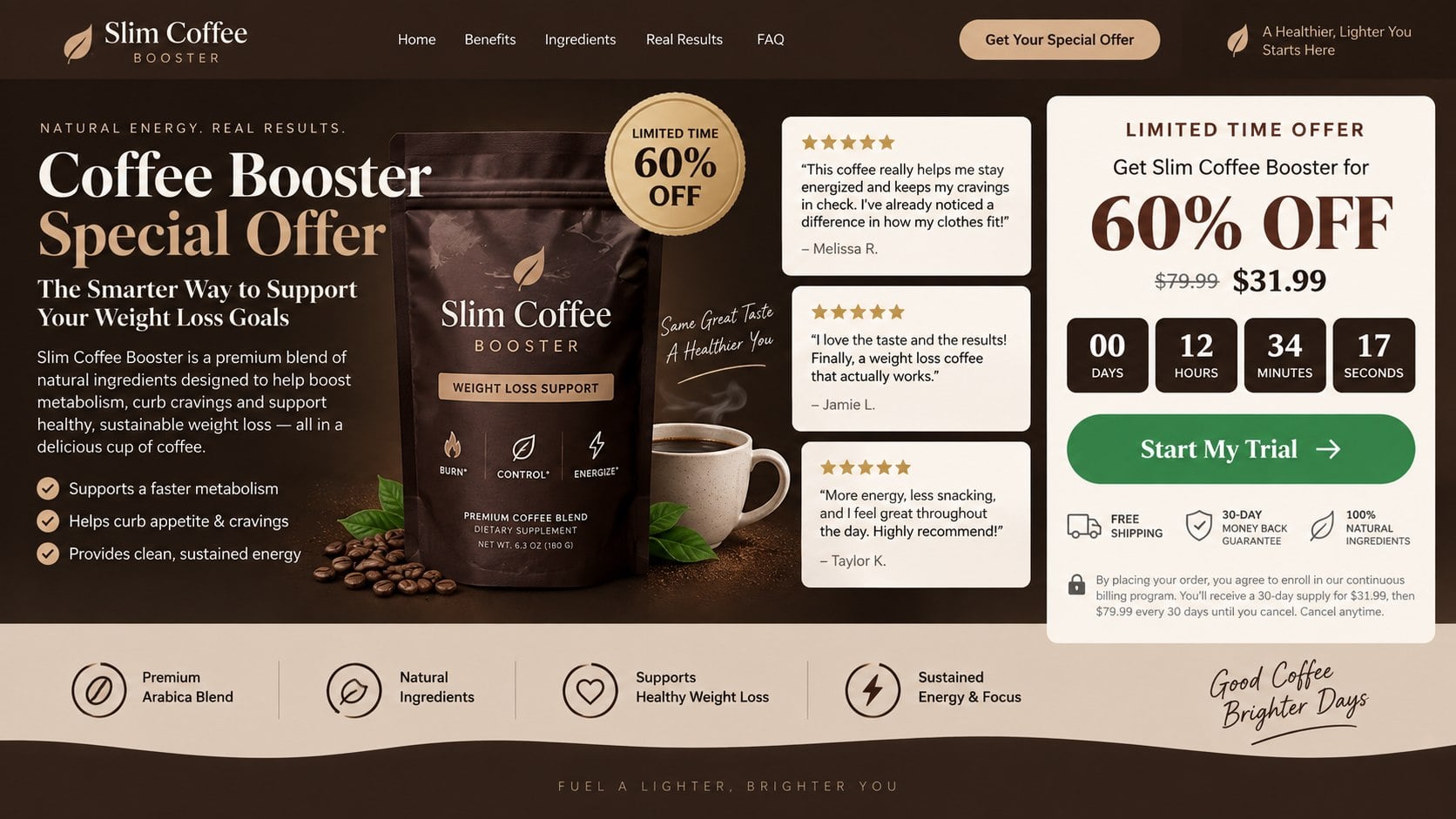
The sales page may also use customer reviews, star ratings, countdown clocks, low-stock notices, media-style badges, and a large discount. Each element pushes the visitor toward an immediate order instead of a careful comparison.
Watch closely for a claim that the product works without meaningful changes to food intake or activity. The FTC says promises of rapid loss without diet or exercise are a major warning sign. Sustainable weight change is more complex than adding a powder to one drink.
How the Slim Coffee Booster Offer Works
Step 1: A social ad turns curiosity into urgency
The funnel often begins with a dramatic headline about a coffee trick, a celebrity-like recommendation, or a consumer who reportedly lost a large amount of weight. The ad may look like a news story rather than a paid promotion.
A button leads to a long sales page where the offer becomes more emotional and the supporting evidence becomes harder to evaluate.
Step 2: The page uses testimonials as proof
Visitors see polished reviews, attractive result photos, and claims that the formula changed lives. The page may not say whether reviewers were paid, whether images are stock photos, or whether the quoted results are typical.
Testimonials can describe individual experiences, but they cannot replace controlled testing of the actual product at the advertised dose.
Step 3: A countdown and discount discourage comparison
The page claims that a 50% or 60% discount will disappear in minutes. It may also say that only a few units remain or that the offer is available only in the visitor’s area.
Reloading the page may restart the clock. A timer that repeatedly resets is a sales device, not evidence of genuine scarcity.
Step 4: The order is framed as a cheap trial
A prominent price can appear to cover the complete purchase. Shipping, handling, membership enrollment, or future shipments may be disclosed less prominently.
The buyer enters an address and card information believing the risk is limited to the introductory amount.
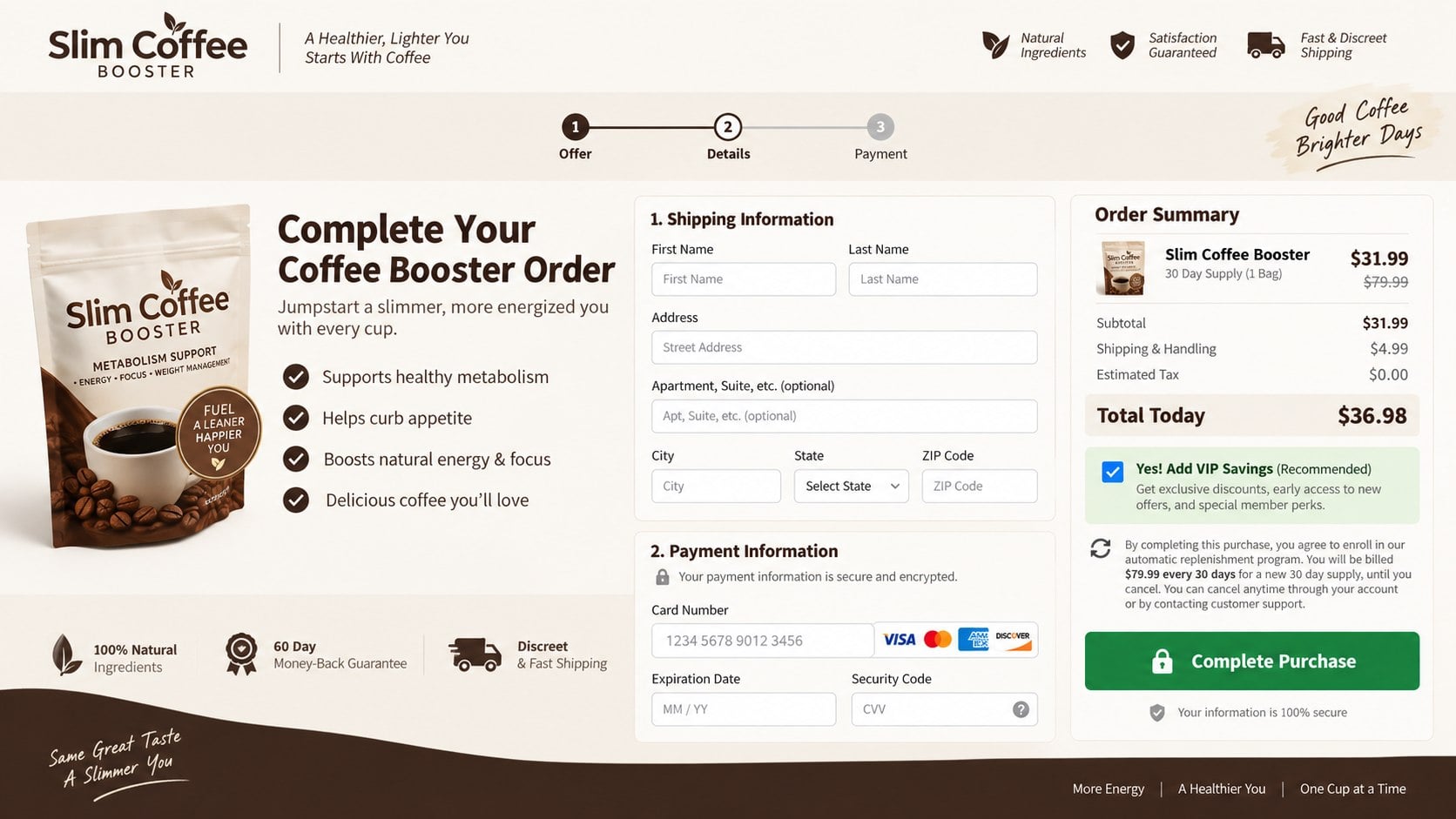
Step 5: The checkout may enroll the buyer in recurring billing
A preselected savings option or acceptance statement can authorize repeated charges. The amount billed on the next cycle may be much higher than the amount highlighted in the ad.
This is why screenshots of the complete checkout and terms are important. They show what was displayed when consent was supposedly collected.
Step 6: Cancellation becomes harder than ordering
The sales page is designed to accept an order quickly, while cancellation may require a call during limited hours, an account number, a return authorization, or shipment of unopened products.
If the support address bounces, the number does not connect, or representatives continue offering discounts instead of canceling, another billing cycle may begin.
Step 7: Refund conditions reduce the practical guarantee
A money-back promise can sound reassuring until the exclusions are read. Shipping may be nonrefundable, opened packages may be rejected, and the return deadline may begin on the order date rather than the delivery date.
Return postage and restocking rules can make a small refund uneconomical. A guarantee is useful only when its conditions are clear and realistically accessible.
Company, Formula, Billing, and Support Checks
Company identity should be easy to verify
The website should identify the legal seller, not only a product name. Look for a company name, physical business address, working telephone number, and a support email on the same domain.
Search the business name separately. A mail-drop address, recently created storefront, or privacy-protected domain is not proof of fraud, but several missing identity details weaken accountability.
Formula claims require product-specific evidence
Research on an ingredient does not establish that every supplement containing it works. Dose, purity, combination, manufacturing quality, and the population studied can all change the result.
Ask whether the seller links to a published trial of the exact finished product. Vague phrases such as “clinically inspired” or “science-backed ingredients” may sound authoritative while avoiding that question.
Billing terms must appear before the final click
A recurring plan should state the future amount, frequency, start date, and cancellation method clearly and close to the purchase control. Important terms should not be concealed in faint text or a separate document that a buyer is unlikely to open.
Uncheck optional clubs, priority programs, or automatic replenishment boxes unless you deliberately want them. Keep a screenshot of the order summary and confirmation.
Support quality is part of the risk assessment
Contact support before buying when the offer is unclear. Ask a direct question about recurring billing and returns. A legitimate seller should answer in writing without evasion.
Do not rely on a phone number shown only in an advertisement. Confirm that the same contact information appears in the site’s terms, privacy policy, and order confirmation.
Red Flags That Deserve a Pause
No single design choice proves a scam. The concern grows when several pressure and concealment tactics appear together.
- The ad promises rapid weight loss without meaningful diet or exercise changes.
- A news-style page does not clearly identify itself as advertising.
- Testimonials show extraordinary results but no typical-result disclosure.
- The finished product has no accessible clinical trial.
- Ingredient amounts are missing or grouped into a proprietary blend.
- A countdown restarts whenever the page is reopened.
- The lowest price is large, while future billing is printed in small text.
- A membership box is selected automatically.
- The legal seller is hard to identify.
- Cancellation requires a different process than the easy online purchase.
- Refund rules exclude opened products even though trying the product requires opening it.
- Support responds with more discounts instead of confirming cancellation.
How to Evaluate the Product Before Ordering
Start by separating the product from the advertisement. Write down the exact name, ingredient panel, serving size, seller, and total price. Search each independently instead of repeating the promotional headline.
Look for studies of the finished formula, not articles about a single ingredient. Check whether the research was randomized, controlled, peer reviewed, and conducted at the same dose sold to customers.
Read the complete checkout without entering payment information. Calculate the cost for three months, including shipping and any membership. A cheap first shipment can hide an expensive ongoing commitment.
Ask a doctor or pharmacist about ingredients, especially if you take medication, are pregnant, have heart or blood-pressure concerns, or are sensitive to caffeine. “Natural” does not mean risk-free or appropriate for everyone.
Use a credit card rather than a debit card when possible. Credit cards generally provide a clearer dispute process and do not expose money held directly in a current account.
What to Do if You Have Fallen Victim to This Scam
- Preserve the purchase trail before it disappears. Screenshot the promotion, sales page, checkout, terms, order confirmation, product label, emails, and every charge. Note when each item appeared while the pages are still available.
- Send a clear written cancellation. State that you cancel any subscription and revoke authorization for future charges. Ask for a confirmation number and keep the sent message.
- Call the card issuer. Explain whether the charge was unauthorized, misrepresented, or repeated after cancellation. Ask about blocking future merchant charges and replacing the card if necessary.
- Dispute charges with accurate evidence. Give the bank the receipt, screenshots, cancellation request, and dates. Do not describe a purchase you made as card theft; explain the misleading terms or continued billing precisely.
- Do not pay a separate cancellation fee. A demand for gift cards, crypto, wire transfer, or remote access to process a refund is a second scam. End the conversation.
- Ask a medical professional about symptoms. Stop using the product and seek advice if you experience an adverse reaction. Keep the container and ingredient label.
- Check the device if the ad triggered downloads. Run a full Malwarebytes scan if you installed a browser extension, file, or application from the promotion. Remove unfamiliar programs and review browser notifications.
- Reduce repeat exposure. AdGuard can block many deceptive ad networks, malicious redirects, and known scam domains. It cannot judge every supplement claim, so keep evaluating the offer itself.
- Report deceptive advertising. Submit the promotion and billing details to the FTC at ReportFraud.ftc.gov and to your state attorney general. Report the ad to the platform where it appeared.
- Monitor statements for several months. Look for altered merchant names and small test charges. Sellers and payment processors sometimes appear under names that differ from the product.
- Ignore recovery solicitations. Anyone who unexpectedly promises a guaranteed refund for an upfront payment is trying to profit from the same loss.
Frequently Asked Questions
Is Slim Coffee Booster proven to cause weight loss?
Promotional statements are not proof. Look for credible human research on the exact finished formula and dose. Evidence about an individual ingredient cannot automatically be applied to the complete product.
Does a real ingredient make every claim legitimate?
No. A supplement can contain real ingredients while its advertising overstates what they can do. Quantity, quality, combination, and evidence for the claimed outcome still matter.
How can I tell whether the order is a subscription?
Read the text beside the final purchase button, any checked savings option, and the billing terms. Search for “recurring,” “auto-renew,” “replenishment,” “membership,” and “every 30 days.”
What if the countdown says the deal ends today?
Do not let the clock replace research. Reload the page later and see whether it restarts. A legitimate product can be evaluated without surrendering card information under pressure.
Can I rely on the money-back guarantee?
Only after reading its conditions. Check whether opened products qualify, which fees are excluded, how quickly returns must arrive, and whether authorization is required before shipping anything back.
Should I cancel my card after an unexpected charge?
Contact the issuer immediately and follow its recommendation. A replacement may be appropriate when future charges cannot be blocked or when card details may have been exposed to an untrusted seller.
The Bottom Line
The concern around Slim Coffee Booster is not simply whether coffee ingredients exist. It is whether the finished product can support the advertised results and whether the buyer clearly understands the full billing commitment.
Ignore countdowns and dramatic testimonials long enough to verify the seller, evidence, subscription terms, and refund process. If any of those details remain hidden, the safest purchase is the one you do not make.
If you already ordered, document everything, cancel in writing, and involve the card issuer quickly when billing does not match what you knowingly accepted.








