

A new-device notification deserves attention when it concerns webmail. Unfortunately, the same concern can be manufactured by someone who wants the account password.
This message borrows the appearance of a routine hosting alert. Its most important clues appear only after the sender and destination receive equal scrutiny.
Overview
A Suspicious Login Alert With a Precise Time
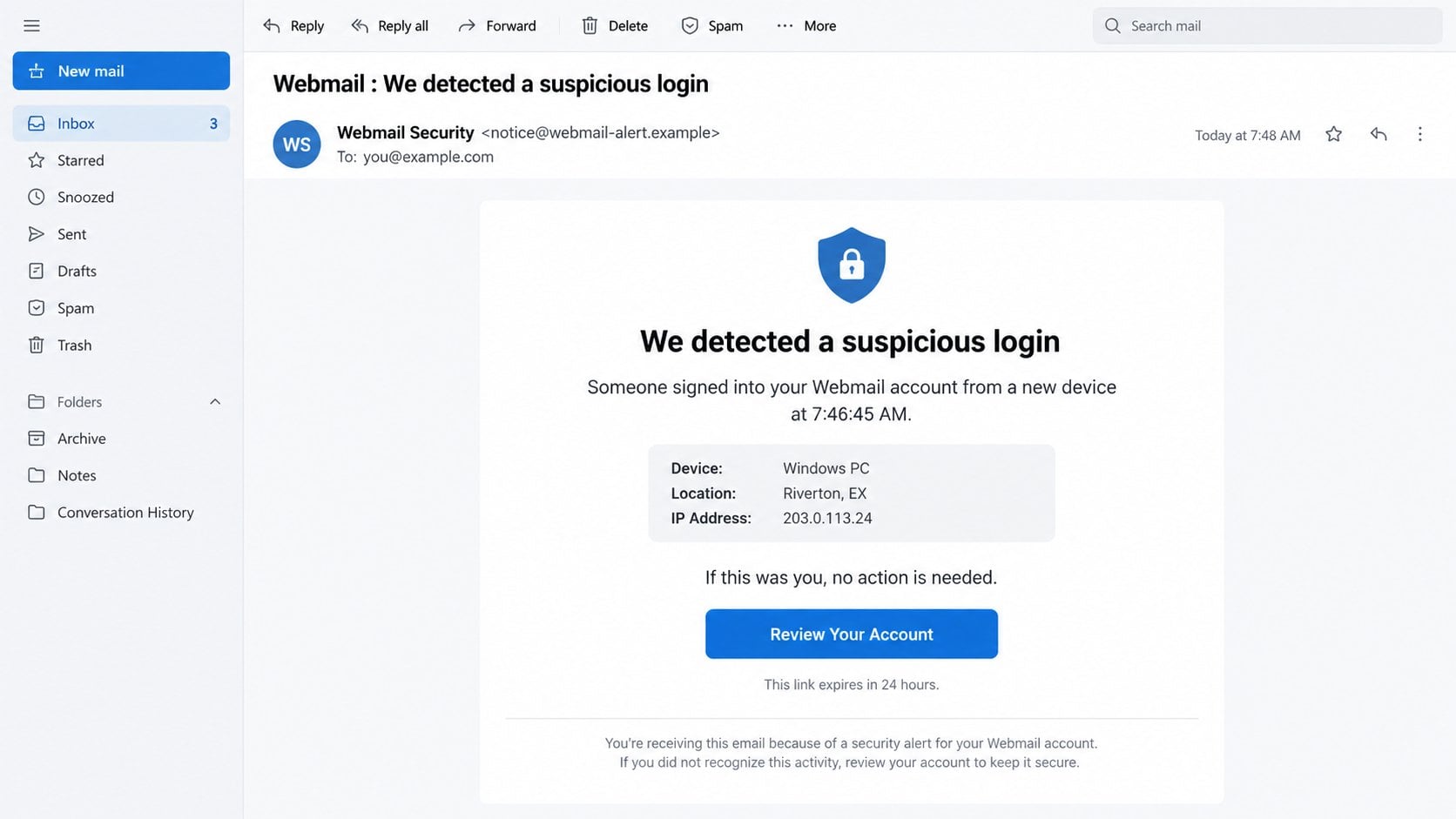
The cPanel Webmail Login From a New Device email scam says somebody accessed the recipient’s webmail account from an unfamiliar device.
The examined message used the subject “Webmail: We detected a suspicious login.” It placed the alleged event at 7:46:45 AM.
That second-by-second timestamp lends authority. It resembles the exact telemetry a real security platform might record after a successful sign-in.
The email tells recipients to do nothing if they recognize the activity. Everyone else is directed toward a “Review Your Account” button.
The Review Link Is the Trap
The button does not lead to a protected cPanel session. It opens a fake Webmail page built to collect an address and password.
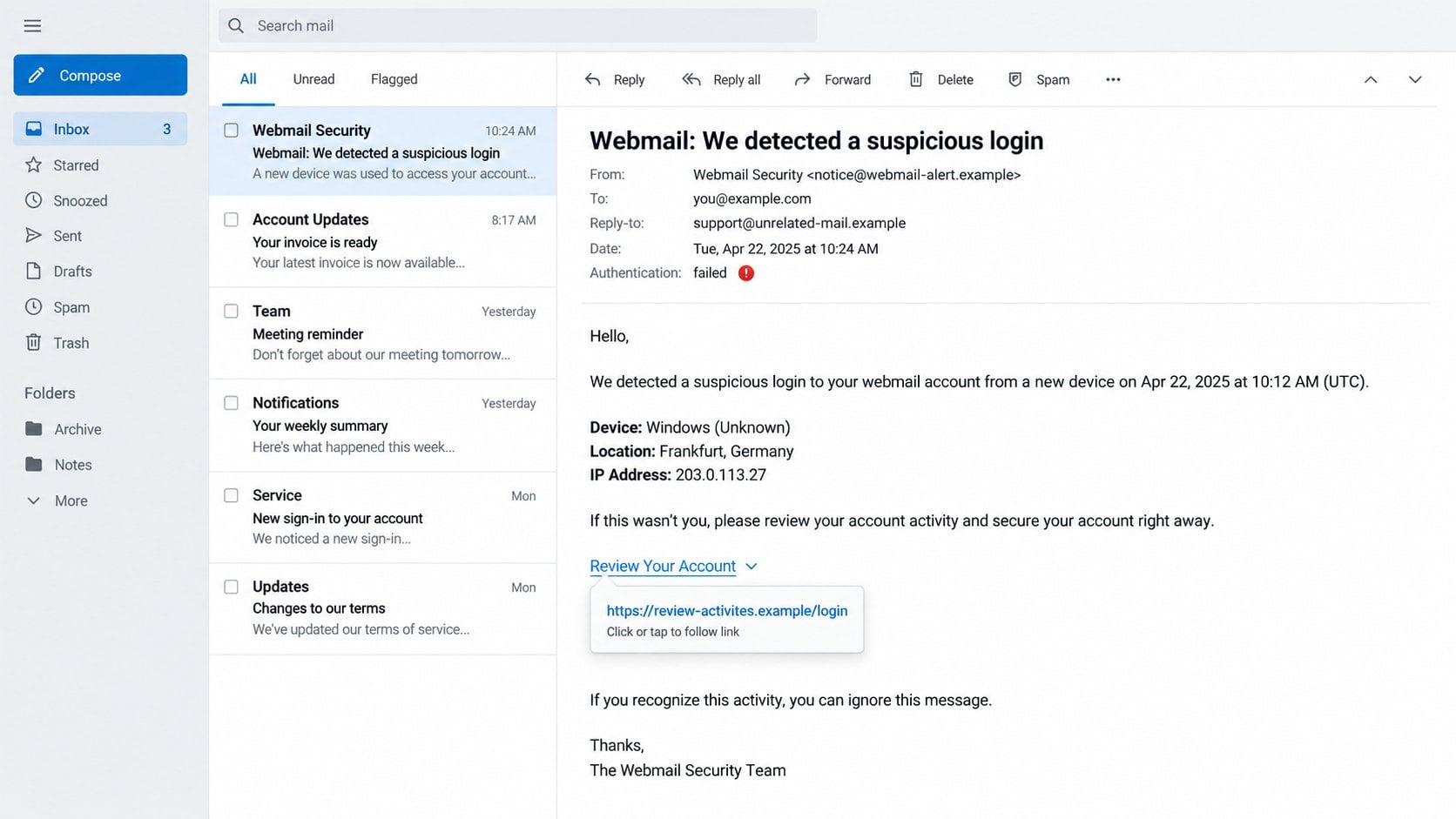
The observed destination included a misspelling resembling “review activites.” Small errors like that matter because genuine account portals use controlled, consistent domains.
- The alert arrives without a matching notification inside webmail.
- A precise time makes a vague claim appear logged.
- The recipient gets only 24 hours to respond.
- The sender address is not an established hosting contact.
- The review button leaves the genuine control-panel domain.
- The landing page asks for the full mailbox password.
- The misspelled destination is easy to overlook.
cPanel is a real hosting-control platform and is not responsible for this campaign. Criminals imitate familiar webmail language to gain trust.
What Criminals Can Do With Webmail Credentials
Webmail often belongs to a custom business domain. Access may expose customers, suppliers, quotations, invoices, support tickets, and internal discussions.
A criminal can study how the organization communicates before sending a tailored payment request. That later fraud may look far more convincing than the original lure.
Hosting accounts sometimes reuse or connect credentials across services. The attacker may test the stolen password against control panels, file transfer, and billing portals.
The operation is credential phishing, not a legitimate security review. The “new device” exists only to push the victim into authenticating on hostile infrastructure.
How the cPanel Webmail New Device Scam Works
Step 1: The Email Mimics a Familiar Security Notice
The campaign opens with restrained language rather than an extravagant claim. New sign-in alerts are common, so the message does not initially seem unusual.
It addresses the service generically as Webmail. That wording lets one template target thousands of independently hosted domains using different providers.
The sender avoids naming an actual hosting plan, server, organization, or administrator. Specific account facts would be difficult to invent accurately.
Instead, the email relies on the recipient’s existing concern about unauthorized access. The reader supplies the missing context.
Step 2: The Timestamp Simulates Security Evidence
The alleged login occurred at 7:46:45 AM. Including seconds suggests that an automated monitoring system recorded the event precisely.
Yet a timestamp alone proves nothing. The warning may omit a usable date, time zone, browser, IP address, or device identifier.
Real alerts usually let customers compare those details with activity shown inside the account. This message offers no independently reachable record.
Even when a phishing email includes an IP address, the value may be random, reserved, or copied. Every clue must agree with the real portal.
Step 3: A 24-Hour Expiration Encourages Immediate Action
The button is presented as a temporary security link that expires within 24 hours. That deadline makes delaying the review feel unsafe.
Expiration language also discourages asking a hosting company for help. Victims may believe support will respond after their only recovery opportunity disappears.
A genuine provider can be reached independently, and a compromised account can be secured through the normal portal. Safety never depends exclusively on one email button.
The message’s conditional phrasing feels reasonable: ignore it if the activity was yours. That small detail helps the fabricated alert sound operational.
Step 4: The Review Button Opens an Impostor Domain
The visible words “Review Your Account” conceal the address underneath. The recipient sees a security action, while the browser visits an unrelated site.
In the analyzed campaign, the destination imitated webmail and used a suspicious spelling in its host. It was not the server that normally handled the mailbox.
Phishing domains may contain terms such as webmail, review, secure, account, or activity. Keywords are inexpensive and confer no official relationship.
The registered domain should match the provider’s established address. A plausible path on the wrong host remains the wrong destination.
Step 5: The Counterfeit Panel Requests the Password
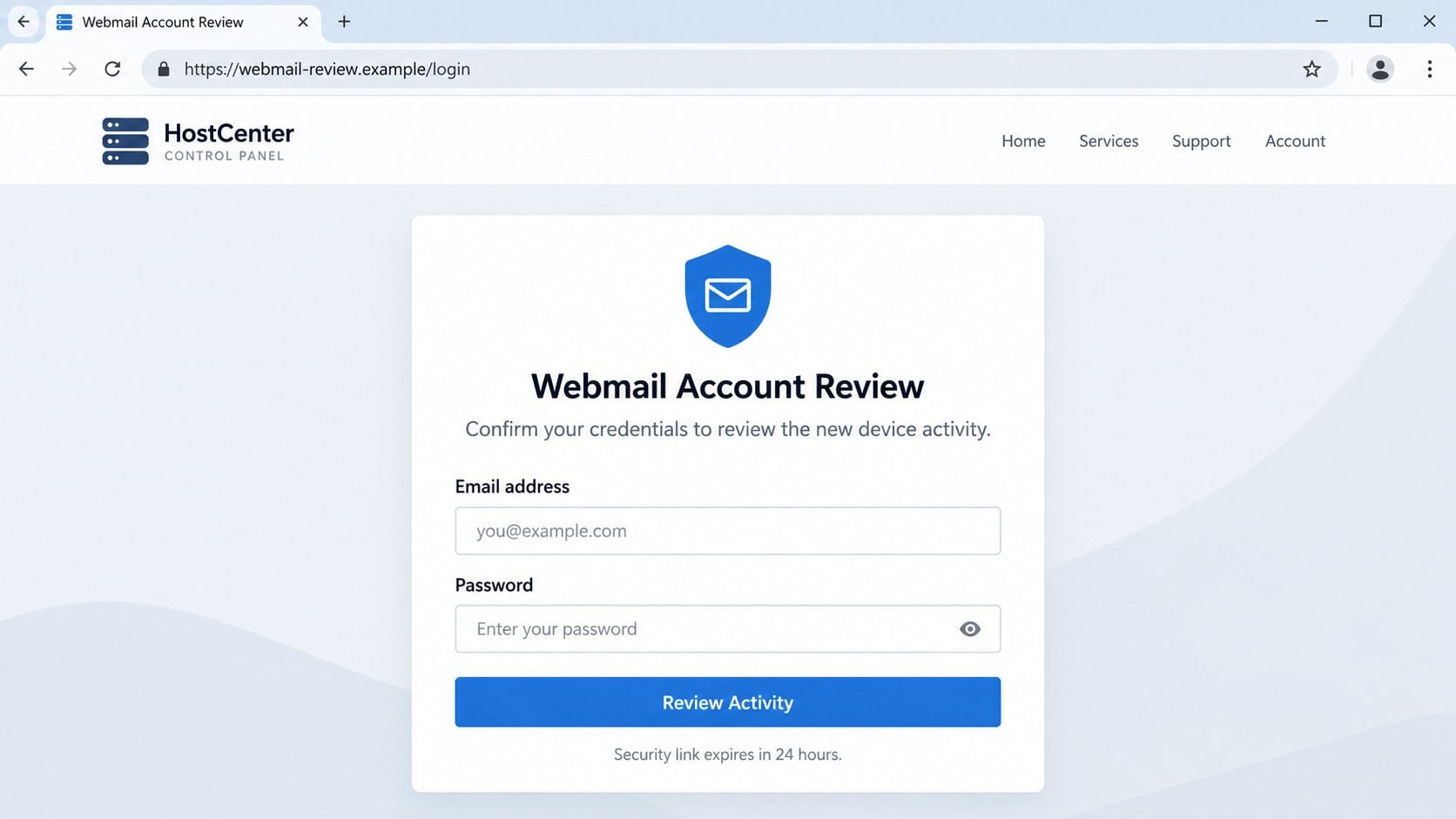
The landing page resembles a clean hosting interface. A shield icon, white card, and blue button reproduce the visual expectations of an account-security workflow.
It asks for the mailbox address and password to review activity. Those fields do not connect the visitor to cPanel or the legitimate hosting company.
Submitting the form transfers the data to the operator. A loading animation or generic error may appear while the information is stored elsewhere.
Some kits prefill the address from the link. Personalization of that kind means the URL carried the email value, not that the site verified ownership.
Step 6: The Intruder Turns One Mailbox Into Leverage
Successful access lets the attacker search for billing messages, password resets, domain-renewal notices, and conversations involving money.
The criminal may register forwarding rules, create application passwords, or keep a session active. Those footholds can survive an incomplete cleanup.
A compromised custom-domain address carries organizational authority. Fraudulent requests from that address can reach customers, contractors, or other employees.
If the credential was reused, the attack expands. Hosting panels, domain registrars, and remote administration tools become especially valuable targets.
How to Verify a Webmail Login Alert
Check Activity From the Known Control Panel
Use the bookmark or hosting dashboard you already trust. Navigate to account security and recent sessions without touching the email’s button.
Look for a login matching the stated time, allowing for your actual time zone. Compare the device, browser, IP address, and approximate location.
If no corresponding event appears, capture the warning and report it. Do not sign in repeatedly through the questionable route.
Identify Who Actually Operates the Mailbox
cPanel software may power the service, but your host, employer, or administrator manages the account. Their verified contact details matter.
Compare the sender with earlier billing, support, or maintenance notices. Hosting providers generally send from stable domains with recognizable ticket references.
For workplace mail, ask the internal technical team. An outside message claiming to be “Webmail Security” may bypass the organization’s established support identity.
Read the Destination Character by Character
Preview the link and inspect the hostname. Misspellings such as “activites” instead of “activities” are strong warnings, especially inside a security portal.
Watch for added words, unusual endings, substituted letters, and domains that place the real brand only in a subdomain.
A valid certificate does not correct a deceptive address. Encryption protects the connection to whoever owns the impostor site.
Contact Hosting Support Outside the Message
Open a ticket from the provider’s normal dashboard or use a telephone number on a known invoice. Describe the alert without relying on its reply address.
Support can confirm whether the notice format is theirs and inspect the login logs. They can also secure the account if a genuine intrusion occurred.
Never send a password to support by email. Legitimate technicians can reset access or verify records without learning the customer’s existing secret.
What to Do If You Fell Victim to the cPanel Webmail Login Scam
A prompt response can contain the incident. Begin with the mailbox, then consider every service where the same credential may have been used.
- Stop interacting with the imitation panel.
Close it and do not test additional credentials. Record the alert subject, sender, destination, and the time you submitted information.
Hosting customers should retain relevant screenshots and headers. Those details help the provider identify the kit and remove similar messages.
- Change the password through the genuine host.
Open the trusted control panel directly and set a unique replacement. If access fails, begin recovery from the provider’s official support page.
Do not use a password derived from the old one. Attackers often test predictable variations after a reset.
- Protect connected hosting services.
Review cPanel, domain registrar, file-transfer, database, billing, and site-administration accounts. Replace any credential that matched or closely resembled the exposed password.
Check whether contact emails, nameservers, authorized keys, or recovery options changed. Website control can be more damaging than mailbox access alone.
- End sessions and inspect mailbox persistence.
Sign out unfamiliar devices, revoke application passwords, and remove unrecognized connected applications. Then inspect forwarding, filters, aliases, and delegates.
Search sent and deleted mail for messages you did not create. Hidden replies may show which contacts the intruder targeted.
- Add strong multifactor authentication.
Enable a passkey, hardware key, or authenticator application on both mail and hosting accounts. Protect the registrar separately when possible.
Review backup codes and recovery contacts. Remove old telephone numbers or addresses that an attacker could exploit later.
- Examine devices if anything was downloaded.
The observed route focused on credential capture, but copycat pages may add files or browser prompts. Scan opened downloads with Malwarebytes.
AdGuard can stop many reported phishing hosts and intrusive redirects. Use it as supporting protection, not as permission to trust unexpected account buttons.
- Notify the provider and exposed correspondents.
Ask the host to review authentication logs and preserve evidence. Tell customers or coworkers if fraudulent mail left your address.
Contact banks immediately when payment instructions or financial records were accessible. Preserve case numbers and document each remedial action.
Is Your Device Infected? Run a Free Malware Scan
Slow performance, constant pop-ups, or strange behavior? These are classic signs of a malware infection. The fastest way to find out is to scan your device with Malwarebytes Free — one of the most trusted malware removal tools available.
The free version detects and removes the most common threats, including:
- Adware — the cause of those annoying pop-ups
- Browser hijackers — unwanted redirects and changed homepages
- Trojans and spyware — hidden programs stealing your data
- Potentially unwanted programs (PUPs) — software you never asked for
👉 Select your device below — Windows, Mac, or Android — then follow the simple steps to download Malwarebytes, scan your system, and remove any threats it finds. The scan usually takes 5 to 20 minutes.
Run a Malware Scan with Malwarebytes for Windows
Malwarebytes is one of the most popular and trusted anti-malware tools for Windows — and it’s completely free for removing infections. It catches threats that many antivirus programs miss, including adware, browser hijackers, and trojans. Follow the steps below to scan and clean your PC in just a few minutes.
Download Malwarebytes
Click the button below to download the latest version of Malwarebytes for Windows from the official source. The free version is all you need — it will scan your computer and remove adware, browser hijackers, and other malicious software at no cost.
Download MalwarebytesOfficial installer for Windows 11 and 10. Your download starts right away.Want real-time protection? See Malwarebytes Premium Malwarebytes Free for WindowsScans and removes malware at no cost
-
Install Malwarebytes
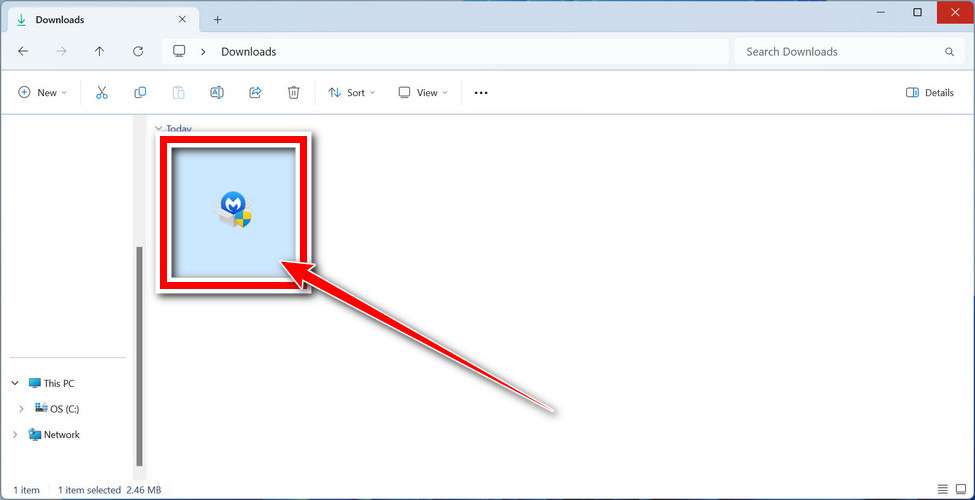
When the download finishes, open your Downloads folder and double-click the MBSetup file. If Windows shows a User Account Control pop-up, click “Yes” to allow the installation.
Follow the On-Screen Prompts to Install Malwarebytes
The setup wizard will walk you through a few quick screens:
-
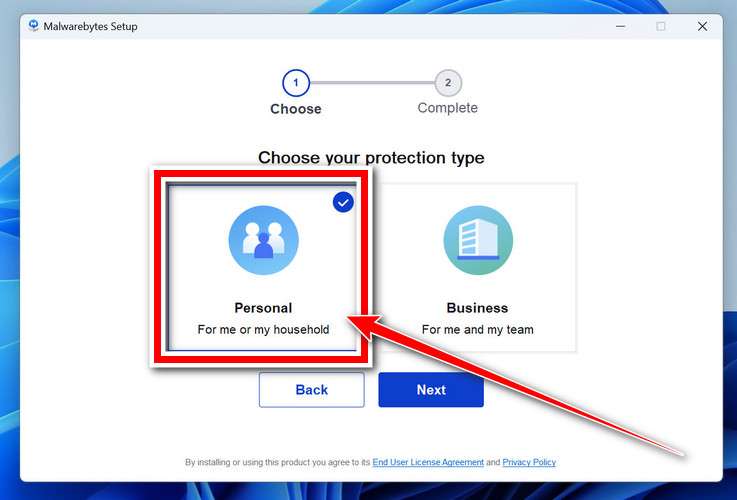
Choose where you’re installing the program — “Personal Computer” or “Work Computer” — then click Next.
-
Malwarebytes will now install on your device. This usually takes under a minute.

-
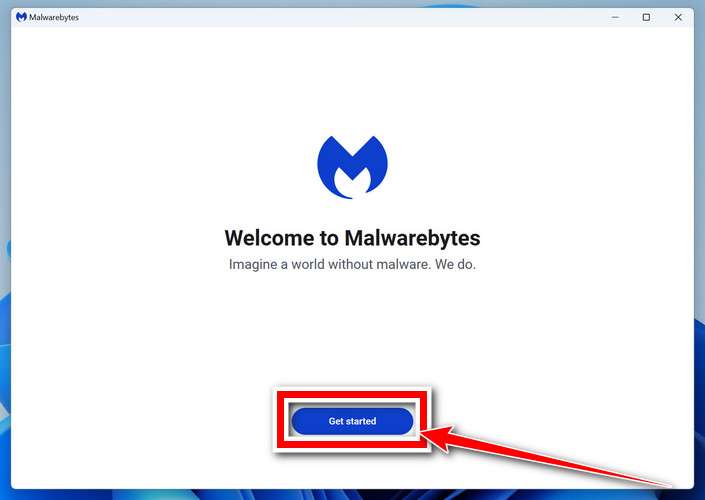
When installation is complete, the “Welcome to Malwarebytes” screen will open automatically.
-
On the final screen, click Open Malwarebytes to launch the program.

-
Enable “Scan for Rootkits”
Before scanning, turn on rootkit detection so Malwarebytes can find even the most hidden threats. Click the Settings gear icon on the left side of the screen.
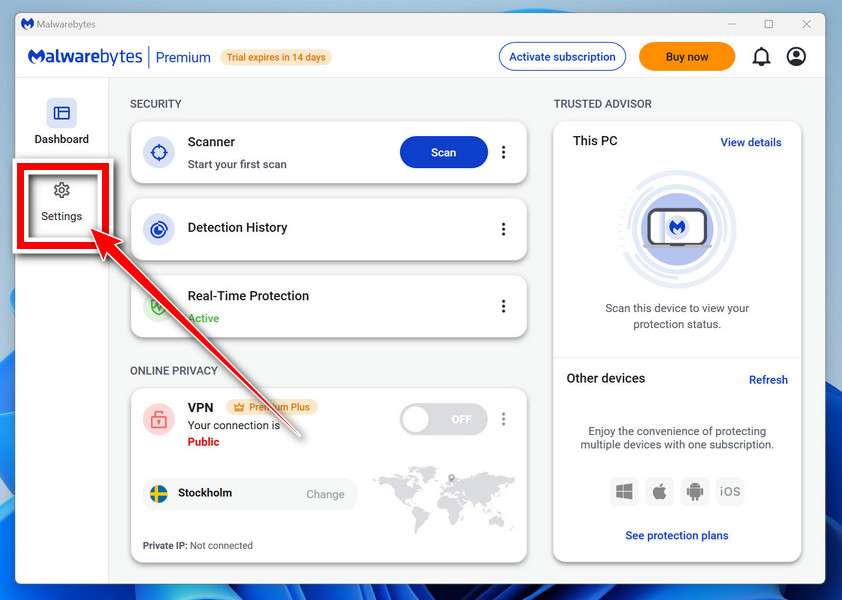
In the settings menu, find “Scan for rootkits” and click the toggle so it turns blue.

Done? Click “Dashboard” in the left pane to return to the main screen.
Start the Scan
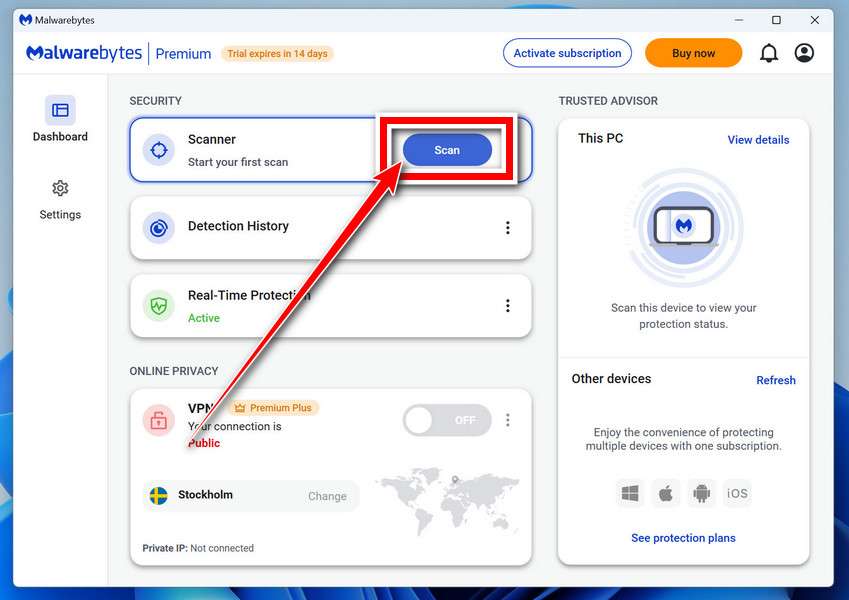
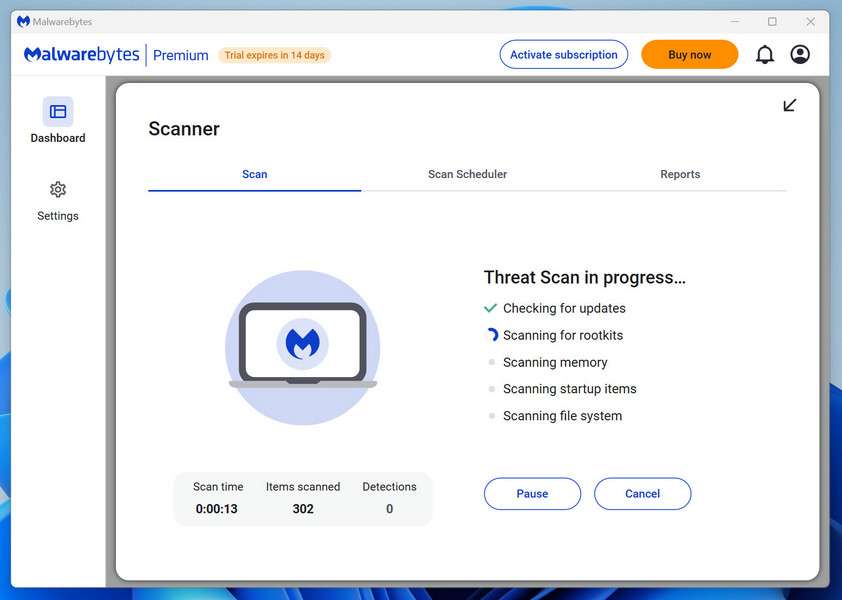
Click the blue Scan button. Malwarebytes will automatically update its virus database and start checking your computer for malware.
-
Wait for the Scan to Finish
The scan checks your entire system for browser hijackers and other malicious programs, so it can take 5 to 20 minutes depending on your computer. Feel free to do something else — just check back occasionally to see the progress.
-
Quarantine the Detected Threats
When the scan is done, you’ll see a list of everything Malwarebytes found — malware, adware, and potentially unwanted programs. Click the “Quarantine” button to remove all of them at once.
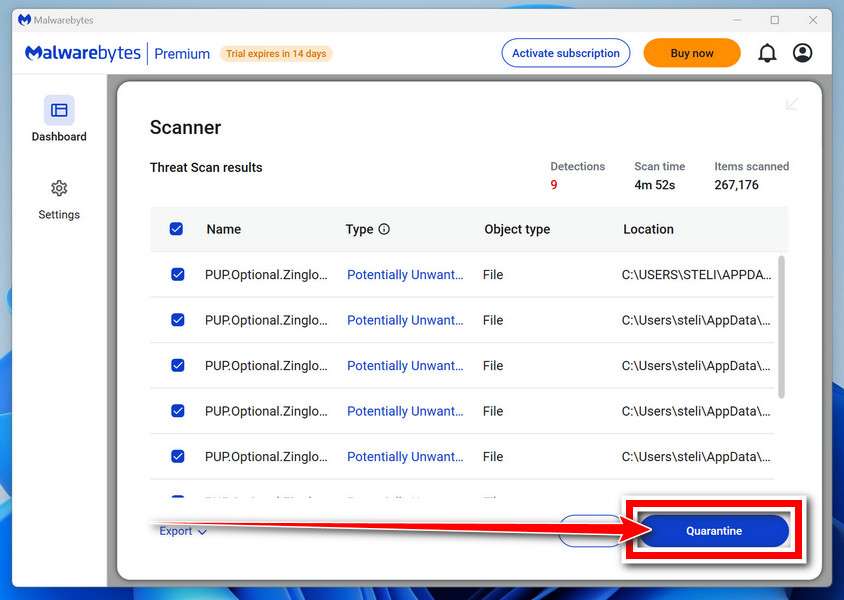
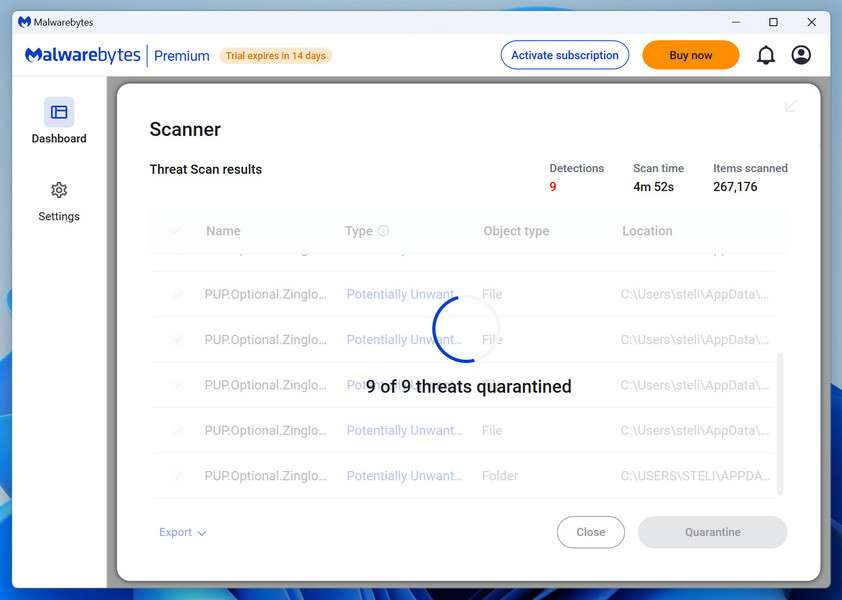
Malwarebytes will now remove the malicious files and registry entries and move them safely into quarantine.
-
Restart Your Computer
Some threats can only be fully removed after a reboot. If Malwarebytes asks you to restart, click Yes. Once you’re logged back in, Malwarebytes has finished removing the threats it found.
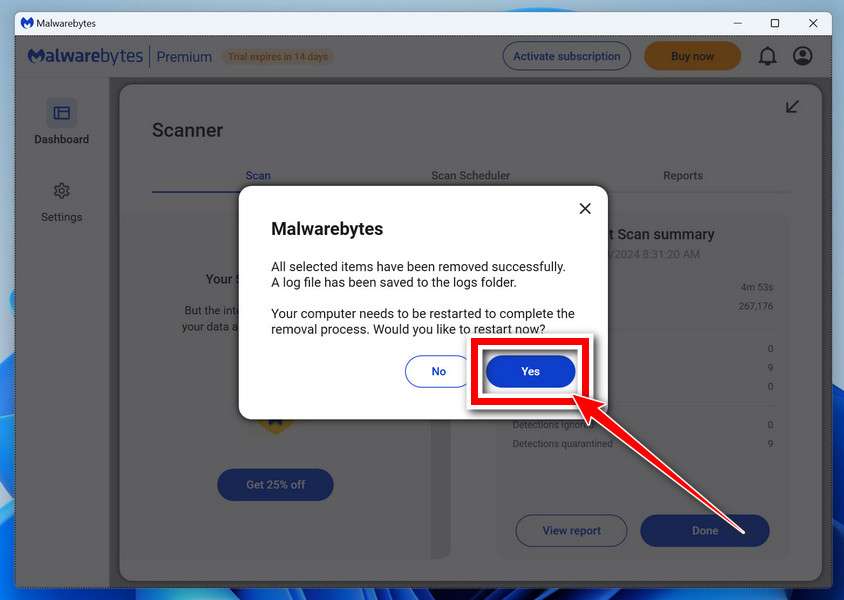
That’s it — your Windows PC is now clean of trojans, adware, and other malware, and should be back to running smoothly.
If you are still having problems with your computer after completing these instructions, then please follow one of the steps:
- Run a computer scan with ESET Online Scanner
- Ask for help in our Windows Malware Removal Help & Support forum.
Run a Malware Scan with Malwarebytes for Mac
Malwarebytes for Mac is a free on-demand scanner that removes the malware other security software tends to miss — adware, browser hijackers, and unwanted programs included. Cleaning an infected Mac with Malwarebytes has always been completely free, and it’s our go-to recommendation. Follow the steps below to scan and clean your Mac in just a few minutes.
-
Download Malwarebytes for Mac
Click the button below to download the latest version of Malwarebytes for Mac.
Download MalwarebytesOfficial installer for macOS. Your download starts right away.Want real-time protection? See Malwarebytes PremiumMalwarebytes Free for MacScans and removes malware at no cost -
Open the Malwarebytes setup file
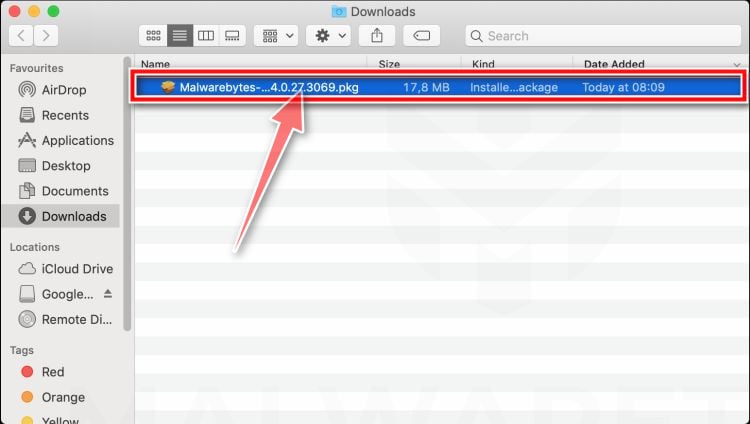
When the download finishes, open your Downloads folder and double-click the setup file to begin the installation.
-
Follow the On-Screen Prompts to Install Malwarebytes
The Malwarebytes for Mac Installer will guide you through a few quick screens. Click “Continue” and keep following the prompts until the installation completes.
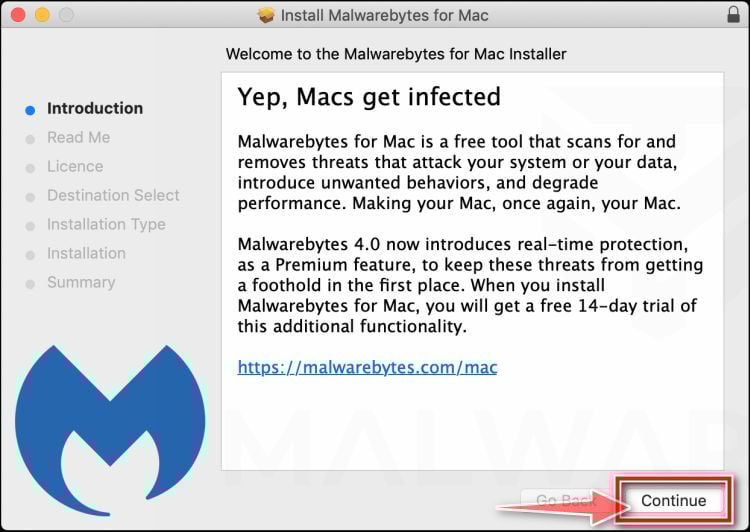
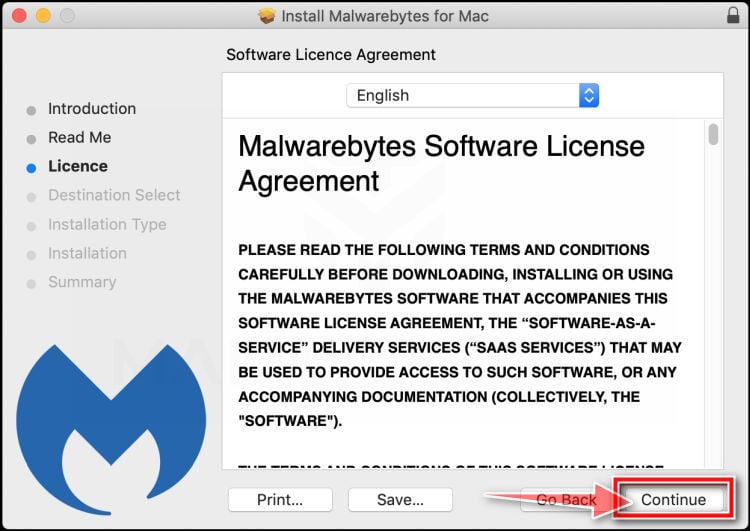
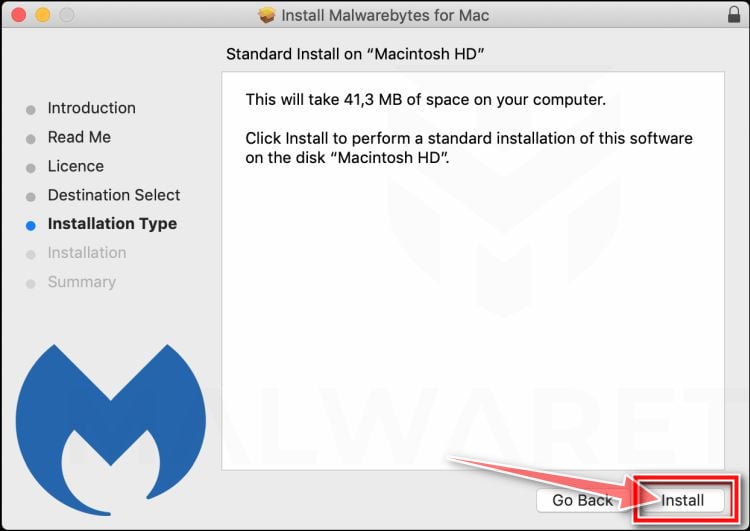
When the installation is complete, Malwarebytes opens to the Welcome to Malwarebytes screen. Click “Get started“.
-
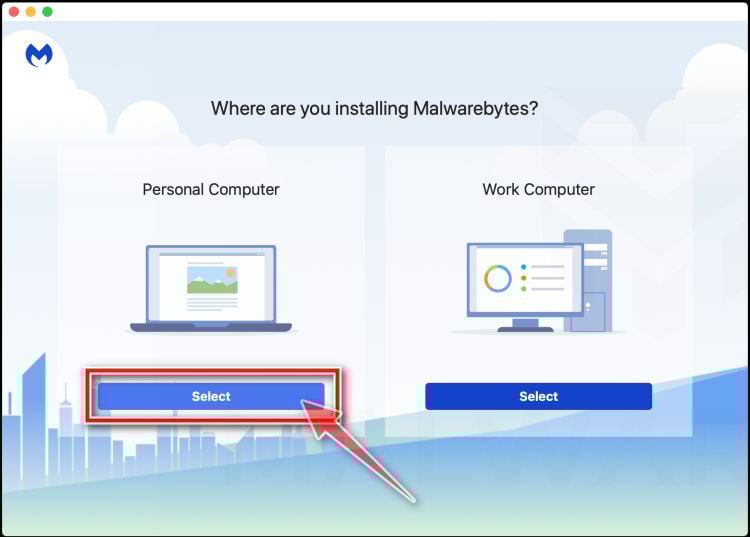
Select “Personal Computer” or “Work Computer”
Malwarebytes will ask what type of computer you’re installing it on. Click either Personal Computer or Work Computer, whichever applies.
-
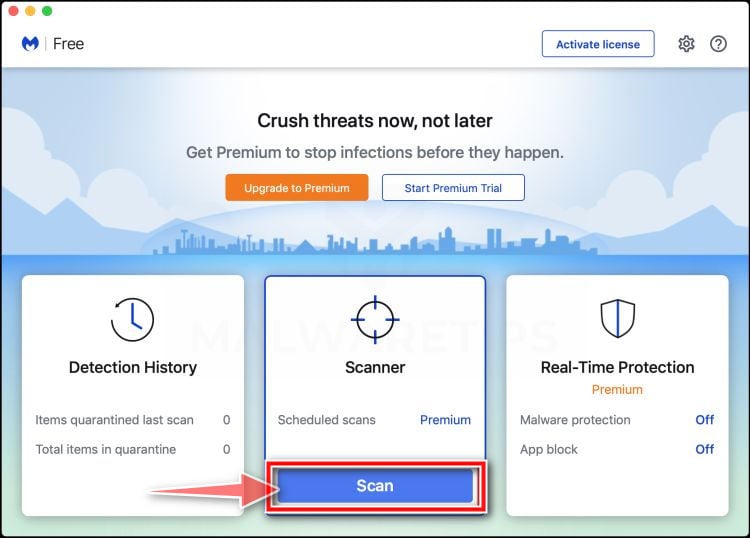
Start the Scan
Click the “Scan” button. Malwarebytes will automatically update its detection database and begin checking your Mac for malware.
-
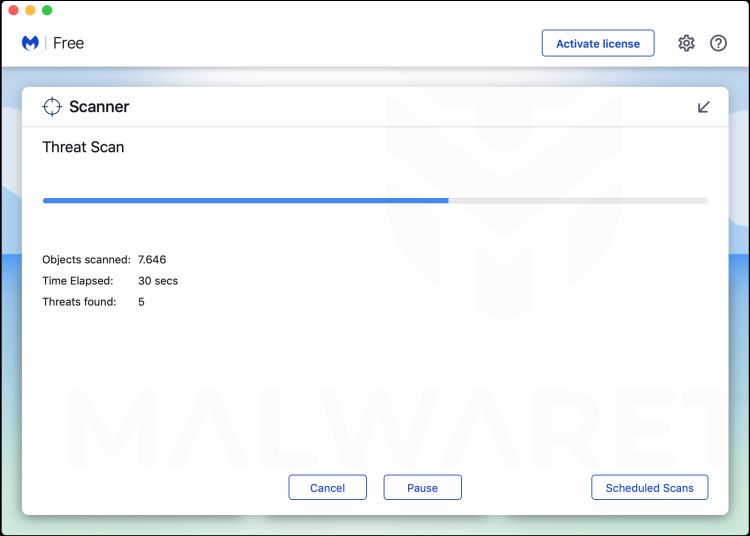
Wait for the Scan to Finish
Malwarebytes will scan your Mac for adware, browser hijackers, and other malicious programs. This can take a few minutes, so feel free to do something else — just check back occasionally to see the progress.
-
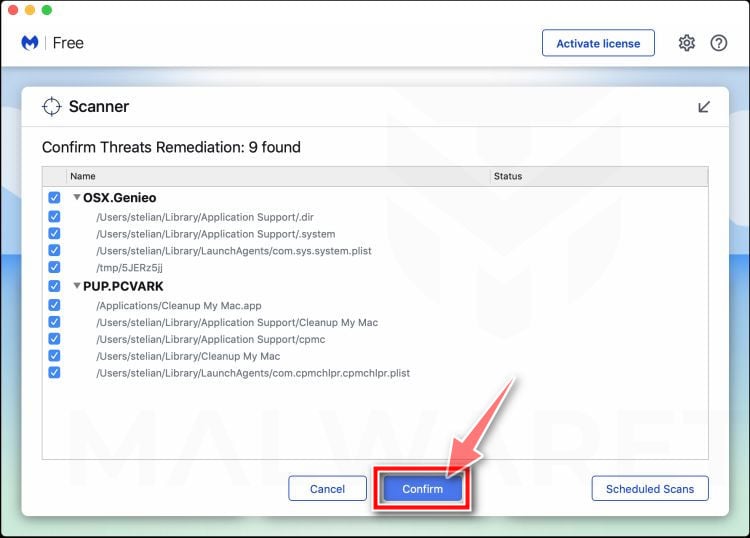
Quarantine the Detected Threats
When the scan is done, you’ll see a list of everything Malwarebytes found. Click the “Quarantine” button to remove all the threats at once.
-
Restart Your Mac
Malwarebytes will now remove all the malicious files it found. Some threats can only be fully removed after a reboot — if Malwarebytes asks you to restart, allow it. Once you’re logged back in, your Mac is clean.
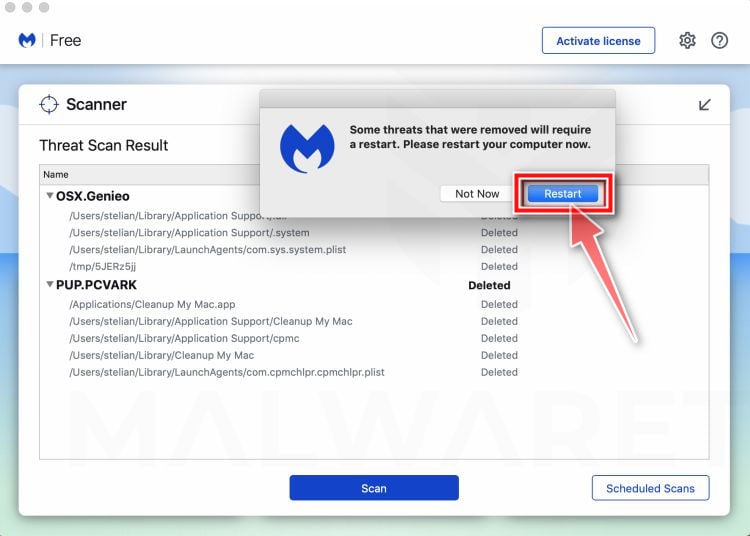
That’s it — your Mac is now free of adware, rogue browser extensions, and other potentially harmful software.
If you are still experiencing problems while trying to remove a malicious program from your computer, please ask for help in our Mac Malware Removal Help & Support forum.
Run a Malware Scan with Malwarebytes for Android
Malwarebytes for Android automatically detects and removes dangerous threats like malware and ransomware so you don’t have to worry about your most-used device being compromised. Aggressive detection of adware and potentially unwanted programs keeps your Android phone or tablet running smooth.
-
Download Malwarebytes for Android.
You can download Malwarebytes for Android by clicking the link below.
Get Malwarebytes for AndroidOpens Google Play in a new tab.Want real-time protection? See Malwarebytes Premium for AndroidMalwarebytes for AndroidScans your phone and removes malware at no cost -
Install Malwarebytes for Android on your phone.
In the Google Play Store, tap “Install” to install Malwarebytes for Android on your device.

When the installation process has finished, tap “Open” to begin using Malwarebytes for Android. You can also open Malwarebytes by tapping on its icon in your phone menu or home screen.

-
Follow the on-screen prompts to complete the setup process
When Malwarebytes will open, you will see the Malwarebytes Setup Wizard which will guide you through a series of permissions and other setup options.
This is the first of two screens that explain the difference between the Premium and Free versions. Swipe this screen to continue.
Tap on “Got it” to proceed to the next step.
Malwarebytes for Android will now ask for a set of permissions that are required to scan your device and protect it from malware. Tap on “Give permission” to continue.
Tap on “Allow” to permit Malwarebytes to access the files on your phone.
-
Update database and run a scan with Malwarebytes for Android
You will now be prompted to update the Malwarebytes database and run a full system scan.

Click on “Update database” to update the Malwarebytes for Android definitions to the latest version, then click on “Run full scan” to perform a system scan.

-
Wait for the Malwarebytes scan to complete.
Malwarebytes will now start scanning your phone for adware and other malicious apps. This process can take a few minutes, so we suggest you do something else and periodically check on the status of the scan to see when it is finished.

-
Click on “Remove Selected”.
When the scan has been completed, you will be presented with a screen showing the malware infections that Malwarebytes for Android has detected. To remove the malicious apps that Malwarebytes has found, tap on the “Remove Selected” button.

-
Restart your phone.
Malwarebytes for Android will now remove all the malicious apps that it has found. To complete the malware removal process, Malwarebytes may ask you to restart your device.
That’s it — your Android phone is now clean — no more malicious apps, adware, or browser redirects.
If you are still having problems with your phone after completing these instructions, then please follow one of the steps:
- Restore your phone to factory settings by going to Settings > General management > Reset > Factory data reset.
- Ask for help in our Mobile Malware Removal Help & Support forum.
Stay Protected: Block Ads and Malicious Sites
Now that your device is clean, keep it that way. Most infections start with a malicious ad or a fake download button — so blocking them at the source is your best defense.
We recommend AdGuard, which blocks malicious ads, phishing pages, and dangerous redirects before they can reach you.
👉 Download AdGuard and browse safely
Why Hosting-Account Phishing Is Especially Serious
A personal inbox is valuable, but a custom-domain mailbox can represent an entire business. Its address often signals authority to outsiders.
Hosting correspondence may reveal renewal dates, registrar details, support PINs, server names, and administrative usernames. Those fragments support more focused attacks.
Website reset messages can also arrive there. The intruder may request a new administrator password and intercept the response.
Small businesses are attractive because one person may control email, billing, domains, and the website. A single credential can bridge several systems.
The fake new-device warning reverses the roles. The victim believes they are excluding an intruder while actually supplying that intruder with access.
Practical Defenses for Hosted Email
Use separate passwords for mailbox users, hosting administration, domain registration, and website management. Separation prevents one captured secret from opening every layer.
Require multifactor authentication on privileged accounts. Limit administrator access to people who genuinely need it, and remove dormant users.
Configure authentication records for your domain and monitor failures. These controls cannot stop every impersonation, but they improve filtering and investigation.
Teach staff the verified route to webmail. A bookmarked address is more dependable than searching or following an urgent message.
Create alerts for forwarding-rule changes, new application passwords, unfamiliar countries, and excessive failed logins. Early warnings shrink an attacker’s working time.
Keep reliable website and mailbox backups under separate credentials. Recovery becomes much safer when a compromised hosting account cannot delete every copy.
Establish a verbal confirmation process for financial requests arriving by email. An attacker reading existing conversations can imitate tone and timing convincingly.
Finally, make reporting straightforward. The employee who questions a polished notice is providing useful intelligence, not creating unnecessary work.
Hosting customers should keep provider ownership records current. An outdated recovery address can turn a small mailbox incident into a long account-recovery dispute.
Administrators should record which users need access to DNS, backups, databases, and mail. Narrow privileges prevent one compromised identity from controlling every service.
Quarterly restore tests are equally important. A backup that nobody has successfully restored cannot be treated as dependable protection during a hosting emergency.
These measures also clarify responsibility. When users know who manages webmail, a nameless external security team loses much of its persuasive power.
Frequently Asked Questions
Was there really a webmail login at 7:46:45 AM?
The email’s timestamp is not proof. Compare it with recent activity inside the genuine control panel and account for the displayed time zone.
Is cPanel responsible for the suspicious message?
No. The campaign imitates cPanel-style webmail language. The legitimate software company did not authorize the unrelated password-collection page.
Why does the alert say the link expires in 24 hours?
The deadline adds pressure and makes independent support seem too slow. A real provider remains reachable through its normal dashboard after an email link expires.
Does HTTPS mean the review page is safe?
No. HTTPS encrypts traffic between you and the site. It does not confirm that the site belongs to your host or treats credentials honestly.
What if the message time matches a real login?
Secure the account through the official portal and contact the host. A real event can coexist with a phishing message, so avoid the embedded button.
Should I change my cPanel password too?
Yes, if it matched or resembled the submitted mailbox password. Review the hosting account for unauthorized changes and enable separate multifactor protection.
The Bottom Line
The cPanel Webmail Login From a New Device scam invents suspicious activity, supplies a precise time, and hides a credential collector behind account review.
Use the known hosting dashboard, examine the domain closely, and contact the real provider. A security alert should never dictate an unfamiliar route to your password.








