


A mailbox warning reports that storage has reached 98.4% and incoming messages may bounce. For anyone managing a busy domain, the timing feels impossible to ignore.
Before synchronizing anything, examine how this notice was delivered and what the destination expects you to provide.
Overview
The alarming storage report
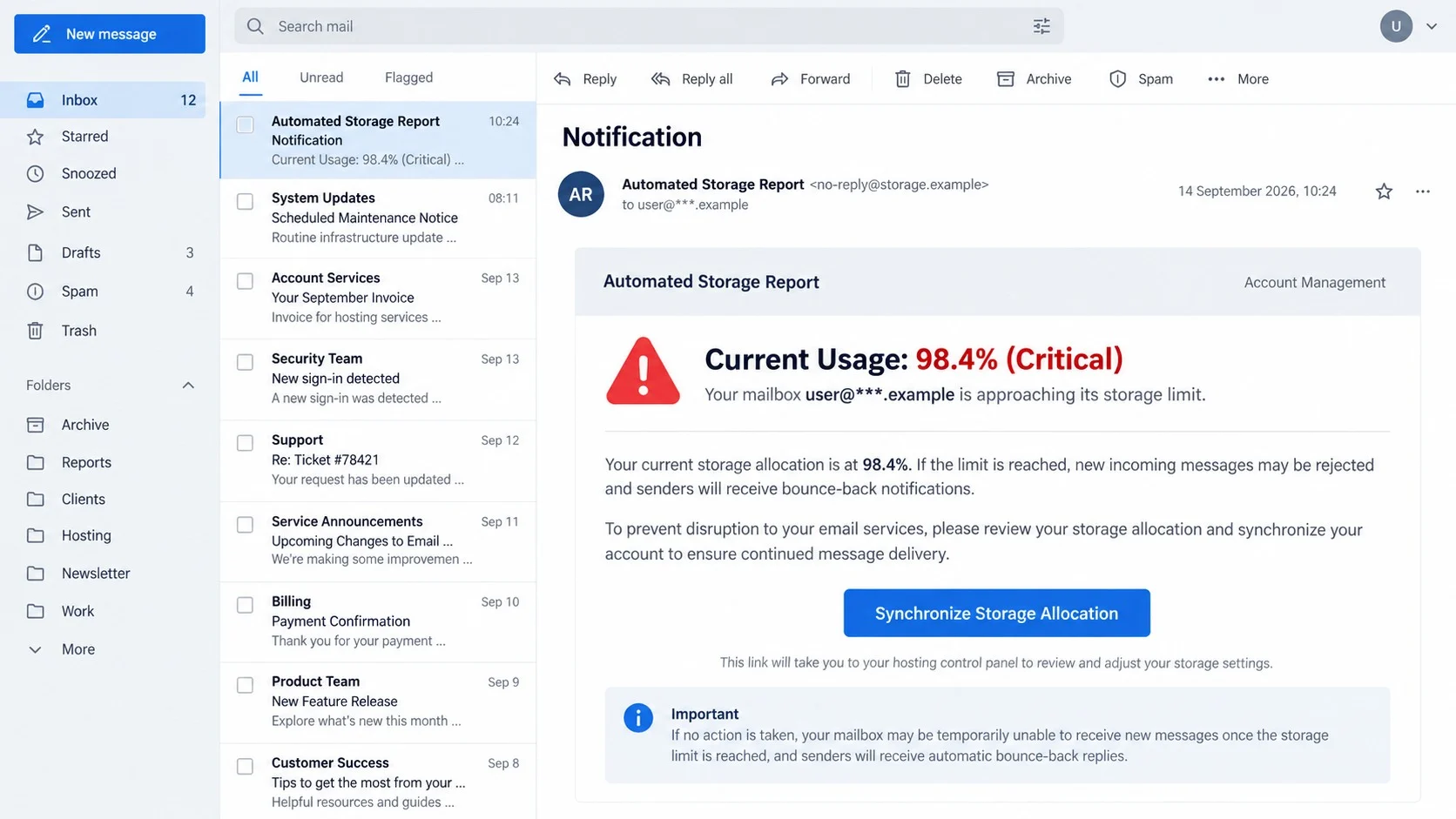
The email presents itself as an automated cPanel report. It claims the recipient’s mailbox is almost full and has reached a critical threshold.
A 98.4% figure makes the warning feel measured rather than invented. The message says new mail could fail unless the allocation is synchronized.
The supposed remedy is a button labeled “Synchronize Storage Allocation.” That technical phrase makes a login request sound like routine server maintenance.
The credential theft behind the button
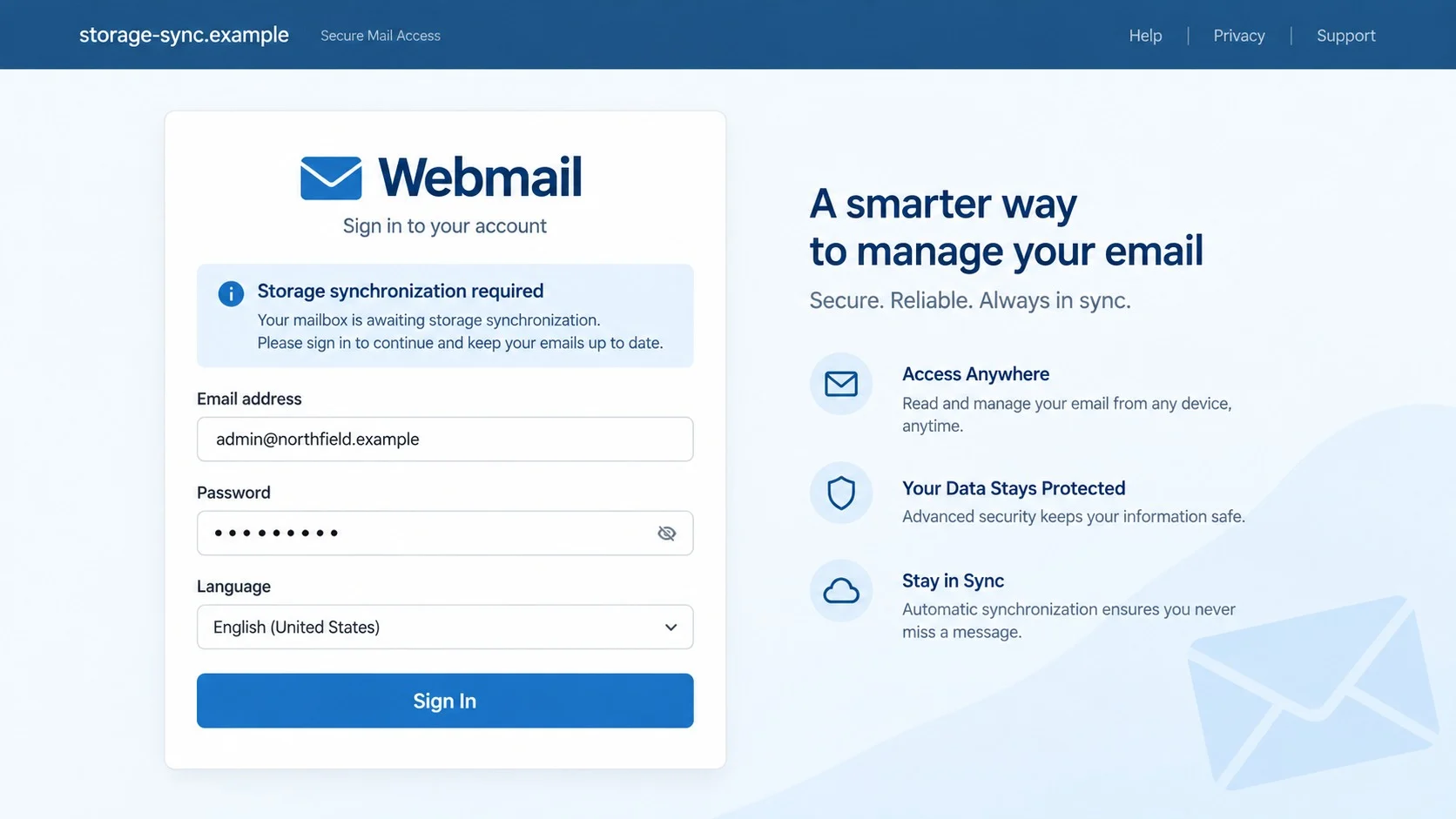
The button opens a counterfeit webmail sign-in page, not the hosting provider’s authenticated control panel. The observed copy was hosted through abused cloud storage.
The page asks for an email address and password. Submitting them hands mailbox credentials to the campaign’s operators instead of changing any quota.
cPanel has no connection to this message. The criminals borrow its familiar name because many websites and business mailboxes run through cPanel-based hosting.
Why one mailbox can expose an entire business
A compromised mailbox contains more than messages. It can unlock password resets, invoices, customer records, private attachments, and internal conversations.
Attackers may quietly add forwarding rules, study payment habits, and send believable requests from the real address. The resulting fraud can outlast the original campaign.
The key findings are:
- The 98.4% reading is an invented pressure tactic.
- The synchronization button does not increase mailbox storage.
- The landing page captures webmail login details.
- Cloud hosting does not make the form part of cPanel.
- Mailbox takeover can lead to invoice fraud and broader account compromise.
How the cPanel Automated Storage Report Scam Works
Step 1: The attacker sends a technical-looking notification
The scam arrives as a brief system alert, often with a generic subject such as “Notification.” It avoids flashy promises and imitates administrative mail.
Recipients who manage websites already expect quota warnings. That familiar business process gives the email a plausible reason to request immediate attention.
The message may insert the recipient’s domain or email address automatically. Personalization can be assembled from public records and does not prove server access.
Because the notice resembles machine-generated mail, an impersonal greeting may not feel suspicious. The template turns its lack of detail into part of the disguise.
Step 2: A precise percentage manufactures urgency
The claim that storage reached 98.4% is designed to look like live telemetry. Precision creates authority even when the number has no connection to the server.
The warning adds a believable consequence: incoming mail will bounce. Missing orders or customer messages feels more urgent than an abstract security notice.
Some recipients will click simply to protect business continuity. The email counts on that reflex and provides no trustworthy path to verify the quota first.
A real provider can show usage inside its control panel. There is no reason to authenticate through a page reached only from an unsolicited email.
Step 3: The synchronization button opens a fake webmail page
The button’s wording suggests a harmless capacity adjustment. In practice, it redirects the browser to a webmail login controlled by the attacker.
The observed landing page was served from Firebase Storage, a legitimate cloud service that can also be abused to host phishing content.
A trusted platform name in the address does not authenticate the page. The relevant question is whether your hosting company owns and directs that exact destination.
The fake form may include a language selector and familiar webmail layout. Those details are visual props, not evidence of a working mailbox service.
Step 4: The form sends the password to criminals
Once credentials are entered, the page can transmit them immediately. No storage synchronization occurs because the form has no administrative relationship with the mailbox.
Victims may see a loading screen, an incorrect-password message, or a redirect. A second request sometimes exists to capture a carefully retyped password.
If the page returns to normal webmail afterward, that redirection only hides the theft. It cannot erase the data already submitted.
The attackers may test access within minutes. Automated login attempts can reveal whether the password works and whether multifactor authentication stands in the way.
Step 5: The intruder establishes quiet mailbox access
A successful login lets the intruder search for financial language, password resets, identification documents, and useful contacts.
Forwarding or inbox rules can copy messages externally and hide security alerts. Filters may move replies into archives so the owner notices nothing unusual.
The attacker can also create application passwords or maintain sessions when the provider permits them. Changing only the main password may leave those doors open.
Quiet persistence matters because observation improves later impersonation. A criminal who understands an organization’s writing style can send much stronger fraudulent requests.
Step 6: The compromised address becomes a fraud tool
Real mailbox access allows messages to pass many superficial authenticity checks. Customers and colleagues recognize the sender because the message genuinely came from that account.
Common next steps include fake invoice updates, payroll redirection, malicious attachments, and password-reset abuse. The original storage story may never appear again.
Attackers sometimes reply inside existing conversations. A payment change placed in a familiar thread can be far more convincing than a cold phishing email.
Compromise can spread when the stolen password was reused. Hosting panels, cloud storage, social accounts, and vendor portals may all become reachable.
How to Verify a cPanel Storage Report
Check quota inside the real control panel
Open your provider’s dashboard through a saved bookmark or billing portal. Navigate to email usage without clicking anything in the warning.
Compare the reported quota, current consumption, and account domain. A genuine limit should exist in the authoritative control panel, not only inside an email.
If the dashboard shows normal usage, take a screenshot for your administrator and delete the suspicious message after preserving any needed evidence.
Identify who actually manages the mailbox
cPanel is software used by many hosts, not necessarily the company that bills or supports you. Real notices usually reflect the provider’s established communication channel.
Ask the organization’s administrator whether quota alerts are enabled and what their templates look like. Internal confirmation is safer than replying to the sender.
Managed accounts may have no direct cPanel access at all. An unexpected cPanel login request is especially suspicious in that situation.
Examine the destination and authentication results
Inspect the complete sender address and link target. A cloud-storage address, redirector, or unrelated domain should not receive your email password.
Mail headers can reveal whether sender authentication passed, although a pass alone does not guarantee legitimacy. Compromised domains can send authenticated phishing.
Report the message to whoever administers your mail gateway. They can block related senders and search for other employees who received the same lure.
Compare the request with normal quota management
Mailbox capacity is changed by adjusting a quota or service plan. Typing a webmail password into an unfamiliar form cannot create server storage.
Real quota tools show disk usage, assigned limits, and administrative permissions. They do not hide the process behind a vague synchronization button.
When uncertain, contact the hosting provider using the customer portal. Provide the email as evidence without following its embedded link.
What the Attackers Can Access After Mailbox Takeover
The inbox can function as a master key. Many services send password-reset links there, allowing an intruder to move beyond email.
Sent folders reveal trusted relationships and normal wording. Calendars show absences, while signatures provide job titles, direct numbers, and corporate formatting.
Searches for “invoice,” “wire,” “tax,” or “password” quickly surface high-value material. Attachments may contain contracts, identification, or customer information.
The criminal can impersonate the mailbox owner from inside genuine conversations. That access turns a generic phishing success into tailored business email compromise.
Organizations should consider legal and privacy obligations when confidential records were exposed. An incident may require notification beyond simply resetting one password.
How to Find Hidden Persistence in a Compromised Mailbox
Changing the password is essential, but it should be followed by a full settings review. Otherwise, copied messages may continue leaving the account.
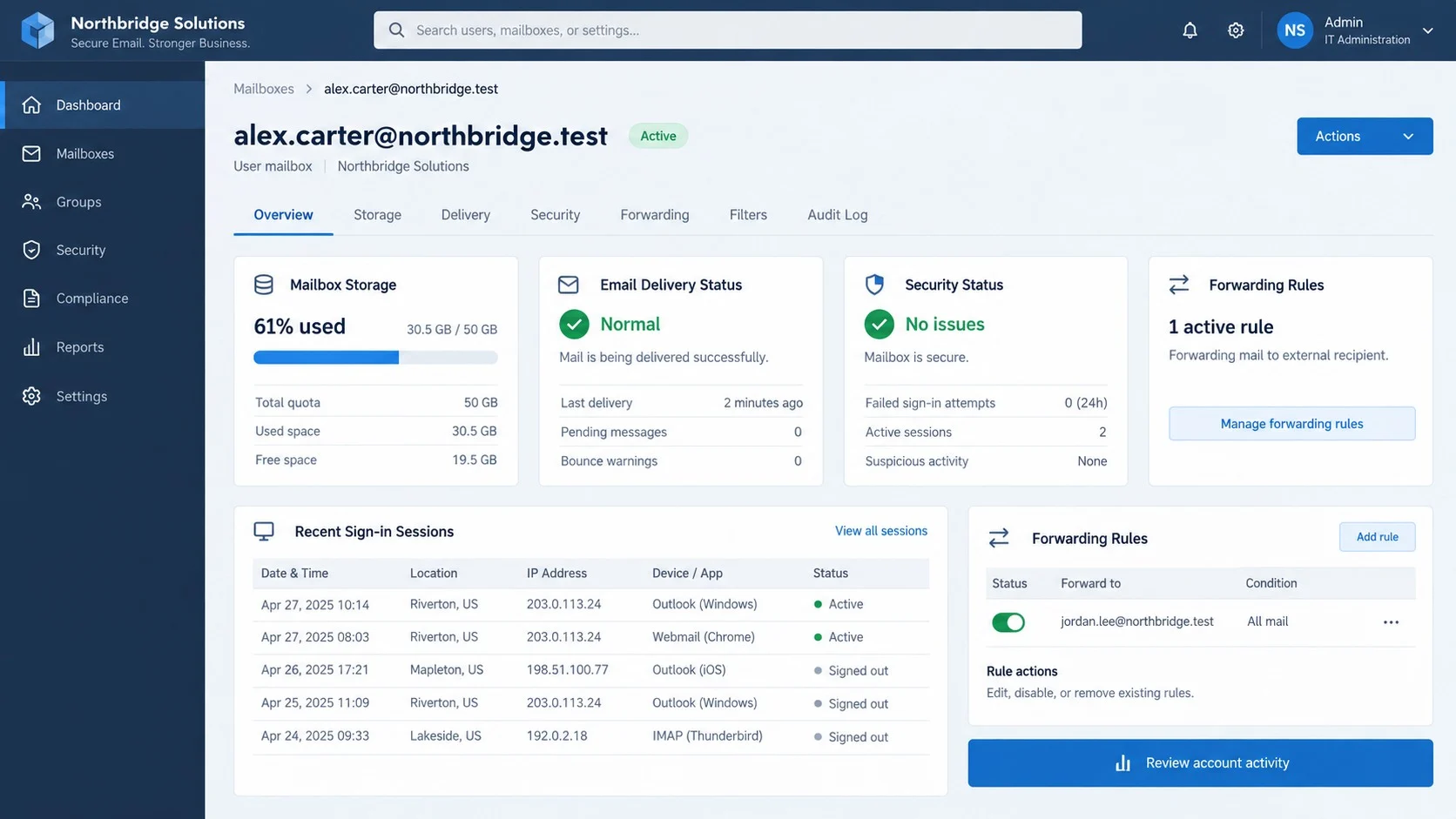
Inspect forwarding addresses, inbox rules, delegates, connected applications, recovery methods, and application passwords. Remove anything the user or administrator cannot explain.
Review active sessions and sign-in history. End every session when possible, then sign back in only on trusted devices.
Check deleted, archived, and sent folders for actions that occurred without the owner’s knowledge. Attackers often erase warnings but overlook secondary folders.
Ask contacts to confirm unexpected requests received from the account. A fast warning can stop a fraudulent payment before it leaves another organization.
What to Do If You Fell Victim to This Scam
Assume the mailbox password is exposed if it was entered on the fake page. Begin containment from a clean, trusted device.
- Change the email password immediately. Use the real provider portal and create a unique password that has never protected another account.
- End existing sessions. Use the security settings to sign out everywhere, revoke remembered browsers, and invalidate application passwords.
- Enable multifactor authentication. Prefer an authenticator app or hardware key when available, then store recovery codes somewhere secure.
- Remove hidden access. Inspect forwarding, filters, delegates, recovery addresses, connected applications, and mailbox permissions for unauthorized changes.
- Notify the administrator. The organization should preserve logs, search for related messages, block the campaign, and assess possible data exposure.
- Check other services. Replace reused passwords and review accounts whose reset links arrive in the compromised inbox.
- Run Malwarebytes. Scan the system used during the incident, especially if any file downloaded or the browser displayed unusual behavior.
- Use AdGuard for added filtering. It can block many known malicious destinations, but mailbox settings and stolen credentials still require direct repair.
- Warn recent contacts. Tell recipients to disregard unusual attachments, invoice changes, or urgent requests sent from the address.
- Monitor sign-ins and financial conversations. Watch for recurring sessions, password resets, altered payment details, and replies hidden by malicious rules.
Is Your Device Infected? Run a Free Malware Scan
Slow performance, constant pop-ups, or strange behavior? These are classic signs of a malware infection. A quick way to check is to scan your device with Malwarebytes Free, one of the most trusted malware removal tools available. If you only visited a scam page and didn’t download or install anything, this scan is optional.
The free version detects and removes the most common threats, including:
- Adware — the cause of those annoying pop-ups
- Browser hijackers — unwanted redirects and changed homepages
- Trojans and spyware — hidden programs stealing your data
- Potentially unwanted programs (PUPs) — software you never asked for
👉 Select your device below — Windows, Mac, or Android — then follow the simple steps to download Malwarebytes, scan your system, and remove any threats it finds. The scan usually takes 5 to 20 minutes.
Run a Malware Scan with Malwarebytes for Windows
Malwarebytes is one of the most popular and trusted anti-malware tools for Windows — and it’s completely free for removing infections. It catches threats that many antivirus programs miss, including adware, browser hijackers, and trojans. Follow the steps below to scan your PC and remove what Malwarebytes finds.
Download Malwarebytes
Click the button below to download the latest version of Malwarebytes for Windows from the official source. The free version is all you need — it will scan your computer and remove adware, browser hijackers, and other malicious software at no cost.
Download MalwarebytesOfficial installer for Windows 11 and 10. Your download starts right away.Want real-time protection? See Malwarebytes Premium Malwarebytes Free for WindowsScans and removes malware at no cost
-
Install Malwarebytes
When the download finishes, open your Downloads folder and double-click the MBSetup file. If Windows shows a User Account Control pop-up, click “Yes” to allow the installation.

Follow the On-Screen Prompts to Install Malwarebytes
The setup wizard will walk you through a few quick screens:
-
Choose where you’re installing the program — “Personal Computer” or “Work Computer” — then click Next.

-
Malwarebytes will now install on your device. This usually takes under a minute.

-
When installation is complete, the “Welcome to Malwarebytes” screen will open automatically.

-
On the final screen, click Open Malwarebytes to launch the program.

-
Optional: Check for rootkits with a Custom Scan
You don’t need to change any settings for a normal scan. The standard Threat Scan in the next step is enough for most problems, so you can go straight to it.
If you also want to check for rootkits, use a Custom Scan. In current versions of Malwarebytes, rootkit scanning is only available there:
- On the Scanner tile, click the three-dot menu and select Advanced Scan.
- Choose Custom Scan. In its options, check Scan for rootkits.
- Select your system drive (usually C:\) as the location to scan, then start the scan. It takes longer than a Threat Scan.
- When it finishes, review and quarantine the results as described in the steps below.
Rootkit scanning isn’t available on Windows devices with ARM processors.
Start the Scan
Click the blue Scan button. Malwarebytes will automatically update its virus database and start checking your computer for malware.

-
Wait for the Scan to Finish
The scan checks your entire system for browser hijackers and other malicious programs, so it can take 5 to 20 minutes depending on your computer. Feel free to do something else — just check back occasionally to see the progress.

-
Quarantine the Detected Threats
When the scan is done, you’ll see a list of everything Malwarebytes found — malware, adware, and potentially unwanted programs. Click the “Quarantine” button to remove all of them at once.

Malwarebytes will now remove the malicious files and registry entries and move them safely into quarantine.

-
Restart Your Computer
Some threats can only be fully removed after a reboot. If Malwarebytes asks you to restart, click Yes. Once you’re logged back in, Malwarebytes has finished removing the threats it found.

When the scan is done, check whether the problems you noticed have stopped. If they continue, see the options below.
If you are still having problems with your computer after completing these instructions, then please follow one of the steps:
- Run a computer scan with ESET Online Scanner
- Ask for help in our Windows Malware Removal Help & Support forum.
Run a Malware Scan with Malwarebytes for Mac
Malwarebytes for Mac is a free on-demand scanner that removes the malware other security software tends to miss — adware, browser hijackers, and unwanted programs included. Cleaning an infected Mac with Malwarebytes has always been completely free, and it’s our go-to recommendation. Follow the steps below to scan your Mac and remove what Malwarebytes finds.
-
Download Malwarebytes for Mac
Click the button below to download the latest version of Malwarebytes for Mac.
Download MalwarebytesOfficial installer for macOS. Your download starts right away.Want real-time protection? See Malwarebytes PremiumMalwarebytes Free for MacScans and removes malware at no cost -
Open the Malwarebytes setup file
When the download finishes, open your Downloads folder and double-click the setup file to begin the installation.

-
Follow the On-Screen Prompts to Install Malwarebytes
The Malwarebytes for Mac Installer will guide you through a few quick screens. Click “Continue” and keep following the prompts until the installation completes.



When the installation is complete, Malwarebytes opens to the Welcome to Malwarebytes screen. Click “Get started“.
Malwarebytes needs Full Disk Access to check your whole Mac. When it asks, open System Settings > Privacy & Security > Full Disk Access, turn on Malwarebytes (it may be listed as Malwarebytes Protection), and confirm with your password or Touch ID. Then return to Malwarebytes. On macOS Monterey and earlier, this setting is in System Preferences > Security & Privacy > Privacy.
-
Select “Personal Computer” or “Work Computer”
Malwarebytes will ask what type of computer you’re installing it on. Click either Personal Computer or Work Computer, whichever applies.

-
Start the Scan
Click the “Scan” button. Malwarebytes will automatically update its detection database and begin checking your Mac for malware.

-
Wait for the Scan to Finish
Malwarebytes will scan your Mac for adware, browser hijackers, and other malicious programs. This can take a few minutes, so feel free to do something else — just check back occasionally to see the progress.

-
Quarantine the Detected Threats
When the scan is done, you’ll see a list of everything Malwarebytes found. Click the “Quarantine” button to remove all the threats at once.

-
Restart Your Mac
Malwarebytes will now remove all the malicious files it found. Some threats can only be fully removed after a reboot — if Malwarebytes asks you to restart, allow it. Once you’re logged back in, check whether the problems you noticed have stopped. If they come back, save the scan report and ask for help in our forum.

If the problems you noticed continue after the scan, see the options below.
If you are still experiencing problems while trying to remove a malicious program from your computer, please ask for help in our Mac Malware Removal Help & Support forum.
Run a Malware Scan with Malwarebytes for Android
Malwarebytes for Android scans your phone or tablet for malware, adware, and potentially unwanted apps. The free version scans only when you start a scan. Real-time protection, which checks apps automatically, is part of the paid Premium version.
-
Download Malwarebytes for Android.
You can download Malwarebytes for Android by clicking the link below.
Get Malwarebytes for AndroidOpens Google Play in a new tab.Want real-time protection? See Malwarebytes Premium for AndroidMalwarebytes for AndroidScans your phone and removes malware at no cost -
Install Malwarebytes for Android on your phone.
In the Google Play Store, tap “Install” to install Malwarebytes for Android on your device.

When the installation process has finished, tap “Open” to begin using Malwarebytes for Android. You can also open Malwarebytes by tapping on its icon in your phone menu or home screen.

-
Follow the on-screen prompts to complete the setup process
When Malwarebytes opens, it walks you through a short setup. Tap Get started and follow the prompts. If you see an offer for a trial or a paid plan, read it before you accept. You can skip it and keep using the free scanner.
Malwarebytes will ask for permission to access the files on your phone so it can scan them. Tap Allow, or turn on the permission in the Android screen that opens, then return to Malwarebytes.
-
Run a scan with Malwarebytes for Android
On the main screen, tap Scan now. In some versions, you open the menu, tap Scanner, and then tap Run a scan.
-
Wait for the Malwarebytes scan to complete.
Malwarebytes will now start scanning your phone for adware and other malicious apps. This process can take a few minutes, so we suggest you do something else and periodically check on the status of the scan to see when it is finished.

-
Remove the detected apps.
When the scan has been completed, you will see a list of the threats that Malwarebytes for Android has detected. Next to each detected item, tap the menu icon (three dots), then choose to uninstall the app or delete the file. Android then asks you to confirm. Tap OK or Uninstall to remove the app.
-
Restart your phone.
When the detected apps are removed, restart your phone if Malwarebytes asks you to. Then check whether the problems you noticed have stopped.
If the problems you noticed continue after the scan, see the options below.
If you are still having problems with your phone after completing these instructions, then please follow one of the steps:
- Ask for help in our Mobile Malware Removal Help & Support forum.
- Only as a last resort, reset your phone to factory settings. Read the warning below first.
- Back up your photos, videos, files, and messages, for example to your Google account or a computer.
- Make sure you know your Google account email and password. The phone asks for them after the reset. If you changed the password recently, Google recommends waiting 24 hours before you reset.
- On a Samsung phone, also make sure you know your Samsung account password.
- If you use an authenticator app for two-step verification, move your accounts to another device or save your backup codes first.
Stay Protected: Block Ads and Malicious Sites
No scan can prove a device is completely clean, so it helps to block threats before they reach you. Most infections start with a malicious ad or a fake download button — so blocking them at the source is your best defense.
We recommend AdGuard, which blocks malicious ads, phishing pages, and dangerous redirects before they can reach you.
👉 Download AdGuard and browse safely
Practical Protection for Domain Email Accounts
Set quota notifications inside the provider dashboard and document how real alerts appear. Employees can then compare future warnings against a known example.
Apply multifactor authentication to webmail and hosting administration. Limit administrator privileges so one stolen mailbox cannot change every domain setting.
Use separate passwords for email, hosting, domain registration, and billing. A password manager makes that separation manageable without encouraging weak variations.
For payments, require confirmation through a second channel. Never approve changed banking details solely because the instruction came from a familiar mailbox.
Keep mail logs long enough to investigate. Useful evidence includes sign-in addresses, rule changes, forwarding activity, and messages sent during the suspected window.
When the Compromised Mailbox Handles Customer Data
A sales or support inbox may contain names, addresses, order histories, complaints, and attachments. Credential theft can therefore become a privacy incident.
Determine which folders the intruder could access and how long the session remained active. Access logs can narrow the period but may not show every message viewed.
Review whether automated exports, downloaded archives, or unusual searches occurred. A quiet login can expose considerable information without generating outgoing spam.
Coordinate customer communication with legal and privacy teams. A rushed notice containing speculation can cause confusion, while silence may violate applicable duties.
Keep the explanation factual. State what happened, what information may be involved, which protections were applied, and what recipients should watch for.
Customers should never be asked to confirm passwords in response to the incident. Provide a separately verifiable support channel for questions.
Monitor for impersonation using stolen signatures or historical tickets. Attackers may contact customers while pretending to continue a genuine support conversation.
Document remediation, including rule removal, session revocation, access changes, and notifications. That record supports later review and improves the next response.
Frequently Asked Questions
Is the cPanel Automated Storage Report email real?
The examined email is fraudulent. Its button leads to a counterfeit webmail form and cannot adjust the recipient’s storage allocation.
Does cPanel send alerts when a mailbox is nearly full?
Hosting environments can generate quota notices, but their appearance and delivery depend on the provider. Verify every warning within the independently opened control panel.
Why does the email say storage is exactly 98.4% full?
The precise figure creates credibility and urgency. It is not reliable telemetry unless the same measurement appears in your authenticated hosting dashboard.
Is a Firebase-hosted login automatically malicious?
No. Firebase is a legitimate platform, but a provider login hosted there is suspicious when your actual host uses a different authenticated domain.
What if I typed my address but not my password?
The attacker may learn that the mailbox is active. Expect more targeted messages, close the page, and report the incident to your administrator.
Will changing my password remove malicious forwarding rules?
Not necessarily. Review rules, delegates, applications, recovery methods, and active sessions separately, then confirm that no external forwarding remains.
The Bottom Line
The cPanel Automated Storage Report scam turns a fabricated 98.4% quota warning into a webmail credential trap hosted outside the real provider.
Check usage through your normal dashboard, never “synchronize” through an email link, and perform a complete mailbox review after any accidental submission.

Join the discussion
0 commentsShare your experience or ask a question about this article.
Community experiences
Did this happen to you?
Your experience could help someone recognize the same scam. Submit a private report for our team to review.
I experienced this tooReports are reviewed before publication. Sharing publicly is always your choice.
Discussion
Start the conversation
Have a question or something useful to share? Add the first comment.