

An unexpected message says a lottery winner has chosen you for a life-changing donation. There was no application, no introduction, and no reason your address should have been selected, yet the promise is large enough to make curiosity feel reasonable.
The Donovan Tura donation scam grows inside that moment of possibility. The first reply seems harmless, but it gives the sender the opening needed to turn a fictional gift into a very real series of fees and requests for personal information.
Overview
The message invents a generous lottery winner
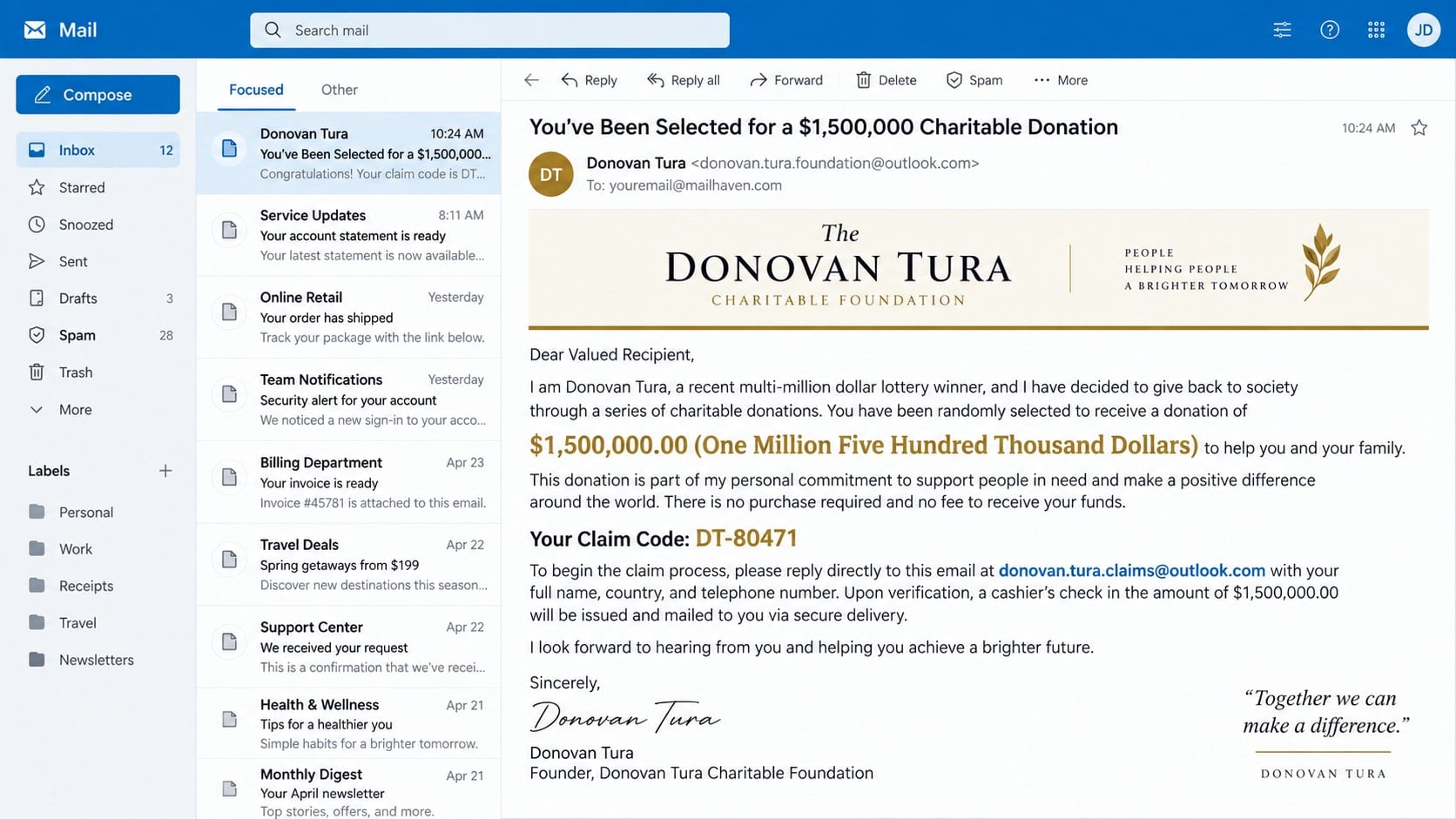
The Donovan Tura donation scam is an advance-fee fraud delivered by email, text message, social media, or private messaging apps. It claims that a wealthy lottery winner or foundation is giving part of a jackpot to randomly selected people and charitable organizations.
The name is part of the story, not proof of a real benefactor. Fraudsters routinely invent donors or borrow the identities of genuine lottery winners, philanthropists, and public figures. The recipient has not been selected for a real grant.
A huge gift makes a small first request feel safe
The initial message may promise $500,000, $1,500,000, or several million in cash. It then asks the recipient to reply with a claim code, full name, address, phone number, age, and occupation.
No payment may be mentioned at first. That is deliberate. The criminal wants the recipient emotionally invested before introducing a courier charge, insurance fee, tax, transfer certificate, or account activation payment.
The donation never arrives
Every document that follows can be fabricated: the foundation letter, bank dashboard, cashier’s check, courier tracking page, tax certificate, and identity form. The only genuine transaction is the victim’s payment to the scammer.
The campaign can cause several kinds of loss:
- Advance fees are sent for delivery, insurance, tax, or transfer processing.
- Identity information is harvested for later impersonation and account fraud.
- Bank and card details are captured through fake beneficiary forms.
- Victims receive counterfeit checks and are asked to forward part of the money.
- Compromised email or social accounts are used to approach friends and relatives.
- Follow-up scammers offer fake refunds after the original fraud is discovered.
Why the Donation Story Can Pull People In
The message does not always look like a conventional lottery scam. It may frame the money as private generosity rather than a prize. The sender says they already won, already paid the taxes, and simply want to share their good fortune.
That distinction is meant to quiet the obvious question: “How could I win something I never entered?”
The story often uses moral language. The recipient is asked to help family members, support a local charity, or remember the less fortunate after receiving the funds. This makes skepticism feel cynical and cooperation feel like participation in something kind.
A real news article or video may be included as “proof.” The linked story might genuinely describe a lottery winner, but it does not connect that person to the email. Scammers use accurate public facts as scenery around a false private claim.
Secrecy is another important ingredient. The sender may warn that discussing the donation could create duplicate claims or cause the bank to cancel the transfer. The real purpose is to keep the victim away from anyone likely to recognize the scheme.
Once a victim replies, messages become personal and attentive. A supposed donor, assistant, banker, attorney, and courier may all appear. They can be the same criminal using several email addresses, or different members of one fraud operation playing assigned roles.
How the Donovan Tura Donation Scam Works
Step 1: A message announces an unsolicited donation
The recipient is told that an email address, social profile, or phone number was chosen through a random draw. The message may say Donovan Tura won a lottery and selected a limited number of individuals to receive private donations.
There is usually no credible explanation for how the recipient was entered. References to Microsoft, Google, a “spin ball,” or an international email database are invented to make mass spam sound like a controlled selection process.
Step 2: The recipient is asked to confirm interest
The first action looks simple: reply with a claim code or state that the donation is accepted. Some messages request a full name, country, phone number, age, occupation, and residential address immediately.
That information helps the scammer personalize the next documents. It can also be combined with data from breaches or social media to support future identity theft and more convincing follow-up scams.
The sender may insist on confidentiality at this point. Anyone who shows the message to a bank employee, family member, or trusted friend is more likely to learn that the offer follows a common advance-fee pattern.
Step 3: A team of fake professionals appears
After the reply, the recipient can be transferred to a “financial secretary,” bank officer, attorney, foundation manager, or courier agent. Each role adds another layer of apparent legitimacy.
Messages may arrive from unrelated free email accounts. The scammer explains this by calling them private channels or secure claim desks. In reality, legitimate financial institutions do not administer seven-figure transfers through disposable mailboxes.
Step 4: Fabricated documents show an approved transfer
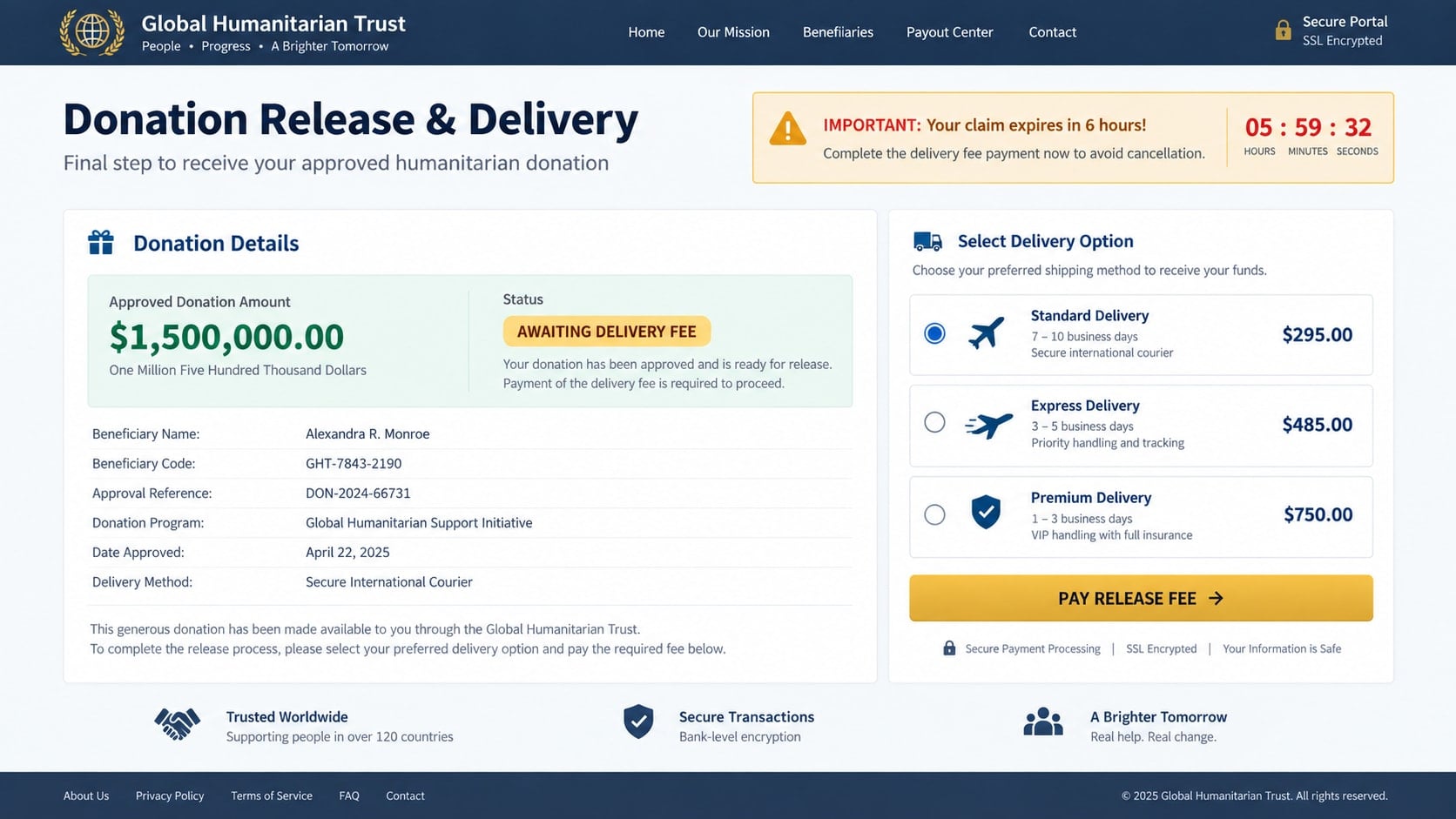
The victim receives a certificate, beneficiary letter, account screenshot, or online dashboard showing the donation as approved. The page may display a large balance beside the recipient’s real name and address.
Seeing personal details inside a polished document can be powerful, but the criminal obtained those details from the victim. A PDF or website does not become official because it repeats information that was supplied moments earlier.
Step 5: A delivery or release fee blocks the money
The promised funds suddenly cannot move until a comparatively small amount is paid. The reason may be courier delivery, insurance, an anti-money-laundering certificate, international tax, account activation, or transfer authentication.
The FTC’s prize scam guidance is direct: if someone requires a payment to receive a prize, it is a scam. A genuine donor can deduct legitimate expenses from the gift and does not need retail gift cards or cryptocurrency from the beneficiary.
Step 6: Each payment produces a new fee
Once the victim pays, the transfer is not released. A new obstacle appears, often presented as the last one. The scammer may create a higher tax, customs charge, notarization fee, conversion fee, or penalty caused by the victim’s delay.
The cycle continues for as long as the victim can send money. When payment stops, the scammer may threaten forfeiture, claim the victim violated an agreement, or disappear and return later under a recovery identity.
Identity, Contact, and Payment Checks
Look for a real, independently verifiable program
A legitimate grant has published eligibility rules, an application process, named administrators, and contact details that can be verified independently. Random selection from the entire internet is not a credible grant program.
Search the donor name and the exact language from the message. Do not treat a news report about a lottery win as confirmation of a private email. The relevant question is whether the named person publicly announced this exact program through a verified channel.
Inspect the reply route, not just the display name
A display name can say “Donovan Tura Foundation” while the underlying address belongs to a free email provider or an unrelated domain. Check the complete sender and reply-to fields.
Be suspicious when several supposed organizations use different generic inboxes. A donor, bank, courier, and attorney should not all operate from recently created or free accounts with no independently confirmed connection.
Question why a gift requires personal identity data
A stranger does not need a Social Security number, passport, bank login, card security code, or one-time verification code to decide whether to give money. Those requests create identity and account-takeover risks even before a fee is introduced.
Do not send identity documents to prove you are the “selected beneficiary.” Once a clear image of a license or passport is shared, it can be reused in account applications, social engineering, and scams aimed at other victims.
Apply the pay-money-to-get-money rule
Any demand for a release fee turns the offer into a classic advance-fee scam. Labels such as refundable bond, delivery insurance, tax clearance, or compliance certificate do not change the mechanics.
Gift cards, crypto, payment apps, and wires to individuals are especially strong warning signs. The FTC advises people never to send money or financial information to claim an unexpected prize.
Red Flags in a Fake Lottery Winner Donation
The names and amounts change, but these messages tend to share the same pressure points:
- You are selected despite never applying, entering, or contacting the donor.
- The offer promises an implausibly large sum for no verifiable reason.
- The sender claims an email address was chosen by Google, Microsoft, or a random spin.
- A public news story is used as proof of a private donation program.
- You are instructed to keep the award secret until the money arrives.
- The donor and supposed agents communicate through free or unrelated email accounts.
- You must submit identity documents or extensive personal information.
- A fee appears only after you have accepted the offer.
- The payment must be made through gift cards, crypto, a wire, or a payment app.
- Every paid fee reveals another reason the transfer cannot be released.
Professional design does not cancel these red flags. Criminals can generate convincing letters, signatures, bank screens, and tracking pages. The transaction itself must make sense, and an unsolicited seven-figure gift that requires money from the recipient does not.
What to Do if You Have Fallen Victim to This Scam
- End the conversation immediately. Do not argue, threaten the sender, or pay one final fee. Save the full emails, headers, chat history, payment instructions, wallet addresses, receipts, websites, and documents before blocking the accounts.
- Contact every payment provider involved. Tell the bank, card issuer, wire service, gift card company, cryptocurrency exchange, or payment app that you were deceived by an advance-fee donation scam. Ask whether the transaction can be stopped, recalled, disputed, or flagged at the receiving account.
- Secure email and messaging accounts. If you clicked a link or entered a password, change it from a clean device. Use a unique password, enable multi-factor authentication, review active sessions, and remove unfamiliar recovery addresses, forwarding rules, and connected apps.
- Respond to identity exposure. If you shared a Social Security number, passport, license, or bank document, create a recovery plan at IdentityTheft.gov. Consider credit freezes and notify the agency that issued the exposed document.
- Scan devices that opened files or installed software. Run a complete scan with trusted security software such as Malwarebytes if you downloaded an attachment, installed a viewer, or allowed remote access. Remove unfamiliar programs and browser extensions.
- Reduce repeat exposure. AdGuard can block many known phishing pages, deceptive advertisements, and tracking links that feed follow-up campaigns. Continue treating every unexpected grant or recovery message as untrusted even if a filter does not block it.
- Report the fraud. Submit the evidence to ReportFraud.ftc.gov, the platform where contact occurred, and local law enforcement if money or identity documents were lost. Report the receiving wallet or account to the relevant provider.
- Warn people close to you. If the scammer accessed your email or social account, tell contacts not to trust recent donation messages or money requests. A compromised account can be used to make the same story appear to come from someone familiar.
Frequently Asked Questions
Is Donovan Tura really giving money to random people?
There is no credible evidence of a legitimate program that selects random email or social media users for large donations under this name. Treat unsolicited messages making that claim as fraudulent, especially when they request personal data or fees.
Why does the email link to a real lottery news story?
A real article proves only that the event in the article happened. It does not prove the sender is the person in the story or that a private donation program exists. Scammers frequently attach genuine public information to a false personal claim.
What if the sender says there is no fee?
The first message may explicitly promise that no fee is required. The demand usually appears after the recipient replies and becomes invested. Do not share personal information merely because the payment request has not arrived yet.
Can a real donor ask me to pay courier or insurance costs?
A genuine millionaire sending a large donation would not need the beneficiary to buy gift cards or send crypto for delivery. If a legitimate cost existed, it could be handled transparently or deducted from the gift. An upfront payment is the core of the scam.
Could the cashier’s check be real?
A counterfeit check may look convincing and can even appear in an account before the bank discovers the fraud. If the sender asks you to forward part of the funds, pay a courier, or return an overpayment, stop and contact the bank’s fraud department.
Will replying once put my money at risk?
A simple reply does not directly transfer money, but it confirms that the address is active and identifies you as a potential target. Stop responding, preserve the messages, and be alert for personalized follow-ups using other names and channels.
The Bottom Line
The Donovan Tura donation scam turns an impossible windfall into a sequence of believable-looking forms, agents, and fees. The emotional promise changes, but the transaction always moves money and information away from the supposed beneficiary.
You do not need to pay to receive a genuine gift. Do not reply, do not send identity documents, and do not let a large number on a screen distract from the simple fact that strangers do not select random inboxes for seven-figure donations.








