

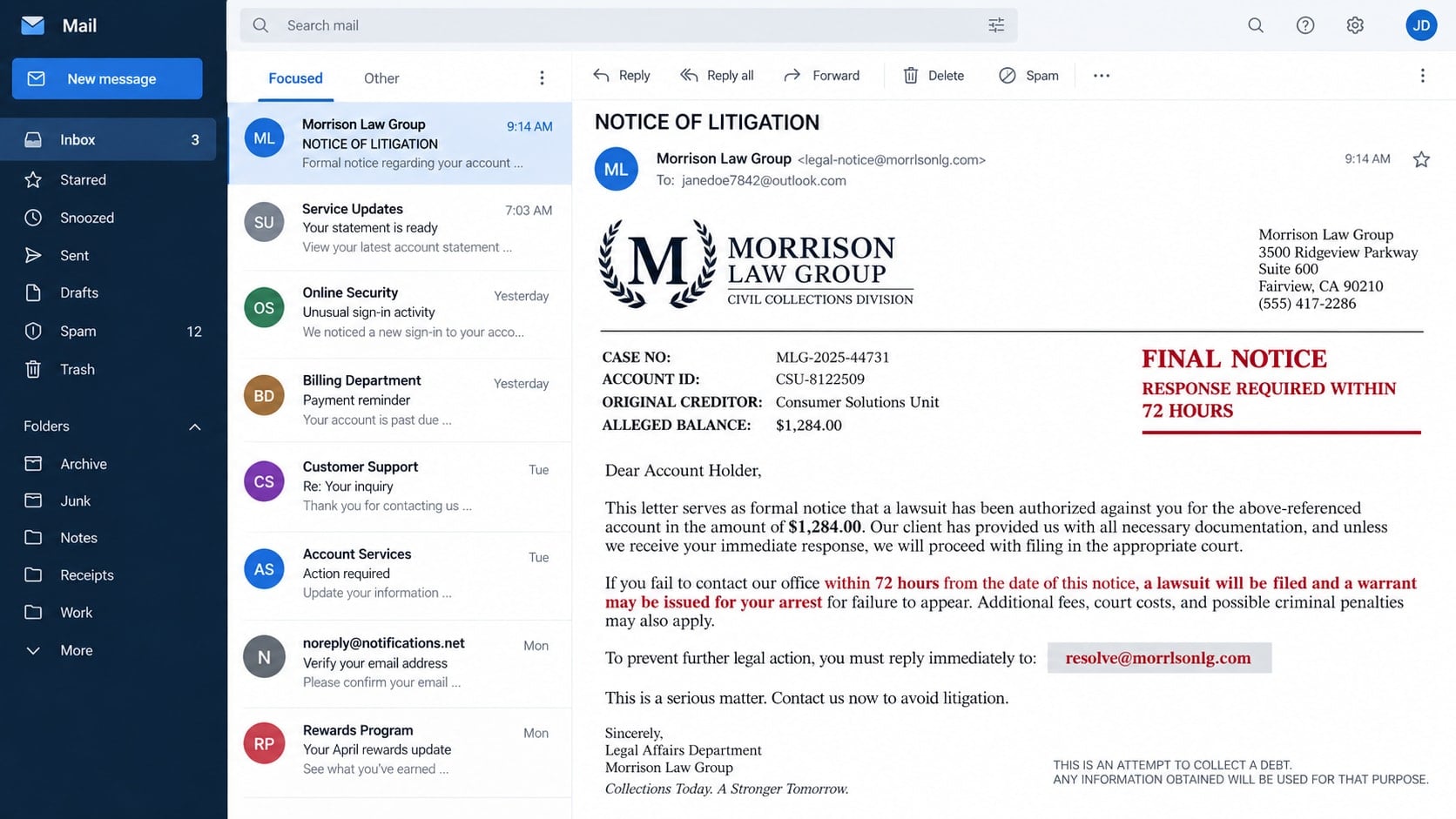
The email looks less like advertising than paperwork. It carries a law-firm name, an account number, a balance, and a warning that litigation will begin within days if you do not respond.
That formal appearance is the hook in the Morrison Law Group legal notice scam. The sender is not delivering a genuine lawsuit. The message is a fake debt demand built to turn uncertainty into an immediate, difficult-to-reverse payment.
Overview
The message uses a law-firm identity without authorization
This scam sends emails that appear to come from “Morrison Law Group,” a legal affairs department, or an attorney collecting for a payday lender such as Cash Advance USA. The sender may use a domain or address designed to resemble a professional firm.
The name on the email does not establish who sent it. Real law firms and lenders can be impersonated, and an official-looking variation of a name may be entirely fictional.
Litigation language is mixed with threats of arrest
The notice claims that previous collection attempts failed and that a lawsuit, wage garnishment, employer contact, criminal charge, or arrest warrant will follow. It may provide a three-day deadline and invite the recipient to settle before the file is sent to court.
A legitimate creditor can pursue a civil claim, but an email sender cannot order an arrest because an ordinary consumer debt is unpaid. Threatening jail to force immediate payment is a hallmark of fake or abusive collection.
The settlement route belongs to the scammer
Replying leads to a supposed attorney or case officer who offers to stop the action for a reduced amount. Payment is directed to a gift card, prepaid card, wire recipient, payment-app account, crypto wallet, or fake online portal.
The scheme can produce several losses at once:
- Victims pay debts that do not exist or do not belong to them.
- Card and bank details are stolen on a fabricated settlement page.
- Personal data is collected under the cover of case verification.
- Email credentials are captured through fake document links.
- Remote-access software may be used to reach financial accounts.
- Additional fees and recovery offers target anyone who pays.
Why a Fake Legal Notice Creates So Much Pressure
Legal language changes how people read a message. A strange invoice might be ignored, but words such as litigation, affidavit, warrant, and court order make the same demand feel dangerous. Scammers use that reaction to push the recipient past ordinary verification.
The notice may contain just enough real information to be unsettling. A name, old address, phone number, or former employer can come from data breaches, public records, or lead-generation databases. It does not prove the writer has a lawful debt file.
A numbered account also looks persuasive. In reality, a scammer can create an account ID, docket, or case reference with a spreadsheet. Unless the creditor and court can independently confirm it, the number is decorative.
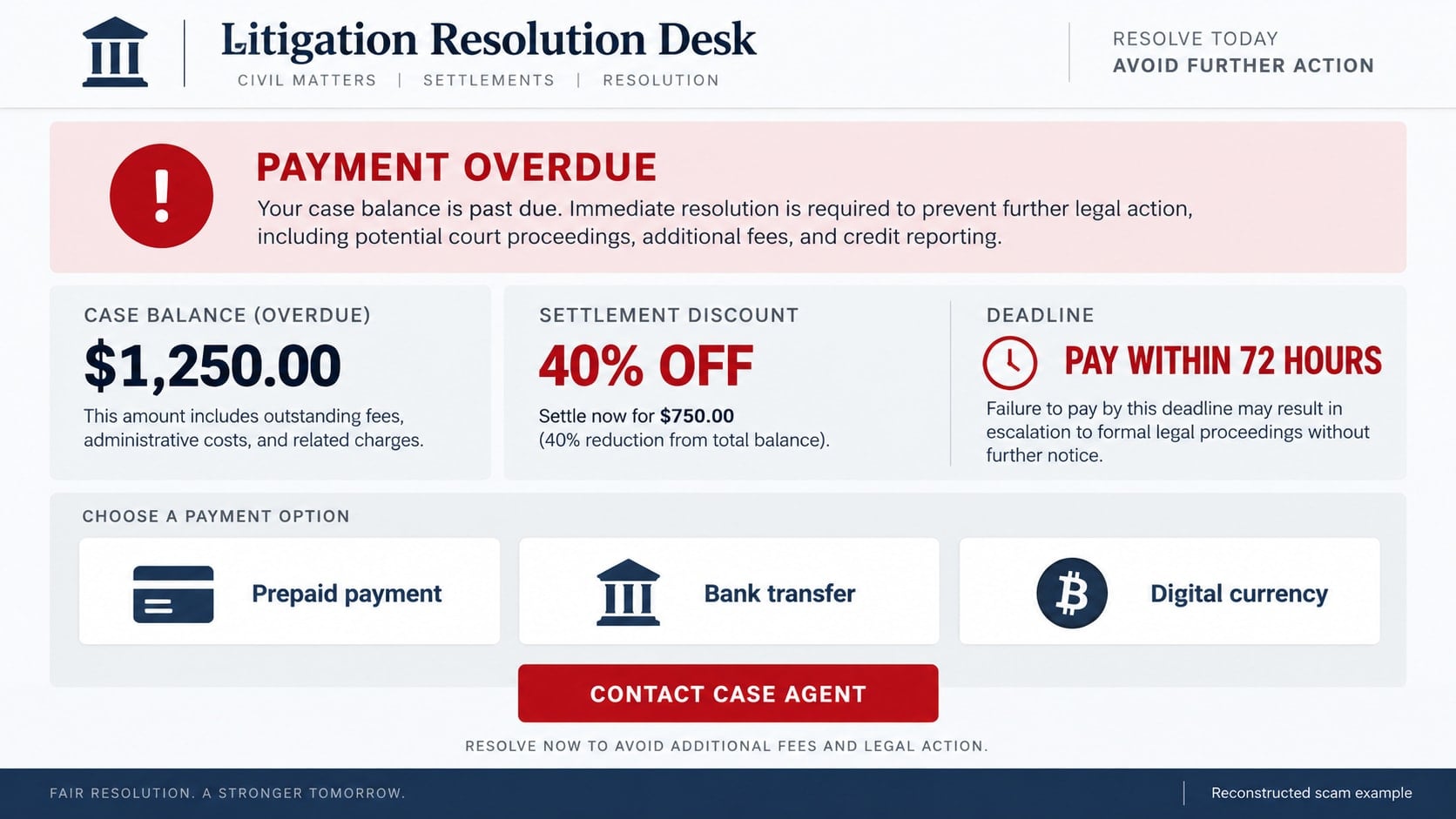
The reduced settlement adds another kind of pressure. A claimed $1,284 balance may fall to $640 if paid by 5:00 PM. The recipient is made to feel that checking the story could cost money, while paying now supposedly buys certainty.
The message may even include consumer-disclosure language copied from a real collection notice. Familiar legal wording does not repair a false identity, nonexistent debt, or coercive payment demand.
How the Morrison Law Group Legal Notice Scam Works
Step 1: A “notice of litigation” arrives unexpectedly
The email claims that a loan account has reached a final stage after unsuccessful calls and previous warnings. It may accuse the recipient of fraud or deliberate nonpayment rather than simply describing an alleged debt.
That accusation is designed to create shame and fear. The recipient may respond defensively and provide details that help the scammer improve the story.
Step 2: A short deadline makes verification feel risky
The notice says the account will be sent to court within 24 or 72 hours. It can threaten service at work, wage seizure, criminal penalties, or an arrest warrant.
Real legal processes do not disappear because an anonymous recipient sends money before a countdown expires. Formal service and court procedures cannot be replaced by an email deadline controlled by the claimant.
The scammer may warn that contacting the creditor, employer, or anyone else will make the settlement invalid. That instruction is meant to keep the victim inside a conversation the criminal controls.
Step 3: The reply collects information the sender lacks
A supposed legal officer asks the recipient to confirm a date of birth, address, employer, Social Security number, or previous loan. The questions are framed as security checks.
A real collector should identify the debt and provide validation information. When the sender asks the recipient to supply the core facts, it can indicate that there is no genuine account behind the threat.
Step 4: A settlement portal turns the threat into a transaction
The victim receives a link showing the case number, balance, and discounted payoff. A timer and status such as “pending litigation” create the impression that the page is connected to a court or law office.
Generic seals, encryption claims, and professional typography are visual props. The operator of a page can display any balance or deadline. The browser padlock does not verify that the debt is real.
Step 5: Payment is routed outside normal collection channels
The supposed firm may demand a prepaid card, gift card, wire, crypto transfer, or payment-app transaction. Some versions accept card details directly, allowing the scammer to attempt additional charges.
A legitimate attorney does not need retail gift card codes to file or stop a lawsuit. A request for irreversible payment is especially dangerous when the debt has not been validated in writing.
Step 6: The case expands after the victim pays
Payment may be followed by a demand for a court filing cancellation fee, notarized clearance, tax, or release certificate. The scammer can say that a partial payment created a binding agreement and use that claim to pressure the victim further.
If the victim refuses, the criminal may send a forged warrant or contact relatives and employers. Those escalations are meant to preserve fear. They do not convert the original email into a genuine legal action.
Identity, Contact, and Payment Checks
Verify the firm through independent records
Search the exact firm name, attorney, address, phone number, and domain. Use a state bar directory and contact the firm through information found independently, not through the email.
Look carefully at small differences in domains. A missing letter, added word, or alternate ending can route replies to an impersonator while leaving the display name unchanged.
Demand proper debt validation
Before discussing payment, ask for written information identifying the original creditor, amount, current collector, and your dispute rights. Do not fill gaps by volunteering previous lenders or account details.
The FTC advises consumers to get validation and warns about collectors who threaten arrest, license suspension, or employer contact. A refusal to provide verifiable documentation is a reason to stop.
Check any lawsuit with the named court
A genuine filing should be traceable through the court that supposedly received it. Find that court’s official government website and call the clerk using the published number.
Do not trust a “court clerk” introduced by the email sender. If the notice gives no jurisdiction, filing date, parties, or verifiable docket, it has not established that a case exists.
Evaluate the payment method and recipient
Gift cards, crypto, and wires to individuals are not normal law-firm settlement methods. A card form on an unverified site is not safer simply because it resembles a professional portal.
Even when a debt is real, pay only after verifying who currently owns or services it and receiving terms in writing. A scammer may know about a genuine old debt without having any authority to collect it.
Red Flags in the Fake Morrison Law Group Email
Review the entire process, not just the logo. Common warning signs include:
- The email is the first notice of a debt or lawsuit you do not recognize.
- The sender threatens arrest, criminal charges, or police action over civil debt.
- The firm name and domain do not match independently verified records.
- The notice supplies a case number that no court can confirm.
- You must respond within hours or lose a dramatic settlement discount.
- The sender asks you to identify the original lender or confirm missing details.
- Written validation is refused or replaced with a threatening PDF.
- Payment must be made with a gift card, crypto, wire, or payment app.
- You are told not to speak with a bank, attorney, or family member.
- A new fee appears after the original settlement is paid.
Some real collection communications can be unpleasant, and some scams are professionally written. The strongest test is independent verification. The creditor, collector, law firm, and court should each be confirmable outside the sender’s own links and phone numbers.
Real legal pressure does not prevent independent verification. You can locate the court through an official government directory, search the docket, and call the clerk using a published number. You can also look up the attorney through the relevant state bar.
A sender who insists that only their payment desk can discuss the case is blocking the very checks that would prove it.
Keep the alleged debt separate from the threatening email. Even if you once borrowed money, that does not establish that this sender owns or services the account.
Ask the original creditor where the balance went, request a written itemization, and compare dates and amounts. A familiar lender name may simply be bait copied from breached or purchased data.
What to Do if You Have Fallen Victim to This Scam
- Stop paying and end direct contact. Preserve the complete email with headers, every document, domain, phone number, payment instruction, receipt, wallet address, and chat. Do not send a supposed cancellation or closing fee.
- Contact the financial provider immediately. Tell your bank, card issuer, wire service, gift card company, payment app, or crypto exchange that an impersonation and fake debt scheme induced the transfer. Ask about a recall, dispute, receiving-account freeze, or fraud flag.
- Secure any account used on the fake portal. Change reused or exposed passwords from a clean device, turn on multi-factor authentication, sign out unknown sessions, and inspect recovery details, email forwarding, connected apps, and recent activity.
- Protect exposed identity information. If you provided a Social Security number, license, passport, or bank document, create a plan at IdentityTheft.gov. Consider credit freezes and notify relevant issuers.
- Remove unwanted software and scan the device. If the sender persuaded you to install a document viewer or remote-access program, disconnect it and run a full scan with trusted security software such as Malwarebytes. Review browser extensions and startup programs.
- Block repeat phishing routes. AdGuard can reduce exposure to known malicious pages, deceptive ads, and tracking links. It is an additional protective layer, not evidence that an unblocked legal notice is genuine.
- Report the conduct. Submit evidence at ReportFraud.ftc.gov and file a complaint with the CFPB if appropriate. Notify the real firm or lender whose name was misused and report the sender to the email provider.
- Respond correctly if real court papers later arrive. A scam email should not be paid, but genuine legal service should not be ignored. Contact the court independently and consider speaking with a licensed consumer-law attorney.
Frequently Asked Questions
Can a law firm email me about a real debt?
Email may be one communication channel, but it does not remove the need to verify the firm, debt, and collector. A threatening message that refuses validation or demands irreversible payment should not be trusted.
Can I be arrested for an unpaid payday loan?
You cannot be arrested simply because you failed to pay ordinary consumer debt. A creditor may pursue a civil lawsuit. The CFPB explains that arrest can relate to ignoring a separate court order, not a collector emailing a payment deadline.
What if I previously borrowed from Cash Advance USA or a similar lender?
A real past application can make the message feel relevant, but the sender still must be verified. Contact the lender through an independently found official channel and ask who, if anyone, is authorized to collect the account.
Does a settlement discount prove the collector has my file?
No. Scammers invent high balances and attractive discounts to create urgency. Ask for the underlying account records and written terms before paying any verified collector.
Should I open the attached warrant or legal notice?
Do not open an unexpected attachment until the sender is verified. It may be a harmless-looking PDF, a credential-stealing link, or a malicious file. Contact the supposed firm and court independently.
Can a payment make the threatening emails stop?
Paying confirms that the tactic worked and often leads to more demands. Stop contact, notify the provider, secure your accounts, and report the fraud. Do not rely on a scammer’s promise to delete a case they invented.
The Bottom Line
The Morrison Law Group legal notice scam uses the tone of a law office to give an unverified debt the appearance of immediate legal force. A logo, account number, and deadline are not substitutes for a validated debt and a real court record.
Do not let the threat decide the process. Verify the firm, creditor, and court independently, refuse gift cards and crypto, and remember that a legitimate dispute cannot be resolved safely inside a conversation controlled entirely by the person demanding money.








