

A call about recovered sweepstakes money can feel like the ending a family has been waiting for. The caller knows about the earlier loss, speaks confidently about a court case, and says a restitution payment is finally ready.
That hopeful moment can become a second theft. The elderly sweepstakes restitution scam targets people who already lost money, then asks them to pay another fee or reveal financial details to receive compensation that does not exist.
Overview
The approach is aimed at people who have already been hurt
Fraudsters often keep or trade lists of previous victims. A record may include a name, address, phone number, the original scam, and the amount that was paid. Those details let a new caller sound unusually well informed.
The person may claim to represent a court, government compensation program, law firm, consumer group, or fraud recovery office. None of those labels should be trusted until the contact is verified through an official channel found independently.
A real restitution process is copied to sell a fake one
Courts do order restitution in criminal cases, and agencies sometimes distribute money recovered from defendants. Scammers borrow that real process, then invent a claim number, payment amount, release date, or case officer to make their offer feel legitimate.
The key difference is simple. A genuine government program does not cold-call a victim and demand gift cards, cryptocurrency, a wire, or a processing payment before releasing court-ordered funds.
The promised recovery becomes a chain of fees and identity requests
The first amount may be described as a filing charge, bond, tax, transfer fee, or identity-verification deposit. Once it is paid, another obstacle appears. The promised restitution remains just out of reach while the losses continue growing.
Common requests in this scheme include:
- An upfront payment for processing, insurance, taxes, or document certification.
- A Social Security number, government ID, date of birth, and bank information.
- Remote access to online banking so an agent can supposedly confirm a refund.
- Cash or gift cards sent to a courier, private address, or unrelated individual.
- Secrecy because the recovery is allegedly part of a confidential investigation.
Why a Fake Restitution Offer Can Sound So Convincing
The scammer may know facts that were never public. That knowledge is not proof of official access. The original fraudster may have retained the information, sold it to another group, or submitted it through accounts that later appeared in criminal evidence.
Victims are also emotionally invested in the possibility of recovery. A person who has felt embarrassment, anger, or financial strain may want to believe that someone finally understands what happened and can fix it. Criminals deliberately present themselves as patient, sympathetic helpers.
Real criminal cases add another layer of plausibility. The U.S. Department of Justice describes genuine restitution distributions connected to prosecuted sweepstakes fraud. A scammer can copy names and public case details without having any role in that process.
Official-looking documents are easy to manufacture. Seals, signatures, barcodes, case captions, and agency names can be copied into a template. A PDF can look formal while every phone number, payment instruction, and reply address leads back to the criminal.
The caller may even warn about recovery scams. This is a trust-building trick. By describing obvious fraud and then claiming their own program is different, the caller tries to position themselves as the safe exception.
How the Elderly Sweepstakes Restitution Scam Works
Step 1: A previous loss identifies the next target
The scheme often begins after someone responded to a fake lottery, prize, or sweepstakes notice. The earlier payment proves that the phone number or address is active and that the victim may still hope to recover the promised prize.
Fraud groups call these collections of data victim lists or lead lists. The information can circulate for years. A new approach may come from a different state, country, email address, or accent, making it appear unrelated to the first scam.
Step 2: A supposed official announces recovered money
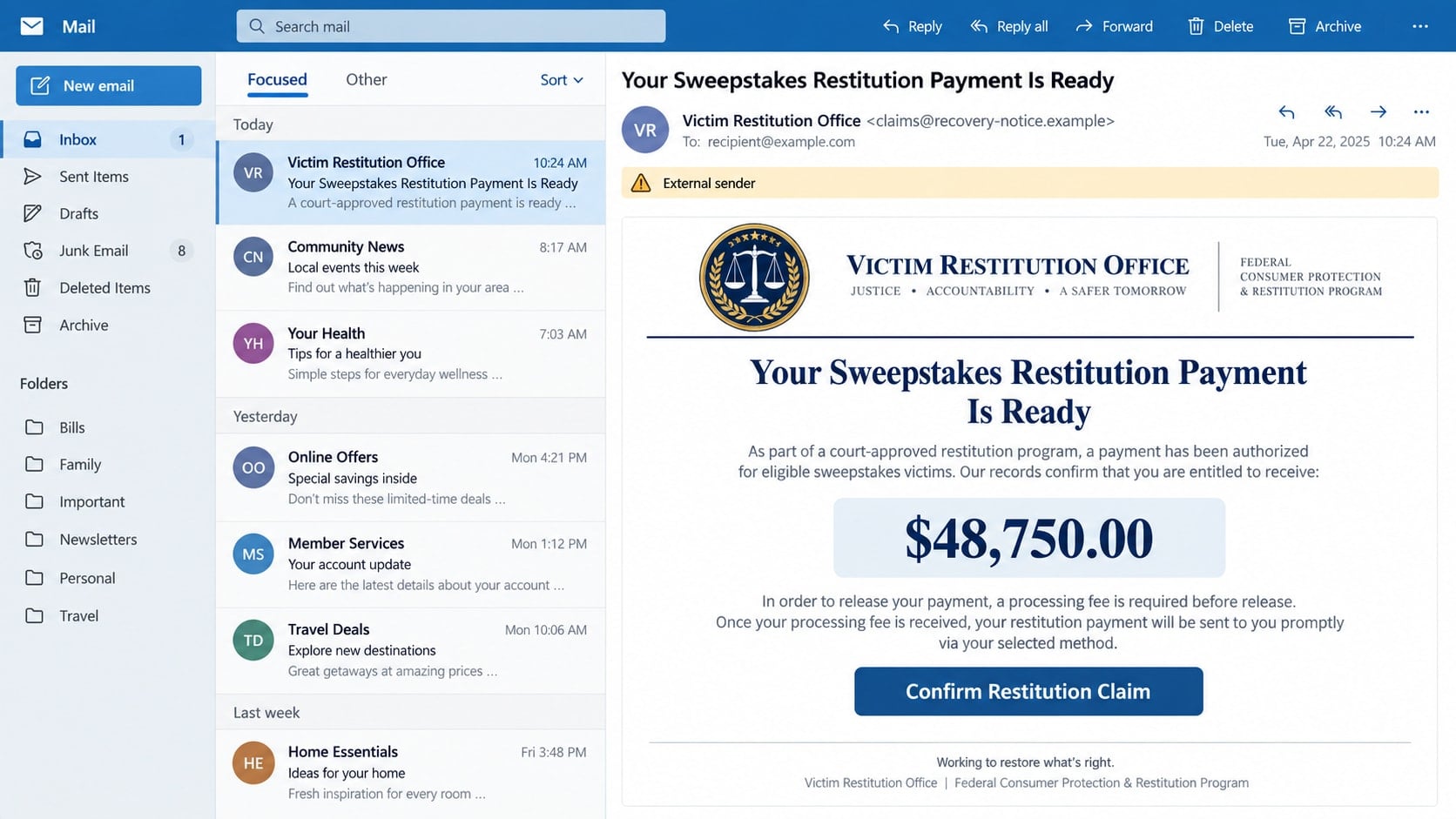
The caller or email claims law enforcement seized assets and a judge approved compensation. The victim may be told that $48,750, $125,000, or another specific amount is being held in their name.
A case number, agent name, court title, and deadline create structure around the story. Some messages link to real press releases or mention genuine prosecutions. Public information does not connect the sender to the case.
Step 3: The victim is moved into a controlled verification process
The supposed case officer asks the victim to confirm information before payment. Questions may cover the earlier scam, the amount lost, the payment method, home address, bank, and government identification.
Some details are framed as harmless checks. In reality, the scammer is filling gaps in the victim profile. The answers can support account takeover, identity theft, fraudulent credit applications, or a more personalized follow-up pitch.
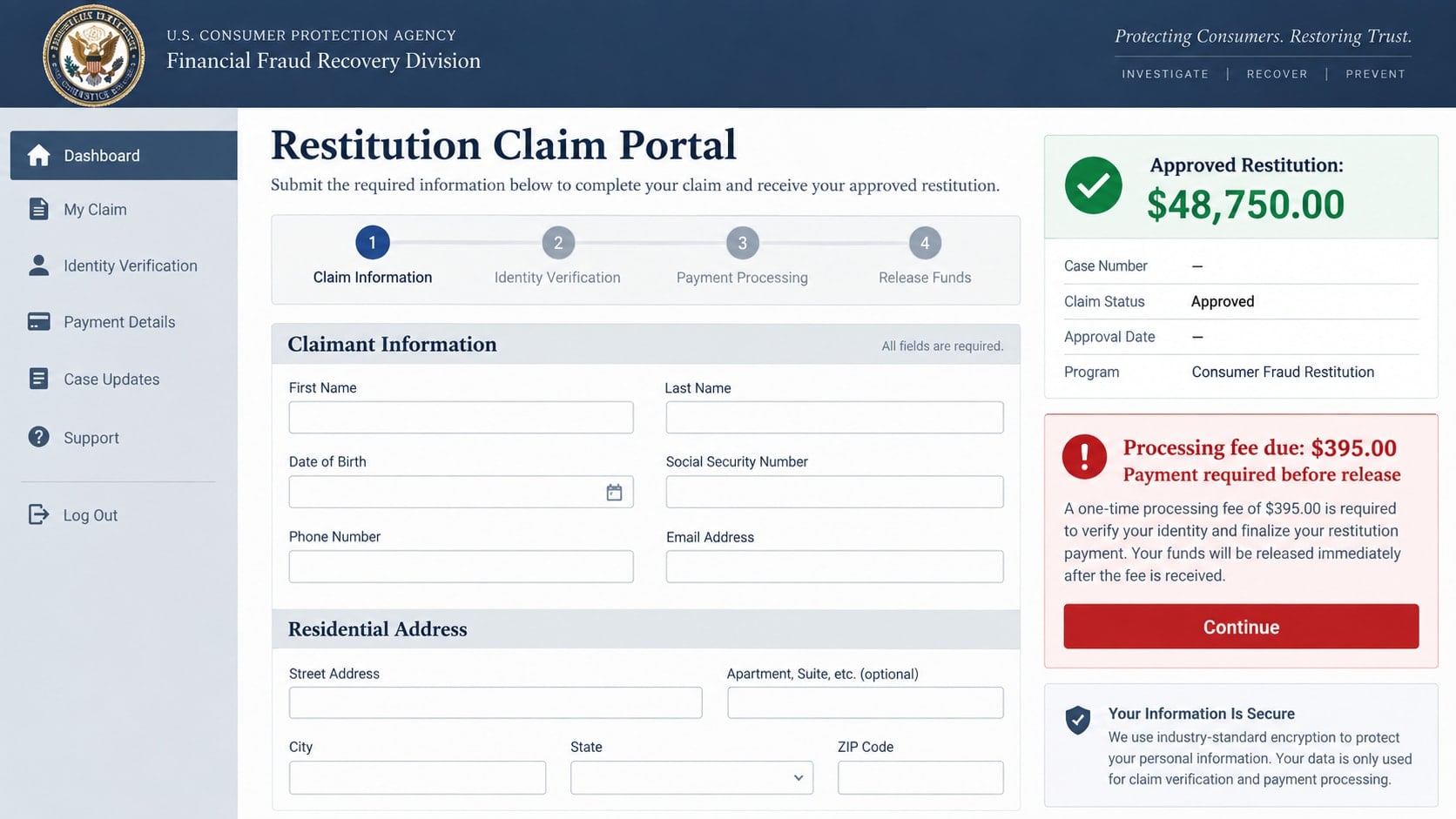
A fake portal may display the victim’s name and an approved status. The page can use encryption, but a secure connection only protects traffic to that site. It does not prove the operator is a court or government agency.
Step 4: A small release cost is introduced
The criminal says the compensation itself is free, but a third-party charge must be paid first. It may be called a $395 administrative fee, courier bond, anti-money-laundering certificate, or tax clearance payment.
The fee is deliberately small compared with the promised recovery. Paying $395 can seem reasonable when $48,750 appears to be waiting. That comparison is the trap because the restitution balance is fictional.
Step 5: Payment instructions bypass normal safeguards
The caller may insist on gift cards, cryptocurrency, a wire transfer, cash in a package, or a payment app. They often remain on the line and tell the victim what to say if a bank employee asks questions.
A scammer may also send a check and ask the victim to return part of it for fees. The bank can make funds appear available before discovering the check is counterfeit. The victim then owes the returned money.
Step 6: Each payment unlocks another fabricated problem
After the first fee, the criminal invents a compliance hold, international transfer tax, insurance premium, or error in the victim’s claim. The tone can shift from friendly reassurance to threats that the recovery will be forfeited.
Victims who stop paying may receive calls from a fake supervisor, lawyer, investigator, or refund specialist. These roles create the illusion that several independent people have confirmed the case, although one group may control every contact.
Identity, Contact, and Payment Checks
Verify the case through the court or agency named
Find the court, prosecutor, regulator, or victim-witness office through a government website. Call the published number and provide only the case number and your basic contact information. Do not use a number from the restitution message.
If the case is real, ask how victims are notified and whether any payment is required. Genuine staff can explain the process without demanding that you stay on the line or visit a store.
Confirm that the sender address belongs to the organization
Look beyond the display name. A message marked “Federal Restitution Office” may come from a free mailbox or a newly registered domain. Government agencies in the United States use official domains, not lookalike addresses ending in unrelated words.
Replying is not a safe verification method because it returns to the sender. Start a new conversation using an address published on the official agency or court website.
Challenge every fee before discussing personal information
The FTC warns that anyone who unexpectedly offers to recover scam losses for an upfront fee is running a recovery scam. Labels such as retainer, processing, administration, or tax do not change that rule.
Do not provide a Social Security number or bank account so someone can supposedly deposit restitution. Legitimate programs use documented procedures and do not need a stranger to verify online banking through remote access.
Inspect who receives the requested payment
A court payment does not go to a private person, crypto wallet, retail gift card, courier, or overseas account. If the recipient name differs from the agency, stop even if the caller offers a complicated explanation.
Also check whether the caller opposes independent verification. A real victim coordinator will not threaten to cancel restitution because a bank, lawyer, or family member became involved.
Real Restitution Versus a Recovery Scam
Genuine restitution usually follows a public legal case. Victims may receive written notices from prosecutors, a court, or an authorized claims administrator. Those notices identify the case and provide contact details that can be matched to official records.
Payment is not guaranteed. Restitution depends on court orders and the assets available from defendants. An honest agency will not promise that every loss will be returned, and it will not sell a faster place in line.
Government staff do not ask victims to hide the process from relatives or financial institutions. They do not direct someone to lie about why cash is being withdrawn. Those instructions exist because the scammer expects trained employees to recognize the fraud.
A real notice may ask a victim to confirm a mailing address or submit a loss form. That does not mean every information request is safe. Confirm the case and administrator first, then reach the official form through a government website.
Be particularly cautious after news coverage of arrests or restitution funds. Criminals watch the same stories and use current case names to make old recovery scripts sound timely.
Warning Signs of a Fake Sweepstakes Recovery Offer
No single visual detail proves a message is fraudulent, but the following combination should stop the conversation:
- You are contacted unexpectedly about money from a case you did not know existed.
- The sender knows about a previous scam and uses that knowledge as proof of authority.
- A large restitution amount is promised before your loss has been independently documented.
- A fee, tax, bond, or insurance charge must be paid before funds are released.
- The payment must be made by gift card, crypto, cash, wire, or payment app.
- You are told to keep the claim confidential or avoid speaking with your bank.
- The reply address is not tied to a verified government or court domain.
- The caller asks to control your screen or watch you sign into online banking.
- A countdown or same-day deadline is used to block independent checking.
- New fees appear each time the supposed payout is scheduled.
Family members can help by discussing these signs without blame. Shame isolates victims and makes a second scam easier. A calm verification plan is more protective than criticism.
What to Do if You Have Fallen Victim to This Scam
- Stop paying and end the conversation. Do not send a final release fee, even if the caller says earlier payments will be lost. Save emails, letters, phone numbers, voicemails, receipts, envelopes, and screenshots before blocking the contacts.
- Contact the financial institution immediately. Ask the fraud team whether a wire can be recalled, a card payment disputed, a check stopped, or a transfer frozen. If gift cards were used, contact each issuer with the card and receipt information.
- Report cash or packages that are still moving. If money was mailed, contact the carrier and the U.S. Postal Inspection Service. A package intercept is not guaranteed, but rapid reporting can improve the chance of stopping delivery.
- Protect identity information shared with the caller. Use IdentityTheft.gov to build a recovery plan. Freeze credit files, review reports, replace exposed identification when appropriate, and alert banks to possible impersonation.
- Secure email and financial accounts. Change reused passwords from a trusted device, enable multi-factor authentication, review recovery settings, and remove unfamiliar forwarding rules. Tell the bank if a caller watched or controlled a login session.
- Inspect any device used with the fake agent. If remote software, an attachment, or an unfamiliar application was installed, disconnect the device from the internet and run a full Malwarebytes scan. Remove remote-access tools and check browser extensions before resuming banking.
- Reduce exposure to malicious follow-up pages. AdGuard can block many known phishing domains, trackers, and malicious ads that lead to recovery sites. It adds protection, but it cannot make an unverified caller trustworthy.
- File detailed reports. Report the recovery scam at ReportFraud.ftc.gov and IC3.gov. If a real criminal case was named, contact its victim-witness coordinator through the official prosecutor’s office.
- Warn trusted relatives and caregivers. Explain that the victim may receive more calls because their information is circulating. Agree on a rule that no unexpected prize, refund, or restitution payment will be handled without a second person verifying it.
Frequently Asked Questions
Can a real court send restitution to a sweepstakes scam victim?
Yes. A criminal court can order a defendant to repay victims, and recovered assets may fund distributions. The existence of real restitution is why the story works. Verify the case and administrator through the court or prosecutor before sharing information.
Will a government restitution program ask for a processing fee?
An unexpected demand for an upfront fee is a recovery-scam warning. Do not pay for access to compensation. Call the relevant victim-witness office through its official government listing and ask how the distribution is administered.
How did the caller know how much money was lost?
The original scammers may have retained or sold the victim’s information. Data can also come from intercepted communications or public court material. Accurate details prove that someone has a record, not that the caller is authorized to return money.
Is a check from the recovery office safe to deposit?
Do not assume so. Fake checks can appear available before being rejected. If the sender asks you to forward part of the money, buy gift cards, or pay a fee, contact the bank’s fraud team before depositing anything.
Can a private recovery company guarantee a refund?
No legitimate company can guarantee that stolen funds will be recovered. Be wary of unsolicited agents who promise a full return, claim special access to law enforcement, or demand payment before doing verifiable work.
Should an older victim feel embarrassed about reporting it?
No. These schemes are built by practiced criminals using personal data, urgency, and emotional pressure. Fast reporting can protect remaining funds, strengthen investigations, and help prevent the same victim list from producing another loss.
The Bottom Line
The elderly sweepstakes restitution scam sells relief after an earlier betrayal. Real cases and convincing personal details are used to support a false promise, while the victim is asked to pay for money that will never arrive.
Pause every unexpected recovery offer. Verify the case through official records, refuse upfront fees, involve a trusted person, and treat secrecy or unusual payment instructions as a reason to end contact immediately.








