

A breezy shirt marked down from $148 to $19.99 can make a social media sale feel too good to miss. Add free shipping and a closing-soon banner, and the decision starts to feel easier than checking the store.
That moment is exactly what fake Tommy Bahama shops are built to create. The tropical design may look relaxed, but the checkout behind it can be anything but harmless.
Overview
The scam imitates a recognizable resort-wear store
Fraudulent storefronts copy the Tommy Bahama name, product photographs, navigation labels, and island-themed visual style. The catalog may contain current shirts, dresses, swimwear, furniture, or accessories lifted from legitimate listings.
The site is not the official retailer. Its operators use the familiar presentation to make an unknown domain feel safe enough for an immediate order.
A dramatic sale story explains impossible prices
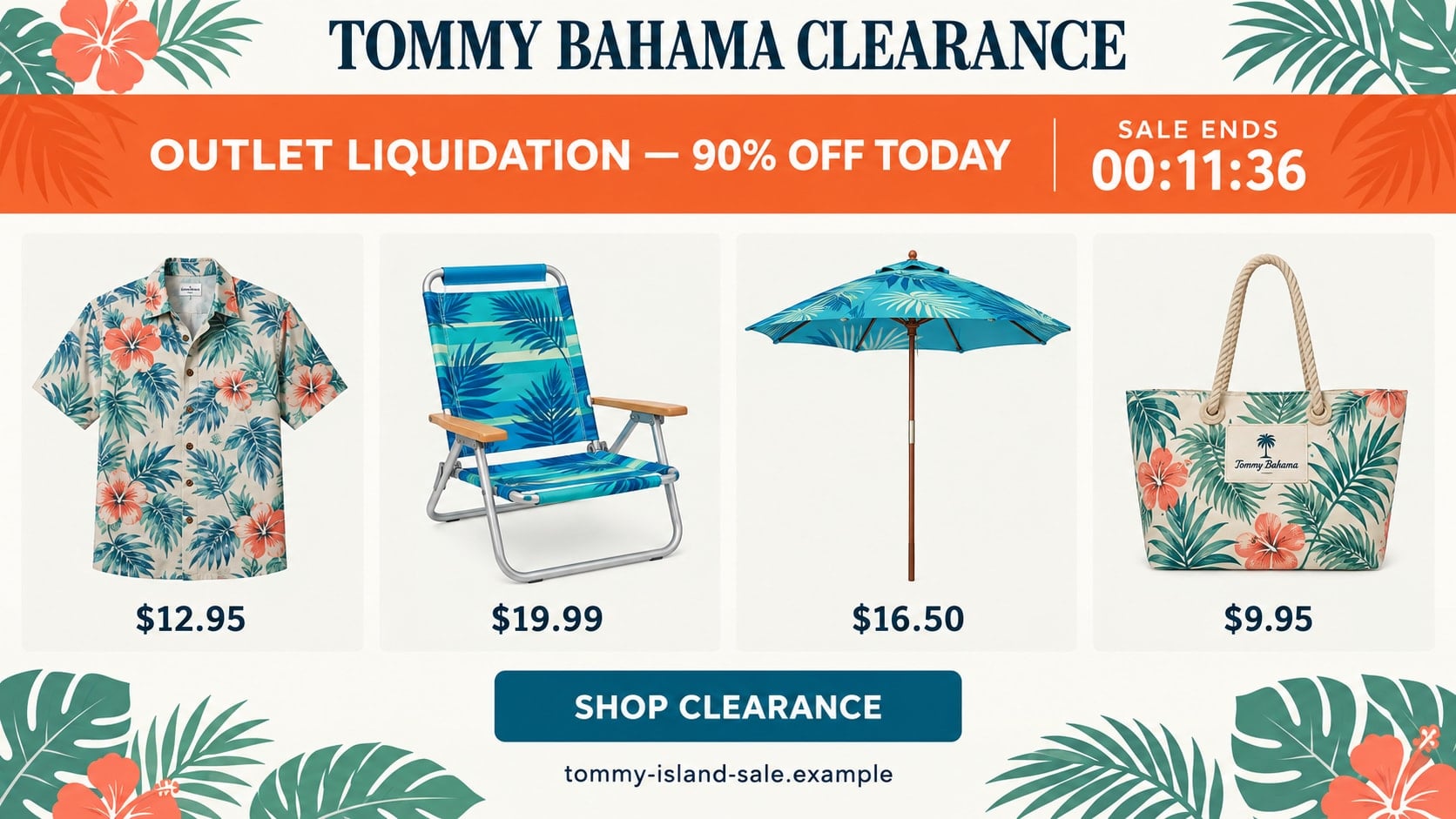
The page may advertise a warehouse liquidation, anniversary sale, outlet closure, or final inventory event. Nearly every item is available at 70% to 90% off, often with all colors and sizes still in stock.
Real retailers run promotions, but a new shop offering the entire catalog at a fraction of normal prices needs more than a banner to prove the offer is genuine.
The checkout can turn one bargain into several problems
Some buyers receive nothing. Others get an unrelated trinket or a poor imitation that bears little resemblance to the listing. The payment page can also collect card and identity information for later abuse.
Reported outcomes from this type of retail scam commonly include:
- No delivery despite a confirmation and tracking page.
- Counterfeit or extremely low-quality merchandise.
- A cheap substitute shipped only to create proof of delivery.
- Unexpected charges from an unrelated merchant.
- Passwords and contact information reused in follow-up scams.
How Fake Tommy Bahama Stores Look Convincing
The strongest fake stores do not rely on spelling errors. They copy high-resolution product images and organize them into a familiar e-commerce layout. Filters work, carts update, and policy pages are long enough to discourage careful reading.
The deception often begins in the address bar. A domain may add sale, outlet, clearance, or shop to the brand name. Another may use a generic domain while placing Tommy Bahama prominently in the page title and logo area.
A strip at the top promises free delivery, easy returns, and secure payment. These statements are controlled by the seller and are not outside guarantees. A padlock shows that the connection is encrypted, not that the company will honor its promises.
Customer reviews may be copied from authentic product pages. If every review is enthusiastic, none mentions delivery, and the dates stretch back farther than the domain’s history, the section is marketing material rather than reliable buyer evidence.
The official retailer identifies itself through tommybahama.com and lists its own Guest Services and return procedures. A separate store that cannot be reached through those official channels should not inherit the brand’s reputation.
Fake shops may also localize prices and shipping notices based on the visitor’s location. Seeing your state or currency on the page is usually automated personalization, not evidence that the seller operates nearby.
How the Tommy Bahama Discount Scam Works
Step 1: A targeted ad presents a rare clearance event
The campaign starts with an image of a popular product and a headline promising a steep markdown. Social platforms let advertisers reach people interested in clothing, travel, golf, or home furnishings, making the offer feel unusually relevant.
The advertising account may be newly created or previously used for unrelated content. A sponsored label means the placement was paid for, not that the merchant’s inventory was authenticated.
Step 2: The copied store lowers the visitor’s suspicion
The shopper sees a familiar logo, professional photographs, and categories that resemble a real retail site. Product names and descriptions may be exact copies, which makes search comparisons appear to confirm the items.
Trust badges, payment logos, and a satisfaction guarantee sit close to the add-to-cart button. Because the seller placed those images, they do not independently verify anything.
Step 3: Timers and cart messages rush the order
A countdown says the promotion ends today. Popups announce purchases in nearby cities, while a low-stock notice claims several people are viewing the same item. The timer may reset each time the page is opened.
Discounts increase as the basket grows. Buy three, get another 20% off is less about clearing real inventory and more about raising the amount the victim sends before the site disappears.
Step 4: Checkout records personal and payment data
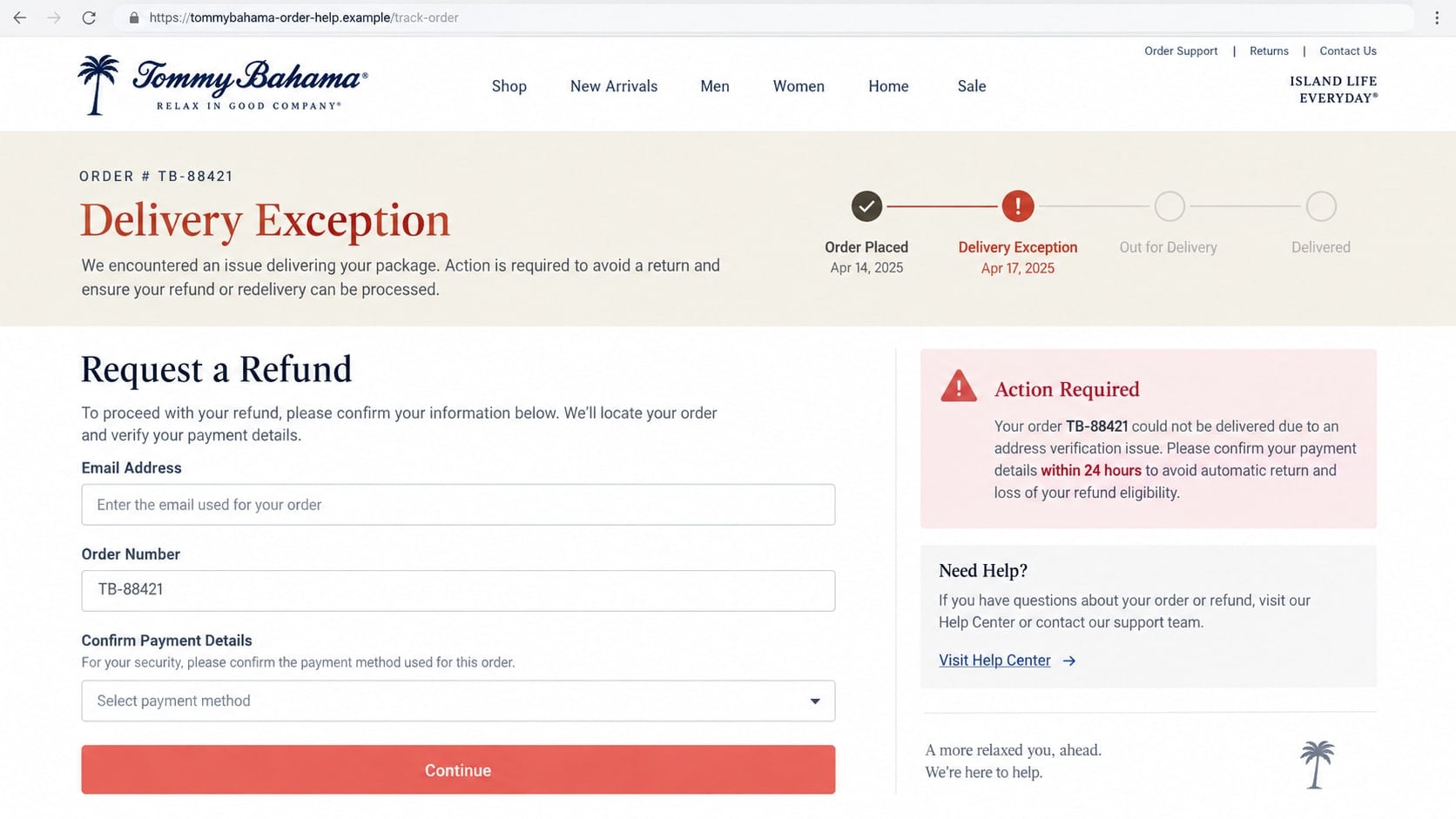
The form collects a shipping address, telephone number, email, and card data. A create-account option can capture a password that the shopper may also use on other websites.
The first payment may produce an error and a request to retry. The data can be captured even when the page claims the transaction failed, so entering a second card increases the exposure.
Step 5: Fake shipping updates keep the buyer waiting
A confirmation email and tracking link make the order feel real. The status can move from processing to international transit without corresponding to a parcel intended for the buyer.
When delivery is delayed, customer service asks the shopper to wait a few more business days. This can consume valuable time for canceling a payment or filing a card dispute.
Step 6: The seller blocks a full refund
If an item arrives, it may be the wrong size, poor quality, or entirely unrelated. Support offers a small partial refund, claims the return address is overseas, or requires tracked postage that costs more than the product.
If nothing arrives, the email address may stop responding. The same operators can close the domain and reopen the template with another brand before complaints accumulate.
Identity, Contact, and Payment Checks
Navigate to the official store independently
Type tommybahama.com into the address bar rather than following the advertisement. Search the official site for the product and promotion. If the clearance event is real, it should be visible through official navigation or customer service.
Look carefully at the registered domain. Words placed before or after a brand name can create a convincing label while still leading to a completely unrelated operator.
Verify the business and return address
Find the seller’s legal name, physical location, telephone number, and jurisdiction. Search each detail separately. A map pin does not prove the business occupies that address.
Read the official return information and compare it with the seller’s policy. A fake store may copy the wording but substitute a generic mailbox or provide no return destination at all.
Test claims instead of trusting page badges
Search the exact domain with terms such as complaints, fraud, and reviews. Check whether outside reviews discuss actual delivery and refunds rather than simply repeating coupon language.
Copy a sentence from the privacy policy into a search engine. If it appears on many unrelated shops, the policy is a reusable template and tells you little about who handles customer data.
Choose a payment method with a clear dispute path
Credit cards generally offer stronger consumer protections than bank transfers, debit payments, gift cards, or cryptocurrency. Never pay an individual or move the conversation to a messaging app to complete a retail order.
Check the final amount, currency, and merchant descriptor before approval. Close the page if an unexpected processing fee appears or the merchant name has no connection to the store.
Red Flags in a Fake Tommy Bahama Sale
- The store uses a lookalike address instead of tommybahama.com.
- Current products are marked 70% to 90% off across the catalog.
- Every popular color and size remains available during a final clearance.
- The countdown restarts or the sale is always ending that day.
- Contact is limited to a form or a free email address.
- The footer names an unrelated company or leaves the operator unidentified.
- Return terms are vague, expensive, or refer to another store.
- The checkout asks for payment by transfer, gift card, or cryptocurrency.
- The card is billed under a strange merchant descriptor.
- Tracking does not show the buyer’s full destination or parcel details.
A scam store may get several details right. The operators can copy authentic SKU numbers, fabric descriptions, size charts, and review text in minutes. Verification must focus on the seller and domain, not only the merchandise shown.
What to Do Before Ordering From an Unfamiliar Fashion Store
Pause the sale timer and open a separate browser tab. Search for the brand’s official site, then look for the same promotion there. A legitimate offer will survive a few minutes of checking.
Run a reverse image search on a product photo. If the exact picture appears on an established retailer at a very different price, the new shop may have copied the entire listing without owning the item.
Read the refund policy for practical details. A useful policy explains where returns go, how long approval takes, who pays shipping, and what happens to discounted merchandise. Generic promises are not enough.
Search the business name and address, not just the display name. Disposable stores frequently use one company name at checkout, another in the footer, and a third on the card statement.
If any result remains uncertain, do not provide card information. Clothing will be available somewhere else; recovering a payment and replacing a card costs far more time than leaving a suspicious cart.
Ask a second person to look at the site if the offer still feels tempting. Someone who has not spent time filling the cart is more likely to notice the unrelated domain, missing business identity, or repeated countdown.
Keep a separate shopping password rather than reusing the one for email. That simple boundary limits the damage if an unfamiliar store records account credentials along with the order.
What to Do if You Have Fallen Victim to This Scam
- Collect proof immediately. Save screenshots of the advertisement, complete domain, product listing, checkout amount, confirmation, delivery promise, tracking page, policies, and support messages. Photograph the parcel and item if one arrived.
- Contact the payment provider. Use the number on the card or the official banking app. Explain whether the order was not delivered, counterfeit, or not as described, and ask about a dispute, card replacement, and recurring-payment block.
- Do not pay a delivery or refund fee. A message may claim the parcel needs customs, address verification, or insurance. Verify any charge with the carrier using contact information from its official site, not the tracking message.
- Replace reused passwords. If the fake store collected an account password used elsewhere, change it on every affected service. Secure the email account first and enable multi-factor authentication.
- Monitor financial activity. Look for small test charges, unfamiliar merchant names, digital-wallet additions, and subscriptions. Ask the issuer how long to continue monitoring after a compromised checkout.
- Scan devices that opened downloads. Remove any shopping application, invoice viewer, or shipping document installed from the site. Run a full Malwarebytes scan to check for malicious software and unwanted browser changes.
- Add another layer against malicious pages. AdGuard can filter many known phishing domains and harmful advertisements. It cannot evaluate every new retailer, so continue verifying sellers manually.
- Report the store and ad. Report the campaign to the social platform, the domain provider, and ReportFraud.ftc.gov. Give the official brand the domain so its abuse or intellectual-property team can investigate.
- Be skeptical of recovery contacts. A stranger who already knows the order amount may have obtained it from the same criminal network. Do not pay anyone who promises a guaranteed refund.
Frequently Asked Questions
Is the Tommy Bahama clearance sale on social media real?
It may be, but the advertisement alone cannot prove it. Open tommybahama.com independently and look for the promotion there. Verify the destination domain before entering any information.
Why does the fake store look almost identical to the real one?
Product images, logos, descriptions, and layout ideas are easy to copy. Modern store templates also let operators reproduce a professional shopping experience without possessing any merchandise.
Does a tracking number prove the order was shipped?
No. It can refer to a cheap decoy item, another parcel delivered in the same area, or a label that was never used. Confirm destination and parcel details with the carrier.
What if the seller offers only a partial refund?
Do not accept automatically. Ask the card issuer how accepting it could affect a dispute. Preserve the seller’s message, especially if the listing promised a full satisfaction guarantee.
Can I safely return a counterfeit item?
Speak with the payment provider first. A fraudulent seller may provide a false overseas address or deny receiving the parcel, leaving you with extra postage and weaker evidence.
How can I tell whether the domain belongs to Tommy Bahama?
Start from tommybahama.com and use links found there. A domain that merely contains the brand name plus outlet, sale, or clearance should be treated as separate until independently verified.
The Bottom Line
The Tommy Bahama discount scam uses copied resort-wear imagery, implausible prices, and a rushed checkout to make an unknown store feel familiar. Confirmation emails and tracking pages can extend the illusion after payment.
Ignore the timer, verify the domain through the official site, and pay only when the seller’s identity and return process hold up. A genuine sale does not need to prevent careful shopping.








