

The call begins with a problem you did not know existed. A serious voice says your identity or bank account has been tied to money laundering, an illegal transfer, or another criminal investigation. Then the caller says there is still a way to clear your name.
For a student living away from home, especially an international student, the threat can feel immediate and difficult to verify. The scammer uses that fear to move the conversation somewhere private and keep outside advice away.
This report explains the active emergency-call scam, the fake evidence used to support it, and the point at which a supposed investigation turns into a demand for money.
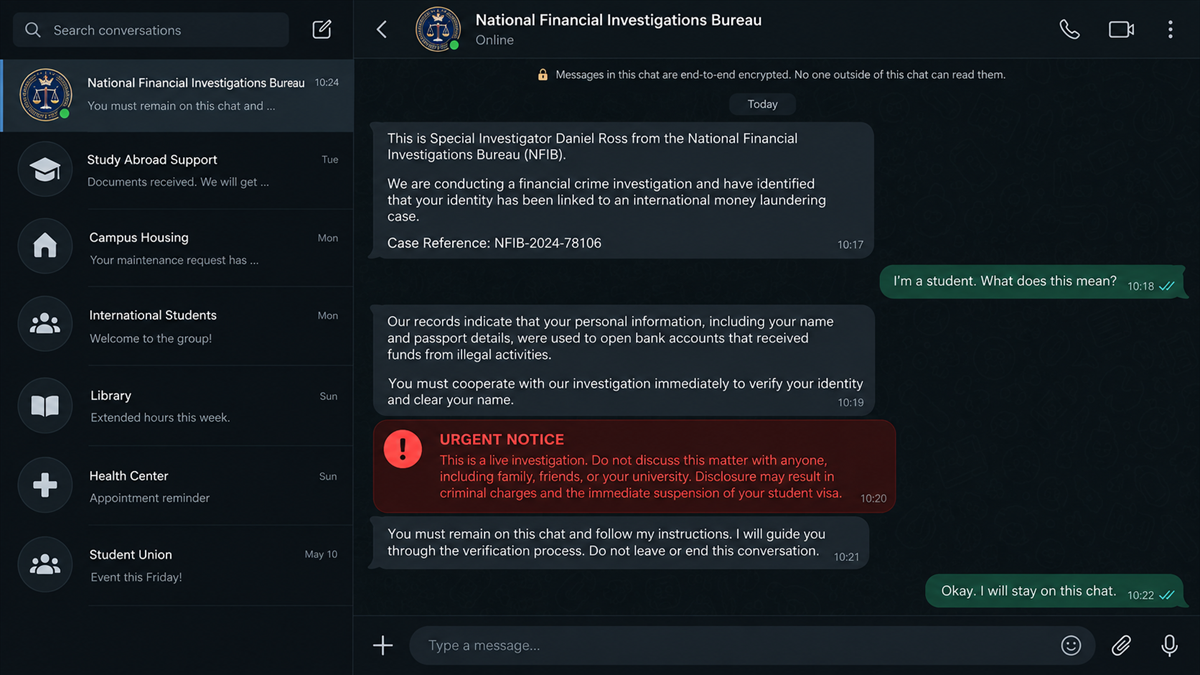
Overview
What students are being told
Scammers impersonate police, immigration officers, embassy staff, or other government officials. They claim the student’s identity, phone number, passport, or banking information has been linked to a crime. Money laundering is a common accusation because it sounds serious while remaining vague enough to fit almost anyone.
The caller then frames obedience as cooperation. The student may be told to stay on the line, move to a messaging app, review documents, and follow instructions without speaking to friends, family, the bank, or local police.
What the scammers want
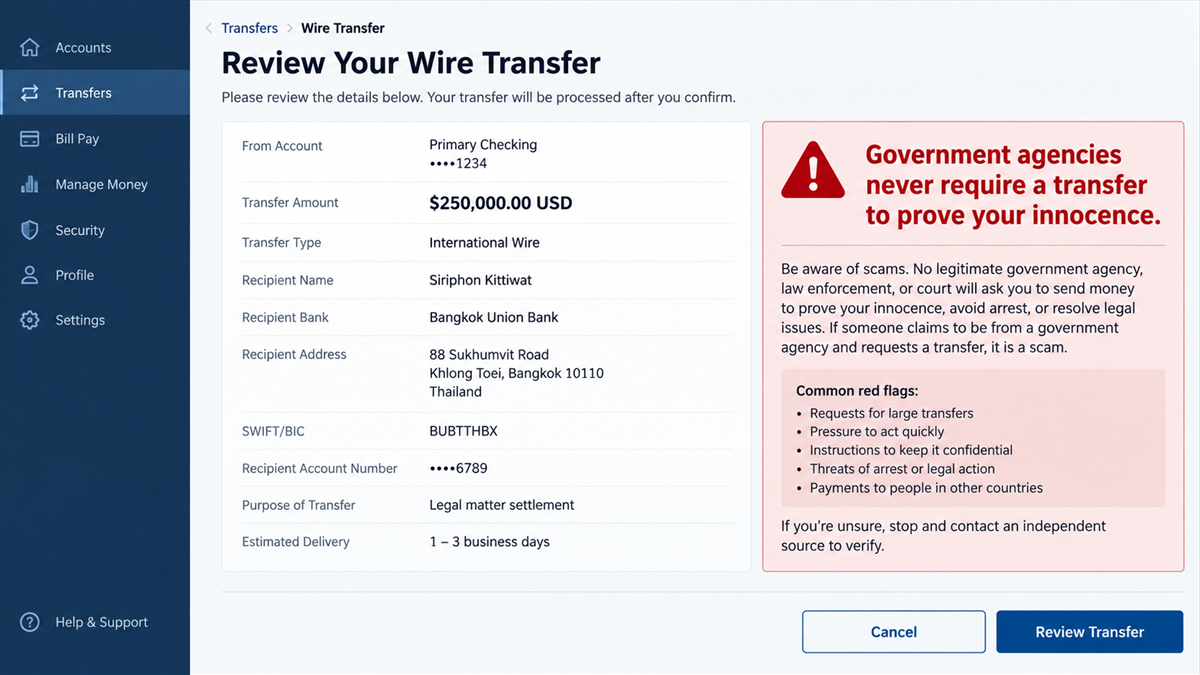
The end goal is a wire transfer, withdrawal, cryptocurrency payment, or disclosure of sensitive information. In the September 2026 alert reviewed for this report, RBC said victims were instructed to send a wire transfer to a South-East Asian country to avoid arrest, fines, or other legal consequences.
No legitimate investigation requires a suspect or witness to move personal money into an account selected by an unexpected caller. A transfer described as bail, verification, safekeeping, evidence review, or a test transaction is still a demand for money.
The fastest way to recognize it
The story can change, but the control tactics are consistent. Treat the contact as fraudulent when it includes any combination of these signs:
- An unexpected official accuses you of a crime over the phone.
- The caller threatens immediate arrest, deportation, fines, or passport cancellation.
- You are ordered to continue on WhatsApp, Telegram, Signal, or another private app.
- You receive police identification, warrants, or court documents through chat.
- You are told to transfer money as part of an investigation.
- The caller coaches you on what to tell your bank.
- You are warned not to discuss the case with anyone.
This Is a Confirmed Active Scam
RBC’s current scam-alert page lists the scheme as an active vishing and impersonation campaign targeting students. The bank warns that scammers are posing as law enforcement, immigration, and other government officials while falsely linking victims to crimes.
The official alert describes the same pressure pattern seen in many authority-impersonation scams: threats of arrest, requests to send money, a move to messaging platforms, fake identification or court papers, and instructions designed to defeat a bank employee’s fraud questions.
RBC’s guidance is direct: legitimate law enforcement will not ask someone to transfer money or communicate through messaging applications. Students can review the warning on RBC’s official scam alerts page.
The scam is not limited to RBC customers. The bank is describing a social-engineering operation aimed at students, and the caller may claim to represent a local police department, a foreign agency, immigration authorities, a consulate, or a financial-crime unit.
How the Student Emergency Call Scam Works
Step 1: The scammer creates an official identity
The contact may arrive as a call, voicemail, text, or message. Caller ID can display a familiar agency name or a local number, but that information can be spoofed. The person introduces themselves with a title, badge number, case number, or department name.
Those details are there to establish authority before the accusation begins. A badge number spoken confidently is not evidence that the caller works for an agency.
Step 2: The student is accused of a serious crime
The caller says the student’s identity or bank account appeared in an investigation. The story may involve money laundering, a package, a compromised passport, an illegal account, or funds transferred by criminals.
The accusation is intentionally frightening and confusing. The scammer may reveal public or stolen personal details to make the allegation feel targeted. Knowing a name, school, address, or partial account detail does not make the caller legitimate.
Step 3: The conversation is isolated
The victim is told that the case is confidential. The caller may insist on an uninterrupted call or move the conversation to an encrypted messaging app. They may say disclosure would obstruct the investigation or endanger the student’s immigration status.
Isolation prevents reality checks. A friend, family member, bank employee, campus adviser, or real police officer would quickly challenge the demand for money.
Step 4: Fake documents make the threat look real
The scammer sends a picture of an identification card, arrest warrant, court notice, evidence sheet, or official-looking web portal. Logos and seals can be copied, and generative tools can create convincing documents in seconds.
A document received from the person making the threat does not independently verify that person’s identity. Real verification means ending the contact and reaching the agency through a number or website you find yourself.
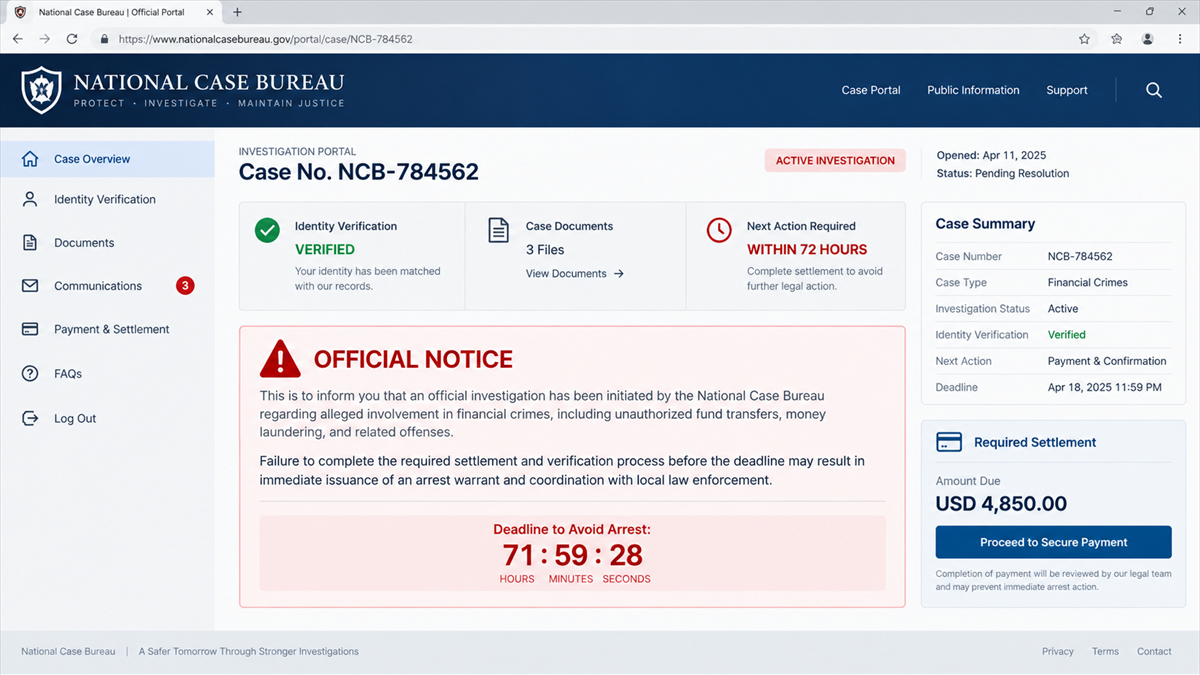
Step 5: The scammer demands a transfer
The payment may be described as a security deposit, temporary verification, refundable bond, compliance transfer, or protected holding account. The student may be promised that the money will return after the investigation confirms their innocence.
RBC specifically warns about instructions to wire money to a South-East Asian country. Other versions can use domestic transfers, cryptocurrency, gift cards, cash couriers, or repeated smaller payments.
Step 6: The student is coached to mislead the bank
A financial institution may stop an unusual international wire and ask why it is being sent. Scammers prepare for that defense. They tell the victim to call it tuition, a family transfer, travel, a purchase, or personal support.
This coaching is one of the clearest fraud signals. A legitimate official would never need you to conceal the true purpose of a transaction from your bank.
Step 7: More demands follow the first payment
Sending money does not close the fictional case. It proves to the scammer that fear is working. New fees, additional accounts, tax claims, or supposed evidence problems may appear until the victim stops paying or runs out of funds.
The criminal may also use collected identity documents and banking information for account takeover or identity theft, extending the harm beyond the original transfer.
Why Students Are Targeted
Students often manage new financial, housing, school, and immigration responsibilities at the same time. International students may be unfamiliar with how local police, courts, banks, and immigration agencies normally communicate. Scammers turn that uncertainty into urgency.
Language differences and distance from family can increase the pressure. A caller may switch languages, claim to represent an overseas agency, or threaten consequences in both the student’s current country and home country.
The scammer also knows that academic schedules create vulnerable moments. A threat of arrest before an exam, loss of enrollment, or cancellation of immigration status can make pausing feel risky. In reality, pausing and independently checking the claim is exactly what protects the victim.
A related pattern appears in the digital arrest scam built around fake police video calls. The student version uses the same manufactured authority and isolation, but adapts the threat to education, immigration, and overseas family concerns.
Students may also have daily transfer limits, tuition savings, or family funds in one account, making them attractive targets for a high-pressure wire request. A criminal does not need to know the exact balance. They can ask questions during the supposed investigation, learn how much is available, and adjust the demand.
The accusation is often tailored after the victim reacts. If the student denies opening an account, the caller says identity theft is part of the case. If the student questions the overseas destination, the caller says the foreign account belongs to an investigative unit. Every objection becomes another detail in the script rather than an opportunity to verify the claim.
Red Flags in the Call, Chat, and Documents
Do not focus on whether one logo looks real. Judge the entire process. Genuine agencies do not resolve criminal allegations by directing students to privately move money.
- The official refuses to let you hang up and call the agency back.
- The conversation moves from a phone call to a consumer messaging app.
- The caller says the investigation must remain secret from family and the bank.
- A payment is presented as proof of innocence or cooperation.
- The recipient is an individual, private business, exchange, or overseas account.
- You are told to lie about the purpose of the payment.
- Documents contain a countdown, immediate deadline, or threat of arrest.
- The caller asks for passwords, one-time codes, passport images, or remote access.
Company and Checkout Checks
Verify the agency independently
End the call. Find the agency’s public number on an official government website and ask whether the person, department, and case number exist. Do not use a number, link, QR code, or extension provided by the caller.
Ask campus support for help
International-student services, campus security, and student legal resources understand how real notices are delivered. They can help verify a claim without sending money or exposing more information.
Tell the bank the full story
If a caller instructs you to transfer funds, tell the bank exactly what happened. Do not repeat the cover story provided by the scammer. The bank needs accurate information to recognize and stop the payment.
Examine the destination, not the explanation
A transfer to a personal account, unrelated company, cryptocurrency address, or overseas beneficiary cannot become legitimate because the caller calls it an official holding account. Payment destination is evidence; the caller’s label is not.
What to Do if You Have Fallen Victim to This Scam
- End all contact. Hang up, leave the chat, and do not warn the scammer about the steps you plan to take.
- Call your bank immediately. Ask the fraud department to stop, recall, or freeze the wire. Speed matters, and recovery is not guaranteed.
- Report the incident to real police. Use a verified local non-emergency number or visit a station. If there is an immediate safety concern, use the local emergency number.
- Tell your school. Contact campus security and international-student support. Other students may be receiving the same calls.
- Preserve evidence. Save phone numbers, usernames, chat exports, documents, recipient details, transfer receipts, and timestamps.
- Secure exposed accounts. Change passwords from a clean device, revoke unknown sessions, and replace any one-time recovery codes that were shared.
- Protect identity documents. If you sent passport or ID images, contact the issuing authority and follow its identity-theft guidance.
- Scan devices if you installed anything. A reputable security tool such as Malwarebytes can help check for remote-access software or malware introduced during the conversation.
AdGuard can help block known phishing pages and deceptive advertisements, but it cannot identify every caller or stop a wire that you authorize. The most important defense is to end the contact and verify through a channel the scammer does not control.
How Students and Families Can Prepare
Agree on a simple rule before a crisis: no one sends money because of an unexpected official call. The student should be able to contact a trusted person without fear of getting in trouble or being judged.
Save official numbers for the school, bank, immigration adviser, and local police. Discuss caller-ID spoofing and the fact that real logos, names, and documents can be copied. Preparation removes some of the shock on which the scam depends.
Families should also know that scammers may contact them separately. A criminal can claim the student is detained or in danger and demand money from relatives. Verify through a known number or a separate trusted contact before acting.
Schools can help by circulating examples before enrollment, tax deadlines, and holiday travel periods. The most useful warning is specific: officials do not investigate crimes through consumer chat apps, and they do not ask students to wire money into an account selected during a call.
Frequently Asked Questions
Can police legally ask me to send money by wire?
Police may collect official fines or fees through documented legal processes, but they do not call unexpectedly and order you to wire money to prove innocence or avoid arrest.
What if the caller knows my passport or school details?
Personal details can come from breaches, public profiles, stolen documents, or earlier phishing. Correct information does not verify the caller. Contact the agency through an independent official channel.
Can caller ID show a real police number?
Yes. Caller ID can be spoofed, so the displayed number is not proof. Hang up and place a new call using a number from the agency’s official website.
Why do scammers move the chat to a messaging app?
Private apps help them maintain continuous contact, send fake documents, and isolate the victim. They can also switch accounts quickly when one identity is reported.
Will my bank reverse an international wire?
Sometimes a bank can stop or recall a transfer, especially when contacted quickly, but wires can be difficult to recover. Report the fraud immediately and provide complete recipient details.
Should I pay a company that promises to recover the money?
Be very cautious. Recovery scammers target people after an initial loss and demand more fees. Work with your bank, police, and recognized victim-support organizations rather than unsolicited recovery agents.
The Bottom Line
A frightening accusation is not an investigation, and a wire transfer is not proof of innocence. The active student emergency scam succeeds by turning authority, secrecy, and time pressure into control.
Hang up, verify independently, and tell someone you trust. If money has already moved, contact the bank and real law enforcement immediately, without using any number or link the scammer supplied.








