

Fatigue, slow recovery, and brain fog can make almost anyone search for a deeper explanation. PrimeCell H2 offers one inside every cell.
The store surrounds dissolving hydrogen tablets with clinical language, age-reversal imagery, and a generous guarantee. Its own policies tell a far messier story.
Overview
What PrimeCell H2 Promises
PrimeCell H2 is sold as tablets that release molecular hydrogen when dropped into cool or room-temperature water.
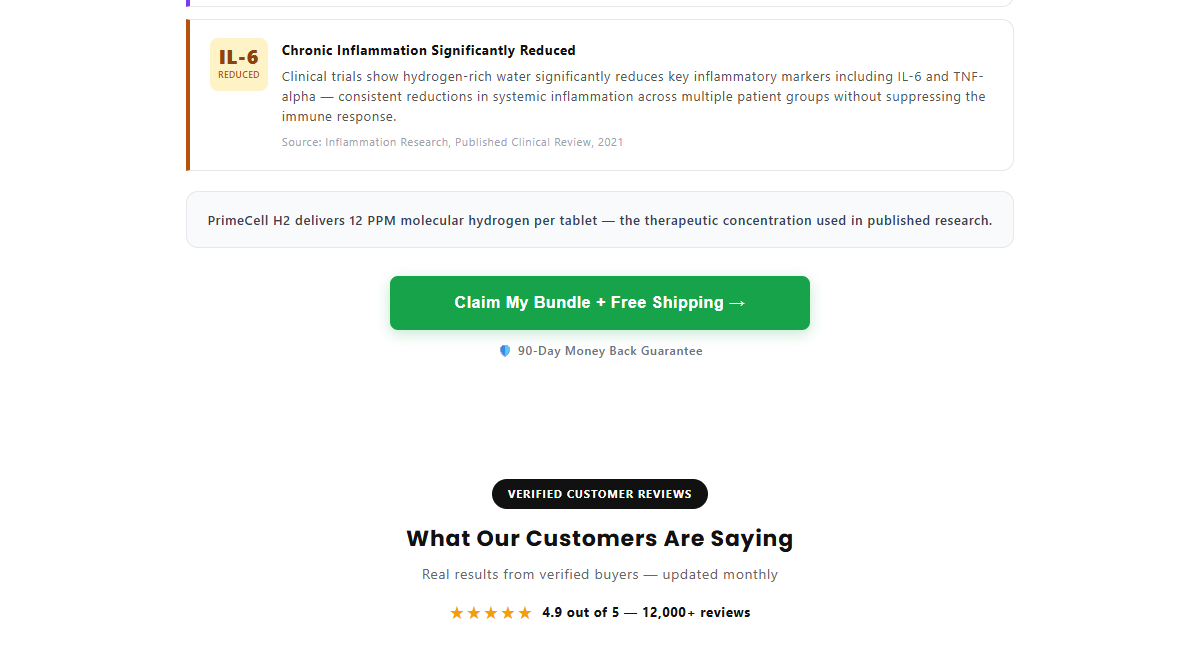
The page says each tablet delivers 12 PPM hydrogen and supports clean energy, sharper focus, recovery, healthy inflammation responses, and cellular protection.
Its broader story goes much further, describing measurable biomarker changes and vitality resembling someone 10 to 15 years younger.
How the Store Builds Scientific Authority
The seller cites more than 2,000 peer-reviewed studies, over 170 researched conditions, at least 19 clinical trials, and a 39% oxidative-stress reduction.
It also says molecular hydrogen crosses the blood-brain barrier, selectively targets harmful radicals, and is recognized as GRAS by FDA.
Those statements blend general research about hydrogen with promises for one branded tablet. That transition requires product-specific evidence the page does not clearly provide.
Our Assessment
The most damaging evidence is not hidden in scientific debate. It appears inside PrimeCell’s own legal and customer-service pages.
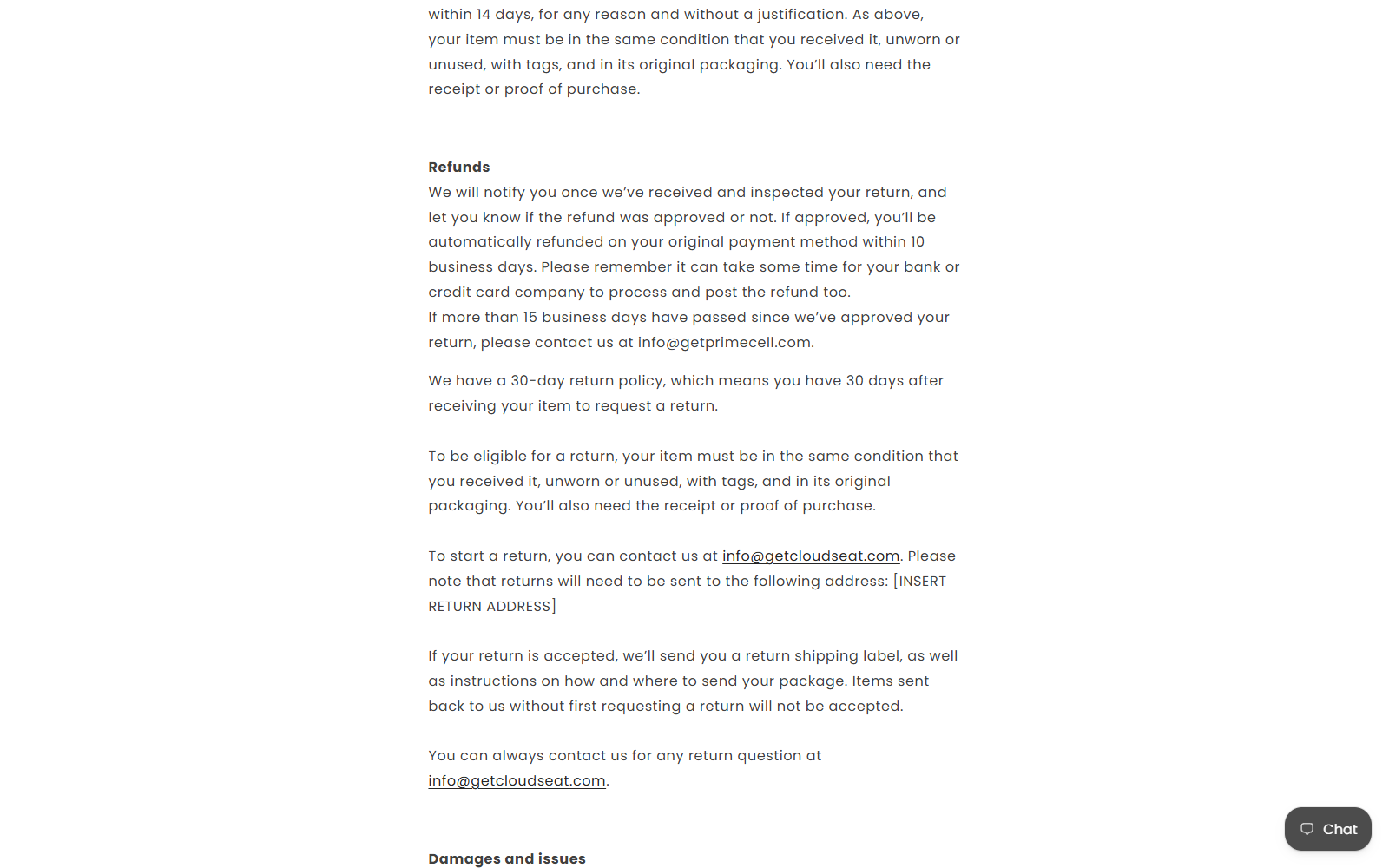
The refund policy contains another store’s email, a literal “[INSERT RETURN ADDRESS]” placeholder, and repeated sections using multiple unrelated identities.
Before considering this offer, understand the central concerns:
- The product page’s 90-day promise conflicts with a 30-day unused-item policy
- No usable return address appears in the reviewed refund text
- CloudSeat and colominamartbiz names remain inside PrimeCell policies
- Large research totals do not prove this formula’s advertised outcomes
- GRAS concerns an ingredient’s food use, not approval of anti-aging benefits
- Urgency, review totals, and bundles are controlled by the seller
The Cellular Restoration Story
PrimeCell tells visitors that ordinary supplements do not reach the real problem because exhaustion is “cellular.”
Molecular hydrogen is presented as uniquely small, able to penetrate every cell, cross the brain barrier, and reach mitochondria directly.
The page then connects that mechanism with clearer thinking, stronger workouts, reduced stiffness, better skin, improved biomarkers, and younger biological age.
This is persuasive because one invisible cause appears to explain many unrelated frustrations.
Yet broad symptom clusters can arise from sleep disorders, anemia, thyroid disease, medication effects, depression, infection, nutrition, or other medical conditions.
A supplement page cannot determine why a person feels tired. Dramatic cellular language should never delay an appropriate medical evaluation.
What the Research Numbers Do Not Prove
A large number of papers about a molecule does not establish that every commercial tablet produces the same concentration, exposure, or clinical outcome.
Studies vary by water preparation, hydrogen level, participant group, duration, control, outcome, and risk of bias.
Some research explores mechanisms or early biomarkers rather than practical improvement that a consumer can feel.
PrimeCell should provide testing for its exact lot, dissolution method, measured hydrogen concentration over time, tablet composition, purity, and stability.
It should also distinguish exploratory studies from replicated clinical evidence and avoid applying one population’s result to every buyer.
The claim of a 39% reduction needs context. The same page later describes a 39% increase in an antioxidant enzyme and a 43% marker decrease.
Changing a complex study into a short sales statistic can remove participant details, limitations, and whether the product itself was ever tested.
GRAS Is Not FDA Approval of the Benefits
GRAS means “Generally Recognized As Safe” for a substance under specified conditions of food use.
It is not an FDA finding that PrimeCell restores cells, reverses aging, treats inflammation, or improves memory.
The site’s own FDA disclaimer says its statements were not evaluated by the agency and the product does not diagnose, treat, cure, or prevent disease.
That disclaimer is easy to overlook after pages of medical-sounding claims and green check marks.
Safety status for an ingredient also does not prove every finished product has accurate dosing, uncontaminated ingredients, stable packaging, or honest manufacturing records.
How the PrimeCell H2 Offer Works
Step 1: Everyday Symptoms Become a Cellular Problem
The pitch begins with exhaustion, poor focus, joint discomfort, slow recovery, and frustration with ordinary vitamins.
It suggests those products failed because they never reached a deeper source inside the body.
Step 2: One Tiny Molecule Appears Uniquely Powerful
Hydrogen is described as the smallest molecule in existence and a selective antioxidant that reaches places other substances cannot.
The scientific vocabulary makes a dissolving tablet feel closer to advanced therapy than an ordinary supplement.
Step 3: General Research Becomes Product Proof
Thousands of papers, many conditions, and several clinical trials are grouped around PrimeCell’s branded offer.
Unless those trials used the exact tablet and dose, the research supports interest in hydrogen, not every outcome promised by this seller.
Step 4: A Transformation Timeline Sets Expectations
The page describes changes after weeks and months, ending with better defenses and vitality associated with being 10 to 15 years younger.
A small note says the timeline comes from a voluntary customer survey and that individual results vary.
Seller-collected survey responses cannot establish biological age reversal or provide the control group needed for a clinical conclusion.
Step 5: Scarcity and Bundles Push a Larger Order
The reviewed page said only 10 or 11 units remained and warned that high demand was causing an almost sold-out situation.
Bundles advertised savings reaching 57%, with per-day pricing that makes multiple boxes appear economical.
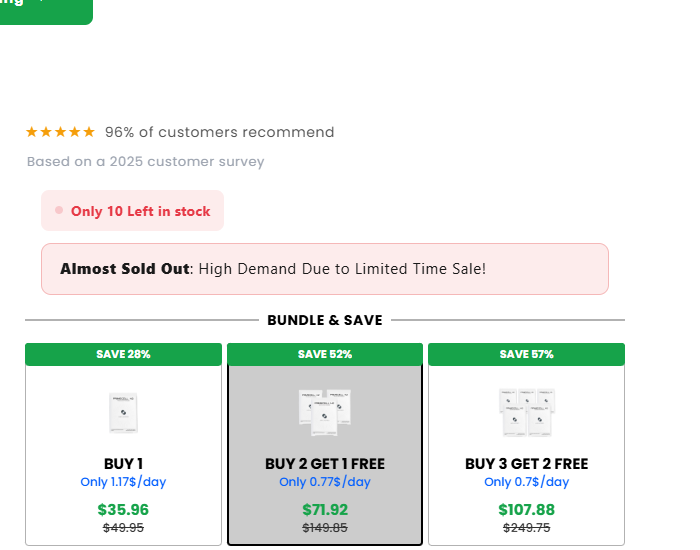
Scarcity counters deserve skepticism when they are not connected to verifiable inventory.
A large first order increases the amount at risk and can complicate returns when sale items or opened packages are restricted.
Record the selected quantity and final total before paying. Never assume the highlighted bundle contains the smallest order.
Step 6: Reviews and a Guarantee Close the Sale
PrimeCell displays a 4.9 rating, 12,000 reviews, 96% recommendation, and “verified” customer labels.
It also promises a 90-day cellular restoration trial and says dissatisfied users can obtain a full, no-hassle refund.
The legal policy undermines that reassurance by describing 30 days, unused goods, sale exclusions, wrong emails, and no real return address.
The Refund Policy Is a Major Warning
PrimeCell’s product page tells buyers to use the tablets during daily life and judge results within 90 days.
The refund page says returns generally require the item to be unworn or unused, with tags and original packaging.
It also says sale items cannot be returned, while the product is presented with substantial sale pricing.
Most seriously, the policy instructs customers to contact info@getcloudseat.com and send returns to “[INSERT RETURN ADDRESS].”
Other repeated passages use info@getprimecell.com and info@colominamartbiz.com.
A shipping policy thanks customers for choosing colominamartbiz, while the terms call the store CloudSeat and retain unfinished merchant notes.
These are not minor punctuation mistakes. They make it unclear who accepts a return, which business issued the promise, and where merchandise should go.
Company, Address, and Fulfillment Checks
The Legal Seller Is Not Clearly Presented
The reviewed PrimeCell pages do not prominently identify one legal company responsible for manufacturing, billing, fulfillment, and refunds.
Brand names cannot replace a legal entity when a customer needs to enforce a guarantee.
The Return Address Is Literally Missing
The refund policy contains the placeholder “[INSERT RETURN ADDRESS]” instead of a usable destination.
Do not mail a package until support supplies a complete address and confirms authorization in writing.
Multiple Unrelated Emails Remain in the Policies
PrimeCell, CloudSeat, and colominamartbiz email identities appear in overlapping legal text.
That pattern strongly suggests copied storefront templates were published without adequate review.
The Manufacturer and Testing Chain Are Opaque
The seller should name the tablet manufacturer, production country, quality laboratory, lot tester, and facility responsible for supplement compliance.
Without that traceability, buyers cannot connect broad hydrogen research to the tablets arriving in their package.
Does PrimeCell Enroll Buyers in a Subscription?
The footer includes a “manage subscriptions” link, which shows that subscription functionality exists somewhere in the storefront system.
That link alone does not prove every PrimeCell purchase automatically renews.
Before paying, inspect the selected option for “subscribe,” “auto-renew,” “delivery frequency,” “membership,” or a recurring-discount statement.
Read the final checkout summary and receipt. A one-time purchase should state one-time clearly and should not include a future billing date.
If a recurring option is selected, save its price, interval, cancellation method, minimum commitment, and renewal notice.
Additional Warning Signs
PrimeCell combines several familiar direct-response techniques:
- A single cellular explanation for numerous vague symptoms
- Research totals presented without an organized product-specific evidence file
- A dramatic age-reversal timeline based on self-reported survey responses
- Thousands of seller-hosted reviews and unusually precise popularity claims
- Low-stock counters and escalating bundle discounts
- A 90-day marketing promise contradicted by a 30-day unused-return rule
- Other store names, emails, placeholders, and unfinished notes in policies
Any one issue might be fixable. Together, they show a storefront that should not receive blind trust.
What to Do if You Have Fallen Victim to This Scam
- Capture every version of the promise. Save the 90-day guarantee, product claims, bundle, checkout, refund policy, receipt, and card descriptor.
- Contact the correct domain first. Write to the PrimeCell address on your receipt and note the contradictory CloudSeat and colominamartbiz details.
- Demand a complete return authorization. Ask for the legal entity, physical return address, authorization number, deadline, and refund amount.
- Do not ship to a placeholder. A guessed warehouse or unrelated address may leave you without merchandise or refund proof.
- Cancel recurring billing separately. Check the order confirmation and any account portal for future delivery dates or subscription status.
- Watch the payment card. Identify unexpected rebills, different merchant names, or additional quantities and report them promptly.
- Open a documented dispute. Provide the bank with policy screenshots, unanswered requests, missing address, shipment evidence, and misleading guarantee language.
- Seek medical advice for symptoms. Persistent fatigue, cognitive changes, pain, or inflammation deserves assessment rather than continued supplement experimentation.
- Run a security check. Use Malwarebytes after suspicious downloads, browser prompts, or redirects connected with the order.
- Reduce repeated supplement ads. AdGuard can limit trackers and aggressive ad networks that keep resurfacing similar offers.
How to Evaluate a Hydrogen Supplement
Ask for a complete Supplement Facts panel, ingredient amounts, tablet weight, lot number, manufacturer, and third-party certificate of analysis.
Request measured dissolved hydrogen concentration using the exact water volume, temperature, container, and drinking time recommended to consumers.
Check whether cited studies used comparable exposure and meaningful clinical outcomes rather than unrelated laboratory measurements.
Discuss the ingredients with a clinician, especially during pregnancy, chronic illness, surgery preparation, or medication use.
Do not interpret “natural,” “cellular,” “clinically studied,” or “GRAS” as proof that the finished product produces the advertised transformation.
Why Broken Policies Matter More Than Typos
An ordinary spelling mistake rarely changes a buyer’s rights. PrimeCell’s errors involve the identity, destination, and timing of a return.
A customer cannot follow a policy that sends them to an unfinished address or another store’s inbox.
Multiple merchant names also complicate payment disputes because the bank may ask which company promised the refund.
Copied text raises another question: which business actually reviewed the supplement claims, ingredients, and safety language?
A seller managing ingestible products should maintain tighter control than a generic template shop.
Legal pages should match the receipt, checkout, package label, card descriptor, and support signature.
PrimeCell should correct the documents, publish the responsible company, and explain whether earlier customers remain protected.
Until that happens, a 90-day badge cannot overcome the practical absence of a coherent return route.
Check the Delivered Bottle
Compare the bottle with the sales page before opening it. Photograph every side, seal, lot code, expiration date, and ingredient panel.
Look for the manufacturer or distributor, domestic contact, serving size, warnings, and exact tablet count.
Do not consume tablets from a broken seal, damaged bottle, missing label, or package with unexplained powder or odor.
If the label differs from the advertisement, request clarification and preserve the unopened item for a possible return.
Frequently Asked Questions
Is PrimeCell H2 a confirmed scam?
The copied policies, missing address, conflicting guarantees, and unexplained company identities create serious credibility and refund concerns.
Does molecular hydrogen have research behind it?
Yes, research exists, but study volume does not prove PrimeCell’s exact tablets deliver younger vitality or every benefit listed.
Is PrimeCell H2 FDA approved?
No such approval is established by a GRAS statement. The site itself says FDA has not evaluated its health claims.
What is wrong with the refund policy?
It mixes 30 and 90-day messages, requires unused goods, names other stores, uses unrelated emails, and leaves the return address unfinished.
Does PrimeCell H2 automatically renew?
A subscription-management link exists, but renewal depends on the selected checkout option. Verify the receipt and future billing schedule.
Can PrimeCell make someone 10 years younger?
The page’s timeline is not proof of age reversal. It cites voluntary customer reporting and includes an individual-results disclaimer.
The Bottom Line
PrimeCell H2 uses genuine scientific interest in molecular hydrogen to support claims that run far beyond demonstrated product-specific evidence.
Its storefront then weakens buyer protection with copied policies, unrelated identities, conflicting deadlines, and no completed return address.
Those failures are enough to avoid the offer. A supplement promising cellular restoration should meet a much higher standard of traceability and accountability.








