

AlphaEars promises clear calls without shutting out traffic, coworkers, or the world around you. For drivers and active workers, that practical pitch has obvious appeal.
The headset may be a real physical product, but a sensible purchase depends on more than its speaker design. The store’s discounts, policies, and seller identity need equal attention.

Overview
AlphaEars appears to sell actual headsets
We found a working Shopify storefront, product pages, shipping information, order tracking, and policy documents. Nothing we reviewed proves the hardware is imaginary.
That matters because “scam” would be too broad. The strongest concerns involve promotional certainty, limited seller transparency, and directly conflicting refund language.
The return promise is not truly risk-free
The homepage describes zero-risk returns and a 30-day no-stress promise. The detailed policy requires unused goods, original packaging, and customer-paid return shipping.
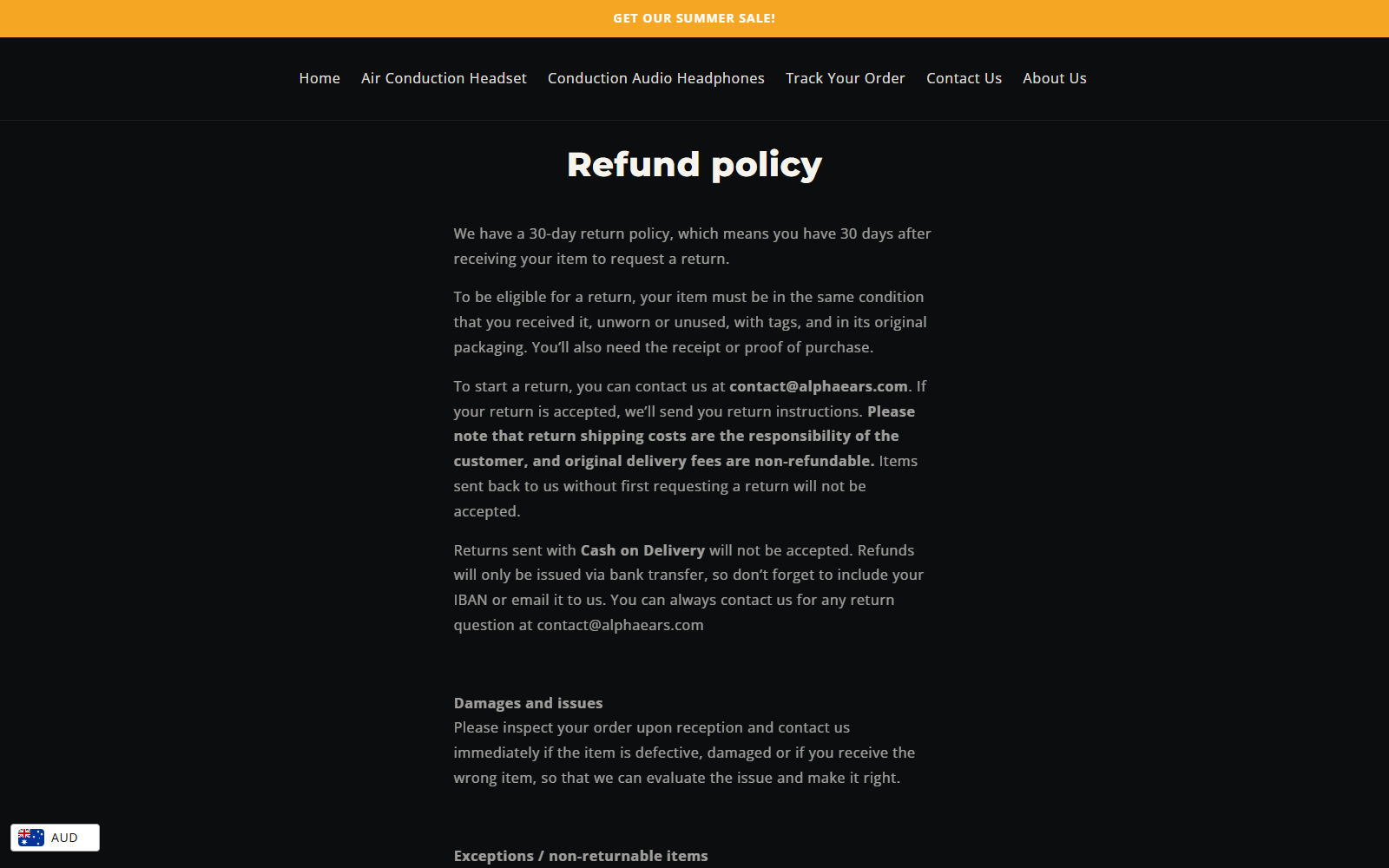
More seriously, the policy excludes sale items while the storefront displays its headsets at roughly 49% off. Buyers need written confirmation that their discounted order remains returnable.
Basic business details remain thin
AlphaEars provides an email address and forms, but its visible terms do not name a registered legal company, street address, telephone number, or responsible individual.
Our main findings are:
- A real ecommerce store and tangible product category are present
- Prices are shown in Australian currency during our review
- The site advertises 8 to 10 hours of battery life
- The homepage promises awareness and clearer calls
- Refund instructions contradict each other on payment method
- Discounted merchandise may fall under a no-return exclusion
AlphaEars should be approached as an unproven direct-to-consumer headset seller, not automatically as established audio equipment with independently validated specifications.
What AlphaEars Claims the Headset Can Do
The primary product is described as an air-conduction headset that leaves the ear canals open. A wraparound frame positions speakers outside rather than sealing the ears.
This general design exists across many brands. Open-ear audio can help users retain environmental awareness, although volume and surroundings still affect what they hear.
AlphaEars says its adjustable boom microphone improves voice clarity during common road, engine, and worksite noise. The wording describes design intent, not measured laboratory performance.
The store advertises up to 8 to 10 hours of use. Actual battery time can vary with volume, call duration, temperature, connection quality, and battery condition.
Multipoint pairing is also promoted, allowing two Bluetooth connections. That feature is useful when switching between a work telephone and another enabled device.
No independent test report, Bluetooth certification reference, microphone comparison, or battery protocol appears in the material we reviewed. Buyers must rely mainly on seller statements.
The homepage shows a 4.9 rating and more than 8,800 happy drivers. It does not explain the review platform, collection method, date range, or verification standard beside that number.
A large rating can be genuine, imported, aggregated, or decorative. Without traceable entries, it cannot substitute for independent long-term reviews.
The Refund Policy Contradictions
The refund page begins with a familiar 30-day return promise. Eligibility requires the headset to remain unworn or unused, with tags and original packaging.
That condition limits practical testing. Comfort, microphone quality, multipoint behavior, and battery endurance cannot be judged meaningfully while keeping a headset untouched.
The customer pays return postage, and original delivery fees are not refunded. Therefore, an accepted return can still leave the buyer out of pocket.
One paragraph says refunds will be issued only by bank transfer and asks customers to provide an IBAN. That is unusual for a card-funded ecommerce purchase.
A later paragraph says an approved refund goes automatically to the original payment method. Both instructions cannot describe the same ordinary process accurately.
Never send banking information simply because an email requests it. Ask support to explain the contradiction and preserve its written answer before returning anything.
The policy also says sale items cannot be returned. Meanwhile, the collection page showed the main headsets with prominent 49% reductions.
If every appealing item is on sale, the broad 30-day promise may offer far less protection than the homepage implies. This should be clarified before payment.
How the AlphaEars Sales Offer Works
Step 1: The advertisement targets a specific daily frustration
Drivers and workers need calls while keeping track of nearby sounds. AlphaEars presents its open-ear shape as a direct answer to that problem.
A narrow use case feels more credible than a gadget claiming to suit everyone. It also lets the store speak in the language of dispatch, routes, cabs, and jobsites.
Step 2: A comparison price makes the discount feel temporary
The storefront displays a much higher crossed-out amount beside the selling price. That presentation encourages shoppers to judge savings before judging the hardware.
Reference prices matter only when they reflect genuine prior sales. We did not find evidence showing how long the headset regularly sold at the higher amount.
Step 3: Quantity bundles increase the order
Multiple-unit options offer additional reductions. A shopper who has never tested one headset can therefore be nudged toward two or three.
The strategy raises average order value. It also multiplies return postage and potential frustration if fit or sound quality disappoints.
Step 4: Reassurance moves the buyer past uncertainty
Labels such as secure payment, risk-free guarantee, expedited shipping, and no-stress promise appear close to buying decisions. Each reduces perceived danger.
The detailed policies then add conditions that those short labels do not communicate. A reassuring badge is a summary, never the contract.
Step 5: A fulfillment center handles shipment
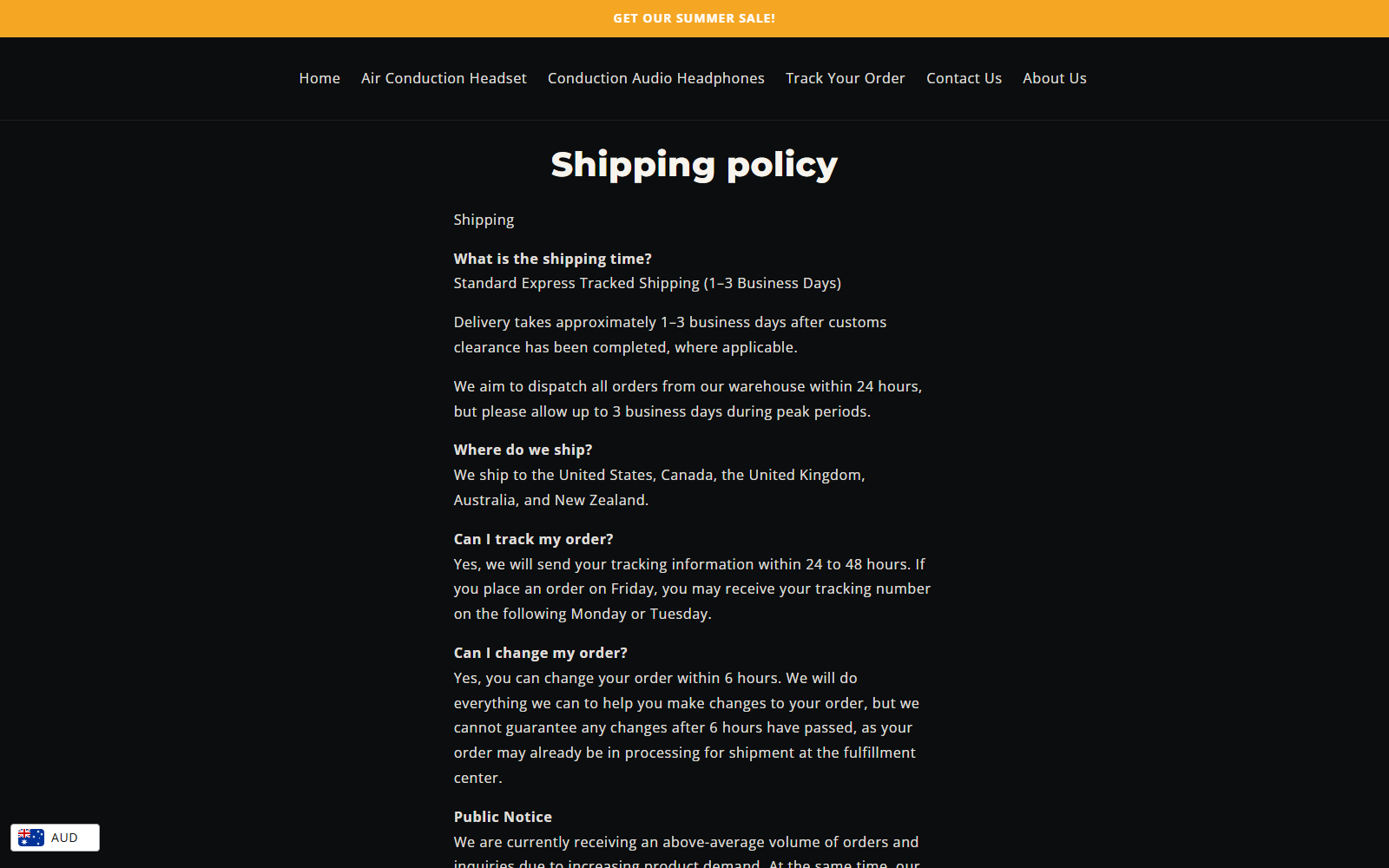
The shipping page says order changes may become impossible after six hours because processing can begin at the fulfillment center.
It does not identify that facility or dispatch country. Delivery is described as one to three business days after customs clearance, leaving the pre-clearance period undefined.
Step 6: Returns depend on support approval
Customers must contact support first. Parcels sent without an accepted request will not be processed, according to the published policy.
This makes the email exchange essential. Do not ship to an address found on a parcel label unless AlphaEars confirms it as the authorized return destination.
Is the Hardware Unique or Generic?
The store uses broad terms such as air conduction, open-ear clarity, noise-canceling boom microphone, and multipoint. Those features are available on many unbranded and branded headsets.
We did not find a model number, downloadable manual, manufacturer name, compliance certificate, or detailed codec specification on the main pages reviewed.
That absence makes price comparison difficult. Two similarly shaped products can differ considerably in microphone processing, water resistance, radio stability, battery cells, and comfort.
Before ordering, ask for the exact model identifier and regulatory markings. Search that identifier, not only the AlphaEars marketing name.
Request photographs of the retail box, manual, charging connector, label, and declared manufacturer. A seller confident in its hardware should provide them.
Also confirm whether “noise canceling” refers to the microphone or the sound delivered to your ears. Open-ear designs do not physically isolate outside noise.
A boom microphone can improve pickup because it sits near the mouth. That does not guarantee callers will hear clean speech beside heavy machinery.
Safety and Driving Considerations
Hearing some surroundings does not make any headset universally legal or safe while driving. Local rules differ for commercial drivers, motorcycles, bicycles, and private vehicles.
Audio can still distract attention even when the ear canal remains uncovered. Keep volume moderate and stop using the device whenever concentration suffers.
Workers should follow employer policies and protective-equipment requirements. A wraparound headset can interfere with helmets, hearing protection, or other mandated gear.
The store’s phrase “made for drivers” is marketing, not legal clearance. The user remains responsible for road rules and safe operation.
A Better Headset Comparison Checklist
Compare AlphaEars against identified models, not vague images. Start with microphone samples recorded in a moving vehicle, quiet room, wind, and steady machinery noise.
Look for continuous-call battery results rather than standby claims. A headset used for dispatch may spend far more time transmitting audio than playing music.
Check charging compatibility. A proprietary magnetic cable can become a problem if replacements are unavailable after the store changes products.
Ask whether the device supports standard Bluetooth profiles, voice assistants, mute controls, multipoint behavior, firmware updates, and common conferencing applications.
Water-resistance claims should include a recognized IP rating. Words such as sweatproof or weather-ready are difficult to compare without a defined test.
Weight and clamping pressure matter across a full shift. Head size, glasses, caps, helmets, and hair can change comfort significantly.
Independent reviews should mention call quality from the listener’s perspective. Many headsets sound acceptable to the wearer while transmitting poor speech.
Compare warranty length with the return window. A 30-day return policy does not explain who handles battery or microphone failure after several months.
Search the exact product image and specifications. Matching generic models can reveal normal market prices, manuals, alternative sellers, and more realistic feature descriptions.
If AlphaEars cannot provide a model identifier, evaluate the purchase as generic hardware with uncertain after-sales support. Price it accordingly.
Company, Address, and Fulfillment Checks
The legal seller is not clearly disclosed
The terms say the website is operated by AlphaEars, but they do not identify a registered corporate entity. A trademark-style name alone offers limited accountability.
The governing-law clause points to Romania. Buyers elsewhere should know which actual Romanian person or company accepts the contract.
No street address appears in the policies
We found no headquarters, returns facility, or formal correspondence address in the visible terms, privacy, refund, shipping, or contact material reviewed.
A return address supplied only after approval may be legitimate. Still, consumers cannot estimate postage or verify the destination before purchasing.
The site mentions telephone help without a number
Several pages invite customers to contact support by phone or email. Only contact@alphaears.com and web forms were visibly provided during our check.
That inconsistency does not prove fraud. It does show the support language is more expansive than the actual contact options presented.
The fulfillment center is unnamed
The shipping policy refers to a fulfillment center and customs clearance without identifying the warehouse country. This can indicate cross-border fulfillment.
Cross-border shipping is common, but it affects delivery estimates, return costs, taxes, and enforcement. Ask where your order and any return will travel.
Call or email before buying and request a written answer about sale-item eligibility, refund method, return country, and model number. Vague replies are a reason to leave.
Use a credit card or protected payment service when possible. Avoid bank transfer for the original purchase or refund unless your bank confirms the procedure.
What to Do if You Have Fallen Victim to This Scam
- Preserve the advertisement. Save the product page, claimed discount, guarantee language, specifications, and checkout total. These records support any later dispute.
- Test only after clarifying returns. If the item is unopened, ask whether opening it removes eligibility. Request the answer in writing before deciding.
- Contact support promptly. Email contact@alphaears.com within 30 days of delivery. Describe the problem and ask for authorization, destination, and full refund amount.
- Do not send sensitive banking data casually. Ask why an IBAN is required when the policy also promises repayment to the original method.
- Keep delivery proof. Use tracked postage only after approval. Photograph the headset, accessories, packaging, parcel, label, and shipping receipt.
- Escalate unresolved billing. Give your card issuer the advertisement, policy conflict, support messages, and return proof. Ask about its chargeback deadlines.
- Secure your accounts. Change any reused store password. Malwarebytes can scan the device if you installed an unexpected tracking application or downloaded a suspicious file.
- Limit aggressive advertising. AdGuard can reduce repeat ads and risky redirects. It does not establish return rights or recover money.
- Report misleading claims. Notify the advertising platform and the consumer authority where you live if the guarantee or specifications materially differ from your experience.
Frequently Asked Questions
Is AlphaEars definitely a scam?
No. We found a functioning store offering a plausible physical product. Our warning concerns unverified performance claims, opaque business details, and contradictory return conditions.
Does AlphaEars use bone conduction?
The main product is described as air conduction. Open-ear placement does not automatically mean the headset transmits sound through the cheekbones.
Can sale headsets be returned?
The policy excludes sale items, while the store advertises large discounts. Obtain written confirmation for the exact item before paying.
Why does the policy mention an IBAN?
It says refunds are issued by bank transfer, then later promises the original payment method. The seller should reconcile this inconsistency before receiving banking details.
Is an open-ear headset safe for driving?
Not automatically. Check local law, employer rules, volume, fit, and distraction. Environmental awareness depends on behavior as well as the headset’s shape.
What should I ask before ordering?
Request the model number, manufacturer, certification, dispatch country, return destination, sale-item eligibility, refund method, and realistic total delivery time.
The Bottom Line
The headset category is credible. The store’s contractual clarity is the weaker part of this offer.
AlphaEars may deliver a usable open-ear headset, but its website does not provide enough independent proof to justify the strongest ratings, savings, and performance impressions.
The return-policy conflicts are the clearest warning. Get the important answers in writing, compare the exact hardware elsewhere, and use payment protection if you proceed.








