

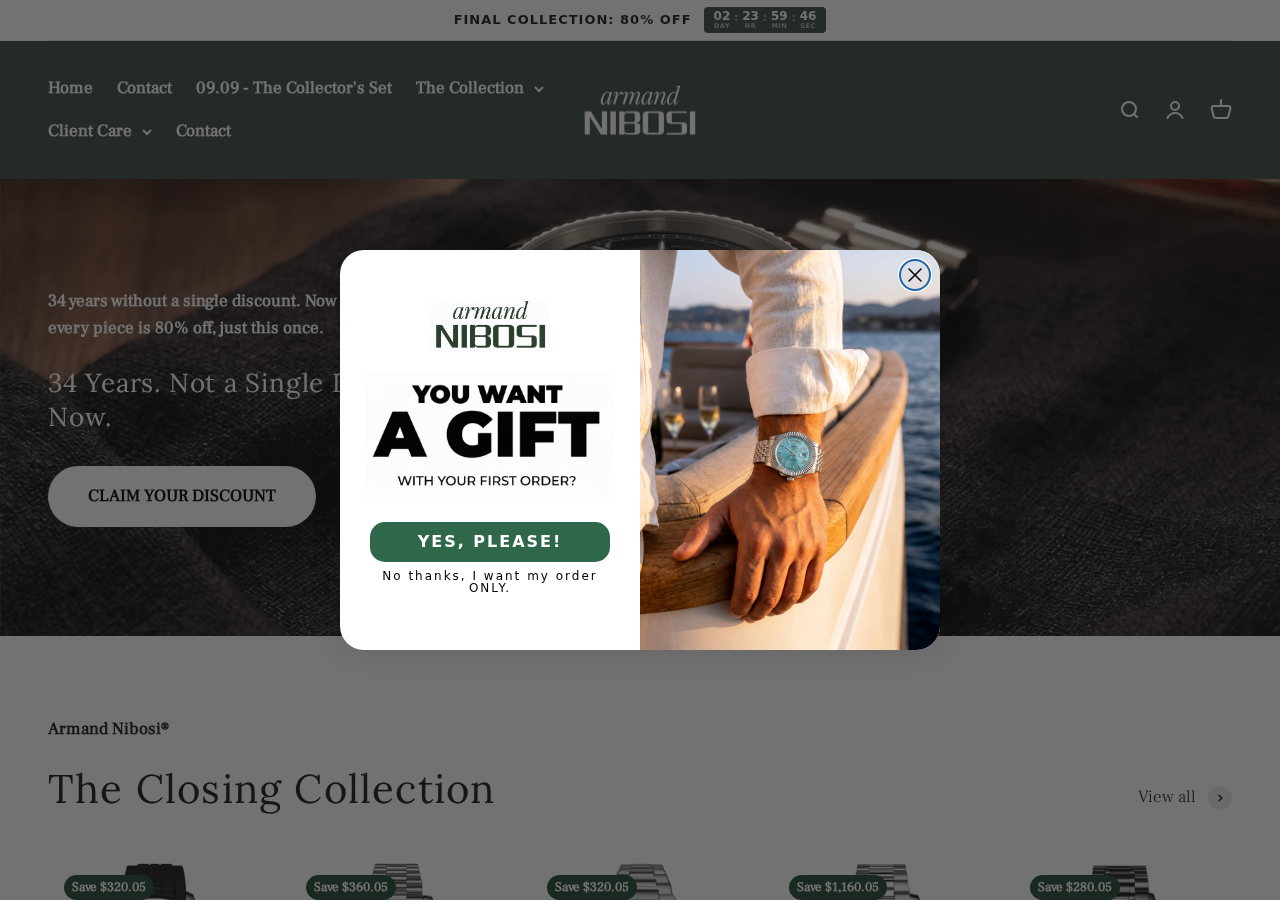
The advertisement reads like the last page of a craftsman’s life: 34 years at a watch bench, one final collection, and no second chance.
It is an effective story because it gives an ordinary purchase emotional weight. The details behind that farewell tell a far less romantic story.
Overview
The supposed 34-year atelier appeared online months ago
ArmandNibosi.com was registered on June 1, 2026. The storefront says its namesake spent 34 years producing watches without offering a single discount.
The site supplies chapters, quotations, portraits, and a closing narrative, yet it does not provide verifiable history for the claimed atelier.
We found no clear archive of a workshop, watchmaker, trade presence, or previous full-price business matching the account presented to shoppers.
The recent domain does not disprove an offline career. It does make independent documentation essential before accepting the biography as fact.
The watches belong to a familiar mass-market brand ecosystem
NIBOSI watches have been sold online for years through marketplaces and separate websites. They are not newly discovered heirlooms from an obscure closing studio.
The products use conventional quartz styling, familiar model names, stainless-steel claims, chronograph layouts, and prices associated with mass-market catalog watches.
That reality conflicts with the landing page’s impression of individually handmade pieces emerging from one retiring artisan’s final production run.
A watch may still function acceptably. The issue is whether the invented provenance and reference price distort its perceived value.
The final sale behaves like a reusable conversion system
A countdown appears above the page, while 80% reductions, sold-out labels, gifts, bundle discounts, and “no restock” language create constant scarcity.
The store simultaneously offers a 09.09 edition and quantity rewards, which resembles active promotional merchandising more than a quiet final liquidation.
The site claims over 10,000 verified customers and displays recent testimonials, but those statements remain within the seller-controlled page.
If a farewell resets, expands, or introduces new incentives, its emotional deadline should not be treated as reliable evidence.
- The domain was registered in June 2026, not 34 years ago.
- No documented atelier history supports the biography presented online.
- NIBOSI is already associated with widely sold mass-market watches.
- The site advertises permanent-looking 80% reductions and countdown pressure.
- Large review totals are displayed without independent verification.
- Returns require approval and compliance with detailed conditions.
How the Armand Nibosi Closing Atelier Story Works
Step 1: A social advertisement introduces a retiring craftsman
The promotion centers on Armand rather than the movement inside the watch. His supposed retirement transforms inventory clearance into a personal event.
A customer is invited to preserve craftsmanship, reward a lifetime of work, and obtain something that will never be produced again.
This narrative discourages ordinary comparison shopping. Searching for the same case and dial elsewhere feels less relevant once the piece seems historical.
The story also explains the enormous markdown in advance. The price is supposedly falling because a life chapter is ending, not because the reference price is inflated.
No independent biography, workshop address, interview, trade record, or earlier catalog is offered to substantiate that emotional premise.
Step 2: The website borrows the language of heritage watchmaking
Words such as atelier, craft, final production, legacy, precision, and collector create associations with small European manufacturers and trained watchmakers.
Elegant photography, serif typography, handwritten signatures, and numbered chapters make a recent online store feel older and more exclusive.
Those design choices are not evidence of hand assembly, origin, movement quality, or historical continuity.
The site should identify where watches are manufactured, which movements they contain, and who performs final assembly if craftsmanship is central.
Without that information, the heritage vocabulary functions mainly as price framing.
Step 3: An 80% anchor turns a budget watch into an apparent collectible
A price reduced from roughly five times the sale amount suggests the buyer is obtaining luxury construction for ordinary money.
The supposed original price matters only if the watch was genuinely offered and sold at that level for a meaningful period.
A retailer can type any reference amount beside a crossed-out line. The graphic alone does not establish market value or real savings.
Customers should compare the case, bracelet, dial, movement, dimensions, and model imagery with NIBOSI listings on established marketplaces.
Comparable hardware provides a better value benchmark than an unverified story about three decades without discounts.
Step 4: Countdowns, stock labels, and gifts suppress patient research
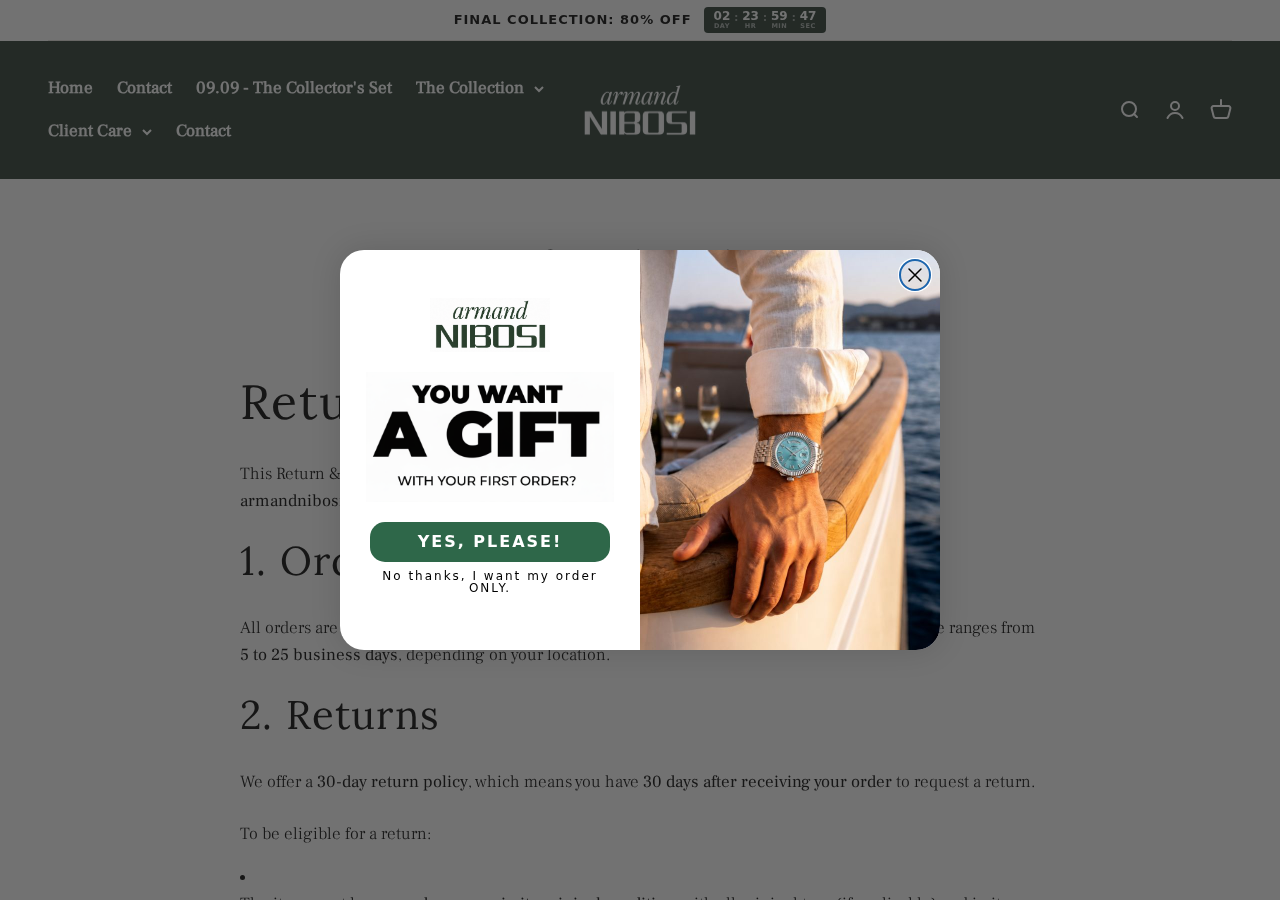
The page displays an atelier-closing timer and describes gifts as available today only. Product cards show large savings and limited availability.
A visitor who pauses may fear losing both the watch and the opportunity to participate in Armand’s farewell.
That pressure narrows attention to checkout while questions about ownership, manufacturing, taxes, servicing, and returns remain unanswered.
Screenshots taken on different visits can reveal whether the deadline moves. A reset timer measures visitor sessions, not necessarily inventory.
True liquidation should have a fixed closure date and a consistent explanation of what happens after support and warranty obligations continue.
Step 5: Bundle rewards convert sentiment into a larger transaction
Buyers are offered cases, gifts, and additional discounts for purchasing two, three, or four watches. The incentive grows with the basket.
A genuine collector might want several models, but quantity should follow inspection of one watch rather than precede it.
Multiple pieces increase exposure if sizing, finish, movement, or bracelet quality fails to match the advertisement.
They also make international returns heavier and more expensive. A promotional case does not offset a difficult refund route.
The farewell story and bundle structure work together: one creates emotion, while the other monetizes it.
Step 6: After delivery, the dispute becomes about policy rather than romance
The buyer no longer deals with a cinematic craftsman. They deal with email support, eligibility rules, evidence requests, postage, and inspection.
Warranty claims require a functioning business, available parts, a reachable operator, and a practical service destination after the alleged closure.
The site’s one-year warranty badge does not explain the same history that a recognized watch manufacturer’s service network would provide.
If the customer simply dislikes the item, return shipping and policy exclusions may reduce the usefulness of the 30-day guarantee.
That is why legal identity and return logistics matter more than farewell prose at the moment of payment.
What the Watch Evidence Actually Shows
NIBOSI is a commercial brand, not proof of Armand’s personal workshop
Searches for NIBOSI reveal many watches, marketplace offers, independent sellers, and other official-looking channels unrelated to the new farewell narrative.
The existence of real NIBOSI products means a parcel could arrive. It does not validate this retailer’s claimed history or crossed-out values.
A physical watch and a misleading origin story can coexist. Delivery alone would not make every marketing statement accurate.
The correct question is whether the seller accurately describes provenance, price history, warranty responsibility, and return obligations.
“Handmade” needs a precise definition
Mass-produced watches involve assembly steps performed by people, but that does not make them artisan-made in the sense implied by the page.
A meaningful claim would identify component sources, movement maker, assembly location, quality-control process, and the work completed by the named watchmaker.
The sales page instead relies on atmosphere and repetition. It does not provide workshop documentation matching the claimed three-decade practice.
Buyers should not pay a heritage premium for a heritage that exists only inside advertising copy.
Customer reviews require separation from seller-curated testimonials
The store says it is rated 4.8 from more than 10,000 customers and showcases uniformly favorable short reviews beside customer-looking photographs.
We could not independently confirm that volume for this recently registered Armand Nibosi storefront.
Reviews of NIBOSI products elsewhere include delivery, defect, and warranty complaints, although they may involve different sellers.
Those reports do not prove this site caused each problem. They do show why seller identity must be matched before drawing conclusions.
The strongest finding concerns deceptive framing
The evidence supports describing the atelier story as unverified and materially inconsistent with the broader mass-market product trail.
We cannot establish from the website alone that every payment results in non-delivery or that every watch is unusable.
We can establish that the recent domain, permanent closing language, huge markdown, and unsupported biography create an unreliable sales context.
That is sufficient reason to avoid urgency and compare the same type of watch through transparent retailers.
A Practical Watch-Buyer Checklist
Verify the movement and construction
Ask for the exact movement caliber, case diameter, lug width, crystal material, water-resistance test standard, bracelet construction, and total warranty coverage.
A working chronograph should have functional subdials and predictable reset behavior. Decorative subdials are common in low-cost fashion watches.
Check whether “stainless steel” describes the entire case or only the case back. Those are materially different claims.
Search the model number with image search and marketplace filters before accepting the seller’s stated original price.
Verify the business behind the guarantee
Request the legal entity, registration jurisdiction, physical return location, warranty address, and name expected on the card statement.
Ask who will honor the warranty if the atelier is supposedly closing permanently after the final shipment.
Keep the response with the product page. A guarantee is only useful when its responsible party can be located later.
Avoid irreversible payment methods, especially when company details remain incomplete or the sale supposedly ends within minutes.
Inspect one watch before considering a bundle
Check timekeeping, crown alignment, pusher action, date change, clasp security, bracelet edges, moisture resistance, and finish consistency.
Do not remove protective film or resize the bracelet until you understand how those actions affect return eligibility.
Photograph the package and serial markings before use. Missing identifiers can matter in a warranty or authenticity dispute.
A discounted four-watch order multiplies risk when the buyer has never handled the brand.
Company, Address, and Fulfillment Checks
The named craftsman is not a verifiable company identity
A first and last name printed beside a signature can feel accountable, yet the site does not establish a documented watchmaker behind that persona.
Customers need the legal entity that processes orders, holds money, imports products, and accepts consumer claims.
Search that entity in the relevant registry and compare it with the receipt and payment descriptor.
If support supplies a different name later, preserve the discrepancy rather than assuming every alias represents the same business.
The website’s address trail is too thin for a 34-year atelier
An established workshop normally leaves records through directories, trade events, repairs, catalogs, press coverage, archived pages, or corporate filings.
The sales narrative provides scenery but no independently checkable location where Armand supposedly practiced the craft.
A fulfillment address, if later provided, may belong to a logistics company and should not be mistaken for an atelier.
Use street-view history and business records when a geographic claim materially affects your decision.
Email support cannot replace a complete service structure
The site lists support@armandnibosi.com, an address attached to the same recent domain carrying the sale.
Ask a technical question before purchasing. A scripted answer about discounts reveals little about movement service or warranty capability.
Telephone access, published hours, named personnel, and a stable postal address provide stronger accountability than a single inbox.
Save messages locally because access to a website account can vanish when a storefront closes or changes domains.
Manufacturing and fulfillment origin should be disclosed plainly
The marketing emphasizes an atelier while leaving the production chain unclear. That omission prevents informed comparison with ordinary factory-made watches.
Ask whether the watch is manufactured in China, assembled elsewhere, or merely branded by the retailer.
The package sender may be a consolidator. It does not necessarily reveal the seller or acceptable return location.
Long international postage, customs forms, and tracking requirements can turn a simple return into a costly project.
What to Do if You Have Fallen Victim to This Scam
- Archive the closing story. Save the biography, claimed 34-year history, 80% price, timer, testimonials, product specifications, warranty, and return promise as dated evidence.
- Confirm the order contents. Check every watch, gift, case, and discount against the confirmation. Challenge unintended quantities before fulfillment whenever possible.
- Request cancellation in writing. State the order number and ask the seller to stop shipment. Keep proof showing when the request reached support.
- Film the unboxing. Record the sealed package, shipping label, model, dial, movement operation, accessories, defects, and any differences from advertised photographs.
- Avoid altering the watch. Do not resize the bracelet, remove films, expose it to water, or discard packaging while a return remains possible.
- Demand usable return instructions. Obtain the complete address, authorization, customs description, recipient, deadline, and responsibility for tracked postage.
- Dispute a materially misleading purchase. Give the payment provider screenshots, correspondence, comparison images, tracking, and a concise timeline rather than emotional conclusions.
- Monitor future transactions. Watch the card for unexpected debits. Contact the issuer immediately if the merchant charges more than the confirmed total.
- Protect the shopping device. Scan with Malwarebytes and use AdGuard to block aggressive advertising networks that repeatedly circulate fake closing-sale promotions.
How To Recognize the Next Fake Atelier Farewell
Look for biography before inventory
Deceptive closing stores often spend more space introducing a founder than documenting the products being sold.
The founder may have a polished portrait, emotional letter, and exact career length but no external professional history.
Search names, quotations, images, and address claims independently. A life story should exist beyond the page benefiting from it.
Test whether the deadline belongs to the business or your browser
Open the page in another browser, record the timer, and return later. A deadline that resets is a sales device.
Compare banners, product stock, and closure dates across pages. Contradictions reveal that scarcity may be decorative.
Do not let a disappearing gift replace a careful assessment of the item’s normal market value.
Separate brand recognition from seller reliability
A familiar logo on a real product does not authenticate every website using that name or every story attached to it.
Confirm authorized sellers through a stable manufacturer channel when possible. Compare warranties and serial-number policies.
If ownership cannot be established, assume you may need the card issuer rather than the merchant to resolve problems.
Frequently Asked Questions
Is Armand Nibosi a real watchmaker?
We found no independent record confirming the 34-year artisan biography displayed by this recently registered store.
The page itself is the primary source for that story, which is not enough to establish a professional history.
Are NIBOSI watches real products?
Yes, NIBOSI-branded watches are widely listed through marketplaces and other sellers. That does not validate this site’s atelier narrative or reference prices.
A delivered product can be genuine mass-market merchandise while the surrounding origin story remains misleading.
Is the 80% discount genuine?
The page shows a crossed-out price, but we found no reliable history demonstrating meaningful sales at that amount.
Compare identical models elsewhere. A percentage created from an unsupported reference price does not measure real savings.
Is the atelier actually closing?
The site repeatedly says it is closing permanently, while using timers, gifts, fresh promotions, bundles, and active merchandising.
Without a fixed closure record and verifiable business history, treat the deadline as unproven marketing.
Can I return an Armand Nibosi watch?
The posted policy offers returns subject to authorization, condition requirements, deadlines, and other terms. Read the current policy before purchase.
Obtain the return country and full address in writing because international tracked postage can erase the apparent discount.
Should I order if I only care about the design?
Even then, compare the model with transparent marketplace listings where ordinary reviews and easier returns may be available.
Purchase based on specifications and price, not the retirement story, artificial urgency, or supposed collector status.
The Bottom Line
Armand Nibosi’s website sells more than watches. It sells a retiring artisan, three decades of integrity, and a final opportunity that evidence does not substantiate.
The products may exist, but the recent domain, mass-market NIBOSI trail, unsupported history, extreme markdowns, and recurring urgency make the farewell untrustworthy. Skip the story.








