

A full-size cloud sofa for less than dinner for two is the kind of offer that makes a person stop scrolling.
The photograph looks convincing and the checkout appears ordinary. The difficult questions begin when the price is compared with physical reality.
Overview
The store appeared weeks before advertising extraordinary furniture prices
HomeAndCove.com was registered on September 3, 2026. Our review took place while the domain was approximately three weeks old.
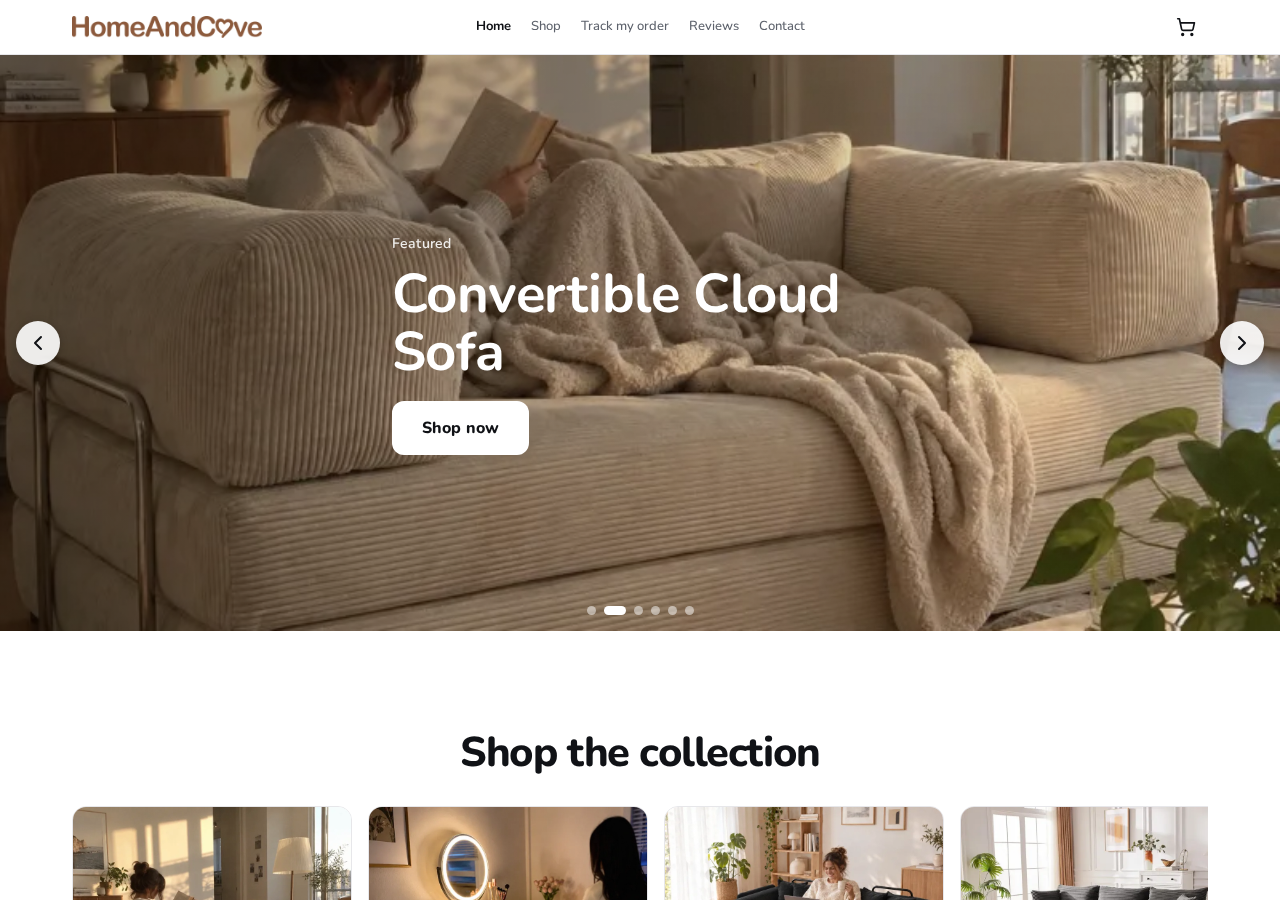
The catalog advertised a convertible cloud sofa for $19.99, down from $79.99, alongside vanities and other bulky home products at similarly striking prices.
Shipping a real sofa can cost more than the entire advertised order. Materials, packaging, handling, and last-mile delivery make the economics difficult to reconcile.
A new retailer can run a promotion, but impossible-looking prices demand clear dimensions, weights, shipping terms, and a traceable company.
The polished homepage provides atmosphere instead of operational detail
Large lifestyle images show complete rooms, soft seating, mirrors, storage furniture, and home accessories. The presentation resembles an established décor retailer.
The site says it hand-picks 25 products, ships fast and free, provides live tracking, and stands behind purchases with a 30-day guarantee.
Those promises appear before a clear legal business name, verifiable address, telephone support line, or explanation of how oversized products are fulfilled.
The gap between a professional visual identity and sparse accountability is one of the most important findings.
The support route points to a separate generic domain
Customer contact uses homeandcove@thesupportcare.com rather than an address on the HomeAndCove.com domain.
A shared-sounding support domain can serve outsourced operations, but the site does not explain who owns it or which company answers messages.
The return wording promises a prepaid label and broad eligibility, yet shoppers still need a real operator to honor those terms.
When merchandise, payment, support, and legal identity cannot be connected, recovering money can become harder than placing the order.
- HomeAndCove.com was registered on September 3, 2026.
- The catalog included a $19.99 convertible cloud sofa.
- Bulky-item prices appeared inconsistent with ordinary freight economics.
- The store did not prominently identify a responsible legal company.
- Support used an email address on TheSupportCare.com.
- Independent reputation services flagged the domain for extreme caution.
How the Home and Cove Shopping Trap Can Work
Step 1: A social advertisement presents an irresistible household bargain
The strongest creative usually shows an expensive-looking sofa, vanity, cabinet, or appliance inside a carefully styled home.
The price creates the hook. Shoppers know comparable furniture costs hundreds or thousands, so a double-digit offer feels like a rare pricing error.
The advertisement may imply clearance, liquidation, warehouse savings, or direct-to-consumer efficiency without documenting any of them.
A buyer clicks because investigating later feels safer than losing the supposed deal now.
That reversal is the funnel’s first advantage: urgency arrives before evidence.
Step 2: Lifestyle photography hides uncertainty about what is actually sold
The listing image can depict a complete sofa while the purchasable item is smaller, different, incomplete, or described ambiguously elsewhere.
Scam stores have also used photographs copied from legitimate retailers while offering unrelated merchandise or delivering nothing.
Buyers should inspect dimensions, package weight, materials, assembly requirements, model numbers, and every variation selected at checkout.
If a full sofa supposedly ships worldwide for free, ask for the carton measurements and carrier before paying.
A seller unable to answer basic freight questions should not be trusted with a furniture order.
Step 3: A small catalog and reassuring policies imitate a curated retailer
Home and Cove says it offers only 25 carefully chosen products. That limited range can make the operation look deliberate rather than disposable.
Free shipping, live tracking, 24-hour support, and a 30-day promise answer the objections most people raise during checkout.
The claims are inexpensive to place on a website. Fulfilling them requires staff, logistics contracts, inventory, capital, and accountable ownership.
The site’s recent creation leaves almost no time for an independent service record to develop.
Policy text should therefore be treated as a promise awaiting proof, not proof itself.
Step 4: Checkout collects a realistic payment for an unrealistic product
A small charge can feel safe because losing $19.99 seems manageable. Shipping upgrades, multiple units, or additional products can increase the actual exposure.
The seller also receives the customer’s name, address, email, telephone number, and payment-related information processed through checkout.
A secure connection encrypts transmission but does not confirm that the advertised sofa exists or will be delivered.
The card statement may show a name unrelated to Home and Cove, making later recognition difficult.
Capture the final basket and merchant identity before submitting payment.
Step 5: Tracking can delay action without proving the correct delivery
Some risky stores provide a tracking number for a small parcel, an unrelated shipment, or a package traveling to the same postal region.
Carriers may mark that number delivered even when the purchased furniture never reaches the buyer.
A delivery scan proves movement of a parcel, not its contents, weight, dimensions, or connection to the order.
Ask the carrier for documented package weight and destination confirmation when a merchant relies on tracking to reject a claim.
Do not let repeated “in transit” messages push the dispute beyond payment deadlines.
Step 6: The refund promise meets an untraceable operator
If nothing arrives, the item differs, or a tiny object replaces the advertised furniture, the buyer turns to the support email.
The site promises a prepaid label, but a promise requires a responsive business willing to issue it.
Delayed answers, partial-refund offers, repeated evidence requests, and shifting addresses can consume the available chargeback period.
Customers should establish a written deadline and escalate through the card issuer when the seller does not provide a concrete remedy.
The goal is recovery, not an endless email discussion with an unidentified support desk.
Why the $19.99 Sofa Is the Central Warning Sign
Freight economics do not disappear online
A sofa requires foam, upholstery, framing, labor, protective packaging, warehousing, and transport of a large dimensional weight.
Even vacuum-compressed modular seating occupies far more carrier capacity than a small parcel. Free delivery must still be paid by someone.
The advertised amount appears too low to cover ordinary materials and transportation, before marketing, payment fees, support, returns, or profit.
A legitimate seller should explain exactly what arrives, how large it is, and which carrier can deliver it at that price.
The crossed-out price does not make the offer plausible
Reducing $79.99 to $19.99 creates a 75% discount, but even the reference price looks abnormally low for the pictured furniture.
Both numbers can be marketing inputs rather than evidence of retail history or cost.
Search the exact image to identify the original product, seller, and normal price. Copied photography often reveals the scale of the mismatch.
If the original retailer sells the pictured sofa for hundreds more, assume Home and Cove’s listing needs extraordinary proof.
A new domain leaves no margin for reputation
The domain’s September 2026 creation does not alone prove fraud. Every genuine retailer has a first day.
However, the business asks strangers to trust exceptional prices before it has accumulated normal reviews, delivery reports, or complaint handling history.
Independent risk services noted the new registration, hidden ownership, low traffic, and an external malicious-site flag during our review.
Automated scores can be wrong, but their concerns align with the observable price and transparency problems.
The safest decision is to avoid testing the promise with your card
We did not order a sofa and cannot state that every customer receives nothing. The commercial proposition remains too implausible to recommend.
A responsible article should separate an unproven universal outcome from strong evidence of exceptional risk.
Here, the new domain, anonymous operation, unrelated support domain, and impossible-looking bulky-item pricing reinforce one another.
Choose a retailer where product dimensions, company identity, freight method, and returns can be verified before payment.
Checks To Run Before Buying Discount Furniture Online
Confirm the exact object and package
Ask whether the listing includes the entire sofa, one cover, one cushion, a deposit, a miniature, or an accessory shown in the photograph.
Record the selected variation and demand carton dimensions, shipment weight, material composition, assembly instructions, and model number.
Compare those figures with the pictured furniture. A full sofa cannot arrive in a package sized for a pillowcase.
Read the checkout line item rather than relying on the advertisement headline.
Verify the delivery chain
Request the carrier name, origin country, dispatch warehouse, handling time, final-mile provider, and whether appointments are required.
Oversized deliveries normally have different procedures from ordinary parcel mail. A vague “tracked shipping” answer is insufficient.
Ask how damage is documented and who collects an unusable item that cannot be placed in normal post.
If support cannot describe its own furniture logistics, leave the site.
Test customer service before checkout
Send a specific question whose answer is not copied from the FAQ. Note the response time and whether the reply addresses your actual concern.
Ask for the company name, registration number, return address, and telephone contact. Verify each detail independently.
A vague agent signature or generic support domain does not establish the merchant’s identity.
Pay only when the business can be located outside its own storefront.
Company, Address, and Fulfillment Checks
No prominent legal entity connects the store to the transaction
The Home and Cove name appears as branding, but branding is not necessarily the registered company receiving money.
Look for the legal entity in terms, privacy disclosures, receipts, card descriptors, and correspondence. They should form a coherent trail.
An anonymous seller can close a domain while leaving customers with no obvious defendant or complaint target.
Do not proceed simply because the checkout displays familiar payment logos.
The support email raises additional ownership questions
Messages go to TheSupportCare.com, a different domain that sounds like a shared service rather than a Home and Cove office.
Outsourced support can be legitimate, but the relationship and responsible merchant should be disclosed clearly.
Ask the agent to identify the legal seller and provide the address where a formal complaint can be served.
Save full email headers if a dispute later requires proof of who communicated with you.
A warehouse label would not prove a domestic headquarters
Risky stores sometimes route small parcels through consolidation centers, freight forwarders, or last-mile return facilities.
Those addresses process packages and may have no authority to refund payments or accept unauthorized returns.
Verify every address through maps and business records. Identify whether it belongs to the named company or an unrelated logistics operator.
For oversized goods, obtain written collection arrangements rather than paying substantial return freight yourself.
The product may be mass-produced, substituted, or never shipped
Without manufacturer and model information, buyers cannot determine whether the store holds inventory or merely copied a supplier photograph.
A cheap substitute may use weaker materials or unsafe components. Furniture also raises structural and fire-safety concerns.
Inspect delivered goods before use, especially frames, electrical features, glass, fasteners, load ratings, and stability.
Stop assembly if parts, instructions, or labels conflict with the listing. Photograph everything before seeking a remedy.
What to Do if You Have Fallen Victim to This Scam
- Preserve every page. Save the advertisement, product image, exact variation, dimensions, $19.99 price, policies, checkout, confirmation, and promised delivery window.
- Identify the merchant descriptor. Check pending and posted card transactions. Record any business name that differs from Home and Cove.
- Cancel before shipment if possible. Send a dated request through every available channel and require written confirmation rather than a generic ticket response.
- Verify tracking with the carrier. Ask for package weight and destination confirmation when the shipment seems too small or shows an unfamiliar delivery.
- Film delivery and opening. Capture the label, package dimensions, sealed condition, contents, damage, and comparison with the advertised furniture.
- Reject endless partial remedies. If goods are missing or materially misrepresented, state the required full solution and a reasonable response deadline.
- Start a card dispute promptly. Select the accurate reason and provide a timeline, screenshots, carrier evidence, correspondence, and photographs.
- Watch for further charges. Review the account and ask the issuer about card replacement when transactions appear unauthorized.
- Secure your browser. Scan with Malwarebytes and enable AdGuard to reduce malicious redirects and repeated exposure to deceptive shopping advertisements.
How To Avoid Copycat Furniture Stores
Calculate whether the offer could physically work
Estimate materials, package size, carrier cost, payment fees, and returns before believing an extreme price.
When the entire amount would barely cover postage, the seller owes shoppers a detailed explanation.
An image cannot repeal manufacturing and freight costs.
Search the image and descriptive phrase
Reverse-search the hero photograph and copy a distinctive sentence from the listing into quotation marks.
Earlier appearances can reveal the real product, original retailer, or repeated storefront template.
Compare dimensions and model details, not merely colors and marketing names.
Use payment protection as a backup, not a test strategy
A chargeback consumes time and may fail when evidence is incomplete or deadlines pass.
Avoiding a highly implausible store is safer than purchasing because the bank might recover the money later.
If you proceed, use one protected payment method and never authorize a second charge to fix the first.
Frequently Asked Questions
Is Home and Cove a legitimate furniture store?
We could not verify the operation as an established furniture retailer. Its domain was only weeks old during this investigation.
The anonymous ownership, unrelated support email, and improbable prices make the site too risky to recommend.
Is the $19.99 cloud sofa really a full sofa?
The photograph and headline create that impression, but buyers should not rely on imagery alone.
Demand exact package dimensions, weight, model, materials, and written confirmation that the entire pictured sofa is included.
Why is the domain age important?
A three-week-old store has little independent history showing successful deliveries, refunds, or long-term customer support.
Age alone is not proof of fraud, but it sharply increases concern when combined with extraordinary claims.
Does free shipping make sense for large furniture?
Some retailers subsidize freight, but a $19.99 total for a full sofa and worldwide delivery appears commercially implausible.
The seller should identify the carrier and package specifications before asking for payment.
What if tracking says delivered?
Contact the carrier and request package weight and destination confirmation. A tracking scan does not prove the correct item reached you.
Use door-camera footage, delivery photographs, and package records when disputing a mismatched or missing order.
Can the 30-day guarantee be trusted?
It is a written promise, not proof that support will issue a label or refund. The operator must still honor it.
Save the policy and act quickly through your payment provider if the seller delays or refuses a valid remedy.
The Bottom Line
Home and Cove asks shoppers to believe that a newly created, thinly identified store can sell and ship large furniture for prices that barely cover a small parcel.
The $19.99 sofa, anonymous operator, unrelated support domain, and missing logistics detail make the offer an unnecessary gamble. Do not provide payment information.

Join the discussion
0 commentsShare your experience or ask a question about this article.
Discussion
Start the conversation
Have a question or something useful to share? Add the first comment.