

Hester Melbourne welcomes shoppers with a warm boutique, a smiling founder, and clothing presented as carefully chosen for Australian women.
The atmosphere feels reassuringly local. A closer examination, however, reveals several details that deserve attention before anyone places an order.
Overview
The storefront creates the impression of an established Melbourne boutique
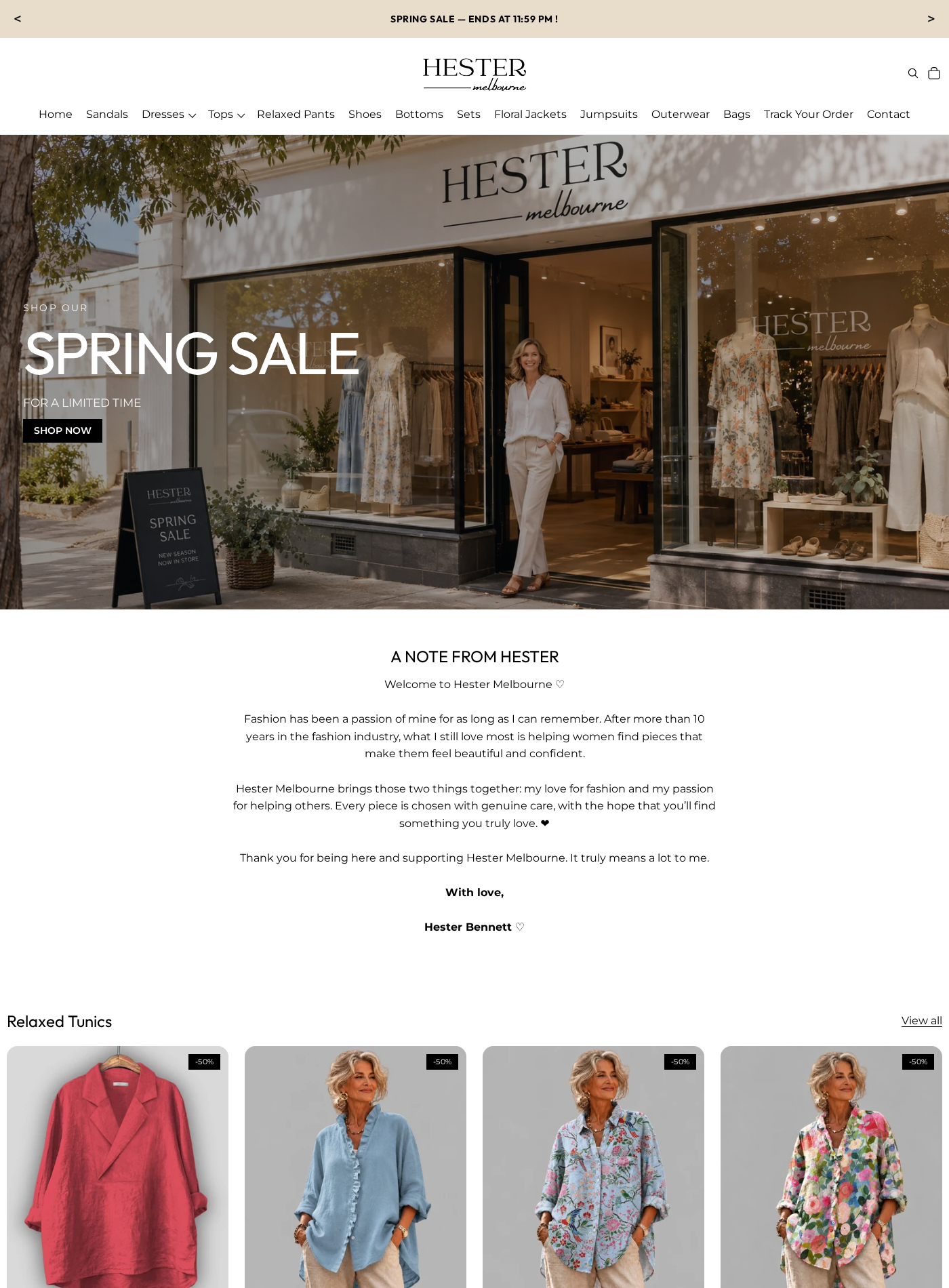
The homepage shows a polished physical shopfront carrying the Hester Melbourne name. A founder called Hester Bennett appears inside a carefully styled store.
Her note describes more than 10 years in fashion and a personal commitment to selecting every piece with care.
That presentation invites shoppers to imagine a familiar neighborhood retailer with local experience, stable staff, and a genuine premises.
We could not independently verify the founder, the pictured shop, or a matching Melbourne business history from the information displayed publicly.
A beautiful photograph can establish a mood. It does not establish who owns the business, where stock is held, or who accepts legal responsibility.
The domain is far younger than the story suggests
Public registration records show HesterMelbourne.com was created on September 1, 2026. Our investigation occurred later that same month.
A new domain does not automatically make a retailer dishonest. New businesses launch every day and established stores sometimes adopt new websites.
The problem is context. The site offers a mature founder narrative without providing an older store address, company registration, press history, or archived trading record.
Shoppers are left to connect an apparently established boutique story with a digital presence that is only weeks old.
When a brand relies heavily on heritage, that heritage should be verifiable somewhere beyond the page collecting payment.
The sale language keeps every visit urgent
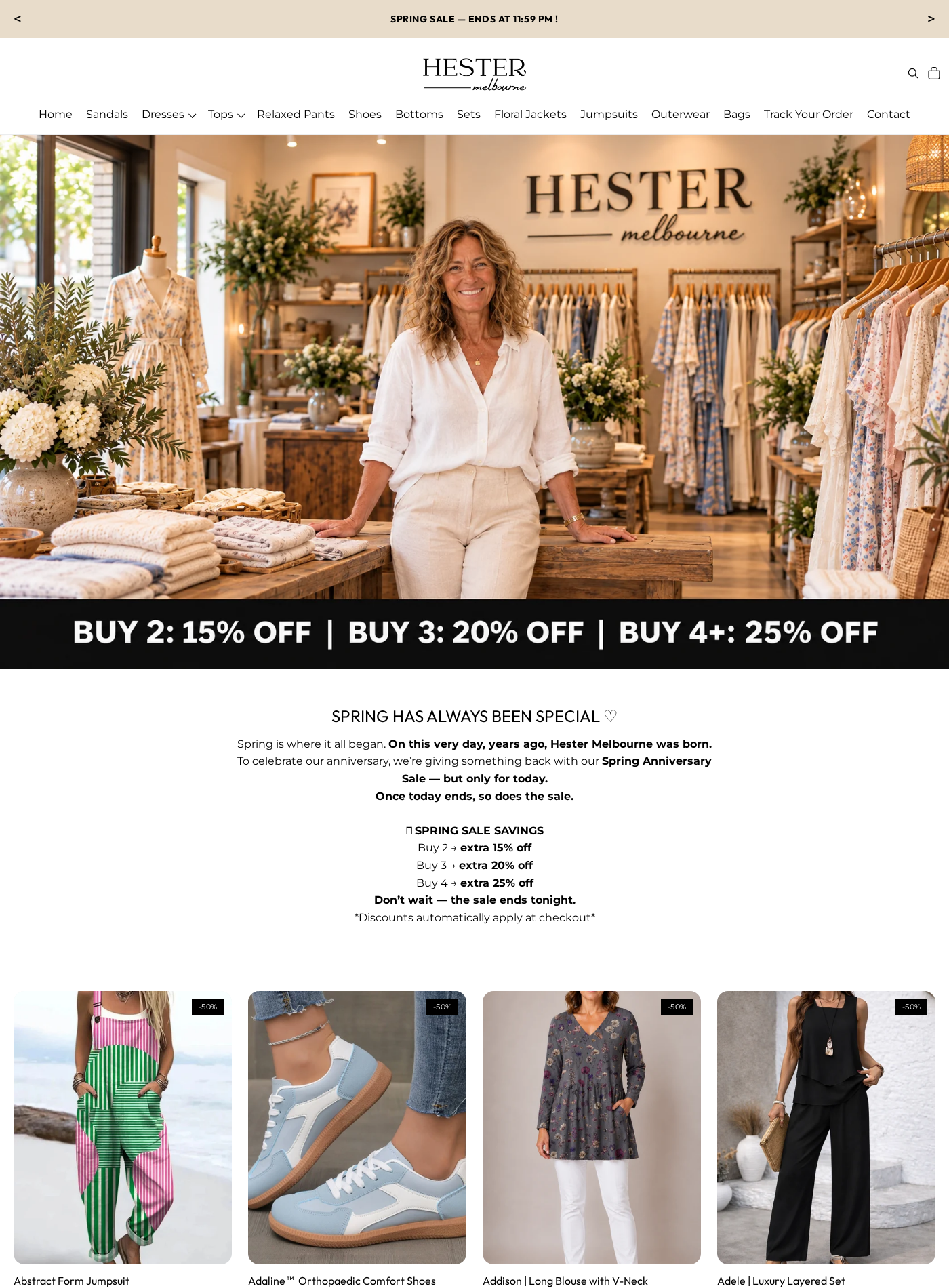
A banner says the spring sale ends at 11:59 pm. Another section says the anniversary promotion is available only today.
Many products show 50% markdowns, while buying two, three, or four items unlocks another 15%, 20%, or 25% reduction.
This design rewards shoppers for ordering several unfamiliar garments before seeing the fabric, sizing, stitching, or actual color of one item.
The listed former prices are controlled by the seller. A crossed-out amount does not prove meaningful sales occurred at that price.
Repeated urgency matters because it reduces the time shoppers spend checking the business identity and practical return route.
- The domain was registered on September 1, 2026.
- The website presents an unverified 10-year fashion history.
- No visible legal company, street address, or telephone number appears in the footer.
- Numerous products carry permanent-looking 50% discounts.
- Multi-item promotions encourage larger first orders.
- The linked Shopify refund page displayed a heading without substantive terms during our review.
How the Hester Melbourne Boutique Sales Funnel Works
Step 1: A social advertisement introduces a closing-style local boutique story
The journey commonly begins with a social post showing elegant clothing, an emotional founder message, or a dramatic seasonal discount.
The creative is designed to feel personal rather than corporate. Shoppers are invited to support a woman, a family, or a local fashion dream.
That emotional framing lowers normal skepticism because purchasing begins to feel like helping someone, not simply buying an unknown garment.
The advertisement can target Australians with Melbourne references, local currency, and familiar delivery language even when fulfillment happens elsewhere.
Nothing in a localized advertisement proves the stock, team, or warehouse is actually located in Melbourne.
Before clicking, buyers should save the exact advertisement because claims may differ from those later shown in the store policies.
Step 2: A polished storefront turns the invented familiarity into trust
The landing page continues the story with boutique imagery, a founder portrait, affectionate language, and a signature from “Hester Bennett.”
The photograph is unusually important because it supplies the physical reality missing from the company information.
Visitors see racks, signage, flowers, and a smiling proprietor. Their minds naturally fill in staff, leases, inventory, and local customer history.
Yet the site does not publish the shop address shown in the image or invite customers to visit that location.
A reverse-image check, business-register search, and street-address confirmation should come before treating such imagery as documentary evidence.
The burden belongs to the seller when a claimed local identity is central to the purchase decision.
Step 3: Timers and stacked discounts push the shopper toward a larger basket
The sale allegedly ends at 11:59 pm, while the collection page says the anniversary discount lasts only today.
Products already marked down by 50% receive further quantity discounts. The mathematical appearance of savings grows with every extra garment.
That structure shifts attention from “Is this seller reliable?” to “How much will I lose if I buy only one?”
A shopper who intended to test a blouse may add shoes, a dress, and another top to unlock the advertised tier.
If quality or sizing disappoints, the buyer now faces a multi-item return instead of a limited trial purchase.
Urgency is especially questionable when the deadline reappears on later visits or new promotions replace supposedly final ones.
Step 4: Generic catalog photographs make comparison difficult
The catalog spans dresses, shoes, jackets, bags, trousers, sets, and many other unrelated styles within weeks of the domain appearing.
Such breadth can indicate a supplier-fed catalog rather than clothing designed, photographed, and stocked by one local boutique.
Some images use different models, studios, crops, lighting, and visual styles. That inconsistency deserves reverse-image research before purchase.
Searching a product photograph may reveal identical garments on marketplaces under other names and at substantially different prices.
An identical photo does not alone prove unlawful copying. It does show that the boutique branding may not reflect exclusive merchandise.
The seller should disclose materials, measurements, manufacturer details, garment-care information, and country of origin for meaningful comparison.
Step 5: Checkout hides the unanswered identity and fulfillment questions
Recognizable payment logos can make the final page feel safe, but they verify a payment method rather than the merchant’s biography.
A customer can pay without seeing a legal company name, registration number, shop address, telephone line, or domestic return location.
The receipt may later show a descriptor that does not match Hester Melbourne. That difference can confuse customers and complicate disputes.
Free shipping through Australia Post describes the final delivery network, not necessarily the origin of the parcel or location of inventory.
Overseas merchandise can still enter the Australian postal system for last-mile delivery after traveling through consolidators.
Buyers should record the checkout, total, currency, promised quantity, delivery estimate, and merchant descriptor before completing payment.
Step 6: A return request exposes conditions that the sales story minimized
The homepage repeatedly promises a 30-day return guarantee and describes customer care as friendly and ready to help.
During our review, the linked Shopify refund-policy endpoint showed a title but no useful return instructions in its body.
The site also linked a separate returns page, creating uncertainty about which terms control the purchase at checkout.
Without a published return address, shoppers cannot estimate postage, customs requirements, tracking costs, or whether the destination is domestic.
Garments may need to remain unworn, unwashed, tagged, and packaged while support decides whether to authorize a return.
A broad guarantee is not equivalent to an easy refund when the responsible company and physical return route remain unclear.
What Our Hester Melbourne Investigation Found
The boutique biography has no visible supporting trail
The site provides a name and a first-person letter, but it does not link to an older boutique record or documented fashion career.
We found no shop address beneath the storefront image, no company number, and no professional profile establishing Hester Bennett’s claimed experience.
That absence is significant because the founder’s identity is not incidental. It is a central trust signal used throughout the homepage.
An authentic founder can usually be connected to a registration, historic location, local directory, event, supplier, or earlier social presence.
Until such evidence appears, shoppers should treat the biography as advertising copy rather than verified business history.
The physical-store imagery raises questions that the site never answers
The hero image displays permanent-looking Hester signage on an attractive storefront. Another image shows a different interior and a woman behind a counter.
The website does not state where either shop can be found, whether customers may visit, or when the photographs were taken.
The lack of an address prevents ordinary verification through maps, business listings, tenancy records, and nearby customer photographs.
AI-generated or composited retail scenes are increasingly used in direct-response advertising, although visual appearance alone cannot prove an image’s origin.
The decisive issue is simpler: the seller uses a store image while withholding the factual location needed to authenticate it.
The catalog resembles a broad dropshipping operation
A genuinely curated boutique can sell varied clothing, yet launching hundreds of styles immediately requires suppliers, stock systems, and a substantial operation.
The site offers many generic names and repeated promotional formats across unrelated product types. This pattern is common in supplier-imported catalogs.
Dropshipping itself is not illegal. Problems arise when delivery origin, quality, sizing, returns, and retailer identity are obscured by a local story.
Customers may receive an item that technically resembles the listing but differs in fabric weight, construction, print placement, or fit.
When the retailer never handled the product, support may rely on supplier photographs and struggle to resolve detailed complaints.
The evidence supports a high-risk warning, not a claim that every parcel vanishes
We did not place an order or inspect merchandise delivered from Hester Melbourne. The site may fulfill some or all purchases.
Our concern is the gap between the local boutique impression and the limited verifiable business information supporting that impression.
The new domain, unpublished shop location, unverified founder, sale pressure, generic catalog, and incomplete refund information concentrate risk.
A delivered garment would not validate the founder history, original price, local inventory, or ease of obtaining a refund.
For those reasons, shoppers should avoid the offer until the operator provides transparent evidence and a credible service record.
How To Check a Boutique Website Before Ordering
Verify the person and premises separately
Search the founder’s full name with the city, business name, and claimed profession. Look for records predating the current domain.
Search the boutique name in Australian business registers and maps. Confirm that the stated entity actually trades from the pictured location.
Reverse-search exterior and interior photographs. Reused stock imagery can appear across unrelated boutiques carrying different signs.
Do not accept a photograph as an address. Ask the seller directly where customers, regulators, and returns can reach the business.
Compare one garment across the open market
Use product-image search and copy distinctive phrases from the description. Compare seams, patterns, buttons, pockets, hems, and model poses.
Check whether identical goods appear on wholesale platforms or marketplaces for far less than the supposed sale price.
Read independent reviews of the actual seller, not testimonials embedded within its own checkout funnel.
Order no bundle until one item has been inspected and the return process has been tested successfully.
Ask practical questions before the timer decides for you
Request the legal company name, Australian business number, warehouse country, return country, full address, and telephone support details.
Ask whether sale items remain returnable and whether the seller supplies a prepaid label when goods differ materially from photographs.
Keep the answers in writing. Vague reassurance is less useful than specific information that a card issuer can later compare with events.
A legitimate retailer should not need a countdown to prevent customers from understanding basic contractual terms.
Company, Address, and Fulfillment Checks
The storefront does not identify the legal seller clearly
Hester Melbourne is a trading name on the page, not necessarily the registered entity accepting payment and consumer obligations.
The footer lacked a company number, legal entity, street address, and telephone number when we reviewed it.
That makes it difficult to check corporate status, directors, complaint history, insolvency records, or the jurisdiction governing the transaction.
A buyer should match the website entity with the receipt, card statement, parcel sender, policy text, and return authorization.
Different unexplained names should be preserved as evidence rather than dismissed as harmless processing labels.
The photographed boutique cannot be treated as a verified address
The hero picture shows an appealing Hester Melbourne shop, but the site provides no street where customers can locate it.
A physical-looking scene may be stock photography, a digital composite, a temporary set, or an image created with generative tools.
We cannot determine its production method from appearance alone. We can determine that the operator has not supplied the location needed for verification.
Never send a return to an address discovered through an image search without written authorization from the merchant.
A legitimate fulfillment center may handle packages while having no authority to issue refunds or accept unsolicited returns.
Email-only support leaves buyers with a fragile contact route
The site lists info@hestermelbourne.com and opening hours, creating the impression of a staffed local customer-care desk.
No telephone number accompanies those hours, and the email depends on the same recently created domain as the storefront.
If the domain stops operating, shoppers could lose both account access and the main support channel simultaneously.
Save confirmations and conversations outside the website. Include complete headers when messages become important to a dispute.
Test support before ordering with a specific question that cannot be answered by copying a generic guarantee.
The fulfillment origin remains unresolved
The homepage promises free Australian shipping and tracking. Neither statement confirms that garments are stocked or dispatched from Australia.
A parcel may pass through manufacturers, consolidators, forwarding agents, and last-mile carriers before reaching the customer.
The sender address on a label can belong to a logistics partner rather than the retailer or authorized returns department.
Overseas return postage may cost enough to make a refund impractical, especially when multiple discounted items are involved.
Ask for the dispatch and return countries in advance. Those two answers reveal more than decorative local branding.
What to Do if You Have Fallen Victim to This Scam
- Preserve the sales story. Save the boutique images, founder letter, deadline, discounts, product page, guarantee, policies, checkout, confirmation, and every message before pages change.
- Check the order immediately. Compare the confirmation with your intended sizes, colors, quantities, discount, shipping cost, currency, and final total. Report any difference in writing.
- Request cancellation before dispatch. Provide the order number and exact reason. Ask for written confirmation that shipment has stopped and the full amount will be refunded.
- Record the parcel opening. Film the sealed package, labels, every garment, tags, measurements, material details, defects, and differences from the advertised photographs.
- Keep everything return-ready. Do not wash, wear, alter, remove tags, or discard packaging while eligibility remains disputed. Store items cleanly and photograph their condition.
- Demand complete return instructions. Obtain the recipient, physical address, authorization number, deadline, customs description, tracking requirement, and responsibility for postage before sending anything.
- Challenge material misrepresentation promptly. Give the payment provider dated screenshots, correspondence, tracking, comparison images, and a precise timeline showing what was promised and received.
- Monitor the payment method. Watch for unexpected merchant descriptors or further debits. Contact the issuer immediately about charges you did not authorize.
- Secure the shopping device. Run Malwarebytes to check for unwanted software and use AdGuard to reduce exposure to deceptive boutique advertisements and risky redirects.
How To Recognize Similar Fake Boutique Stories
The founder has a vivid biography but no independent existence
Question a story containing exact career lengths, emotional hardship, and personal signatures when searches reveal no matching professional record.
The more heavily a sale relies on one person’s identity, the more important independent verification becomes.
A real proprietor may value privacy, but the company accepting payments must still be identifiable and reachable.
Look for consistent names across registries, older social accounts, domain history, invoices, and policy pages.
The supposed final sale never develops a fixed ending
Closing, anniversary, spring, retirement, and warehouse-clearance language often rotates while the inventory and timer remain active.
Record the deadline and revisit later. A reset does not measure remaining stock or a genuine business closure.
Percentage discounts should be checked against identical merchandise elsewhere, not the seller’s unsupported reference price.
Do not let multi-buy savings transform an untested purchase into an expensive return problem.
Local vocabulary replaces local accountability
A city name, local currency, national-post logo, and familiar seasonal language can be added to almost any storefront quickly.
Accountability requires a legal operator, verifiable address, telephone support, realistic delivery details, and usable consumer remedies.
Ask where the parcel starts and where a return ends. Those locations often reveal the commercial arrangement.
Buyers should value a transparent warehouse over a romantic storefront image that cannot be placed on a map.
Frequently Asked Questions
Is Hester Melbourne definitely a scam?
We cannot prove that every order fails or that no customer receives merchandise. We did not place a test order.
The evidence supports a high-risk warning because the local boutique story lacks verifiable ownership, premises, history, and clear refund logistics.
How old is HesterMelbourne.com?
Public registration records show the domain was created on September 1, 2026. We reviewed it during the same month.
That short timeline conflicts with the mature impression created by the founder story and physical-store imagery unless an older business can be documented.
Is Hester Bennett a real boutique owner?
The website presents that name, portrait, signature, and a 10-year fashion claim. We could not independently verify the biography from published details.
A seller can resolve this concern by identifying the company, shop location, registration, and professional history behind the story.
Are the 50% discounts genuine?
A displayed discount proves only that the website placed two prices together. It does not establish prior sales at the crossed-out amount.
Compare identical product photographs and specifications across other retailers to determine a realistic market value.
Can customers return Hester Melbourne clothing?
The homepage promises 30-day returns, but the public refund information was incomplete and the physical return destination was not displayed clearly.
Obtain eligibility rules, return country, full address, postage responsibility, and sale-item exclusions in writing before relying on the guarantee.
What is the safest alternative?
Choose a retailer with an independently verifiable company, established review history, clear domestic returns, and product information matching the delivered garment.
Pay by credit card, begin with one item, and preserve the advertisement and policies in case a merchandise dispute becomes necessary.
The Bottom Line
Hester Melbourne does not merely sell clothing. It sells the comforting image of an experienced local boutique owner welcoming shoppers into her carefully curated store.
The weeks-old domain, unverified founder, unlocatable shop, relentless sale pressure, broad catalog, and unclear return route make that image unreliable. Avoid ordering until transparency improves.

Join the discussion
0 commentsShare your experience or ask a question about this article.
Discussion
Start the conversation
Have a question or something useful to share? Add the first comment.