

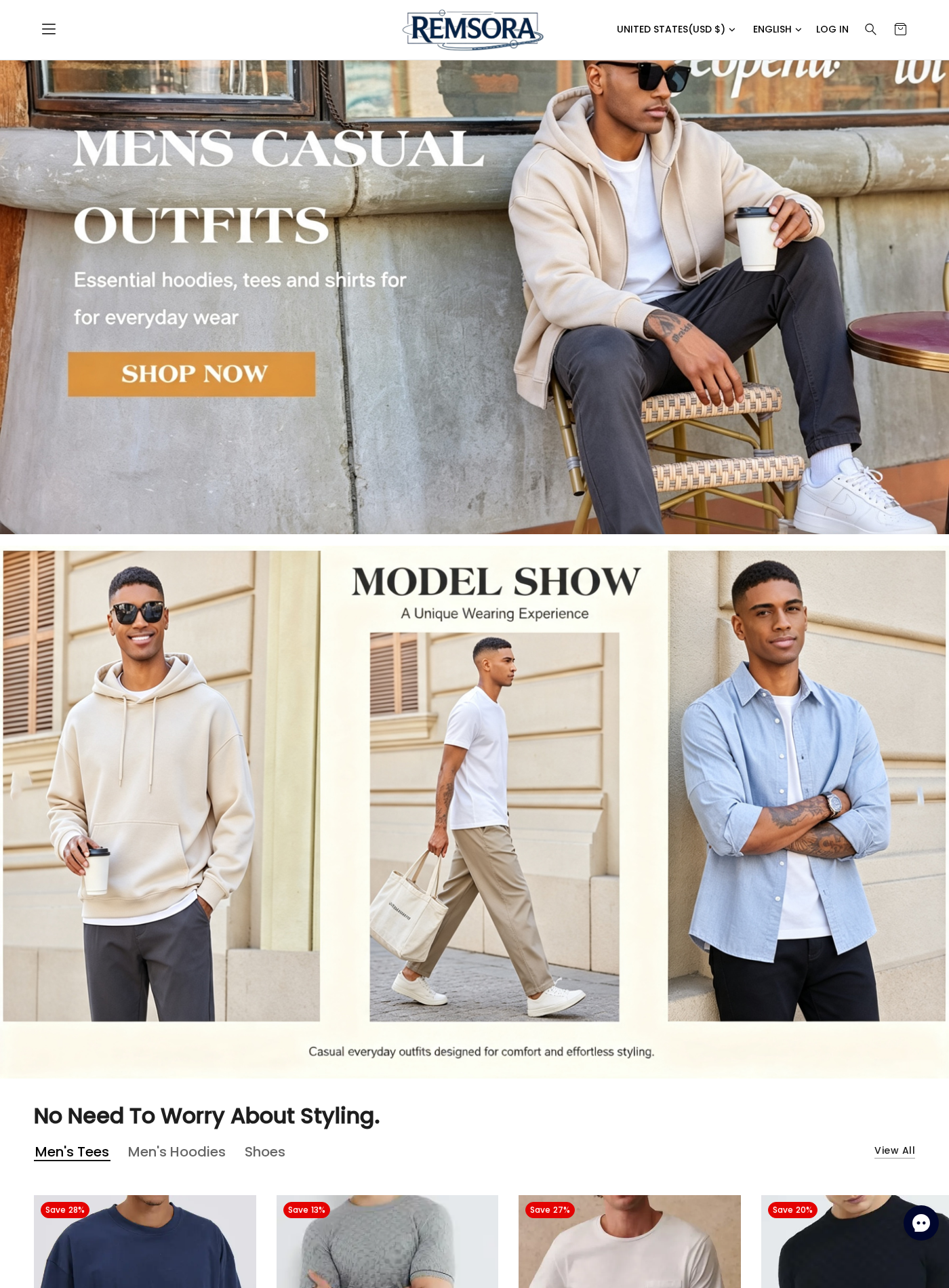
Remsora looks like a general online fashion store, with polished menswear photographs, familiar categories, sale badges, and a conventional shopping layout.
Its most consequential details appear elsewhere. They reveal a transaction that can become surprisingly complicated after a customer clicks the purchase button.
Overview
Remsora combines ordinary clothing with an unusual subscription option
Product ordering controls observed during our review offered both a one-time purchase and “Subscribe & Save,” described as cancelable at any time.
Recurring purchase controls make sense for regularly consumed goods. They are unusual on a broad fashion catalog of shirts, hoodies, trousers, and shoes.
A shopper focused on size and color could overlook the difference between a single order and an arrangement permitting future charges or shipments.
We did not complete checkout, so we cannot state that every product or every visitor receives a subscription selection.
Its presence is enough to require careful order review, clear consent language, and immediate preservation of the final checkout configuration.
The change-of-mind return window is only seven days
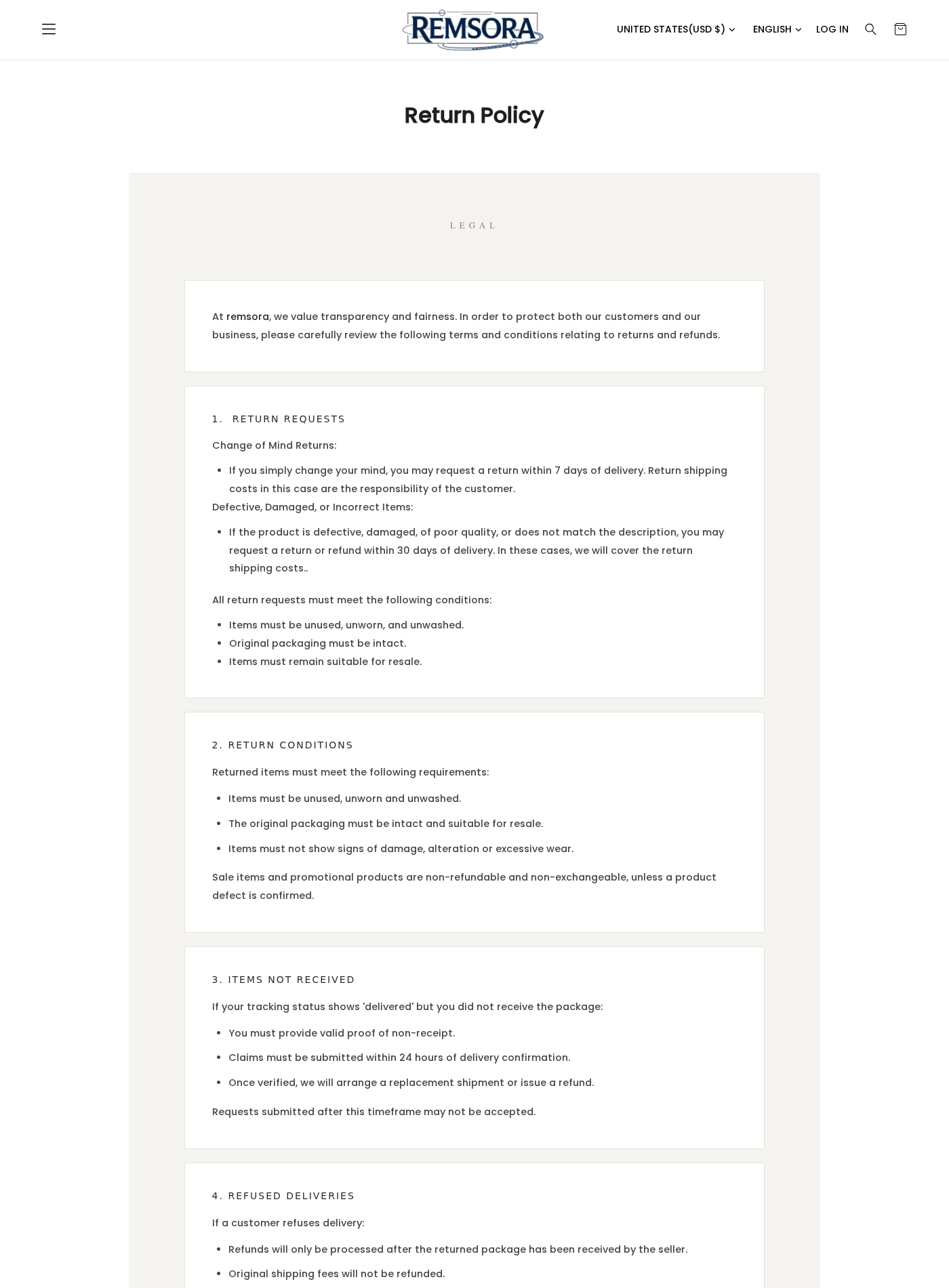
Remsora’s policy allows ordinary change-of-mind requests within seven days of delivery, with the customer responsible for return shipping.
Damaged, defective, poor-quality, or misdescribed items receive a longer thirty-day request period, according to the page.
The policy requires goods to remain unused, unworn, unwashed, resalable, and in their original packaging.
It also states that sale items and promotional products are nonrefundable and nonexchangeable unless a defect is confirmed.
Because many homepage items display savings badges, that exclusion could affect merchandise most likely to attract buyers.
Several checkout and support signals do not fit together cleanly
The storefront displayed United States pricing in $ after initially exposing another currency context during automated examination.
Its terms name PAIRLAND INC and list 1649 E Victor Rd, Lodi, California, while the visible brand is Remsora.
Extracted contact text repeatedly rendered a placeholder-like protected email instead of an immediately usable address during our checks.
The site claims live chat availability and email responses, but unclear contact information weakens those promises when a deadline is only seven days.
Young domain history, cross-border delivery estimates, and strict policy conditions increase the importance of identifying the actual seller before payment.
- Remsora.com was registered on January 19, 2026.
- The store displayed one-time and subscription purchase options.
- Change-of-mind returns must be requested within seven days.
- Customers pay postage for ordinary returns.
- Sale and promotional goods are generally excluded from voluntary returns.
- The terms identify PAIRLAND INC at a California address rather than the Remsora brand alone.
How the Remsora Clothing Purchase Trap Can Work
Step 1: An advertisement leads with style and low prices
Remsora’s homepage uses large fashion imagery, modern layouts, savings labels, and categories familiar to mainstream clothing shoppers.
The presentation encourages browsing rather than investigating the corporate relationship between Remsora and PAIRLAND INC.
A social advertisement may feature one inexpensive product while the landing page immediately exposes the visitor to a much larger catalog.
The model photographs and lifestyle scenes create perceived value before the buyer learns about fulfillment time, return exclusions, or subscription controls.
Generic merchandise can still be delivered, but attractive creative does not establish fabric quality or an accurate fit.
Customers should image-search the product and compare specifications rather than treating the store’s branding as proof of exclusivity.
Step 2: Sale badges make restricted merchandise look like the obvious choice
Many products show red savings percentages, turning discounted items into the most visually prominent options on the page.
The return policy later says sale and promotional merchandise cannot be returned or exchanged unless a defect is confirmed.
That difference changes the risk. A poor fit or simple disappointment may not qualify if the seller classifies the item as promotional.
A customer can therefore be steered toward merchandise carrying fewer voluntary remedies than full-price goods.
The policy does not become irrelevant because a product page emphasizes convenience, comfort, or savings more strongly.
Before purchase, buyers should obtain written confirmation that their exact item remains eligible for a sizing return.
Step 3: The purchase selector can introduce recurring billing
The product interface presented a subscription discount alongside the one-time option, an unusual arrangement for apparel.
If the recurring choice is highlighted, preselected, or cheaper, a hurried buyer may authorize more than one transaction without appreciating the schedule.
Subscription consent should explain charge frequency, shipment contents, renewal amount, cancellation route, timing, and whether discounts expire.
The phrase “cancel anytime” is incomplete unless customers know exactly where to cancel and how quickly the change becomes effective.
A confirmation email and account page should repeat the recurring terms prominently rather than hiding them inside general conditions.
Shoppers should stop when checkout does not display “one-time purchase” unambiguously beside the final total.
Step 4: International fulfillment delays the moment of truth
Remsora’s public shipping information indicates a delivery range that can extend from roughly seven to twenty business days.
The customer pays before feeling the material, checking measurements, examining stitching, or learning which warehouse dispatched the parcel.
A California company address does not necessarily mean products are stocked in California or returnable there.
Currency controls and international language options suggest the website serves several markets through a broader fulfillment arrangement.
The shipping label may identify a consolidator whose role ends when the parcel reaches the last-mile carrier.
Buyers should never assume that a sender address is an approved returns department without written instructions.
Step 5: A narrow claim window places speed above normal problem solving
Seven days gives customers little time to contact support, receive a response, understand conditions, and prepare an authorized change-of-mind return.
A delivered-but-missing claim has an even tighter policy requirement: the site says it must be reported within twenty-four hours.
People traveling, working shifts, or receiving parcels through communal mailrooms can miss that deadline easily.
The policy says unauthorized returns may be rejected, so simply mailing goods back before receiving instructions can create another problem.
Customers must preserve timestamps from delivery notifications, building cameras, neighbors, carriers, and their support message.
Strict deadlines make a visible, functioning email and responsive support team essential rather than optional.
Step 6: Cancellation and return friction can outlast the original promotion
A buyer seeking to stop future subscription charges may need to manage both the recurring agreement and the current merchandise order.
Canceling renewal does not automatically reverse a shipment already created, while returning one parcel may not terminate future billing.
The customer should demand separate written confirmation for cancellation, refund eligibility, and the absence of additional scheduled charges.
When support details are unclear, the card issuer may become the only reliable party able to block disputed recurring payments.
Replacement cards do not always terminate merchant tokens automatically, so the issuer should be told explicitly about the subscription concern.
The correct resolution closes every path, not merely the package currently in the customer’s hands.
What Our Remsora Investigation Found
The subscription control does not suit the surrounding catalog
Remsora sells varied fashion goods rather than a predictable consumable that customers naturally replenish on a fixed schedule.
That makes “Subscribe & Save” look more like a generic commerce feature than a carefully designed wardrobe service.
Generic implementation creates risk because the operator may not have written cancellation explanations appropriate to clothing renewals.
It could also reflect a template configuration that appears unintentionally, which would still be a serious checkout-quality failure.
We recommend selecting only a plainly labeled one-time option and saving the final page whenever recurring language appears.
The policy distinguishes defects from ordinary dissatisfaction sharply
Customers receive thirty days to report damaged, defective, poor-quality, or incorrectly described goods, and the seller says it covers return shipping.
A change of mind receives only seven days, customer-paid postage, and strict condition requirements.
Disputes can therefore center on classification. The shopper may describe inaccurate fabric or sizing while the merchant calls it preference.
Objective evidence becomes crucial: measurements, close photographs, unboxing video, labels, listing screenshots, and side-by-side comparisons.
Avoid vague statements such as “bad quality” when a precise seam failure or material mismatch can be documented.
The legal name requires independent confirmation
The terms associate the operation with PAIRLAND INC and a Lodi, California address at 1649 E Victor Rd.
A published address does not prove that retail staff, inventory, manufacturing, and returns are located at the same premises.
Customers should verify the company through California records and ask whether the address accepts authorized consumer returns.
If the invoice or statement names another entity, compare it with PAIRLAND INC and request an explanation immediately.
A registered company can improve traceability, but registration alone does not validate every product claim or policy practice.
The safest classification is high commercial risk
We did not order clothing, trigger a renewal, or attempt a completed return. We cannot claim that every Remsora customer loses money.
Some transactions may arrive correctly and satisfy their buyers, while automated reputation services have produced mixed rather than unanimous signals.
Our warning rests on direct site evidence: recurring purchase controls, strict voluntary returns, promotional exclusions, short claim deadlines, and unclear support rendering.
Those terms shift too much risk toward the customer for an unfamiliar retailer with a short public history.
A more established merchant offers similar apparel without requiring shoppers to accept these avoidable complications.
How To Audit a Clothing Checkout for Subscription Risk
Read the option beside the price, not just the button
Confirm whether the selected control says one-time, subscription, membership, auto-delivery, replenishment, or recurring order.
Change the selection deliberately and watch whether the total, discount, delivery frequency, or consent text changes.
Do not assume an ordinary “Buy Now” button cancels a recurring option chosen earlier on the product page.
Capture the final selection with the product, quantity, schedule, and total visible together.
Find the cancellation route before creating the agreement
Locate the account control, support address, cancellation deadline, renewal frequency, notice requirement, and treatment of already processed shipments.
Search the terms for subscription, recurring, automatic, renewal, cancel, and frequency instead of relying on a marketing phrase.
A service that is genuinely easy to cancel should explain the steps before enrollment and confirm cancellation afterward.
If the only route depends on an unclear email address, do not authorize future charges.
Test the voluntary return rule against your actual item
Check whether the product is labeled sale, discounted, promotional, clearance, final sale, or purchased with a coupon.
Ask if trying the garment indoors preserves eligibility and whether opening packaging changes the seller’s assessment.
Request the return country and estimated postage, because a seven-day window is useless when instructions arrive too late.
Choose a protected payment method and retain the response as part of the contract you understood when paying.
Company, Address, and Fulfillment Checks
PAIRLAND INC is the entity named in Remsora’s terms
The terms provide a legal name that differs from the customer-facing Remsora brand, which is not unusual by itself.
The relationship should remain consistent across invoices, receipts, card descriptors, privacy notices, and return authorization.
Customers should search the California business registry and confirm current status, registered agents, and filing history independently.
They should also ask whether PAIRLAND INC directly owns the store or provides another role in the sales chain.
Unexplained variation among merchant names makes bank disputes and regulatory complaints harder to direct correctly.
A California address may not be the warehouse or return center
The terms list 1649 E Victor Rd in Lodi, California, but do not establish that customer-service or authorized returns operate there.
Commercial addresses can belong to offices, mail handlers, registered agents, warehouses, residences, or unrelated occupants.
Never ship clothing to a published address merely because it appears in legal text. Obtain explicit written authorization first.
An overseas fulfillment model can use a United States company while directing returns to a different country.
The cost and destination of returns should be disclosed before the customer commits to a seven-day decision period.
Support information should work before a customer pays
Extracted pages repeatedly displayed protected or placeholder-like email text rather than a clearly readable address in the content we reviewed.
The store also promotes live chat and short response times, but claims about availability need practical testing.
Ask a detailed pre-sale question and preserve the answer time, sender domain, signature, and information supplied.
A chat bubble can be automated, offline, or operated by a contractor without authority to approve refunds.
If no durable support route answers, the strict claim deadlines become too risky to accept.
Generic fulfillment can obscure the product source
The broad catalog and international controls suggest merchandise may move through third-party supply and logistics networks.
That arrangement can deliver real goods, but quality control, stock accuracy, and return responsibility may be distributed among several companies.
A parcel label identifies where one shipment entered the carrier network, not necessarily the manufacturer or legal seller.
Request material composition, country of origin, manufacturer, dispatch location, and return destination for the exact product.
Unknown textiles should be washed according to instructions and discontinued after irritation, dye transfer, strong odor, or other adverse effects.
What to Do if You Have Fallen Victim to This Scam
- Check whether you enrolled in recurring orders. Review the product selection, confirmation, account, receipt, and card authorization for subscription, renewal, frequency, or future-shipment language.
- Cancel through every available channel. Use the account control, chat, and written support route. Request a timestamped confirmation that no further charges or parcels will occur.
- Preserve the exact policy version. Save the subscription language, return rules, sale exclusions, twenty-four-hour claim limit, shipping estimate, and company details as dated files.
- Document the merchandise immediately. Film the unopened parcel, label, garments, measurements, tags, material claims, defects, and differences before wearing, washing, or altering anything.
- Open the correct claim within the deadline. State whether the issue is non-receipt, damage, defect, poor quality, misdescription, unauthorized renewal, or change of mind.
- Obtain authorized return instructions. Demand the destination, recipient, reference, deadline, condition requirements, postage responsibility, and expected refund date before mailing goods.
- Contact the card issuer about continuing authority. Ask it to block disputed recurring merchant charges, not merely reverse one payment or replace the physical card.
- Report unresolved conduct. Send the evidence to the relevant consumer authority, payment provider, advertising platform, and company registry jurisdiction when appropriate.
- Secure the purchase device. Scan with Malwarebytes and enable AdGuard to reduce malicious redirects, deceptive fashion promotions, and repeated retargeting from risky stores.
How To Avoid Hidden Subscriptions on Retail Sites
Treat every discount as a possible exchange of obligations
A lower first price may require future purchases, membership fees, stored-payment authority, or a minimum period rather than being an ordinary sale.
Look for a recurring cadence printed near the amount, quantity selector, purchase button, or checkout consent box.
Read the confirmation before closing the page and challenge unexpected subscription wording immediately.
The merchant must earn continuing consent; it should never depend on a shopper overlooking a small option.
Cancel both the contract and the payment authority
Use the seller’s process first when it is accessible, then retain the successful confirmation number or message.
Tell the card issuer that the dispute concerns recurring merchant authority if further charges remain possible.
Check the account and statements after cancellation because merchants can process renewals before a request becomes effective.
Do not assume deleting an account, returning one product, or replacing a card automatically ends every agreement.
Choose merchants whose remedies match the product
Clothing needs realistic fitting time, clear sale rules, responsive support, and practical return shipping.
A seven-day voluntary window is especially poor when delivery is international and the contact route is uncertain.
Compare the retailer’s complete refund process before comparing minor percentage savings.
Transparent stores explain the worst-case process as clearly as they advertise the best-case outfit.
Frequently Asked Questions
Is Remsora definitely a scam?
We cannot conclude that every purchase is fraudulent. The site may deliver clothing and resolve some customer requests.
Its subscription option, strict return terms, sale exclusions, young history, and unclear support create substantial commercial risk that shoppers can avoid.
Does Remsora use subscriptions?
We observed a “Subscribe & Save” option displayed alongside a one-time purchase selection during the investigation.
Review your exact product and final checkout because site controls can vary by item, visitor, location, or later configuration changes.
Can sale clothing be returned?
Remsora’s policy states that sale and promotional items are nonrefundable and nonexchangeable unless a defect is confirmed.
Obtain written clarification for your product before ordering, especially when a homepage savings badge makes nearly every item appear promotional.
What is Remsora’s return deadline?
Change-of-mind requests must be made within seven days after delivery, while qualifying defective or misdescribed goods receive thirty days.
Delivered-but-missing claims have a stated twenty-four-hour reporting requirement, making immediate documentation essential.
Who operates Remsora?
The terms identify PAIRLAND INC and provide a Lodi, California address. That should be verified independently and compared with billing and invoice information.
The published address should not be used for returns unless support confirms it as the authorized destination.
How do I stop an unexpected renewal?
Cancel in the website account and notify the seller in writing, then obtain confirmation that future charges and shipments are stopped.
Contact the card issuer promptly about recurring authority and monitor statements rather than assuming a single refund ends the arrangement.
The Bottom Line
Remsora wraps an unusual recurring-purchase control inside an otherwise ordinary fashion storefront, while its policies give customers little room for indecision or delayed action.
The subscription risk, seven-day returns, promotional exclusions, twenty-four-hour missing-delivery rule, and uncertain support make this store a poor choice. Use a clearer retailer instead.

Join the discussion
0 commentsShare your experience or ask a question about this article.
Discussion
Start the conversation
Have a question or something useful to share? Add the first comment.