

A small projector promises to make a room feel like Christmas in seconds. The price is reduced, the clock is running, and the offer looks simple.
Snowlit’s page has the details many shoppers want at a glance. The less visible conditions deserve attention before that seasonal impulse becomes an order.
Overview
The product behind the winter scene
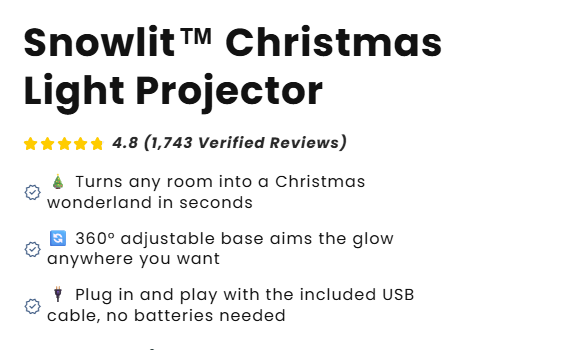
Snowlit sells a USB-powered Christmas Light Projector at snowlit.store. The page describes a 360-degree adjustable base and decorative patterns for a darkened room.
On October 1, the site displayed a 50% off entire-store banner, a sale-ending countdown, and a 4.8 score from 1,743 “verified reviews.”
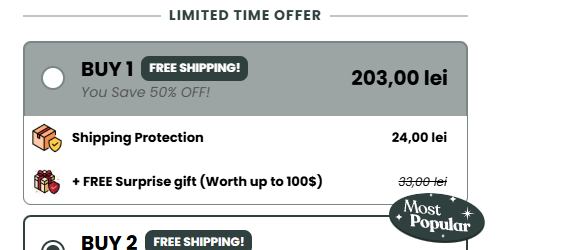
The offer also showed one- and two-projector selections, an optional shipping-protection charge, and a promotional surprise gift. These details can change the cart total.
The promise that needs a careful reading
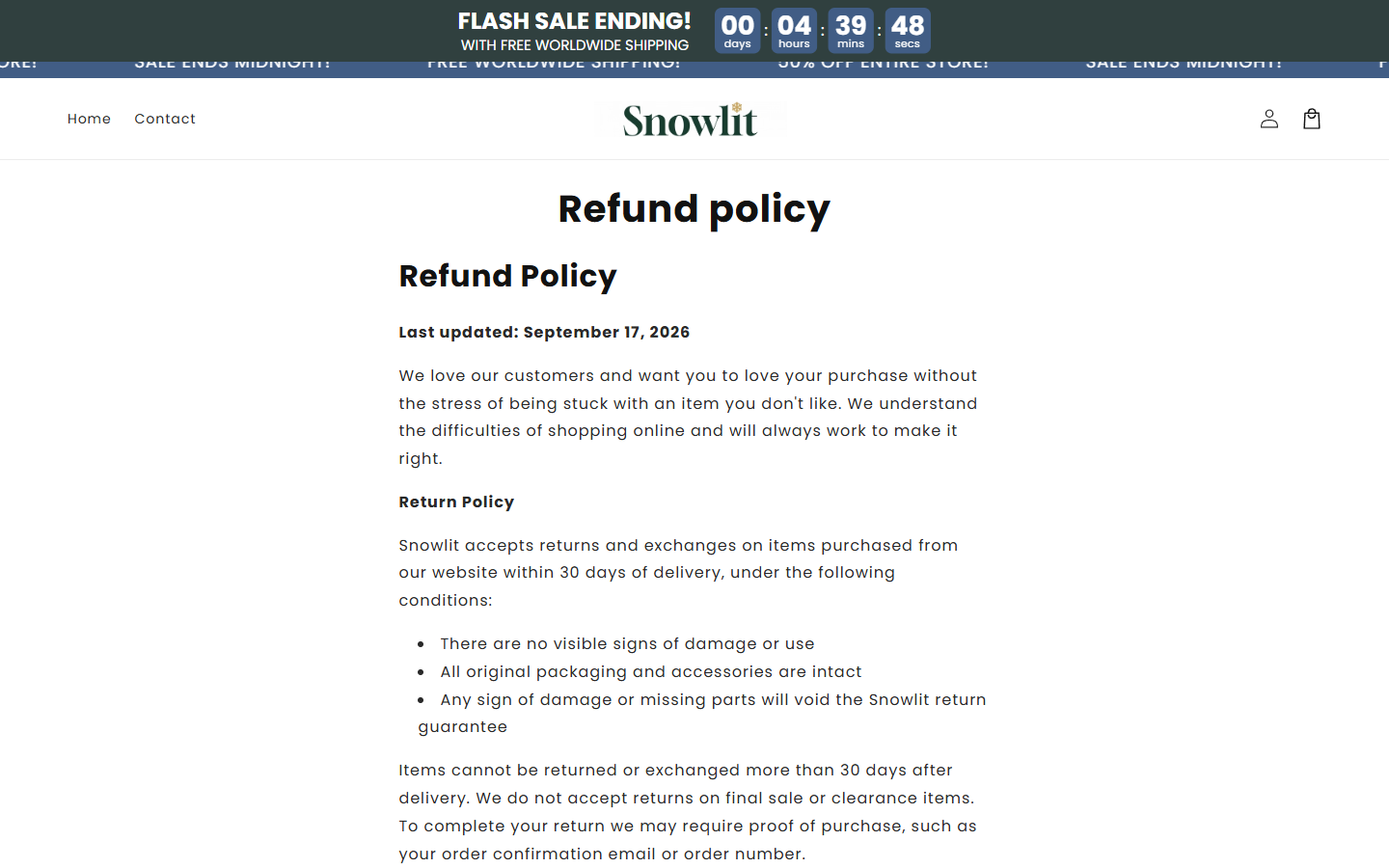
The homepage reassures visitors that they can return a purchase they do not like. Its formal refund policy describes a 30-day window.
That policy also says final-sale or clearance items cannot be returned or exchanged. The store simultaneously presents a sweeping discount campaign.
It is not clear from the reviewed pages whether the promoted projector is classified as final sale. A buyer should obtain that answer before ordering.
Our assessment
We did not place an order, test the projector, or verify the displayed purchase and review counters. No evidence here proves every buyer is denied a refund.
The issue is a specific possible conflict: a storewide sale can persuade customers to buy while a sale exclusion may narrow their ordinary return options.
Other questions concern add-on charges, response times, and the real appearance of the light pattern outside polished promotional imagery.
- The site advertises 50% off across the store and free worldwide shipping.
- The written policy excludes final-sale or clearance merchandise.
- Damage should be reported within 48 hours, according to the policy.
- Return shipping for an ordinary change of mind falls to the buyer.
- The shipping page provides estimates, not guaranteed arrival dates.
Those terms may be acceptable to some buyers. They should not be discovered only after a holiday purchase fails to meet expectations.
What the Projector Page Does and Does Not Prove
A product image is not a room-size guarantee
The marketing shows a neat, bright projection in a festive setting. A small light can look impressive in a dark room photographed from the right angle.
Real performance depends on ceiling height, ambient light, distance, wall color, and how the optics distribute the pattern.
The 360-degree base means the device can be aimed in different directions. It does not tell us how wide or bright the image becomes.
Snowlit describes a USB cable and no battery requirement. Check what power adapter is supplied, if any, before planning to use an outlet.
If the projector is intended for a child’s room, examine the manufacturer’s instructions for placement, heat, cords, and unattended operation.
We have not independently tested this model. A shopper should seek unedited footage showing it in a normal room with the lights partly on.
Reviews and purchase counters are site claims
The page labels 1,743 reviews as verified and says more than 100 orders were placed in the prior 24 hours.
These numbers may be accurate, but the page alone cannot independently substantiate them. It also cycles a small set of visible testimonials.
Repeated carousel entries do not prove the total count is fabricated. They simply do not provide the detailed evidence a buyer needs.
Look for reviews that discuss projection sharpness, durability, noise, and actual delivery. Photos of the device in ordinary rooms are more useful than generic praise.
Do not let a counter substitute for product specifications. A device can be popular and still be unsuitable for your particular space.
“Free” can appear beside a priced add-on
The offer includes a “free surprise gift” and separately displays shipping protection. In our localized view, a monetary value appeared beside the gift.
That screen arrangement could confuse shoppers about which items cost extra. The only reliable number is the final total immediately before payment.
Toggle optional items and recheck the subtotal. Confirm whether the protection covers loss, theft, damage, or something already covered by seller obligations.
Save the final cart page. It can show whether an extra was selected and what the seller promised for that charge.
Buying two units should also be an intentional choice. A “most popular” badge is not evidence that your home needs two projectors.
How the Snowlit Sales Journey Works
Step 1: A seasonal visual creates urgency
The site opens with Christmas imagery and a countdown. It suggests that a small gadget can turn an ordinary evening into a holiday scene quickly.
That appeal is understandable, particularly when a gift deadline is close. Pause long enough to measure the room and check where the projector would sit.
Do not infer that a timer reflects a unique discount that disappears permanently. We did not establish how the sale mechanism operates over time.
Step 2: Ratings make the offer feel established
Five stars and a large review count appear close to the product title. A “100+ orders” notice adds social pressure.
Neither number is independently verified by our review. Treat them as seller representations and seek detailed off-page feedback when possible.
A useful review describes the throw distance, pattern appearance, power connection, and any complaint resolution. “Loved it” offers much less insight.
Step 3: The bundle and extras set the real price
The one- and two-unit offers have separate price cards. One version is framed as popular, which can steer a shopper toward a larger order.
Shipping protection appears as an extra. Check whether it is automatically selected, what it costs in your currency, and whether you actually want it.
The gift’s wording should be compared with its line-item price at checkout. A crossed-out value is not the same as a zero charge.
Take a screenshot showing quantity and all selected extras before proceeding. The checkout total, not the hero price, is what your card will reflect.
Step 4: A broad return message reduces hesitation
The homepage’s return language sounds welcoming. It tells a buyer who might dislike the effect that a remedy is available.
Open the formal policy before paying. It requires unused merchandise and original packaging for ordinary returns, and it excludes final-sale or clearance items.
Because the page promotes a storewide discount, ask specifically whether the currently advertised projector remains returnable for a change of mind.
Get the answer in writing. Do not assume a general FAQ overrides a narrower exclusion in the actual policy.
Step 5: Shipping begins under estimates
The shipping policy says processing usually takes one to two business days. U.S. transit is estimated at five to eight more.
Those are estimates, not a Christmas-delivery guarantee. The store gives recommended ordering dates and warns that carrier volume may cause delays.
International customers may face import taxes or duties, despite the free standard-shipping promotion. The policy assigns those charges to the recipient.
Keep the tracking email and compare its first real carrier scan with the date the seller says the parcel shipped.
Step 6: A problem triggers two different deadlines
For an ordinary eligible return, the policy describes 30 days after delivery. For damaged goods, it asks customers to report within 48 hours.
Open and inspect the parcel promptly. Film a simple setup test if it does not light, aim, or project as the listing describes.
Send photographs and the order number to the support address in the shipping policy. Ask whether the seller will replace, refund, or request a return.
Keep the original box until the issue is resolved. Missing accessories or packaging can complicate an ordinary return request.
Company, Address, and Return Logistics
Snowlit is the storefront name, not a manufacturer record
The product and shipping pages identify the Snowlit brand. They do not establish the factory that produced this specific unit.
Its support email uses the name StepNest rather than Snowlit. That mismatch is worth asking about, but it does not prove a fake seller.
Write down the merchant name on the checkout and later card statement. A different processor name may be legitimate, but you should be able to identify it.
Return postage can erase a low-priced bargain
The formal policy places change-of-mind postage on the customer. It requires items to be in suitable condition and does not promise a prepaid label.
Ask for the return destination before assuming a refund makes sense. A projector’s packaging may cost more to send than the displayed sale price suggests.
For damage or nonfunctioning goods, explain that your request is not a simple change of mind. Ask what remedy the seller will provide.
Do not mail a package to the address on its incoming label without authorization. It may be a carrier or fulfillment location.
Support claims should be tested with a specific question
The site says customers can email stepnestofficial@gmail.com about shipping and damage. The policy refers to replies within 24 to 48 hours.
We have not contacted this inbox, so its actual response time remains untested. A pre-purchase policy question offers a low-risk test.
Ask whether the advertised discounted projector is classed as final sale and whether ordinary returns are accepted after a short indoor test.
If you receive an answer, save it. If you receive none, consider that silence before committing money.
The supply chain is not established by a courier list
Snowlit’s shipping page mentions FedEx, DHL, UPS, SF Express, EMS, and local couriers. That list does not identify manufacturing origin.
We cannot assert that this projector is Chinese-made or unsafe from the carrier names alone. Actual labeling and product documentation would be required.
For electronics, check voltage requirements, adapter certification, and written safety instructions. If they are absent, ask before use.
The Sale-Item Exception Is the Key Buying Decision
“50% off everything” and “no sale returns” can collide
A buyer seeing a storewide promotion could reasonably expect the advertised product to qualify for the 30-day return promise.
The written exception introduces doubt. If the discount makes every listed item a final-sale item, ordinary returns could be far narrower than the homepage implies.
We cannot confirm that interpretation without the seller’s classification of the specific projector. That is exactly the question to ask.
A clear seller answer should say whether a discounted, unused projector may be returned simply because it does not meet expectations.
If the answer is no, decide whether you are comfortable buying without that option. If the answer is yes, retain the response.
Damage and change of mind are different
The policy’s 48-hour reporting language applies to damaged goods. That is different from deciding the visual effect is not to your taste.
Document defects immediately, including a video of the device connected to an appropriate power source and the pattern it produces.
A product that differs materially from its listing may raise questions beyond a voluntary return. Describe the difference precisely rather than using generic dissatisfaction.
Card issuers and consumer protections have their own deadlines. Do not let prolonged email exchanges consume the time available to seek help.
A gift date changes the risk calculation
A late Christmas projector can be useless even when it eventually arrives. The shipping policy offers estimates and recommended order dates, not certainty.
If you need it for a fixed event, seek a guaranteed delivery commitment from a retailer that offers one.
Check tracking early. A label created in a system is not the same as the carrier accepting the parcel.
When requesting cancellation over delay, cite the promised date you actually saw at checkout and attach a screenshot.
What to Do If You Ordered a Snowlit Projector
- Check your order confirmation. Verify whether you bought one or two units and whether shipping protection or any gift line added a charge.
- Save the advertising and policy. Preserve the 50% off banner, return message, formal exclusion, checkout total, and estimated delivery shown when you paid.
- Inspect within 48 hours. Open the parcel, photograph the contents, and test the projector safely. Report damage or nonfunctioning parts quickly.
- Ask about return eligibility in writing. If you simply dislike the effect, request confirmation that the discounted item is returnable before sending it anywhere.
- Request a remedy tied to the problem. For a defect, ask for repair, replacement, or refund instructions. For an unwanted item, ask about postage and condition requirements.
- Follow tracking and payment deadlines. If the item never arrives or the seller refuses a clear promise, contact the payment provider with your records.
Keep the conversation focused on the order and the written terms. You do not need to prove a grand conspiracy to ask for a fair resolution.
Frequently Asked Questions
Is Snowlit a confirmed scam?
No. We found a genuine policy tension and sales-pressure elements, but we did not verify fraudulent billing, universal non-delivery, or a fake product.
Can I return a discounted Snowlit projector?
The policy excludes final-sale or clearance items. Ask the seller whether the current storewide discount places this exact product in that category.
Is shipping really free worldwide?
The site advertises free standard shipping. Its shipping page says international buyers may still owe import taxes, duties, or customs fees.
Does the projector include a power adapter?
The page describes USB power and an included cable. Confirm the adapter and power specifications before ordering or connecting it.
Are the 1,743 reviews independently verified?
We could not verify that count independently. Treat it as a site claim and look for detailed, dated reports outside the sales page.
What if the projector arrives broken?
Document the problem and contact support within the policy’s 48-hour damage-reporting period. Ask for a clear replacement or refund path.
The Bottom Line
The Snowlit projector may be a real decorative light, but the buying risk is in the fine print. A storewide sale sits beside a return-policy exclusion.
Confirm whether this discounted item remains returnable, remove unwanted extras, and keep the final cart. A few minutes of checking can prevent a costly surprise.

Join the discussion
0 commentsShare your experience or ask a question about this article.
Discussion
Start the conversation
Have a question or something useful to share? Add the first comment.