

A baseball-themed projector can look like an easy gift for a fan. MLB Glow’s page turns that simple idea into a bright, heavily discounted checkout.
We examined the offer as a buyer would, from the first price to the optional extras. Some numbers deserve a second look before payment.
Overview
What the product page promises
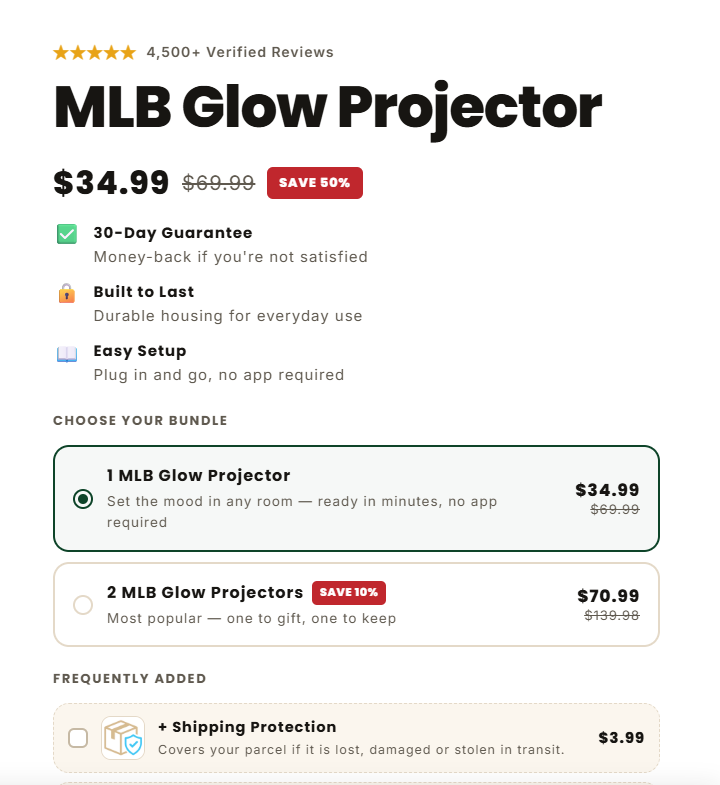
MLB Glow markets a baseball-themed room projector for fans and gift buyers. The page presents easy setup, a 30-day money-back guarantee, and a $34.99 single-unit sale price.
The product imagery features league and team-style graphics. The same page also refers to “Diamond Glow,” creating some uncertainty about the exact branded item shipped.
We did not purchase or test a unit. The article examines the site’s sales claims and checkout presentation, not hardware quality.
The bundle calculation
At our September 30, 2026 check, one projector was $34.99. Two bought at that displayed single price would total $69.98.
The dedicated two-projector bundle was priced at $70.99 and labeled “Save 10%.” That bundle is $1.01 more than two displayed singles.
Shipping, taxes, or checkout limits could affect a final order. The page does not explain the “Save 10%” label against its live single-unit price.
Where the buyer needs more clarity
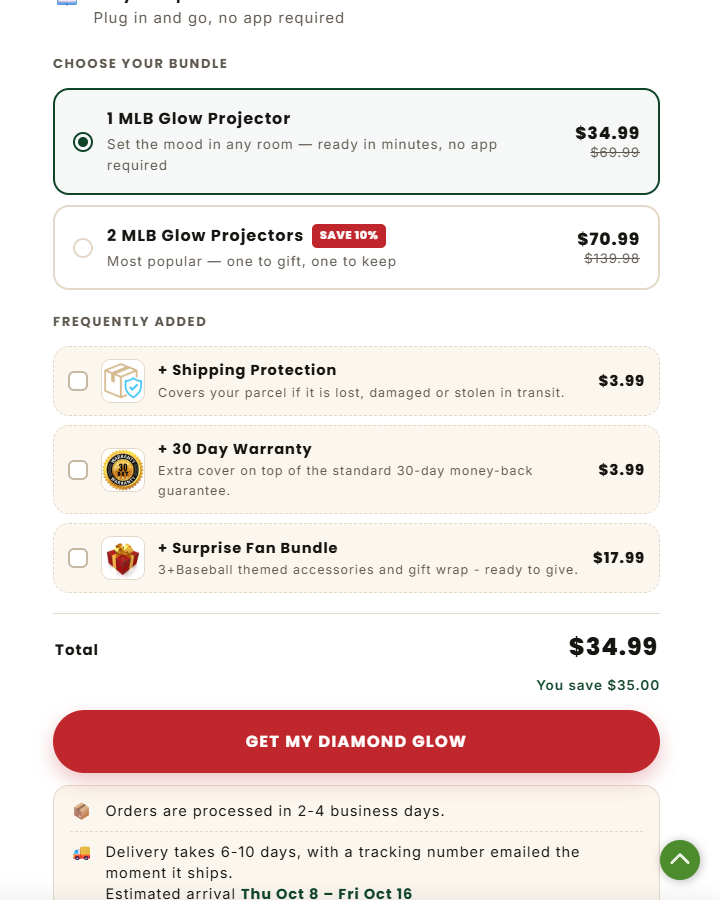
The page offers optional shipping protection and a paid 30-day warranty alongside its existing 30-day money-back guarantee.
Those boxes were not checked in the state we observed. The site did not clearly explain what the paid warranty covers beyond the free guarantee.
- The $70.99 two-pack costs more than two $34.99 singles before other charges.
- A “Save 10%” label lacks a clear comparison to that single price.
- Optional $3.99 protection and $3.99 warranty appear near checkout.
- The site uses both MLB Glow and Diamond Glow names.
- A contact form is visible, but the inspected pages did not identify a legal operator.
These are concrete questions about a commercial offer. They do not prove that the seller never ships, uses unauthorized logos, or runs a subscription trap.
The Bundle Math Is the Clearest Warning
Start with the actual displayed prices
The single unit costs $34.99 on the page we captured. Multiplying that price by two gives $69.98, before tax or delivery.
The labeled two-unit offer costs $70.99. A buyer choosing it pays $1.01 more than the simple two-single calculation.
The “Save 10%” badge may refer to a crossed-out reference price of $139.98. The page does not make that basis clear where a buyer selects the bundle.
Comparison pricing can be lawful and useful when it is understandable. Here, the nearby single price is the natural benchmark most shoppers will use.
Do not assume a bundle is cheaper because it says “most popular.” Calculate against the current individual price and any quantity restrictions at checkout.
A $1.01 gap might seem small, but the direction matters. A bundle badge should simplify comparison, not require the buyer to correct it.
If the seller says the discount applies to a former list price, ask how that price was established and why it is the relevant benchmark.
Optional extras deserve a separate decision
Shipping protection was shown at $3.99. The page describes coverage for a parcel that is lost, damaged, or stolen during transit.
A separate 30-day warranty also cost $3.99. Its short description promises extra cover beyond the standard money-back guarantee.
That phrase does not specify the covered defects, exclusions, claim process, or whether the same shipping issue is already addressed elsewhere.
For a $34.99 product, two $3.99 extras add $7.98. That is a material increase relative to the initial sale price.
Neither box was preselected in our observed session. Still, check the final summary because shopping pages and offer states can change.
Take a screenshot after changing any option. An updated subtotal gives better evidence than a memory of which boxes looked empty earlier.
Do not mistake a 30-day promise for a full policy
The page says unhappy customers can contact the store within 30 days for a refund. It does not clearly spell out item condition or return postage.
During our direct check, conventional `/policies/refund-policy`, `/policies/shipping-policy`, and `/policies/terms-of-service` routes returned 404.
That does not prove no policy exists anywhere. It does mean we could not confirm a full written return process through those expected addresses.
Before paying, ask where the complete refund and warranty conditions can be read. Keep the seller’s written answer with your receipt.
Ask whether the 30-day clock begins at purchase, shipment, or delivery. A two-week transit period can make that distinction important.
Clarify whether a buyer must pay return postage, keep packaging, or provide photos. None of those conditions should be discovered only after requesting help.
How the MLB Glow Sales Funnel Works
Step 1: A fan gift gets a dramatic presentation
The page uses stadium lighting, team imagery, and a large discount. It invites a buyer to imagine a child or fan seeing their room transformed.
That emotional picture is normal retail marketing. It becomes a problem only if the product delivered, rights represented, or terms materially differ.
We did not see a unit in person, so we cannot confirm projection quality, brightness, or how accurately the product photos depict real output.
Ask for an unedited demonstration in ordinary room light if brightness matters. Advertising graphics may illustrate an effect rather than reproduce it exactly.
Step 2: The crossed-out price anchors value
The single projector is shown at $34.99 against $69.99. A “Save 50%” badge makes the current offer look unusually generous.
Reference prices are claims about value, not proof that buyers usually pay the higher amount. We did not establish the product’s price history.
Compare specifications and real demonstrations, not merely the size of the crossed-out number. Similar-looking projectors can differ in image quality and included content.
We also could not verify whether the listing’s team graphics are licensed. An MLB-style image is not by itself a license certificate.
If this is intended as an official sports gift, check whether the package and sales receipt identify an authorized merchandise program.
Step 3: The two-pack carries a confusing savings badge
The “most popular” option contains two projectors at $70.99. The nearby “Save 10%” label encourages the buyer to expect a quantity discount.
But the displayed single price makes two units $69.98. The label and arithmetic point in different directions.
There may be shipping or availability differences at checkout, but the product page does not explain them before the selection.
If the site blocks buying two singles, that is worth knowing. The listing should not ask customers to infer a discount that its visible prices do not show.
The only reliable comparison is the total presented just before payment. Shipping rates might differ by package size and alter the result.
Step 4: Extras sit beside the main choice
The protection and warranty options appear directly below the bundles. Each costs $3.99 in the live session reviewed.
A buyer may add them for peace of mind without noticing that the store already advertises a 30-day money-back guarantee.
Protection against lost parcels and warranty cover for a working product can be distinct. The issue is whether their precise benefits are explained.
We did not select these extras or complete payment. We cannot say they are secretly charged or automatically included in every order.
Step 5: Social proof and naming can obscure details
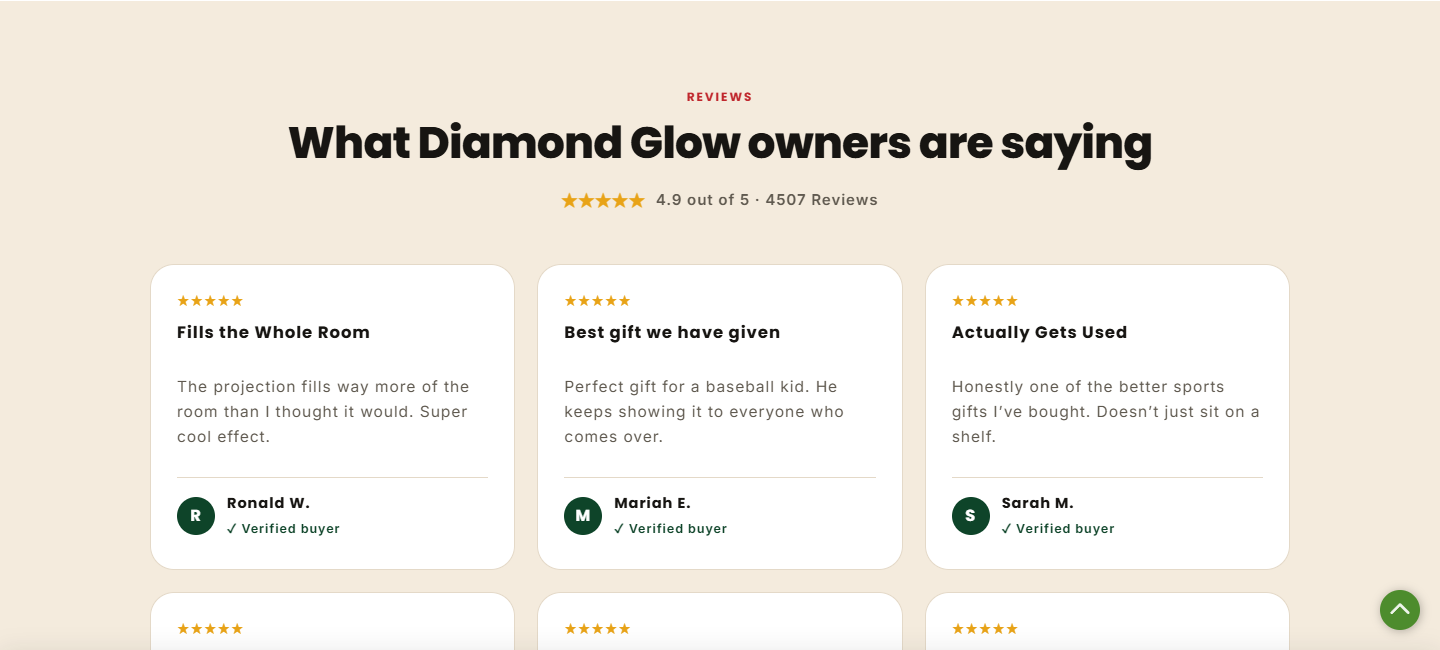
The top of the page advertises more than 4,500 verified reviews. A lower section displayed 4,507 during our check, so those numbers are consistent.
We did not independently verify purchase records behind the reviews. A consistent count still does not prove every testimonial was collected from a real buyer.
The lower section calls customers “Diamond Glow owners,” while the product title says MLB Glow. The button and box description also use Diamond Glow wording.
A naming mix-up could be a rebrand or reused template. It does not prove counterfeit goods, but a buyer deserves to know which item appears on the receipt.
Step 6: After payment, support becomes the critical route
The page estimates processing and delivery time and invites dissatisfied buyers to contact the seller within 30 days.
We found a contact form. We did not see a clearly identified legal operator, direct email, phone, or postal return address on inspected pages.
A form can work perfectly well. The difficulty is proving what was sent and knowing who is responsible if support does not respond.
Save a copy of every message and screenshot the confirmation screen. Ask for a case number, return location, and written warranty terms.
If no confirmation appears, note the time, browser, and text submitted. That record helps establish that a refund request was made promptly.
Company, Address, and Fulfillment Checks
The brand name is not the seller’s legal identity
MLB Glow is the name on the storefront. The public pages we checked did not clearly identify the company that accepts payment.
That gap matters when a charge appears under an unfamiliar descriptor. Ask the store what legal entity issues receipts and handles refunds.
Do not assume Major League Baseball operates this store because the page uses baseball imagery. We did not verify an official commercial relationship.
A return address was not visible in the reviewed pages
The contact page offered a form, but we did not find a published postal return address there. Standard policy routes returned 404 during our browser check.
This may reflect a custom single-page store rather than a missing business. Either way, shoppers need a usable return destination before a refund promise becomes practical.
Never mail the projector to an address found through an unrelated search result. Wait for a written authorization from the merchant.
Support should define the paid add-ons
Ask what $3.99 shipping protection covers that existing delivery obligations do not. Also ask what the $3.99 warranty adds to the free 30-day guarantee.
A useful answer specifies exclusions, proof required, claim deadline, and whether the fee itself is refundable after cancellation.
We did not test a completed support exchange, so we cannot say the seller ignores messages. The concern is missing detail before purchase.
Product origin and licensing need evidence
The promotional graphics include baseball league and team-style marks. We found no license statement in the material reviewed, but absence on a page is not proof of infringement.
Likewise, we did not establish a manufacturer, country of origin, or whether the projector is a generic unit with custom packaging.
If official branding matters, request a written answer about licensing and check the product packaging when it arrives.
If practical performance matters, ask for the projector’s model number, light output, projection distance, included slides, power requirements, and replacement-parts process.
These specifications also make comparisons possible. Without them, a dramatic room image may be the only information shaping expectations.
What to Do If You Ordered an MLB Glow Projector
- Recheck the math on your receipt. Confirm whether you purchased one or two units and compare the charged amount with the visible $34.99 and $70.99 offers.
- Identify optional line items. Look for $3.99 shipping protection, $3.99 warranty, or other extras. Contact the seller promptly if you did not intend to add them.
- Save the offer and packaging. Keep screenshots of the price, guarantee, product name, included contents, tracking, receipt, and delivered box.
- Test promptly after delivery. Check operation, projection appearance, accessories, and quantity while the stated 30-day refund period is still open.
- Request terms in writing. Use the contact form for a return or warranty claim, then save the message and any reply. Ask for the legal seller and return destination.
- Use payment protections if needed. If goods fail to arrive, the charged total differs, or a promised refund stalls, contact the card issuer with your records.
We found no verified automatic refill or ongoing subscription. There is no reason to replace a card merely because a projector page offers optional protection.
Frequently Asked Questions
Is MLB Glow Projector a confirmed scam?
We have not established that. The verified concerns are confusing bundle math, limited policy detail, optional add-ons, and an unclear legal seller.
Does the two-pack save 10%?
Not against the live single-unit price we saw. Two at $34.99 total $69.98, while the labeled bundle was $70.99 before other charges.
Are shipping protection and warranty automatically included?
They were unchecked in our observed state and separately priced at $3.99 each. Confirm their status again on your final checkout screen.
Why does the page say Diamond Glow too?
The reviewed page uses both names. It could reflect a template or rebrand. Ask which product name and model will appear on your receipt and package.
Is this an officially licensed MLB product?
We could not verify that from the inspected page. Do not infer licensing from graphics alone; request documentation if official status matters.
Where can I find the full return policy?
The page advertises a 30-day money-back guarantee. Expected standalone policy URLs returned 404 in our check, so ask support for complete written terms.
The Bottom Line
MLB Glow might deliver a fun room light. The sales page, however, asks buyers to trust a savings badge that does not match its nearby prices.
Calculate the bundle yourself, decline extras you do not understand, and get the complete refund and warranty terms before paying.
That is a sharper, evidence-based warning than calling an untested projector a proven fraud.

Join the discussion
0 commentsShare your experience or ask a question about this article.
Discussion
Start the conversation
Have a question or something useful to share? Add the first comment.