

A bracelet that promises relief during menopause can feel wonderfully simple. Haima turns that hope into a story about iron, ancient history, and a stone worn at the wrist.
We followed the claims through the product page and the store’s own policies. What those pages say together deserves a closer look before anyone orders.
Overview
The bracelet and the promise
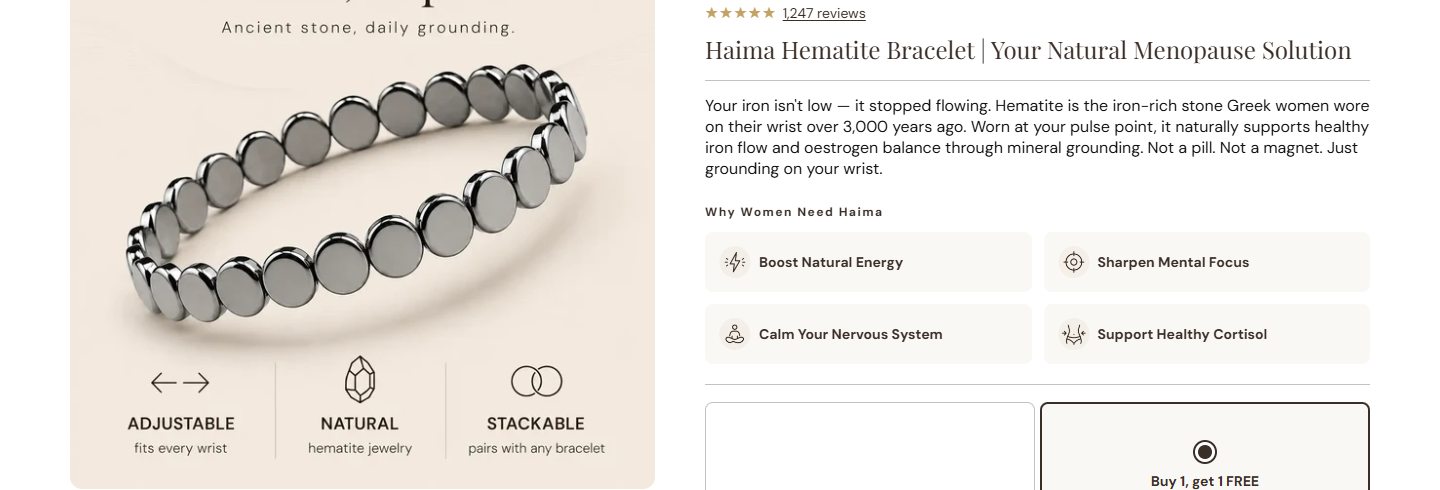
Haima sells a hematite bracelet as a natural menopause solution. Its page connects wrist contact with better iron movement, hormonal balance, energy, focus, and calm.
The pitch sounds more precise than ordinary jewelry advertising. It names a mineral, a pulse point, and a biological pathway, then suggests relief without pills.
At the September 30, 2026 check, the displayed offer started at $39.90. A buy-one-get-one option was selected on the product page.
What we could verify
The bracelet is an actual product offered through a functioning storefront. The site names CODAMERICA LLC, publishes contact details, and has written shipping and return pages.
We also verified that the scientific paper cited by the seller exists. It studied how estrogen influences an iron-regulating protein in mice and cultured cells.
That research did not test a hematite bracelet. The site’s jump from a hormone study to a wearable product is the central issue in this review.
Where the buyer risk sits
Haima’s product page promises a free, no-questions-asked 30-day return. Its formal policy adds unused-condition requirements and customer-paid postage for ordinary returns.
Neither inconsistency proves that buyers cannot obtain refunds. It does mean the generous promise needs written clarification before payment.
- The sales page links hematite contact to iron flow and estrogen balance.
- The cited research does not study jewelry or menopause symptom outcomes.
- The site says the bracelet does not add iron or replace medical care.
- A 30-day return is advertised, but the policy includes important conditions.
- The seller identifies a legal operator, not a verified manufacturer.
Our finding is a commercial-risk investigation into medical-style marketing and return terms. We did not establish a fake company, a subscription, or a criminal scam.
Why the Iron Story Sounds Convincing
A real mineral gives the claim a scientific surface
Hematite is iron oxide. Someone holding a weighty, cool stone can genuinely feel its texture, and wearing jewelry can provide a comforting daily ritual.
Those sensations are not the same as moving iron through the bloodstream. The product page supplies no test showing that skin contact with hematite changes iron markers.
The seller’s own FAQ says the bracelet does not add iron to the body. That acknowledgment matters because the page repeatedly invokes iron deficiency and circulation.
Think of an iron frying pan: its composition is obvious, but holding its handle does not treat anemia. The same category mistake appears in the bracelet pitch.
A person can have normal iron levels and still experience exhaustion. Conversely, someone with low iron needs proper evaluation rather than a stone chosen from photographs.
“Iron is in the stone” and “iron reaches your tissues differently” are different propositions. The first describes material composition; the second requires human clinical evidence.
The study does not bridge that gap
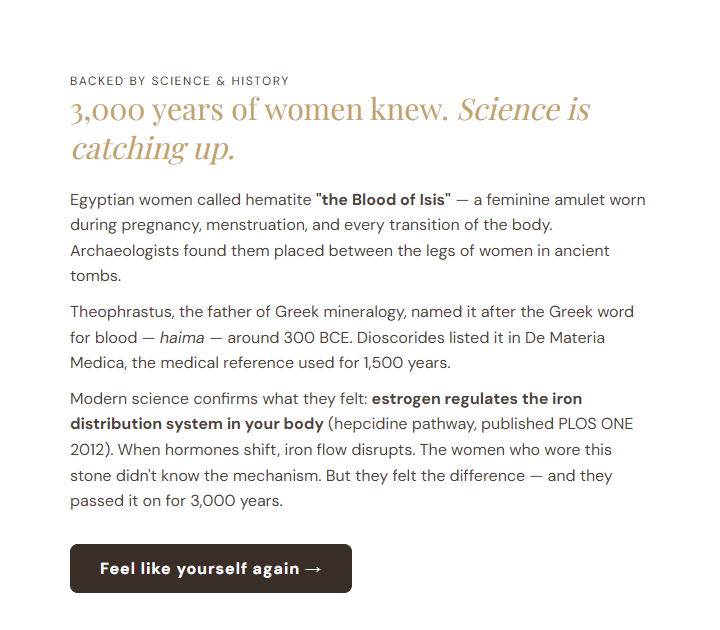
Haima points readers toward a 2012 PLOS ONE paper about estrogen and hepcidin, a protein involved in iron regulation. The research is legitimate.
Its experiments involved mice and laboratory cells. The paper did not place hematite on anyone’s wrist, measure symptoms, or test the product sold here.
Even the researchers warned that their findings were difficult to apply directly to humans. Their work cannot establish that a bracelet restores hormonal balance.
The page does not identify a before-and-after blood test, a comparison group, or a dose of any biologically delivered ingredient. Those omissions are not minor details.
Without them, there is no reliable way to separate a comforting routine from a measurable effect on the hormone and iron systems named in the ad.
The difference is easy to miss when a sales page places “backed by science” beside an ancient-history story. Both can sound authoritative while leaving efficacy untested.
Read the actual PLOS ONE paper and ask one simple question: where is the study of this bracelet in people with menopause symptoms?
Menopause symptoms deserve a proper conversation
Hot flashes, disrupted sleep, mood changes, and fatigue can overlap with other health problems. A bracelet cannot tell which symptom has which cause.
That does not mean every person needs medication. It means treatment choices should follow the symptom, medical history, and the person’s preferences.
The Menopause Society describes evidence-based options for symptoms, including treatments that need individual discussion with a clinician.
If fatigue is severe, a clinician may also decide whether testing for anemia, thyroid conditions, sleep problems, or other causes is appropriate.
Someone can still enjoy a bracelet as jewelry or a grounding reminder. The problem begins when a decorative object is treated as proof of medical benefit.
How the Haima Sales Funnel Works
Step 1: Familiar symptoms become a single hidden explanation
The page speaks to someone who feels unlike herself. Low energy, foggy thinking, stress, and sleeplessness appear together as a recognizable menopause story.
It then offers a neat explanation: iron is present, but has stopped flowing where it should. That framing can make complex symptoms feel suddenly solvable.
Nothing on the page shows an individual customer’s iron status. A persuasive explanation on a sales page is not a diagnosis.
For a person who has already tried supplements or received vague reassurance, the wording may feel unusually personal. That emotional fit is part of the appeal.
Step 2: The mineral becomes a proposed mechanism
Hematite’s iron content is used to make the bracelet sound biologically active. The page says contact at the pulse point encourages mineral grounding.
There is no disclosed clinical measurement of iron absorption, blood distribution, estrogen, cortisol, or hot flashes after wearing Haima.
Instead, the page moves from a property of the stone to a promised property of the body. The missing step is evidence that one causes the other.
Terms such as “grounding” can describe a calming personal ritual. Here they also carry a physiological suggestion that a buyer might mistake for proven treatment.
Step 3: History and a real paper lend extra authority
The copy refers to Greek and Egyptian uses of hematite. Ancient use can be interesting cultural background, but it is not a controlled treatment study.
The 2012 paper adds a more modern layer. Its topic is related to iron regulation, which makes the citation look relevant at a glance.
Yet neither historical use nor that paper tests the advertised wrist-contact mechanism. Joining them in one story does not close the evidence gap.
The page also calls the bracelet a “daily touchstone” rather than a cure. That softer phrase sits beside stronger claims about restoring iron flow.
Step 4: Testimonials make the result feel close
Customer stories on the site describe feeling calmer or more energetic after wearing the bracelet. Some mention disappointment with other attempts to feel better.
We cannot verify each story, its timing, or what else changed. A genuine personal improvement still would not prove a bracelet caused it.
Menopause symptoms often vary from week to week. Sleep, stress, medication, activity, and expectation can all affect how someone feels.
Look for a product-specific comparison study, not just a row of stars. The site does not provide such a study in the material we reviewed.
Step 5: A short sale encourages the order
The page displays a discount, a selected two-bracelet option, and messages about stock. Those cues make the purchase feel both economical and urgent.
Before paying, check the quantity and final total. A buy-one-get-one selection differs from intending to purchase one bracelet, even if the advertised price looks familiar.
We did not complete a paid checkout, so taxes, shipping, and any later checkout choices require confirmation on the buyer’s own payment screen.
Do not let a countdown or restock warning replace that check. A few minutes with the order summary are more useful than a rushed decision.
Step 6: The return promise changes when the policy opens
The product page says customers have 30 days, a free return, and no questions asked. It invites people to try the bracelet without risk.
The formal return policy limits returns to unused products in original packaging and assigns nondefect shipping costs to the customer.
Those conditions matter for a wearable sold on the expectation that a customer will try it for weeks. Ask which wording controls before ordering.
Save screenshots of both pages. If support later applies a stricter rule, the exact offer visible at purchase time may matter to the dispute.
Company, Address, and Fulfillment Checks
Haima is a brand; CODAMERICA LLC is the named operator
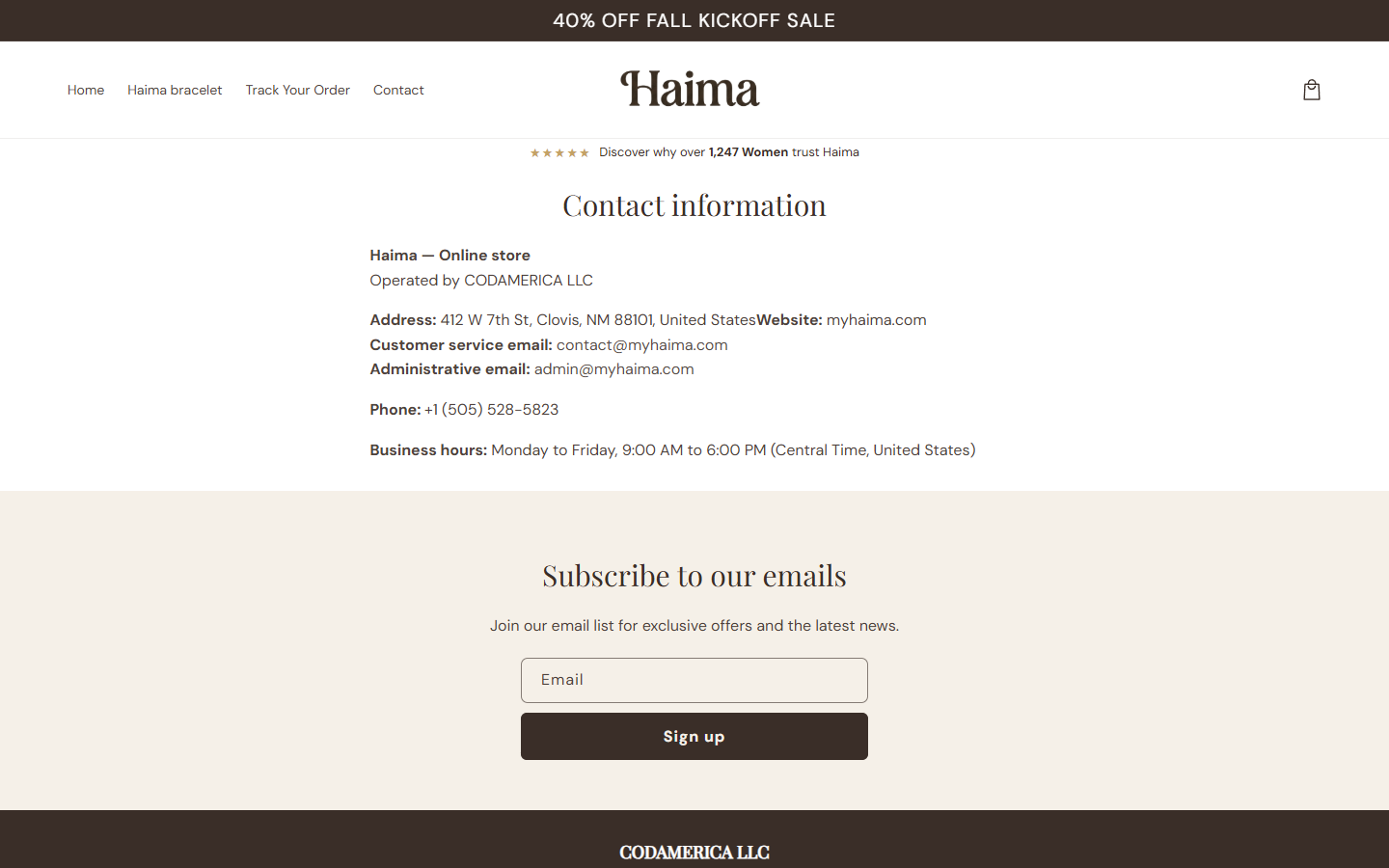
The site’s contact page names CODAMERICA LLC, not a jewelry maker or clinical research sponsor.
That legal name is useful for matching receipts and card statements. It does not establish who manufactures the beads, assembles the bracelets, or handles returns.
If the statement shows another descriptor, ask the seller to explain the relationship in writing. A different billing label is not automatically evidence of fraud.
A published address is not a factory certificate
Haima lists 412 W 7th St in Clovis, New Mexico. We verified the listing on its own site, not the use of that property.
Do not assume an address is a headquarters, fulfillment center, mailbox, or production site without records that establish the function.
A buyer who needs to return an order should obtain the authorized return destination from support. Mailing a bracelet to a contact address could be ineffective.
Contact channels should answer the hard question
The store publishes an email and telephone number. We did not place a test call or request a real refund, so response quality remains unverified.
Ask support whether wearing the bracelet counts as “used.” Ask whether the promised free return includes a prepaid shipping label.
Request an answer identifying when the 30-day window starts and whether the buy-one-get-one package must be returned together.
For buyers outside the United States, ask whether international return postage or customs charges change the advertised “free return” promise.
A clear written reply before purchase is more valuable than a generic reassurance that customer satisfaction is important.
Trace the product, not just the story
The site describes natural hematite but does not provide a product-specific clinical study showing menopause benefit. It also does not identify a manufacturing facility.
Those omissions do not prove poor materials or a particular country of origin. They mean shoppers cannot independently check sourcing from the sales page alone.
For jewelry, ask about bead composition, coatings, metal components, nickel exposure, durability, and the warranty for broken elastic or clasps.
A seller confident in its product should be able to answer practical construction questions without leaning on historical medicine.
If a bracelet breaks after ordinary wear, ask whether the store treats it as a defect, a return, or a separate warranty claim.
What to Do If You Ordered a Haima Bracelet
- Save the offer you saw. Keep the confirmation email, item quantity, total charge, product-page guarantee, and formal policy. Note your order and delivery dates.
- Check whether a second bracelet was included. Compare the receipt with your intended selection. Contact support promptly if the quantity or amount differs.
- Ask for the return rules in writing. Request clarification about worn jewelry, packaging, postage, approval, and the destination. Do not ship anything without authorization.
- Do not use the bracelet as treatment. If symptoms persist, ask a qualified clinician about appropriate evaluation and evidence-based options.
- Follow up on a promised refund. Keep the seller’s responses and tracking number. If the agreed credit does not arrive, ask your payment provider about dispute options.
- Watch for unexpected future charges. We found no verified subscription in this offer, but a card statement is the best way to catch any billing mistake.
There is no reason to scan a device simply because you ordered jewelry from a storefront. Security tools become relevant only if a separate suspicious link or download was involved.
Frequently Asked Questions
Does wearing hematite deliver iron to the body?
Haima itself says the bracelet does not add iron. The site provides no human study showing that wrist contact changes iron levels or circulation.
Did the cited PLOS ONE paper test this bracelet?
No. It examined estrogen and iron-regulation pathways in mice and cultured cells. It did not study Haima, skin contact, or menopause symptom relief.
Is Haima a confirmed scam?
We cannot make that claim from the evidence reviewed. The concerns are unsupported medical-style inferences and return language that differs between pages.
What does the 30-day guarantee actually cover?
The product page advertises a free, no-questions-asked return. The formal policy requires unused condition and generally puts return postage on the customer.
Who operates the Haima website?
The published contact and terms pages name CODAMERICA LLC. They do not identify a bracelet factory or independently verify the product’s source.
Should I stop medical care if I feel better wearing it?
No. A calming ritual can coexist with proper care. Discuss ongoing symptoms and any medication changes with your clinician rather than relying on jewelry.
The Bottom Line
Haima may be a bracelet someone enjoys wearing. Its menopause and iron-flow story reaches much further than the evidence displayed on its site.
The most concrete buyer issue is the return promise: the easy-sounding product-page guarantee does not match the conditions in the formal policy.
Ask for the exact return terms, keep the final checkout record, and treat persistent symptoms as a health question, not a jewelry question.

Join the discussion
0 commentsShare your experience or ask a question about this article.
Discussion
Start the conversation
Have a question or something useful to share? Add the first comment.