

A wooden utensil set seems like an uncomplicated kitchen purchase. Woodsen adds bigger promises: real teak, laboratory testing, a lifetime guarantee, and a steep sale.
We checked what the product page and policies actually commit to. The answer matters most when a buyer wants to return something that arrives perfectly intact.
Overview
What the store offers
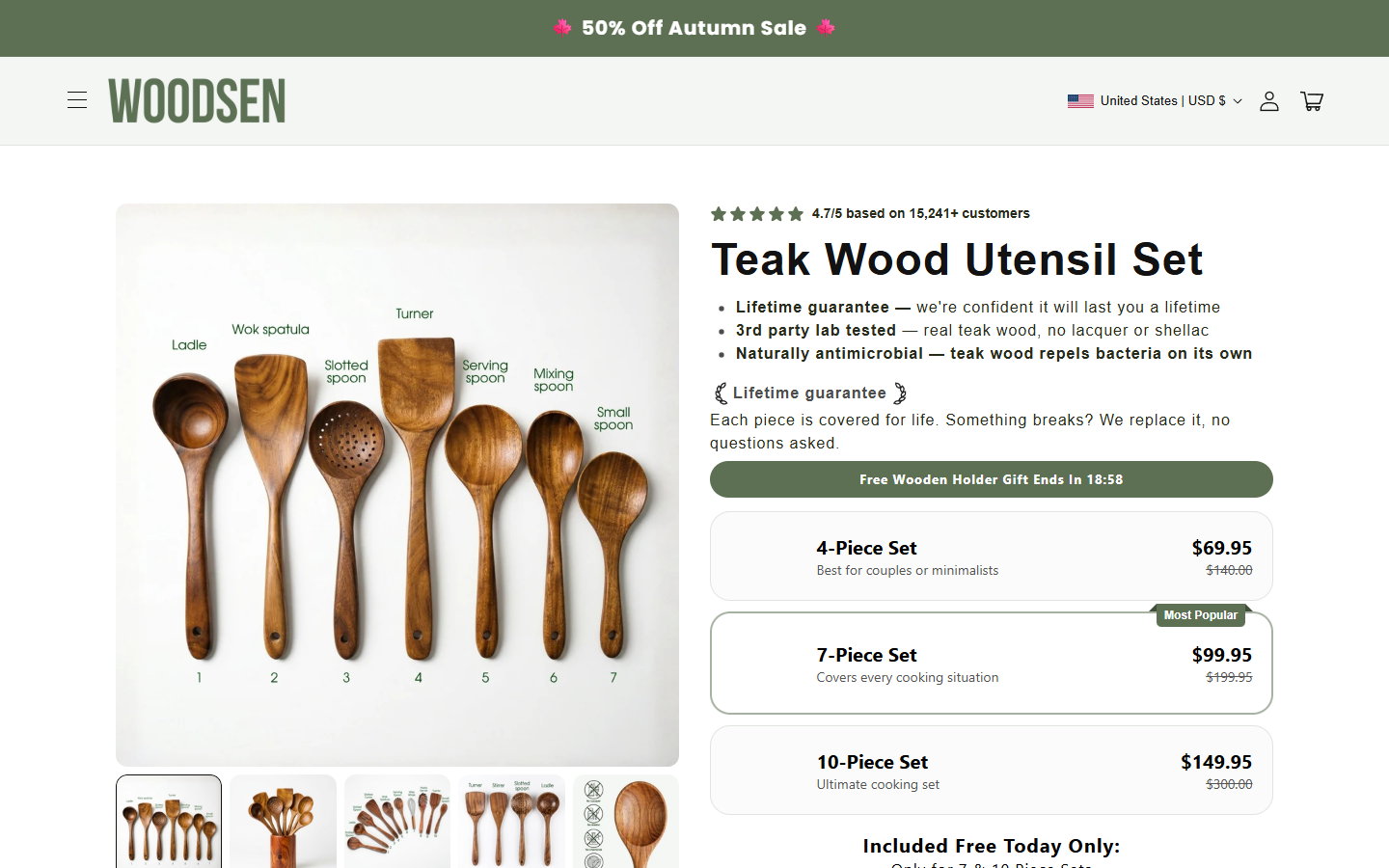
Woodsen markets wooden kitchen utensils in four-, seven-, and ten-piece options. The seven-piece set showed a $99.95 sale price during our September 30, 2026 review.
The page emphasizes teak, cooking-surface safety, antimicrobial properties, outside laboratory testing, and a lifetime guarantee. Each promise speaks to a different buyer worry.
Someone replacing scratched cookware may focus on the smooth wood. Someone worried about coatings may notice the laboratory language first.
The policy language that needs attention
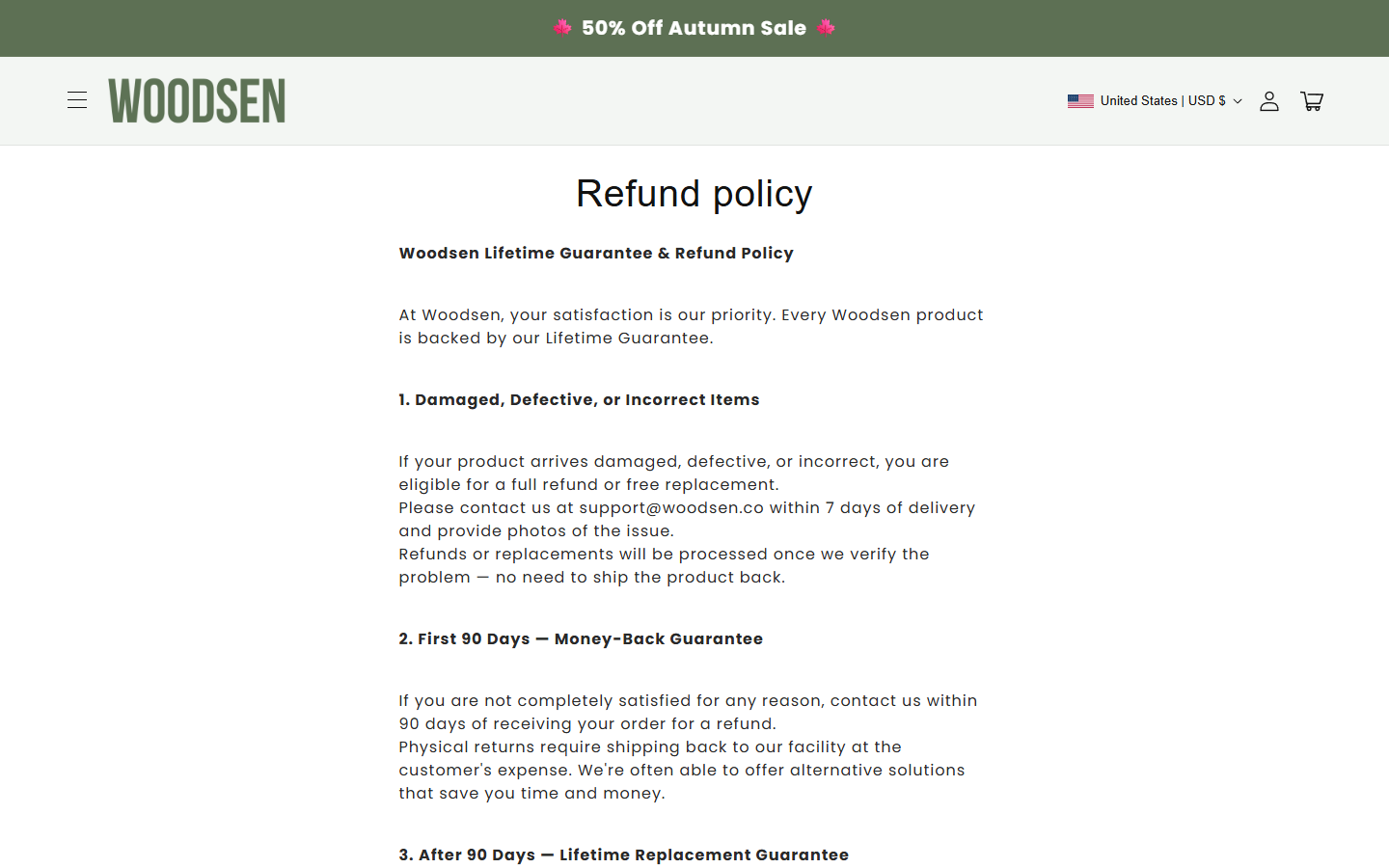
Woodsen’s refund page promises a first-90-day satisfaction refund, with physical return postage paid by the customer. It then offers limited lifetime replacements.
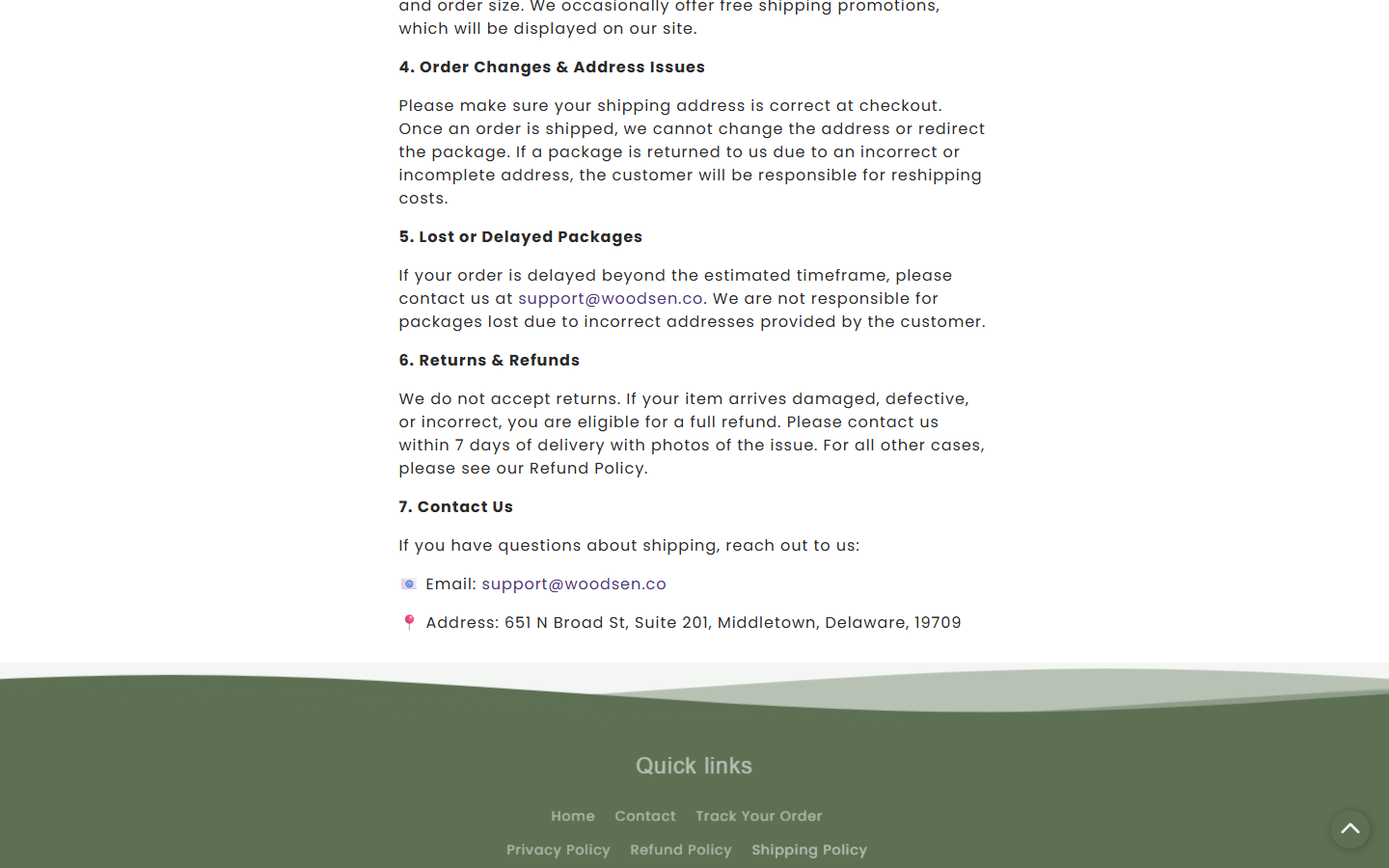
The shipping policy, however, says “We do not accept returns” before pointing other cases back to that refund page. The two statements need reconciliation.
A shopper should not have to guess whether a change-of-mind return is accepted or merely considered for an alternative solution.
What our investigation establishes
The storefront names Gallery No8 LLC in its terms and publishes a support email. We did not verify manufacturing location, laboratory reports, or real-world claim outcomes.
We also found no basis to say this is an automatic-refill scheme. Wooden utensils are sold as ordinary product sets in the pages reviewed.
- The page advertises a lifetime guarantee in prominent copy.
- The formal refund page limits the lifetime benefit to replacement conditions.
- Within 90 days, ordinary returns may require customer-paid shipping.
- A different policy starts with “We do not accept returns.”
- The listed legal operator is distinct from the Woodsen brand.
These points support a firm buyer-risk warning about clarity, not a claim that the utensils are counterfeit or that the seller is committing fraud.
What a Lifetime Guarantee Actually Means Here
A refund is not the same as replacement
The product page says each piece is covered for life and promises to replace a broken item. That sounds broad when read quickly.
The formal refund policy gives dissatisfaction refunds within 90 days of delivery. After that, the stated benefit becomes a replacement guarantee.
The policy says each order gets one guarantee claim. Normal cosmetic wear, dishwasher damage, long soaking, and misuse are excluded.
That is much narrower than an unlimited refund or endless replacement. A buyer should know the distinction before relying on the large “lifetime” headline.
Ask which defects qualify, what evidence is needed, and whether shipping for a replacement is covered. Those operational details determine a guarantee’s value.
For example, a spoon that cracks during ordinary stirring is different from one left soaking overnight. The seller’s exclusions may determine which result receives help.
Photograph care instructions when the package arrives. If an issue appears months later, those directions can show whether normal maintenance was followed.
The 90-day promise has costs and conditions
For a nondefective item, Woodsen says a buyer can contact it within 90 days for a refund. A physical return may be required.
The customer pays that return postage under the refund policy. Shipping seven or ten pieces back can change the economics of a seemingly risk-free purchase.
Damaged, defective, or incorrect items follow a separate path. The page asks for contact within seven days and photos, then describes a refund or replacement.
These are specific windows with different outcomes. Save the delivery date, inspect everything promptly, and choose the correct type of claim.
“We do not accept returns” is hard to square
The shipping policy says the store does not accept returns. In the next sentence, it directs other situations to the refund policy.
That qualifying sentence may mean nondefect refunds are still available under separate rules. It does not explain why a physical return is also described elsewhere.
The discrepancy is concrete and visible on Woodsen’s own pages. It is not a customer rumor or a conclusion borrowed from a video.
Before buying, ask support whether a change-of-mind refund is guaranteed, whether the set must be returned, and where it must go.
Also ask whether an opened but unused set qualifies. The public pages do not clearly answer how handling the pieces affects a satisfaction request.
Get an answer tied to the exact product and order date. A general “we stand behind every order” reply does not resolve conflicting policy text.
How the Woodsen Sales Funnel Works
Step 1: A familiar kitchen worry introduces the set
The product page frames wood as a way to avoid scratching cookware or wondering about coatings on plastic utensils.
Those concerns can be legitimate. The marketing then presents this particular set as a complete answer, with a list of material and durability claims.
A shopper can reasonably prefer wood. That preference does not prove this batch is laboratory tested, uniquely safer, or better than alternatives.
Ask for the underlying report if third-party testing is central to the purchase. A badge on the page is not the report itself.
Step 2: A crossed-out price creates urgency
The seven-piece set showed $99.95 against a higher comparison price. Other bundle sizes appeared next to it with their own savings cues.
A big percentage label can make the order feel time-sensitive. It does not tell you how long the reference price was used or whether comparable sets cost less.
Compare the number, size, and shape of pieces. A seven-piece set is not automatically seven utensils if packaging or a holder is counted differently.
The screenshot reviewed shows seven named utensils. Keep that specific list when you compare against what arrives.
Check whether any holder is part of the paid set or a limited gift. A missing bonus can be a separate customer-service issue from missing utensils.
Step 3: Proof language reduces the desire to ask questions
The page describes third-party testing, teak material, and natural antimicrobial behavior. Those phrases are persuasive because they sound measurable.
We did not obtain a laboratory report identifying the tested sample, test method, date, or result. No such document should be assumed from the label alone.
A report for one prototype would not automatically cover every later production lot. Ask how the claimed testing relates to the exact set currently sold.
“Antimicrobial” can mean different things in controlled testing and an everyday kitchen. Utensils still require proper washing, drying, and maintenance.
Ask whether the product uses a finish, glue, or coating, and whether any stated lab result covers those materials as well as the wood.
Step 4: Reviews and scarcity make waiting feel costly
The site displays a large customer count and a timer associated with a free holder. Those are seller-controlled elements of the sales page.
We did not independently verify the review total or test whether the timer changes between visits. Neither element proves the product’s composition.
The temptation is to order before the “gift” disappears. A better use of that minute is opening the return and shipping policies.
If the free holder matters, save its description in the cart. Check whether it appears as a separate line item on the receipt.
Step 5: Checkout does not resolve the warranty language
A payment screen can confirm quantity and total, but it may not explain how lifetime replacement differs from the 90-day refund.
The buyer should save the terms before completing payment. Policies may be edited later, while the purchase record preserves what was represented at that moment.
We did not submit a paid order or test the return process. Our findings concern published wording, not an observed refund denial.
Do not infer a hidden subscription or unwanted shipment from the presence of bundle options. We found no evidence for that mechanism here.
Step 6: A problem triggers different clocks
If the set arrives damaged or incorrect, the seller asks for photos within seven days. That is a much shorter period than 90-day dissatisfaction.
After 90 days, the guarantee appears to cover one qualifying replacement claim, not a cash refund for ordinary wear.
The shipping policy’s refusal language makes a written support response especially important. Ask which page the seller will honor for your circumstance.
The practical risk is not merely the cost of returning utensils. It is discovering that two pages created different expectations after the payment cleared.
Company, Address, and Fulfillment Checks
Gallery No8 LLC appears in the legal terms
Woodsen’s terms of service name Gallery No8 LLC as the operator doing business as Woodsen.
That gives a customer a name to compare with the receipt and card statement. The page does not prove who cuts or finishes the utensils.
Do not describe the brand as a fake company merely because its trading name differs from the LLC. Many legitimate stores use a separate brand.
The Delaware address does not identify the return depot
The policies list 651 N Broad St, Suite 201, Middletown, Delaware. That is a published contact address, not an established manufacturing location.
We did not inspect property or postal records sufficiently to label the suite a mailbox, warehouse, or headquarters. Its function should remain an open question.
Obtain a return authorization and destination before mailing goods. A listed business address may not accept unscheduled packages.
Support must explain the conflict
The seller lists support@woodsen.co. We did not make a purchase or test a refund request, so we cannot judge its response record.
Send a narrow question: “Will you refund an undamaged seven-piece set returned within 90 days, and who pays postage?”
Follow with a warranty question: “What qualifies as a defect after 90 days, and how many times can one order claim replacement?”
Save the response. It is more useful than reading the biggest promise on the product page in isolation.
When support replies, note whether it cites the refund page, shipping page, or a new rule. An undocumented exception may be difficult to enforce later.
The wood supply chain remains unverified
The page describes teak and testing but does not provide an independent record identifying the tree species, origin, workshop, or finish for the set reviewed.
That gap does not prove the utensils are made in China or contain unsafe coatings. Country and quality claims require actual evidence.
If material authenticity matters, request product-specific documentation with a batch identifier. Ask about finish, food-contact testing, and care instructions.
Check each piece when it arrives for splitting, rough edges, strong odor, flaking finish, or glue at joints. Photograph issues before first use.
Inspect the package label for importer and country-of-origin details. The label may answer questions that the product page leaves open.
If the material seems inconsistent with the listing, ask for a documented explanation before preparing food with the set.
What to Do If You Ordered Woodsen Utensils
- Save both policy pages. Keep the product offer, refund policy, shipping policy, receipt, and delivery notice. The exact wording may matter if a dispute arises.
- Inspect the set immediately. Count each utensil and document damage, defects, or the wrong pieces. The published damaged-item contact window is seven days.
- Ask for a clear return decision. If you simply dislike the set, request written confirmation of the 90-day refund and return-postage rules before shipping.
- Keep warranty claims specific. Photograph the defect, explain normal care, and ask whether the issue qualifies for the one stated lifetime replacement claim.
- Track the refund separately. Use a shipping method with proof of delivery if you return goods. Watch the original payment method for the promised credit.
- Escalate unresolved billing issues. If the seller denies the offer you relied on, show your card issuer the saved pages and communication record.
There is no indication that buying a wooden set requires a malware scan. Security tools are relevant only if a separate malicious link or installation occurred.
Frequently Asked Questions
Is Woodsen a confirmed scam?
We did not establish that. The evidence shows an operating storefront and policy language that can confuse buyers about returns and lifetime coverage.
Can I return an undamaged set within 90 days?
The refund policy says dissatisfied customers may seek a refund within 90 days. The shipping policy says returns are not accepted, then refers other cases back.
Who pays return shipping?
For ordinary satisfaction returns, the refund policy assigns physical return postage to the customer. Damaged or incorrect items have different stated handling.
Does “lifetime” mean unlimited refunds?
No. The policy describes limited replacement after 90 days and says each order gets one guarantee claim, subject to exclusions.
Are the teak and testing claims independently verified?
Not by the material we reviewed. Ask Woodsen for a report identifying the tested product, sample, method, and results if that claim drives your decision.
Is the Delaware address where the utensils are made?
The site lists it as a contact address. It does not identify a manufacturing facility or authorize customers to send returns there without instructions.
The Bottom Line
Woodsen may deliver a useful set of wooden utensils. The public promise of easy protection is less clear once the separate policy pages are read together.
The strongest verified warning is simple: clarify the 90-day return and lifetime replacement terms before ordering, and save the answer.
Material claims, review totals, and sale timers are reasons to ask for evidence, not reasons to assume either safety or fraud.

Join the discussion
0 commentsShare your experience or ask a question about this article.
Discussion
Start the conversation
Have a question or something useful to share? Add the first comment.