

A small projector promises to turn an ordinary room into a Christmas scene within seconds. The presentation looks polished, festive, and unusually popular.
Before paying for that seasonal shortcut, shoppers should examine the store behind it. Several details deserve a closer look while there is still time.
Overview
A nine-day-old domain presented itself as an established holiday favorite
TheXmasGlow.com was registered on September 18, 2026, according to its public registration record. We reviewed the storefront on September 27, 2026.
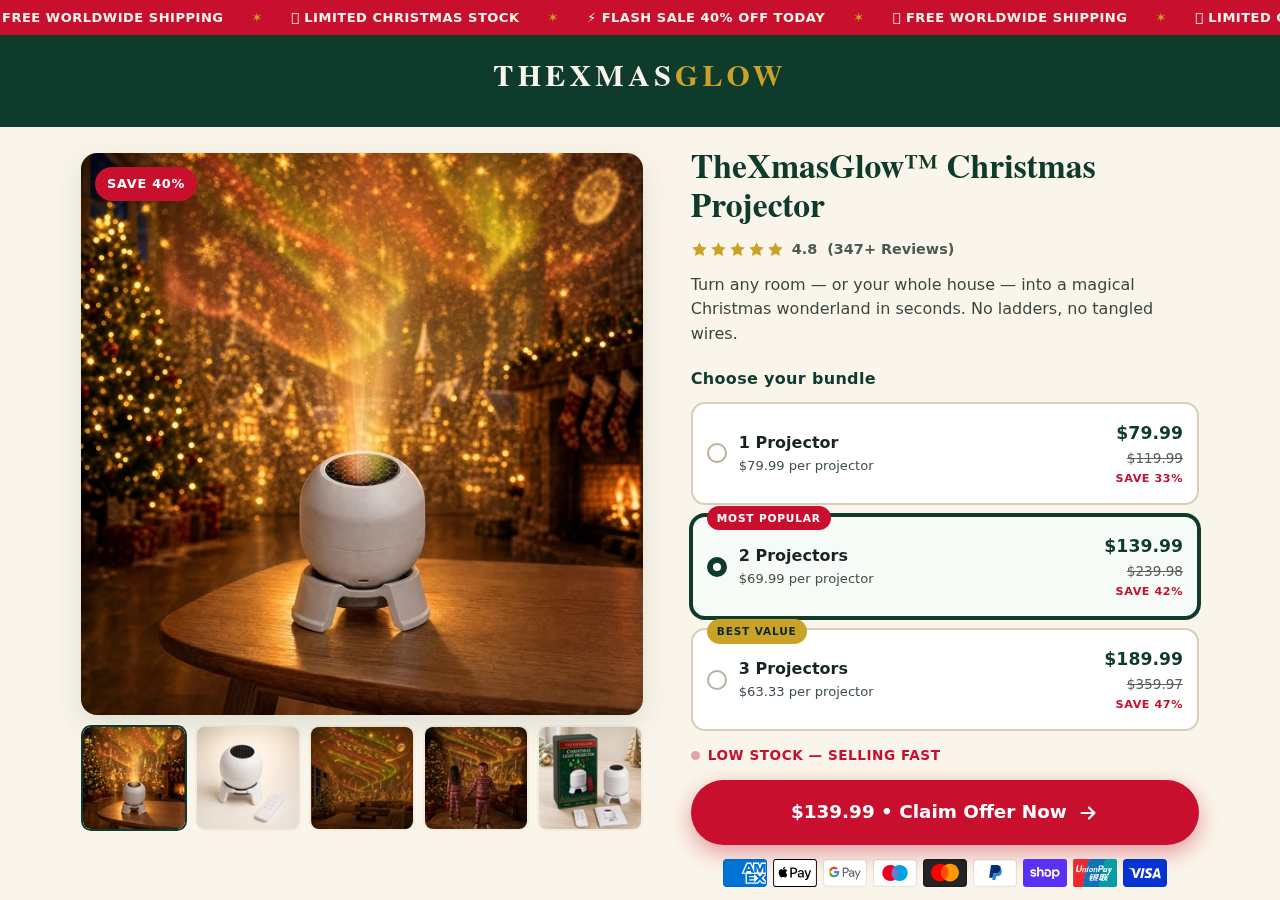
During that short interval, the page was already claiming a 4.8 rating from more than 347 reviews and support from over 10,000 customers.
Those numbers require an extraordinary sales pace for a newly registered store. The site does not explain where the reviews originated or how purchases were verified.
A new domain can represent a genuine launch. It cannot independently support a long customer history that appears without traceable evidence.
The offer uses several urgency devices at the same time
A red banner announces a 40% flash sale, limited Christmas stock, and free worldwide shipping before the visitor reaches the product description.
The order panel labels a two-projector package “most popular” and a three-projector package “best value.” The single-unit choice receives less visual emphasis.
A low-stock warning appears beside the purchase button, while crossed-out prices make larger bundles look substantially cheaper per device.
None of those visual cues proves inventory, popularity, or a genuine former price. They are claims controlled entirely by the seller.
The refund promise is less effortless than the sales copy suggests
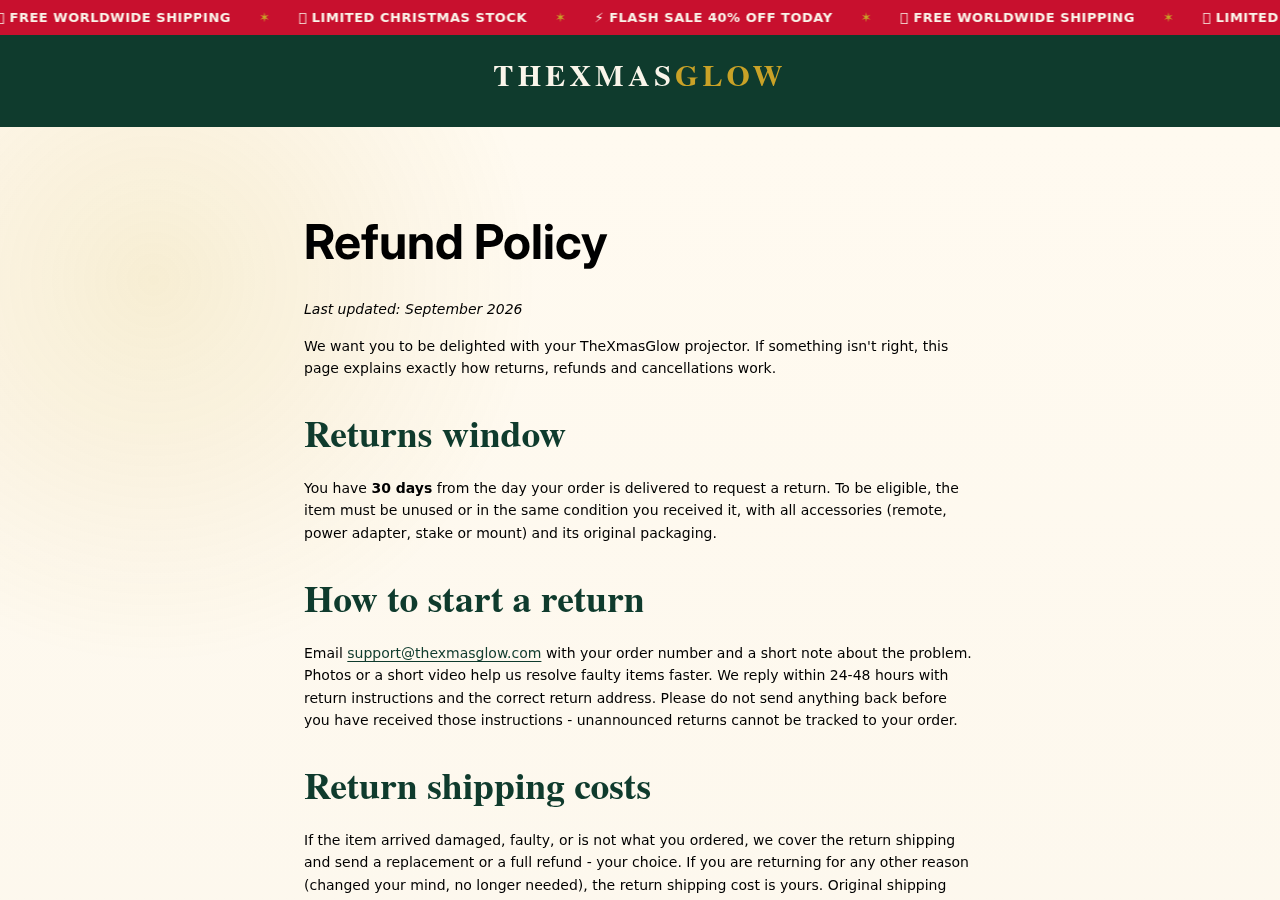
The product page says buyers can return the projector for a full refund with “no questions asked.” That sentence creates a reassuring, low-risk impression.
The detailed policy requires prior authorization, original packaging, every accessory, and an inspection after the parcel reaches an undisclosed return address.
Buyers pay return postage for ordinary dissatisfaction. The policy does not publish the destination, so that cost cannot be assessed before ordering.
The homepage also advertises a two-year warranty, while the available policy pages provide limited information about who legally stands behind it.
- The domain was created on September 18, 2026.
- The store displayed more than 347 reviews almost immediately.
- The page claimed more than 10,000 customers without showing a source.
- Bundle design steered shoppers toward two or three projectors.
- The contact page contained a form but no public business identity.
- The return address was withheld until support approved a request.
How the TheXmasGlow Projector Sales Funnel Works
Step 1: A festive social advertisement sells the transformation, not the hardware
The promotion begins with warm rooms, moving snowflakes, decorated walls, and a family-ready atmosphere. Technical limitations receive much less attention.
Seasonal shoppers imagine the finished display before asking who made the device, where it ships from, or whether comparable projectors cost less elsewhere.
A short demonstration can look brighter than normal use because camera exposure, editing, projection distance, and a darkened room affect the result.
The emotional promise is convenience. Instead of climbing ladders or arranging lights, the buyer supposedly creates a complete display with one plug.
That story is especially effective near Christmas, when delivery deadlines and household expectations make quick solutions attractive.
Step 2: The landing page converts seasonal interest into manufactured confidence
Visitors immediately see ratings, customer totals, verified-buyer labels, and enthusiastic testimonials. Together, these elements imitate an established product launch.
Yet the site provides no independent review platform, review dates, order references, or explanation showing how the displayed feedback was collected.
A testimonial printed by a seller is advertising until it can be independently connected to a genuine transaction.
The young domain makes the scale of the claimed popularity particularly important. Hundreds of reviews should leave a visible footprint beyond one sales page.
Shoppers who accept the social proof may stop comparing specifications, return locations, and ordinary retail alternatives.
Step 3: Urgency and bundle framing enlarge the order
The page combines “selling fast,” “limited stock,” and a flash-sale message. These cues push the visitor to decide before completing basic checks.
Two units are preselected as the popular choice. Three units show the largest percentage saving, making a bigger charge feel financially responsible.
This is a common direct-response technique. The seller increases revenue before the customer has tested a single device.
If performance disappoints, every additional unit becomes another object to pack, document, and ship through the same return process.
A genuine need for one projector does not become a need for three merely because a webpage labels the bundle valuable.
Step 4: Checkout separates payment from the unanswered business questions
Recognizable card and wallet logos create familiarity, but they identify payment options rather than the merchant responsible for fulfillment.
The public contact page offers a form. It does not clearly identify a legal company, physical office, manufacturer, or domestic return center.
A customer can therefore complete payment without knowing which entity will appear on the statement or where a rejected product must travel.
That uncertainty matters when a dispute begins. Banks ask for receipts, merchant descriptors, correspondence, delivery records, and attempted resolutions.
Buyers should capture those details before checkout because short-lived stores can change pages after complaints arrive.
Step 5: A generic projector may arrive after the strongest claims have done their work
The device shown resembles widely sold decorative projectors rather than a clearly documented, proprietary invention. The page does not name an identifiable manufacturer.
Specifications mention coverage, patterns, a remote, weather resistance, and LEDs. They do not provide independent testing, certification documents, or model comparisons.
Actual brightness depends on ambient light, surface color, distance, weather, optics, and power. A staged photograph cannot guarantee the same household result.
A buyer may receive a functioning item yet still feel misled if its visual impact, materials, or value differs sharply from the advertisement.
That distinction matters. Commercial disappointment can occur even when a parcel is delivered and the device technically switches on.
Step 6: The return process transfers friction back to the customer
The buyer must email support, wait for instructions, preserve packaging, include accessories, and use the return address supplied after approval.
For a change-of-mind return, postage belongs to the customer. An overseas destination could make tracked shipping expensive compared with the purchase price.
The policy says unauthorized parcels cannot be matched to an order. Sending an item to any address found independently could therefore jeopardize the claim.
Inspection occurs after delivery, creating another delay before the seller decides whether the merchandise satisfies its conditions.
The easy guarantee on the sales page becomes a sequence of requirements that shoppers rarely study during a countdown-driven purchase.
What Our Investigation Found
The claimed customer history conflicts with the registration timeline
A domain age does not reveal every offline sale, but this store provides no older company record connecting the brand to thousands of customers.
Its privacy policy was dated September 25, 2026, only days after registration. The sales page already displayed mature-looking review and customer figures.
That mismatch does not prove every order fails. It makes the popularity claims unreliable without independent records.
Prospective buyers should treat the site’s statistics as unverified marketing, not evidence of established service.
The product photographs do more work than the technical documentation
The lead image depicts dense golden patterns filling a polished room. Smaller images repeat dramatic coverage across walls and outdoor spaces.
The listing does not provide measured lumen output, lens information, independent weather testing, or a downloadable manual identifying the model.
“Thousands of patterns” can describe combinations created by rotating effects rather than thousands of distinct, selectable scenes.
A careful buyer should request an unedited daylight video, a model number, electrical certification details, and the actual warranty provider.
The guarantee lacks a visible return destination
Return economics cannot be judged without a country and postal address. A low-cost device may become uneconomical to send internationally with tracking.
The site says support will provide the correct location. That leaves a material purchasing condition hidden until after payment.
A trustworthy seller can explain where change-of-mind returns go, whether duties apply, and who pays when an item differs from its advertisement.
Written answers obtained before ordering are more useful than a broad promise displayed beside a checkout button.
The safest conclusion is a high-risk purchase, not a proven non-delivery scheme
We did not place an order, inspect a delivered projector, or find enough verified customer history to determine a universal fulfillment outcome.
The evidence supports a warning about an extremely young store, unsupported popularity claims, bundle pressure, and incomplete operator transparency.
Those facts are enough to recommend avoiding the offer until the business establishes a verifiable record.
Calling every new retailer criminal would exceed the evidence. Ignoring these concentrated warning signs would be equally irresponsible.
How To Check a Seasonal Projector Before Buying
Compare the physical design, not the invented brand name
Use image search on the device, remote, box, and accessories. Generic electronics often appear under many names with substantial price differences.
Compare housing seams, button positions, power adapters, mounting stakes, and remote layouts. These details are harder to disguise than promotional backgrounds.
If an identical model appears elsewhere, compare realistic reviews and return terms rather than assuming the highest price indicates better hardware.
Ask for measurable specifications
Request power consumption, projection technology, rated brightness, operating temperature, cable length, electrical certifications, and replacement-part availability.
Vague superlatives such as magical, premium, and energy-efficient cannot replace numbers or independent tests.
For outdoor use, confirm the complete system’s rating, including the adapter and connectors, not merely the projector housing.
Test the refund route before risking money
Email support with a simple pre-sale question about the return country, full address, and responsible legal entity.
Save the answer. Silence, evasive language, or refusal to disclose the destination is valuable information before a purchase.
Pay by credit card or PayPal Goods and Services. Avoid bank transfers, cryptocurrency, gift cards, or payment methods without a dispute channel.
Company, Address, and Fulfillment Checks
No clearly identified legal seller appears on the storefront
The brand name and copyright notice do not identify the company accepting legal responsibility for orders.
A customer should be able to match the seller in the terms, receipt, card statement, shipping label, and return instructions.
When those names differ, document every variation. Merchant aliases can complicate chargebacks and complaints.
Do not confuse Shopify’s platform role with ownership of the store. Shopify supplies software and does not become the product merchant.
The contact page is a form, not proof of a business location
The page requests the visitor’s name, email, phone, and message. It does not publish an office, registration number, or customer-service telephone line.
The refund policy lists support@thexmasglow.com, an address controlled through the same young domain.
If the website disappears, that mailbox may disappear with it. Save all correspondence outside the account.
A working form demonstrates that a message can be submitted. It does not show who receives it or where the operator is based.
The warehouse and return route remain undisclosed before purchase
Worldwide shipping can involve third-party fulfillment, overseas factories, consolidators, or domestic forwarding partners. The page does not explain which arrangement applies.
A parcel’s last-mile label may show a logistics facility rather than the seller, manufacturer, or authorized return destination.
Never mail a disputed projector to the sender address without written confirmation. Warehouses may not process consumer returns.
Ask whether the return location is domestic and whether the seller provides a prepaid label for misdescribed goods.
Cheap electronics can create safety and warranty concerns
Unknown adapters, outdoor connectors, and decorative electrical devices should not be left running unattended merely because an advertisement calls them weather-resistant.
Look for genuine certification markings, manufacturer details, batch identification, instructions, and a warranty process that survives beyond one website.
Stop using a unit that overheats, smells unusual, sparks, exposes wiring, or behaves erratically. Disconnect it before inspection.
A two-year badge has little practical value when the warrantor, service address, replacement terms, and parts supply are unclear.
What to Do if You Have Fallen Victim to This Scam
- Save the offer immediately. Capture the product page, bundle selected, claimed reviews, countdown, guarantee, policy pages, confirmation, and every email before anything changes.
- Check the exact amount and quantity. Compare the confirmation with what you intended to buy. Request correction immediately if multiple projectors were added unexpectedly.
- Send a clear written cancellation. If fulfillment has not occurred, quote the policy allowing cancellation and ask for written confirmation of a full refund.
- Do not return anything without authorization. Demand the complete address, recipient, required reference number, and confirmation about who pays tracked postage.
- Document performance or damage. Record one continuous video showing the box, label, accessories, startup, defects, and projection under reasonable conditions.
- Open a payment dispute promptly. Tell the issuer whether the problem involves non-delivery, an unauthorized quantity, defective goods, or merchandise materially unlike advertising.
- Monitor the payment card. Review transactions and merchant descriptors. Ask the issuer to replace the card if unauthorized charges appear or card data seems compromised.
- Secure the device used for checkout. Run Malwarebytes, remove suspicious extensions, and use AdGuard to reduce exposure to deceptive advertising and malicious redirects.
- Report the advertisement and seller. Send evidence to the social platform, consumer-protection authority, and payment provider so each organization can examine the same claims.
How To Reduce the Risk of Similar Holiday Store Offers
Slow down when the calendar creates pressure
Seasonal deadlines are real, but a countdown controlled by a webpage is not independent evidence of inventory.
Set a ten-minute pause. Search the domain, company, product image, return address, and recent complaints in separate tabs.
A legitimate offer should remain understandable after the music, snowflakes, discount colors, and low-stock warnings are ignored.
Buy commodity electronics from sellers with practical remedies
For generic projectors, dependable returns and electrical accountability often matter more than an invented brand story.
Prefer retailers that disclose the manufacturer, model, certification, delivery window, domestic return route, and responsible company before checkout.
Pay a modest premium when it purchases a usable warranty and a return method that does not cost nearly as much as the device.
Treat reviews on the sales page as claims requiring verification
Search exact testimonial sentences and customer images. Repeated wording across unrelated stores can reveal recycled content.
Check whether independent reviews predate the domain and whether reviewers discuss ordinary details, including weaknesses and customer service.
A perfect rating beside hundreds of untraceable reviews is weaker evidence than a smaller, mixed record on an independent platform.
Frequently Asked Questions
Is TheXmasGlow Projector definitely a scam?
The available evidence does not prove that every buyer receives nothing. It does show a very young store using unsupported popularity and urgency claims.
That combination creates substantial purchasing risk, so we would avoid ordering until verifiable ownership and a credible customer record emerge.
How old is TheXmasGlow.com?
The public registration record shows a creation date of September 18, 2026. Our review occurred nine days later.
This matters because the site simultaneously claimed hundreds of reviews and more than 10,000 customers.
Are the 347 reviews real?
The storefront labels them as reviews but does not provide an independent source or enough verification to authenticate them.
Until the seller supplies traceable evidence, shoppers should regard the number as an unverified advertising claim.
Will one projector cover an entire house?
Coverage depends on distance, brightness, ambient light, surface shape, weather, and the pattern system. Marketing photographs cannot settle those variables.
Request unedited demonstrations and measurable specifications before relying on the advertised 1,000-square-foot figure.
Can I get a refund from TheXmasGlow?
The posted policy promises a 30-day window but requires prior contact, original condition, accessories, packaging, and inspection.
For ordinary returns, the customer pays postage to an address disclosed after approval. Preserve evidence and involve the payment provider if necessary.
What is the safest way to pay?
Use a credit card or another method offering a documented merchandise dispute. Keep screenshots showing what the seller promised when payment occurred.
Do not use irreversible transfers. A secure checkout connection protects data in transit but does not validate the merchant’s claims.
The Bottom Line
TheXmasGlow wraps a generic seasonal projector in polished imagery, extraordinary early popularity, urgent stock messaging, and bundle pressure.
The nine-day-old domain, hidden operator, undisclosed return destination, and unverified review totals make this an avoidable risk. Buy from a transparent seller instead.

Join the discussion
0 commentsShare your experience or ask a question about this article.
Discussion
Start the conversation
Have a question or something useful to share? Add the first comment.