

A rugged tracked mower usually belongs in a contractor catalog, not beside an impulse purchase priced like a household appliance.
Mowtor Shop presented that unlikely combination with polished machinery footage, steep discounts, and reassuring popularity claims. We examined what buyers could actually verify.
Overview
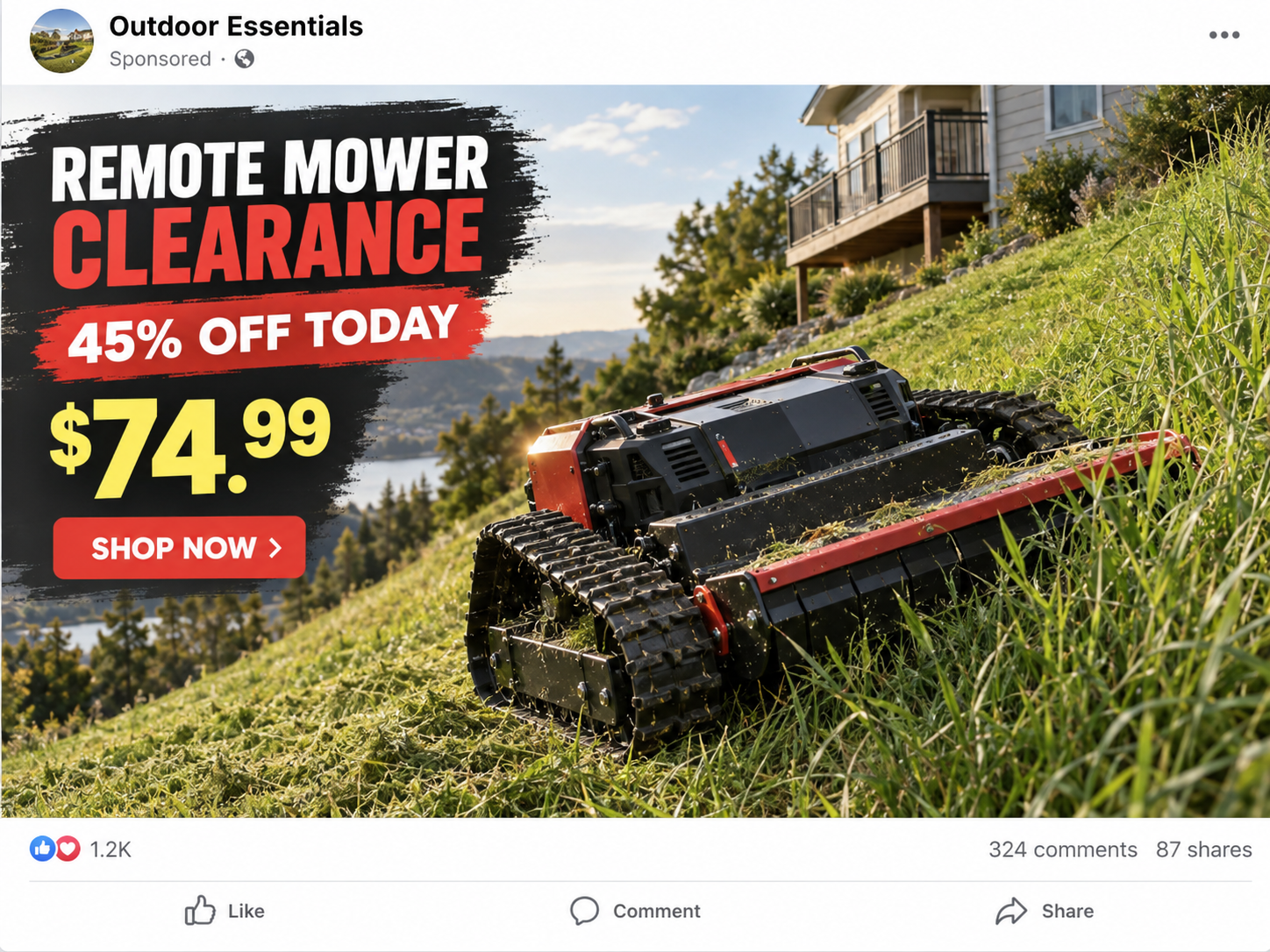
The advertisement borrows the appearance of expensive industrial machinery
The promoted mower resembles professional remote-controlled equipment designed to cut steep banks, rough vegetation, orchards, solar farms, and other difficult terrain.
Machines in this category require an engine, tracked drivetrain, cutting system, radio controls, safety shutdowns, substantial steelwork, freight handling, and specialist after-sales support.
Mowtor Shop reportedly offered models such as the G80 Harvest for approximately $74.99 while displaying a discount near 45%.
That figure is not merely a competitive reduction. It is disconnected from the materials, engineering, logistics, and servicing expected from comparable industrial equipment.
A convincing video can show a real machine operating elsewhere without proving that the advertiser owns it, ships it, or sells the pictured specification.
The storefront was extremely new when the promotion appeared
Public registration data shows the Mowtor shop domain was created on September 3, 2026, only weeks before this investigation.
New businesses are not automatically dishonest, but a young domain has little independent history for delivery, warranty claims, replacement parts, refunds, or support.
The pages reportedly claimed more than 2,500 reviews, over 100 orders during 24 hours, and more than 1,000 purchases during the previous month.
Those numbers would represent extraordinary early demand, especially for heavy machinery, yet the storefront did not provide independently verifiable order or review records.
Popularity counters controlled by a merchant should be treated as marketing until a reputable outside platform connects them with confirmed purchasers.
The store became unavailable before its promises could build credibility
During our check, the storefront returned a Shopify access response rather than a working catalog, preventing ordinary visitors from reviewing current policies or contacting checkout support.
Temporary downtime can happen for innocent reasons, including maintenance, platform review, billing problems, inventory changes, or an owner pausing sales.
However, disappearance is especially concerning when a new store accepted orders for costly-looking equipment while offering little established business history.
Customers may lose access to product descriptions, shipping estimates, cancellation instructions, return conditions, and the evidence needed for a payment dispute.
For that reason, every high-risk advertisement and checkout page should be saved before payment, not after the website stops loading.
- The Mowtor shop domain was registered on September 3, 2026.
- Remote tracked mowers were advertised for roughly $74.99 with a claimed 45% discount.
- The price was implausibly low for the machinery shown in promotional material.
- Store-controlled counters claimed thousands of reviews and unusually rapid sales.
- The storefront later became unavailable through its normal Shopify page.
- An automated reputation service assigned a low-confidence assessment, which supports caution but does not independently prove fraud.
How the Mowtor Remote-Mower Offer Works
Step 1: Professional machinery footage stops a social-media scroll
The promotion begins with dramatic video of a tracked mower climbing slopes, turning remotely, and cutting vegetation without an operator walking behind it.
That demonstration solves an obvious problem for landowners who struggle with steep ground, brush, heat, physical limitations, or expensive landscaping services.
The machine shown may be genuine industrial equipment, promotional footage from another supplier, or edited material assembled from several sources.
Viewers naturally assume that clicking the advertisement leads to the seller of that exact machine, including its engine, controller, attachments, and safety features.
Before believing that connection, search individual video frames and model photographs to identify the original manufacturer and normal market price.
Step 2: An impossible discount is framed as a short-lived opportunity
The landing page reportedly reduced an industrial-looking remote mower to about $74.99 and emphasized a 45% discount.
Urgency changes the shopper’s question from “Can this price be real?” to “Will I lose the bargain if I investigate?”
Stock messages, recent-order notices, timers, and sale labels can intensify that pressure even when the merchant controls every displayed number.
A tracked mower cannot be manufactured, exported, freighted, delivered, supported, and profitably sold for the price of a small cordless garden tool.
When a price contradicts basic production and freight costs, treat it as the central warning rather than an exceptional clearance event.
Step 3: Store-generated social proof makes the young seller appear established
Reported counters described more than 2,500 reviews, heavy monthly demand, and over 100 orders during a single day.
Large numbers can reassure visitors who have never heard of the company because they suggest other customers already tested the transaction successfully.
Yet an on-page counter is code chosen by the operator, not an audit of fulfilled orders, functioning equipment, refunds, or verified ownership.
Authentic industrial-equipment reviews usually discuss engine type, cutting width, incline limits, radio range, service intervals, spare parts, freight, and dealer assistance.
Generic praise that avoids those ownership details provides little evidence that reviewers received the advertised machine.
Step 4: The checkout captures payment before practical questions are answered
A buyer reaching checkout may see a familiar commerce platform and standard card fields, which can make the transaction feel professionally supervised.
Shopify provides software to many legitimate merchants, but platform branding does not verify a seller’s claims, inventory, engineering, or refund performance.
The crucial questions concern parcel weight, freight carrier, customs charges, delivery appointment, assembly, warranty, parts, operator training, and the legal manufacturer.
If a seller cannot answer those questions for powered machinery, the checkout should not receive payment or identity information.
Use a credit card when possible, never bank transfer, cryptocurrency, gift cards, or payment methods that sharply weaken recovery rights.
Step 5: The buyer may receive nothing or something unrelated to the advertisement
Ultra-low-price storefront schemes can end with no shipment, false tracking, a tiny substitute, an accessory, or merchandise fundamentally different from the promoted machine.
A small parcel may contain gloves, a blade component, a toy, printed instructions, or another inexpensive item used to produce a delivery scan.
We have not established which outcome occurred for every Mowtor customer, and a tracking event alone cannot answer that question.
Record the sealed parcel from every angle and film one continuous opening that shows its dimensions, weight label, contents, paperwork, and condition.
Do not discard packaging because the sender, return location, customs description, and weight can become important dispute evidence.
Step 6: Website disappearance complicates cancellation, returns, and disputes
When the storefront stops loading, customers can no longer rely on the account page, contact form, public policies, or product listing.
Emails may go unanswered, and a return address on the parcel may belong only to a logistics consolidator without refund authority.
Waiting for the seller to reappear can consume a card issuer’s dispute deadline while tracking or delivery evidence becomes harder to preserve.
Contact the payment provider quickly, describe the exact issue, and supply archived advertising, order confirmation, correspondence, tracking, and unboxing evidence.
A merchant’s absence does not guarantee a refund, but prompt, organized documentation gives the buyer a stronger factual record.
Why the Remote-Mower Price Does Not Make Commercial Sense
The pictured machine belongs to an expensive equipment class
Remote slope mowers combine substantial mechanical, hydraulic, electrical, cutting, radio, and safety systems inside a chassis built for difficult terrain.
Even basic manufacturing requires steel, tracks, bearings, motors or engines, blades, controls, batteries, wiring, protective covers, testing, crating, and documentation.
Commercial versions commonly cost $1,000s or even $10,000s, depending on size, power, attachments, brand, certification, and dealer support.
Used units still carry meaningful value because the engine, drivetrain, controller, and steel structure cannot be replaced for $10 or $20.
A $74.99 offer therefore demands extraordinary proof, including a model-specific invoice, factory identity, technical sheet, freight quote, warranty, and verifiable dealer references.
Freight alone exposes the contradiction
Industrial tracked equipment cannot normally travel as an ordinary lightweight parcel placed beside a front door by a standard delivery driver.
It may require a crate, pallet, liftgate, commercial address, customs paperwork, dangerous-goods declarations, import duties, brokerage, and a scheduled delivery appointment.
The delivery cost can exceed the entire advertised Mowtor price before manufacturing, marketing, support, taxes, and profit are considered.
A credible seller should publish packed dimensions, shipping weight, dispatch country, freight method, customs responsibility, unloading requirements, and delivery exclusions.
Without those facts, “free shipping” or a modest delivery charge does not match the physical product represented by the advertisement.
Safety and servicing cannot be separated from the purchase
A remote mower uses fast rotating blades around people, animals, vehicles, windows, fences, and uneven ground while the operator stands away from it.
Reliable products need emergency stops, communication-loss behavior, guarding, slope limits, maintenance instructions, parts diagrams, warnings, and a responsible manufacturer or importer.
Customers also need replacement tracks, blades, belts, filters, batteries, controllers, and qualified repair support throughout the machine’s working life.
An anonymous discount seller cannot substitute a refund slogan for that service network or for model-specific safety documentation.
Never operate machinery that arrives without traceable identification, complete instructions, appropriate certification, and a safe method for obtaining parts and technical assistance.
What Our Mowtor Shop Investigation Found
The domain had almost no time to earn the claimed reputation
The September 3, 2026 registration date places the domain’s creation shortly before the advertisements and large popularity claims appeared.
A new store can generate rapid interest, but thousands of credible machinery reviews require sales, manufacturing, international delivery, testing, and owner experience.
That sequence is difficult to reconcile with a domain measured in weeks unless the business provides a documented earlier identity and established dealer network.
We did not find evidence sufficient to connect the displayed review volume with independently confirmed remote-mower purchasers.
Buyers should search company registries, archived pages, dealer directories, complaint databases, and model-specific forums rather than accepting an internal counter.
Automated reputation tools raised caution, not a final verdict
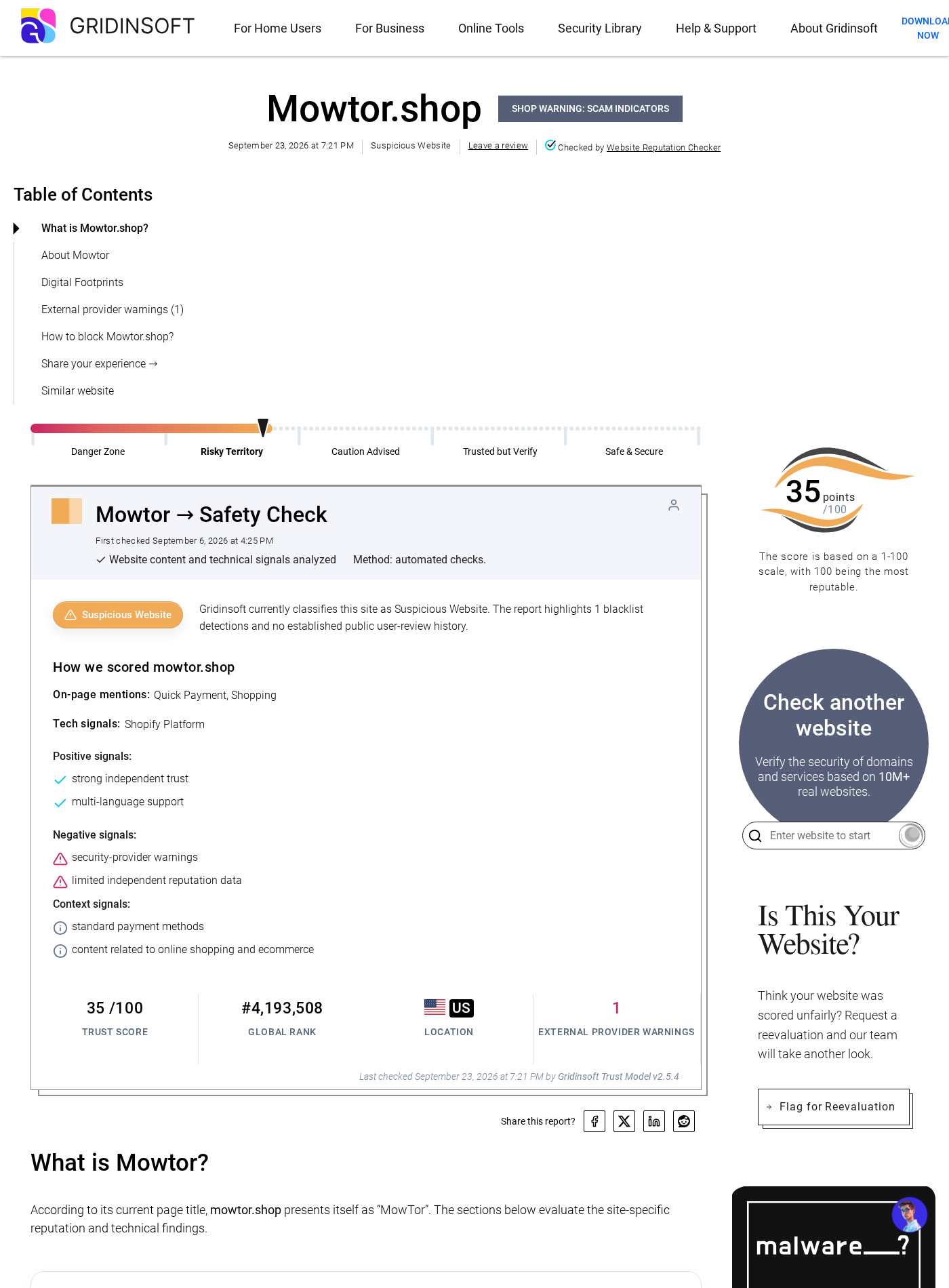
Gridinsoft displayed a 35 out of 100 assessment and described limited reputation information surrounding the Mowtor shop domain.
Automated services evaluate technical, age, hosting, blocklist, and behavioral signals, but they can misclassify both legitimate and deceptive websites.
A numerical score should never be presented as proof that a merchant committed fraud or that a purchase certainly will fail.
Here, it matters because it aligns with independently observable concerns: a recent domain, implausible pricing, oversized social proof, and an unavailable storefront.
The combined evidence supports avoiding payment until the seller can establish identity, inventory, pricing, freight, warranty, and dependable dispute handling.
The unavailable store removes information buyers need most
Our attempt to revisit the shop reached an access response instead of a functioning product and policy experience.
We therefore could not confirm whether the original seller intentionally closed, paused operations, encountered enforcement, or experienced an ordinary platform issue.
The cause remains uncertain, and it would be irresponsible to invent one from the error page alone.
The practical consequence is clearer: buyers cannot presently verify live contact details, return instructions, order status, or current terms through the storefront.
Anyone with a pending order should preserve existing communications and contact the payment provider without waiting indefinitely for a website restoration.
The name must not be confused with unrelated businesses
Short brand names can resemble legitimate companies, products, or domains that have no connection with the investigated shop.
This review concerns the recently registered Mowtor storefront advertising implausibly cheap remote tracked mowers, not every business using similar letters or mower terminology.
In particular, shoppers should compare the exact domain, legal entity, email suffix, payment descriptor, and order confirmation before attributing responsibility.
Scammers sometimes benefit when consumers contact an innocent established company whose name looks close to the one used in an advertisement.
Report the exact URL and merchant descriptor so banks, platforms, and consumer agencies investigate the correct operator.
How to Check a Remote-Mower Advertisement Before Paying
Identify the original machine in the video
Capture clear frames showing logos, control panels, track patterns, engine covers, model labels, attachments, and distinctive bodywork.
Use reverse image search and manufacturer catalogs to locate the earliest source, normal specifications, authorized dealers, and expected price range.
Contact the apparent manufacturer through independently located details and ask whether the advertised domain is an authorized seller.
A copied demonstration can remain technically accurate while the sales page beneath it is unrelated to the machine being demonstrated.
Demand a real freight quotation and serial-number process
Ask for packed weight, crate size, departure warehouse, carrier class, insurance, customs treatment, destination fees, liftgate needs, and estimated arrival date.
Request a pro forma invoice identifying the legal seller, exact model, serial-number assignment, included controller, engine, cutting deck, accessories, and warranty provider.
Verify the company and telephone number independently instead of calling only the contact shown inside the advertisement.
A seller offering industrial machinery should answer these ordinary procurement questions precisely and consistently.
Compare the total price with physical reality
Find several established dealers selling the same or comparable equipment and separate machinery cost from taxes, freight, assembly, training, and attachments.
Do not explain a thousand-fold gap with clearance, factory-direct sales, liquidation, seasonal discounts, or a supposed advertising mistake.
Real clearance machinery still has recoverable material value, transport cost, and a seller capable of documenting ownership and condition.
If the advertised total cannot cover freight, the offer requires proof before payment, not optimism afterward.
Company, Address, and Fulfillment Checks
No clearly verified operator supported the extraordinary offer
A credible equipment seller should disclose a registered legal entity, registration number, tax identity, physical premises, responsible officers, and established service contacts.
Those details should match official corporate records, payment receipts, invoices, warranty documents, freight paperwork, and the merchant name on card statements.
The Mowtor presentation did not provide enough independently confirmed business history to offset the pricing and domain-age concerns.
A professional-looking theme or secure connection proves only that a website can display encrypted pages, not that the listed machinery exists in inventory.
Until the operator is independently established, customers should not send payment, identity documents, or sensitive financial information.
A warehouse address must be capable of shipping heavy equipment
An office suite, residence, virtual mailbox, or unrelated returns center cannot demonstrate possession of tracked industrial machinery.
Search any published location using maps, corporate filings, property records, freight directories, and archived imagery before treating it as a working depot.
Ask for a dated video showing the exact model, serial plate, warehouse surroundings, and a representative referencing the proposed invoice.
Even that evidence should be compared with independent records because recorded material can be copied or edited.
Do not ship a return to an address found through search unless the merchant and payment provider authorize it for the specific dispute.
Telephone and email support should answer technical questions
A real dealer should discuss engine manufacturer, power, cutting width, maximum slope, radio range, failsafe behavior, maintenance, parts, manuals, and certification.
Generic agents who repeat discounts while avoiding specifications are not providing the pre-sale support required for dangerous powered equipment.
Test every channel before purchasing and preserve the response, full headers, telephone number, representative name, date, and promised resolution process.
Never permit remote access to a computer or disclose verification codes when someone claims to confirm, cancel, refund, or track a mower order.
Those requests indicate an additional account-takeover or refund scam, not normal equipment support.
Fulfillment claims must match the product’s size and value
Heavy tracked machinery requires identifiable freight partners, export documentation, customs declarations, cargo insurance, unloading plans, and a consignee able to receive it.
An ordinary parcel-tracking number cannot prove that a remote mower matching the advertisement was shipped.
Compare the recorded parcel weight and service class with the documented weight of the promised model before accepting tracking as fulfillment evidence.
If a tiny package arrives, keep it unopened until recording is ready and ask the carrier for available shipment measurements.
The gap between promised machinery and actual parcel evidence can become the clearest part of a payment dispute.
What to Do if You Have Fallen Victim to This Scam
- Preserve the complete advertisement. Save the video, captions, URL, price, discount, review count, order claims, product photographs, specifications, shipping promise, policies, checkout, and confirmation.
- Contact the payment provider immediately. Explain whether the issue is non-delivery, materially different merchandise, unauthorized billing, false tracking, or an inaccessible merchant, then ask about deadlines.
- Do not wait for the website to return. Continue emailing the seller, but protect card, PayPal, bank, or marketplace dispute windows while support remains unavailable or unresponsive.
- Document every tracking inconsistency. Record carrier, tracking history, destination postcode, service class, parcel weight, delivery photograph, signature, and any mismatch with industrial freight.
- Film the unopened parcel. Show all labels and dimensions, then record one continuous unboxing that captures contents, paperwork, serial numbers, damage, and differences from the promised mower.
- Reject refund-payment tricks. Never send an additional fee, gift card, cryptocurrency, banking password, one-time code, or remote-access session to release a supposed refund.
- Secure exposed payment details. Ask the issuer whether the card should be replaced, monitor statements, enable transaction alerts, and challenge unfamiliar merchant descriptors promptly.
- Report the exact storefront. Notify the advertising platform, commerce provider, payment company, consumer agency, and relevant cybercrime portal using the precise domain and evidence.
- Check the ordering device. Run Malwarebytes if downloads or redirects occurred, and use AdGuard to reduce exposure to deceptive equipment advertisements and malicious landing pages.
Common Outcomes in Impossible-Price Equipment Offers
Nothing arrives and support gradually disappears
The seller may issue vague delay explanations, blame customs, cycle through tracking numbers, or stop answering after a dispute window narrows.
Treat repeated promises without carrier-verifiable movement as unresolved non-delivery rather than proof that heavy machinery is traveling.
Ask the carrier directly whether the number belongs to your address and whether its recorded weight could match the purchased equipment.
Keep the bank informed as new evidence appears and never close a dispute merely because the merchant promises a future shipment.
A small item creates a misleading delivery record
Some deceptive sellers send a cheap object to generate tracking that appears delivered, even though the parcel cannot contain the promoted product.
The card dispute should describe merchandise not as described, rather than simply claiming that no package arrived.
Photographs, uninterrupted unboxing video, carrier weight, customs label, and the original machinery specifications help demonstrate the mismatch.
Do not return the substitute until the issuer confirms what evidence and shipping method preserve your claim.
The advertisement returns under another store name
Videos, product descriptions, countdowns, and checkout templates can reappear on a new domain after the first storefront becomes unavailable.
A different logo does not resolve copied machinery footage, impossible economics, missing operators, or vague freight details.
Search distinctive sentences and image frames before treating a renamed seller as a separate established business.
Report connected advertisements together so platforms can compare creative assets, destination pages, accounts, and payment relationships.
Frequently Asked Questions
Is Mowtor Shop definitely a scam?
The evidence shows a very high-risk offer, but we did not test every order and cannot establish every customer outcome.
The implausible price, new domain, oversized popularity claims, limited accountability, and unavailable storefront justify avoiding the offer.
Can a remote tracked mower really cost $74.99?
A functional industrial remote mower cannot reasonably be manufactured, freighted, supported, and profitably sold at that price.
Comparable machines require costly engines, tracks, cutting systems, controls, safety components, steelwork, and specialist delivery.
Were the mower videos necessarily fake?
Not necessarily. The footage may show real machinery performing genuine work.
The unresolved issue is whether the Mowtor seller owned, stocked, and would deliver that exact machine under the advertised terms.
Does Shopify guarantee that a store is trustworthy?
No. Shopify supplies commerce technology to many independent merchants but does not guarantee every product claim, shipment, warranty, or refund.
Buyers must still verify the individual seller and transaction.
What if a tiny package arrived instead of the mower?
Preserve it, record the sealed parcel and continuous opening, obtain carrier weight information, and contact the payment provider promptly.
Describe the dispute accurately as merchandise materially different from the advertised industrial machine.
Should buyers trust an automated website score?
Automated scores can support an investigation but are not proof by themselves and occasionally produce mistakes.
Use domain age, company verification, price realism, freight details, independent reviews, and live support together.
The Bottom Line
Mowtor Shop paired impressive remote-mower imagery with a price that could not credibly cover the machine, freight, warranty, or dealer support represented by the offer.
The recent domain, unverified popularity, unavailable storefront, and weak accountability make this a purchase to avoid. Industrial equipment deserves an identifiable dealer and realistic contract.

Join the discussion
0 commentsShare your experience or ask a question about this article.
Discussion
Start the conversation
Have a question or something useful to share? Add the first comment.