

Cotabllas looks like a fashion house with a Mediterranean campaign, carefully styled collections, and enough merchandise to satisfy almost any seasonal impulse.
The first impression is smooth and expensive. The underlying store tells a different, more complicated story that deserves examination before checkout.
Overview
The visual identity suggests a mature lifestyle brand
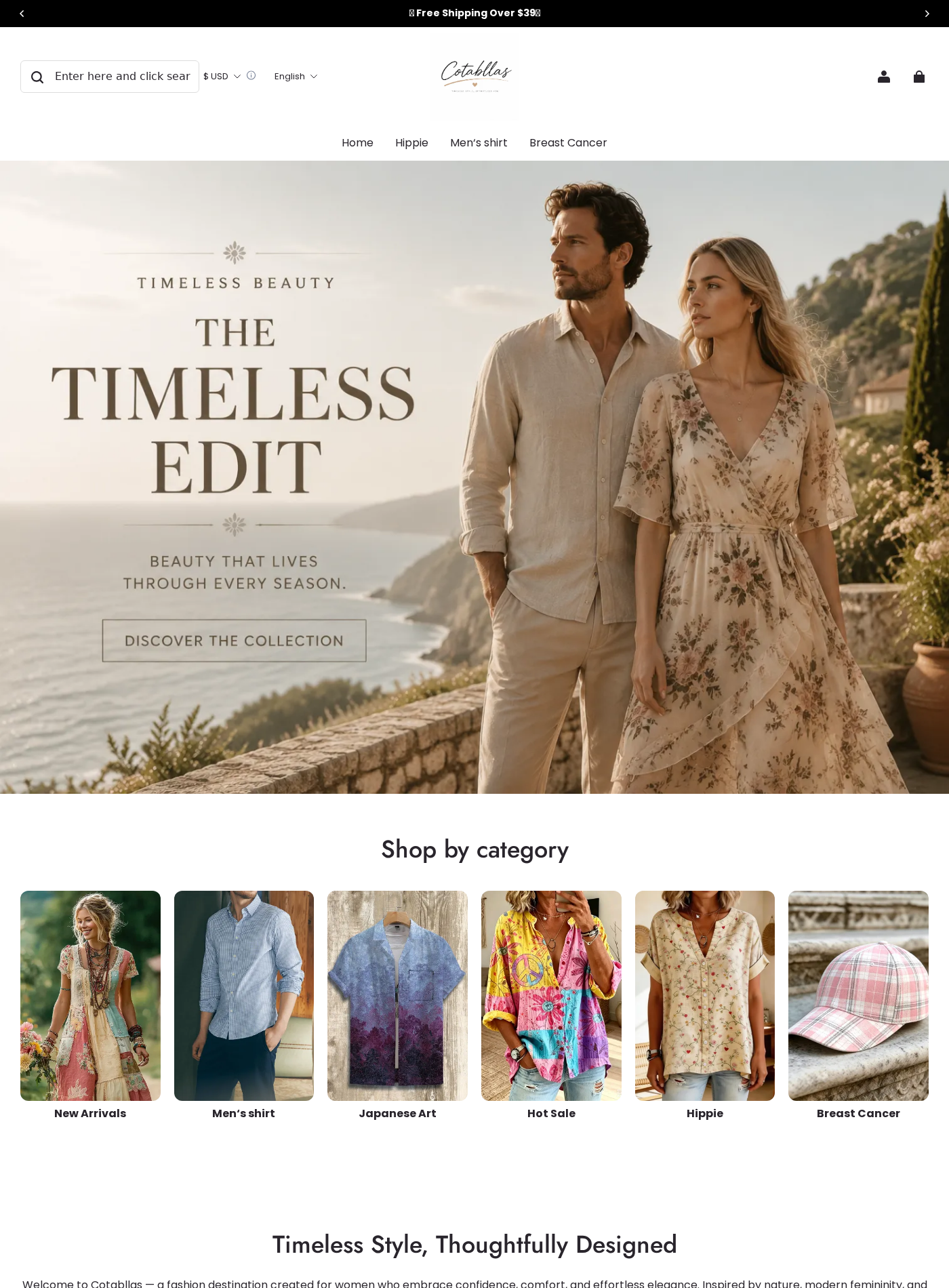
The homepage opens with an elegant couple above a coastal village, muted luxury colors, and a large “Timeless Edit” fashion campaign.
Navigation offers women’s fashion, men’s shirts, hippie styles, and a category labeled “Breast Cancer,” creating the appearance of a broad specialty retailer.
The presentation is designed to feel curated, but the catalog mixes unrelated products, photographic styles, seasons, and design languages.
Some hero and listing images have the polished, overly uniform appearance often associated with generative imagery or heavily composited advertising.
Visual appearance cannot prove how an image was made. Buyers should instead ask whether real inventory and customer photographs support the campaign.
A two-month-old domain claims an enormous product range
Official records show Cotabllas.com was registered on July 13, 2026, only weeks before the store attracted review searches.
The live catalog displayed 7,601 products during our capture, a remarkable inventory for a domain with almost no established public history.
Modern ecommerce software can import thousands of supplier listings quickly, so the number does not demonstrate stocked warehouses or proven fulfillment.
A shopper may mistake catalog size for business scale, even though product pages can be created automatically from third-party feeds.
The missing ingredient is an independent record connecting this exact seller with consistent delivery, quality, returns, and customer support.
The prices resemble a clearance event that never needs a history
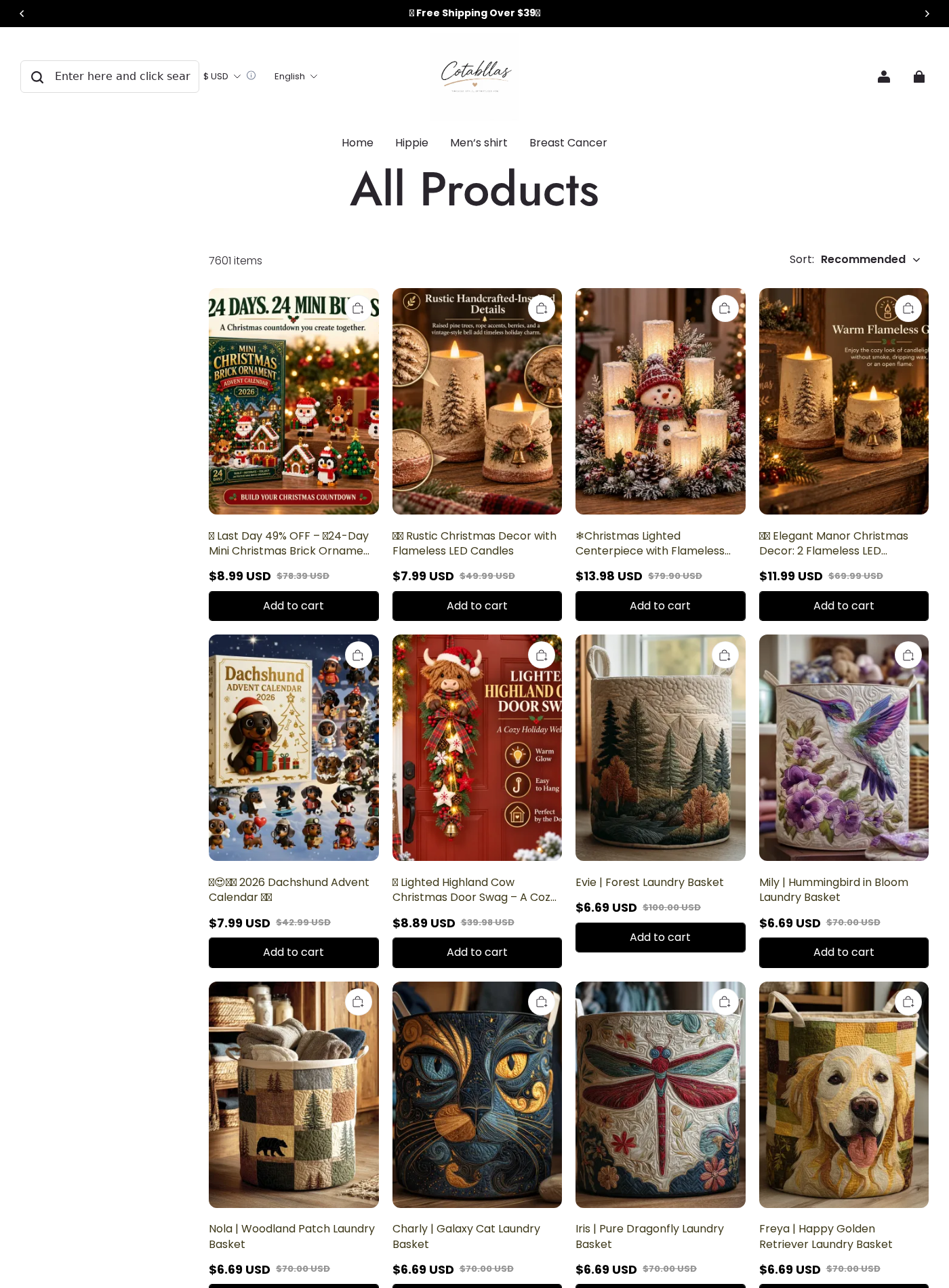
Visible products included decorations and laundry baskets reduced from $70–$100 to roughly $6.69–$13.98, with free shipping advertised above $39.
Such markdowns can encourage buyers to add numerous items simply to reach the free-delivery threshold and capture supposedly exceptional savings.
The crossed-out values come from the seller. They do not prove that meaningful sales occurred at those higher prices.
If goods are sourced from low-cost marketplaces, the discounted figure may be closer to ordinary wholesale value than the reference price implies.
Customers must compare identical photographs and specifications elsewhere before treating the difference as a genuine discount.
- Cotabllas.com was registered on July 13, 2026.
- The catalog displayed 7,601 products during our investigation.
- Several visible items carried markdowns exceeding 80% or 90%.
- The store combines clothing, decorations, household goods, novelty products, and cause-related categories.
- The public storefront does not prominently establish a verifiable legal operator or durable customer-service history.
- Synthetic-looking campaign imagery and inconsistent listing photographs make independent product verification important.
How the Cotabllas Discount-Store Funnel Works
Step 1: A striking social image makes an unknown shop feel established
A fashion photograph, seasonal decoration, or unusually cheap household item can stop someone scrolling long enough to visit the store.
The advertisement may use elegant models, cozy interiors, nostalgic language, or a cause-related theme to create an immediate emotional connection.
Because the creative looks professional, viewers can assume there is a design team, photography budget, warehouse, and customer history behind it.
Generative tools now produce convincing models and rooms cheaply, while supplier images can be copied into new storefronts within minutes.
Shoppers should save the advertisement and reverse-search its main image before accepting it as evidence of an established brand.
Step 2: The homepage extends the luxury atmosphere
Cotabllas continues with a restrained logo, generous white space, seasonal language, and a hero scene that resembles a premium resort campaign.
That design contrasts sharply with the extremely low prices found deeper in the catalog, where many unrelated goods appear beside one another.
A coherent homepage can be assembled from templates while the actual merchandise comes from multiple suppliers with varying quality and delivery times.
The important checks are legal identity, address, phone support, dispatch origin, return destination, and genuine customer photographs.
A beautiful landing page answers none of those questions unless the details are published and independently verifiable.
Step 3: Thousands of listings turn browsing into bargain hunting
The All Products page displayed 7,601 items, far more than a customer can evaluate carefully during one shopping session.
Category boundaries are loose, and photography changes dramatically between apparel, candles, ornaments, baskets, and animal-themed household goods.
This breadth is consistent with an aggregated supplier catalog, although it does not establish which sourcing system Cotabllas uses.
Infinite choice encourages shoppers to compare discounts within the site instead of comparing the same product across independent retailers.
Once several low-priced items enter the basket, the free-shipping target provides another reason to keep adding merchandise.
Step 4: Extreme reference prices manufacture a sense of urgency
A basket shown at $6.69 beside a crossed-out $100 suggests a 93% bargain, even when no documented price history is available.
The shopper begins calculating money supposedly saved rather than the likely manufacturing cost, material quality, size, or delivery origin.
Many temporary stores repeat countdowns, stock warnings, flash-sale labels, and permanent markdowns because urgency improves conversion rates.
Check archived pages when possible and revisit the listing later to see whether the urgent promotion actually ended.
A discount is meaningful only when the product, seller, original price, and fulfillment terms are all credible.
Step 5: Checkout creates commitment before accountability is clear
The cart can feel ordinary because modern ecommerce platforms provide familiar controls, currency selection, accounts, and polished payment pages.
Technical functionality confirms that the website can accept an order. It does not identify who will select, inspect, pack, or refund the goods.
Customers may complete payment without a company number, named proprietor, working phone line, or return address visible beside the purchase terms.
A card statement may later show a descriptor unrelated to Cotabllas, making the transaction harder to recognize or explain.
Before paying, record the seller identity, quantity, currency, shipping charge, promised delivery, cancellation rule, and final merchant name.
Step 6: The customer carries the practical risk after a problem appears
If products never arrive, arrive separately, or differ materially from their photographs, resolution depends on responsive support and usable written policies.
A low-value item can be costly to return internationally once tracked postage, customs forms, and delivery confirmation are required.
Support may offer a partial refund, replacement, coupon, or store credit instead of a full reimbursement to the original payment method.
Delays can consume a card issuer’s dispute window while the customer waits for another parcel or repeated promises.
That is why evidence collection and firm written deadlines should begin immediately, not after weeks of informal messages.
What Our Cotabllas Investigation Found
The domain age does not match the scale implied by the catalog
A website can launch with thousands of imported listings, yet shoppers may interpret that volume as proof of an established retail operation.
Cotabllas had existed for roughly two months while displaying more products than many mature specialty shops maintain online.
We found little independent customer history that could validate delivery quality across such a wide and rapidly assembled selection.
No single domain-age threshold proves legitimacy, but a young site needs stronger transparency to offset its missing service record.
Here, the operator should explain sourcing, inventory ownership, dispatch locations, and quality control in specific terms.
The product mix resembles a feed rather than one merchant’s specialty
The catalog moves from clothing to Christmas decorations, laundry containers, animal designs, accessories, and other unrelated goods without a clear merchandising logic.
Images contain different fonts, promotional panels, crops, lighting, rooms, models, and rendering styles, suggesting many upstream sources.
Supplier feeds are common and lawful. The risk arises when a storefront implies curated quality without testing every imported description and photograph.
A merchant that never physically handles merchandise may struggle to verify dimensions, materials, color, accessories, durability, or packaging before dispatch.
Ask for real measurements and manufacturer details rather than relying on lifestyle scenes or generic benefit statements.
Several visuals warrant AI-image caution
The homepage campaign has unusually smooth skin, carefully balanced figures, perfect atmosphere, and a cinematic landscape typical of modern synthetic advertising.
Some product panels also combine decorative objects and typography in ways that resemble generated marketplace creatives rather than ordinary customer photography.
These observations are not forensic proof, and compressed web images can make authentic photographs appear artificial.
The practical response is to seek independent buyer photos, video demonstrations, consistent angles, packaging images, and manufacturer identifiers.
When a seller cannot provide them, customers should assume the listing may not represent the exact item delivered.
The available evidence supports a high-risk assessment
We did not complete a purchase from Cotabllas and cannot state that every order disappears or every product is misrepresented.
The store may ship some or all items through third-party suppliers, and low prices can reflect inexpensive mass production rather than outright theft.
However, the new domain, giant catalog, extreme markdowns, weak operator transparency, and limited independent history concentrate risk on the buyer.
The safest decision is to avoid payment until the company behind the site and its return process become independently verifiable.
Comparable products are widely available from retailers with established reviews, domestic returns, and clearer accountability.
How to Check Whether Cotabllas Products Are Real
Reverse-search images before reading testimonials
Crop the product away from price labels and search several angles separately through reputable image-search services.
Look for identical wrinkles, props, model poses, rooms, or typography on wholesale platforms and unrelated stores.
Compare marketplace prices, dimensions, materials, shipping origins, and ordinary buyer photographs against the Cotabllas listing.
A repeated image does not prove fraud, but it can reveal that merchandise is neither exclusive nor photographed by the seller.
Test the business identity with precise questions
Ask for the legal company, registration jurisdiction, company number, operating address, telephone support, dispatch country, and physical return destination.
Request written answers that name the specific order and product rather than accepting generic customer-service templates.
Search each disclosed detail independently and compare it with the merchant shown by the payment provider.
Do not send identity documents or authentication codes merely because an unknown retailer claims verification is required.
Evaluate the transaction without the crossed-out price
Ignore the seller’s reference amount and ask whether the item itself is worth the actual checkout total, shipping delay, and remedy risk.
Add possible return postage, customs charges, poor sizing, replacement time, and the cost of an unusable product.
Start with one inexpensive item only if the merchant’s identity and policies withstand verification.
A cart full of 90% discounts can create a larger loss than one fairly priced purchase from a known seller.
Company, Address, and Fulfillment Checks
No clearly verified legal operator anchors the storefront
The Cotabllas brand and domain identify the shopping interface, but they do not by themselves reveal the company accepting legal responsibility.
We did not find a prominent, independently verified company name or registration number supporting the scale of the displayed catalog.
Without that information, buyers cannot readily check directors, filing status, trading history, insolvency, consumer complaints, or applicable jurisdiction.
The legal entity should match the invoice, checkout merchant, privacy controller, terms, parcel sender, and refund correspondence.
Any unexplained mismatch should be documented before a dispute window closes.
The absence of a dependable business address blocks ordinary checks
A usable address lets shoppers examine maps, occupancy, company records, local directories, and whether the location can receive consumer returns.
Cotabllas does not build trust merely by showing luxury scenery while leaving the responsible premises difficult to confirm.
A warehouse, registered office, mailbox, and returns processor serve different functions and should not be presented interchangeably.
Never use the sender label as a return destination unless support confirms it for the exact order.
Logistics centers often handle parcels without owning the store or possessing authority to issue refunds.
Limited contact routes make time-sensitive disputes fragile
A retailer handling thousands of listings should publish support channels proportionate to the potential volume of sizing, delivery, and return questions.
Email or web forms can be useful, but they depend on the same young domain and may leave no independent route if the site disappears.
Test support before ordering with a detailed question about one item’s materials, origin, measurements, and return country.
Save complete messages outside the customer account because access can vanish after a domain, password, or platform change.
Automatic acknowledgments do not demonstrate that trained staff can resolve a damaged or materially different order.
Fulfillment is likely more complex than the homepage suggests
The massive assortment and inconsistent photography suggest goods may originate from numerous suppliers rather than one Cotabllas-controlled warehouse.
That can produce split shipments, variable packaging, delayed tracking, customs processing, and inconsistent quality across a single order.
Low-cost mass production is not inherently unsafe, but weak traceability makes defects and prohibited materials harder to investigate.
Avoid products involving electricity, batteries, children, food contact, skin treatment, protective claims, or medical promises when responsible manufacturers are unidentified.
For ordinary décor and clothing, inspect seams, dyes, sharp components, odors, flammability labels, and small detachable parts before use.
What to Do if You Have Fallen Victim to This Scam
- Preserve the exact listing. Save the advertisement, product photographs, description, original and sale prices, quantity, delivery promise, policies, checkout, receipt, tracking, and all support messages.
- Request cancellation immediately. Send the order number, items, total, and cancellation instruction through every published channel before fulfillment begins, then retain timestamps and responses.
- Record delivery from the sealed parcel. Film labels, weight, packaging, each item, measurements, material tags, colors, defects, missing pieces, and differences from the saved page.
- Keep merchandise unused. Preserve tags, packaging, hygiene seals, inserts, and protective films while return eligibility or a payment dispute remains unresolved.
- Demand a complete return route. Obtain written authorization, recipient, physical destination, deadline, tracking requirement, customs wording, postage responsibility, inspection period, and refund method.
- Set a short response deadline. Do not let repeated apologies or replacement promises consume the card issuer’s dispute window. State the remedy and date required clearly.
- Open the correct payment dispute. Distinguish non-delivery, unauthorized quantity, counterfeit goods, material misrepresentation, and defective merchandise, then attach objective evidence for that category.
- Monitor cards and accounts. Report unrecognized descriptors, duplicate debits, or recurring charges promptly, and follow the issuer’s advice on replacing compromised payment credentials.
- Clean and protect the device. Scan with Malwarebytes after suspicious downloads or redirects, and use AdGuard to block malicious advertising networks and imitation storefront links.
How to Recognize Another AI-Polished Mega Store
The brand story is narrow while the inventory is limitless
A supposedly curated fashion label may suddenly sell tools, holiday décor, health-themed goods, toys, bedding, and novelty household products.
That mismatch often indicates automated supplier imports rather than a merchant selecting and testing every item personally.
Count independent customer experiences, not catalog pages, when estimating the scale and maturity of a business.
Ask who physically inspects products and which company stands behind inaccurate supplier descriptions.
Every photograph sells a different visual universe
Supplier-fed catalogs mix studio models, generated rooms, marketplace collages, text-heavy panels, cutout objects, and inconsistent aspect ratios.
A legitimate marketplace may also contain varied imagery, but it normally identifies individual sellers and preserves review histories.
When one unknown store claims the whole assortment, traceability and accountability should become more detailed, not less.
Search images independently and distrust claims that cannot be tied to the exact delivered model.
The markdown matters more than the merchandise
Pages dominated by 80%–95% reductions train visitors to judge value through the crossed-out number rather than product evidence.
Reference prices can be invented, borrowed from unrelated premium goods, or retained long after a supposed promotion ends.
Compare actual market prices and ask whether the final item remains worthwhile without the discount narrative.
Leave immediately when urgency prevents basic research into ownership, fulfillment, and returns.
Frequently Asked Questions
Is Cotabllas definitely a scam?
We did not place a test order and cannot prove that every Cotabllas customer receives nothing.
Its young domain, huge supplier-style catalog, extreme pricing, and weak business transparency make the store high risk and unsuitable for recommendation.
How old is Cotabllas.com?
Official domain data lists July 13, 2026 as the registration date.
The site therefore built a 7,601-item storefront within roughly two months, without a comparably mature independent customer record.
Are the Cotabllas images generated by AI?
Several campaign and catalog visuals look synthetic or heavily composited, but appearance alone cannot establish their production method conclusively.
Buyers should demand real product video, consistent angles, manufacturer information, and independent customer photographs.
Why are Cotabllas prices so low?
The website controls both the actual and crossed-out prices, so the displayed savings cannot be treated as independent price history.
Low figures may reflect supplier-direct mass production, promotional testing, or a high-risk offer that lacks normal retail overhead.
Does Cotabllas really stock 7,601 products?
The live All Products page displayed that count during our capture.
The number shows how many listings the system exposed, not how many physical items Cotabllas owns, inspects, or can deliver promptly.
What is a safer alternative?
Purchase the same type of merchandise from a retailer with verified ownership, established reviews, realistic prices, detailed specifications, and a visible domestic return route.
Use a credit card and avoid multi-item orders until one product and one refund process have been tested.
The Bottom Line
Cotabllas wraps a newly registered domain in luxury campaign imagery, thousands of listings, and reductions large enough to make ordinary comparison feel unnecessary.
The storefront may dispatch supplier goods, but buyers cannot verify enough about the operator, inventory, imagery, or remedies. Avoid the bargain hunt until accountability catches up.

Join the discussion
0 commentsShare your experience or ask a question about this article.
Discussion
Start the conversation
Have a question or something useful to share? Add the first comment.