

PackageApparelCo sells easygoing men’s clothing through a storefront built around clearance prices, larger baskets, and the promise of timeless everyday style.
Nothing looks especially unusual until the checkout choices, delivery terms, return limits, and company disclosures are read together.
Overview
The store combines ordinary clothing with aggressive basket-building
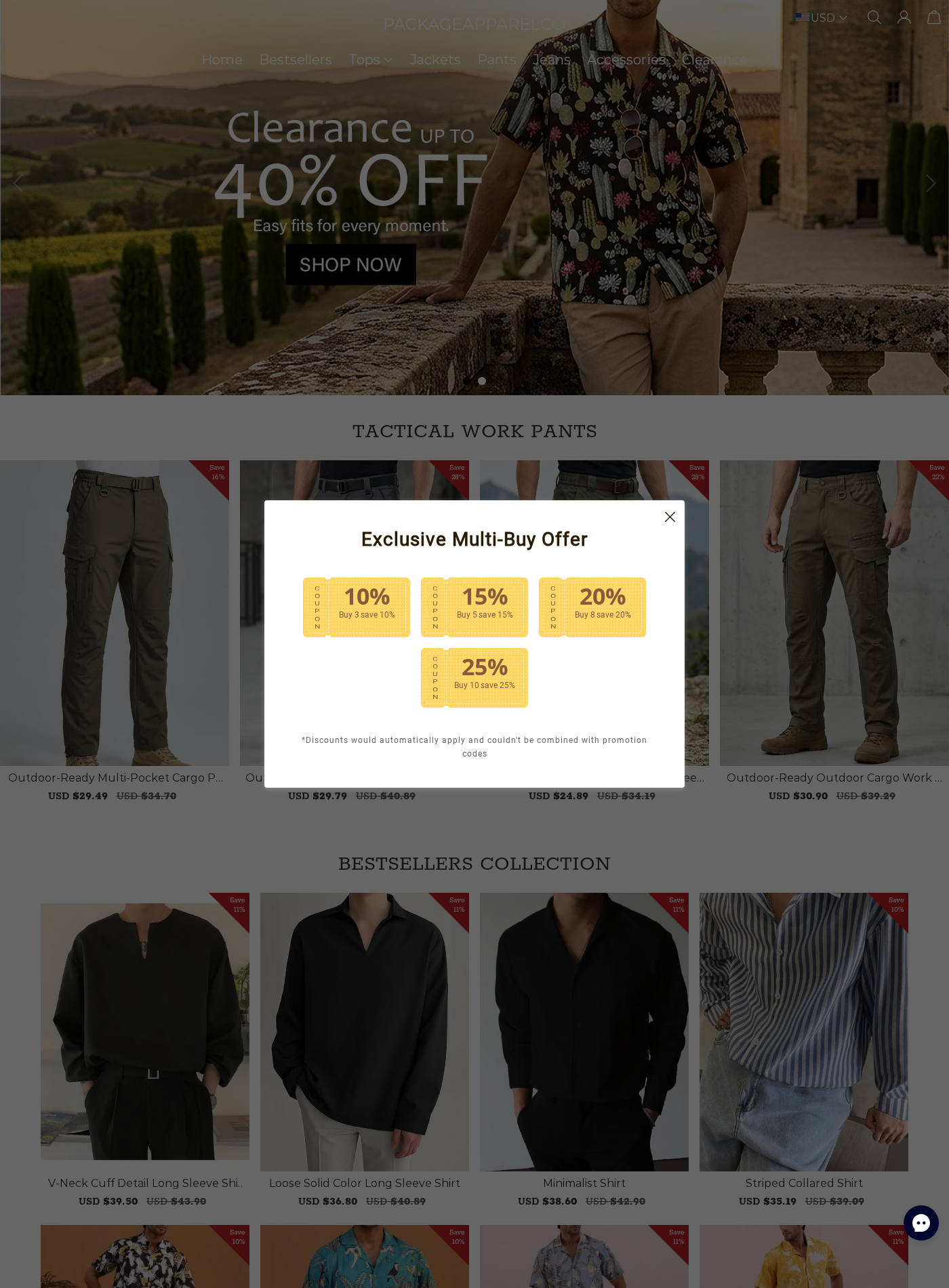
The homepage displays shirts, cargo trousers, jackets, sweaters, jeans, and accessories beneath a large clearance message advertising reductions up to 40%.
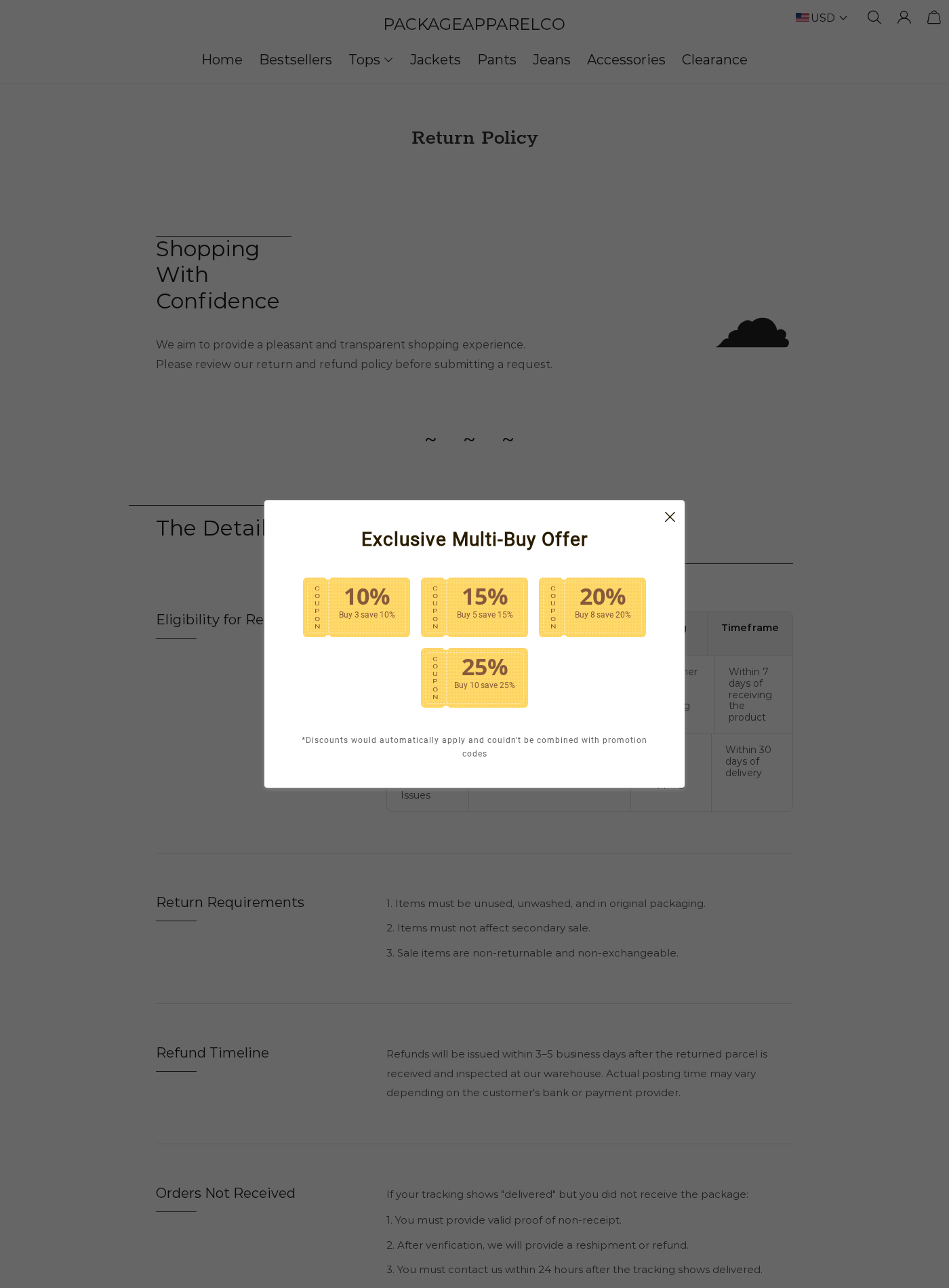
A modal appears over both shopping and policy pages, offering 10% off three items, 15% off five, 20% off eight, and 25% off ten.
That design encourages customers to enlarge their first order before testing fabric, sizing, stitching, color accuracy, delivery, or customer support.
The catalog photographs look professionally produced, yet their varied models, rooms, lighting, and crops are consistent with supplier-fed merchandise.
A larger basket makes every later quality or sizing problem more expensive and complicated to unwind.
The domain is new and the delivery window is long
Official records show PackageApparelCo.com was registered on July 15, 2026, giving the site only a short public track record.
The shipping policy says dispatch preparation generally takes 24 business hours, followed by seven to twenty business days in transit.
That range resembles cross-border supplier fulfillment more than a clothing retailer dispatching local stock for rapid domestic delivery.
The site does not publish fixed shipping charges because costs can vary by destination and order details, adding uncertainty until checkout.
Limited independent reviews make it difficult to know whether delivery, sizing, and refunds consistently match the written promises.
Returns and recurring-purchase controls deserve special attention
Change-of-mind returns must be requested within seven days, while defective or materially different goods receive a 30-day window.
Sale merchandise is described as nonreturnable and nonexchangeable, an important restriction for a storefront dominated by markdowns and clearance language.
Product interfaces also contain “One-Time Purchase” and “Subscribe & Save” choices with “cancel anytime” wording, an unusual arrangement for ordinary apparel.
We have not confirmed that a subscription is preselected for every item, but buyers must verify the purchase option before submitting payment.
A clothing order should not create future charges or automatic shipments unless the customer clearly and deliberately chooses them.
- PackageApparelCo.com was registered on July 15, 2026.
- The homepage pushes multi-buy discounts reaching 25% for ten products.
- Transit is estimated at seven to twenty business days after dispatch.
- Change-of-mind returns have a seven-day request window.
- Sale goods are described as nonreturnable and nonexchangeable.
- The storefront includes a Subscribe & Save option despite selling ordinary clothing.
How the PackageApparelCo Sales and Subscription Funnel Works
Step 1: A clearance advertisement leads with style and apparent savings
A shopper sees a casual shirt, tactical trouser, or seasonal outfit shown against attractive lifestyle photography and marked below a crossed-out amount.
The creative presents the item as a simple wardrobe upgrade rather than a purchase requiring company, delivery, and return research.
Fashion advertisements can target age, location, interests, or prior shopping behavior, making generic supplier products feel selected for one audience.
Before following the link, save the image, price, material claim, sizing promise, delivery statement, and seller name exactly as displayed.
Reverse-image searches can reveal identical garments under other brand names, often with different measurements, prices, and policies.
Step 2: A polished collection makes the new store appear established
The site uses coordinated colors, editorial banners, navigation categories, and professional product grids that resemble a mature menswear business.
Website templates and imported catalogs can create that appearance immediately, even when the underlying domain has existed for only weeks.
Product images vary substantially in background and model style, which may indicate listings gathered from several upstream suppliers.
Supplier sourcing is common, but customers need accurate fiber content, garment measurements, manufacturing origin, care instructions, and real buyer photographs.
A store should not rely on atmosphere when the customer must decide whether an unfamiliar size will fit.
Step 3: The pop-up rewards an untested buyer for ordering ten items
PackageApparelCo repeatedly overlays pages with a coupon ladder that increases as shoppers add three, five, eight, or ten products.
The offer appears even while visitors read terms and returns, interrupting the exact research needed before a large order.
A person interested in one pair of trousers may begin viewing additional products primarily to unlock the highest percentage reduction.
That savings calculation ignores return postage, nonreturnable sale items, inconsistent sizing, split shipments, and the short seven-day window.
Close the pop-up and evaluate one garment at its final price before allowing bundle mathematics to shape the purchase.
Step 4: A subscription option can convert clothing into a recurring transaction
The product interface includes One-Time Purchase and Subscribe & Save language accompanied by a promise that recurring service can be canceled anytime.
Subscriptions can suit consumable goods, but they are unexpected for shirts, trousers, jackets, and other durable apparel.
A customer rushing through a discount checkout may overlook which option is selected, how often future orders ship, or what cancellation requires.
Screenshots should capture the selected choice, renewal frequency, recurring price, trial terms, cancellation route, and final order summary.
Never assume “cancel anytime” means a refund for a renewal that was authorized under terms hidden near the purchase control.
Step 5: Currency and fulfillment signals complicate the final order
The storefront states that orders are processed in USD while parts of the cart can display values in CNY before conversion at checkout.
That technical detail may reflect a Chinese ecommerce platform, supplier system, or localization configuration rather than deliberate deception.
It still signals that operations may be more international than the polished American-facing presentation suggests.
Long transit estimates, customs possibilities, and an undisclosed return warehouse can make exchanges impractical when garments do not fit.
Record the final USD amount, conversion, taxes, shipping, subscription status, merchant descriptor, and delivery estimate before authorizing payment.
Step 6: The return process narrows once the order is delivered
A change-of-mind customer receives seven days to request a return and normally pays the shipment back to the designated warehouse.
Sale items cannot be returned, even though sale labels appear throughout the store and drive the initial purchase decision.
A package marked delivered but missing must be reported within 24 hours with proof of non-receipt, an unusually demanding response period.
Unauthorized returns may be refused, and refunds begin only after receipt and inspection, so written approval is essential.
Customers should inspect every item immediately and avoid washing, wearing, or removing labels until all measurements and materials are checked.
What Our PackageApparelCo Investigation Found
The operator names a company, but the relationship remains thinly documented
The terms identify AJAZ GANESH TRADING INC and publish 1652 North Franklin Street in Denver, Colorado as the company address.
That disclosure is useful, yet the storefront does not clearly explain the company’s history, leadership, warehouse network, or apparel experience.
The domain registration information is privacy-protected and lists Guangdong, China within the redacted registrant address fields reported by public services.
A Chinese technical or ownership connection does not prove wrongdoing, but it makes transparent corporate and fulfillment explanations more important.
Buyers should verify the company through official records and confirm it appears on invoices, receipts, statements, and return instructions.
The return policy is stricter than the storefront mood suggests
The page calls the experience transparent and confident, but practical eligibility depends on a seven-day window and unused, unwashed, packaged condition.
Sale exclusions could cover a substantial portion of inventory when most listings display reductions or appear under clearance categories.
Customers who discover shrinking, dye transfer, loose seams, or poor durability after washing may find the voluntary return route unavailable.
Statutory rights for defective or materially misrepresented goods can exceed a store’s voluntary policy and vary by the buyer’s jurisdiction.
Preserve evidence and consult local consumer guidance rather than assuming the seller’s shortest rule eliminates all legal remedies.
The recurring-purchase interface needs explicit consent controls
A legitimate subscription must clearly disclose frequency, price, duration, cancellation method, renewal notices, and the distinction from a one-time order.
The customer should make an affirmative choice rather than inheriting a preselected option through visual prominence or discount pressure.
PackageApparelCo’s clothing focus makes recurring fulfillment unexpected, increasing the chance that a hurried buyer misunderstands the selection.
We recommend choosing One-Time Purchase and confirming the order summary contains no subscription language unless recurring clothing deliveries are genuinely desired.
Monitor statements after purchase because future charges may use a company descriptor rather than the storefront brand.
The evidence supports high caution, not certainty that every parcel fails
We did not purchase clothing, test customer support, or attempt a return through PackageApparelCo’s designated warehouse.
The store may deliver supplier-sourced apparel and process eligible refunds for customers who follow its procedures carefully.
Our concern is the combined risk created by a young domain, pressure to buy multiples, long transit, limited reviews, strict returns, and subscriptions.
Each feature can exist in a legitimate business, but together they leave first-time shoppers with weak practical protection.
Established retailers offer comparable clothing without requiring customers to solve these uncertainties before discovering whether one size fits.
How to Audit the Order Before Payment
Force the checkout to show a one-time transaction
Select One-Time Purchase, then reopen the cart and verify that no Subscribe & Save wording, renewal interval, or recurring discount remains.
Take screenshots of the product selector, cart, payment summary, terms link, and confirmation immediately after ordering.
If the interface changes the choice automatically after an update, remove the item and leave rather than trusting a later cancellation.
Use a virtual or credit card offering merchant controls and disputes when available in your jurisdiction.
Compare garment measurements, not size letters
Request exact chest, waist, rise, inseam, shoulder, sleeve, and garment-length measurements for the specific listed variant.
Compare those numbers with a similar item you already own, allowing for fabric stretch and intended fit.
Search product images and distinctive description phrases to identify alternate sellers with customer photographs and clearer sizing.
Do not order multiple sizes when the return window is short and sale exclusions may apply.
Price the worst-case return before chasing the bundle
Ask for the warehouse country, full postal destination, expected tracked cost, authorization process, inspection time, and refund method.
Calculate postage for the entire bundle, not one lightweight shirt, and include any original shipping that the policy may retain.
Assume sale goods may be rejected unless support confirms their eligibility in writing before checkout.
If one failed order would be expensive to reverse, the maximum multi-buy discount is not meaningful savings.
Company, Address, and Fulfillment Checks
AJAZ GANESH TRADING INC is the entity named in the terms
PackageApparelCo’s terms list AJAZ GANESH TRADING INC as the company associated with the storefront.
The website should consistently repeat that entity within checkout, invoices, privacy notices, receipts, recurring-payment disclosures, and refund correspondence.
Customers should search official state records and confirm the entity remains active and connected to apparel ecommerce before relying on the name.
A registered corporation can provide a legal contact point, but registration alone does not validate product quality or fulfillment reliability.
Record any different descriptor shown by the payment processor and ask the seller to explain it immediately.
The Denver address is not automatically a warehouse
The terms publish 1652 North Franklin Street, Denver, Colorado 80218 as the company address.
A business address can be administrative, residential, virtual, registered, or shared while inventory is stored elsewhere.
The shipping policy does not identify the dispatch facility, and the returns page withholds the warehouse destination pending approval.
Do not mail unwanted garments to the Denver address unless PackageApparelCo authorizes it for the specific order.
An unauthorized parcel can be refused or become impossible to match with a refund request.
Email and chat are the main visible support channels
The contact page promises chat access and email responses within one or two business days but does not prominently offer a customer-service telephone line.
Those channels depend on the website’s continued operation and may be inadequate when a seven-day return period is running.
Send a test question before ordering and preserve the response outside the account or chat widget.
Ask support to confirm the legal company, warehouse country, subscription status, sale-item eligibility, and realistic sizing for one chosen garment.
A generic answer that ignores those points should be treated as a warning about later dispute handling.
The platform and currency clues suggest international fulfillment
Public technical records place parts of the registration trail in Guangdong, while the cart can display CNY before orders are processed in USD.
The seven-to-twenty-business-day transit estimate is also consistent with goods moving through cross-border supplier networks.
None of those facts proves low quality or fraud because many legitimate retailers use Chinese manufacturers and international logistics.
The problem is incomplete disclosure about who makes, inspects, dispatches, and receives returns for the garments.
Buyers should expect transparent origin labels and stop using apparel that causes severe irritation, dye transfer, or unsafe hardware exposure.
What to Do if You Have Fallen Victim to This Scam
- Check for recurring enrollment. Review the confirmation, account, emails, and card statement for Subscribe & Save wording, a renewal date, frequency, or future shipment schedule.
- Cancel through every available channel. Use the account control, email, and chat, then demand written confirmation that both recurring billing and future fulfillment have ended.
- Save the pressured checkout. Preserve product pages, selected purchase option, discounts, popup, cart, return policy, shipping estimate, confirmation, merchant descriptor, and all support communications.
- Inspect delivery immediately. Record the sealed parcel, labels, every garment, tags, fiber content, measurements, colors, defects, missing items, and discrepancies from the listing.
- Protect the seven-day window. Request authorization promptly and keep products unwashed, unworn, tagged, and packaged while eligibility is determined.
- Demand the actual return warehouse. Obtain recipient, full address, country, reference, deadline, tracking standard, postage responsibility, inspection period, and promised refund date.
- Challenge unauthorized renewals quickly. Tell the card issuer when a recurring transaction lacked informed consent or continued after documented cancellation, and provide the complete timeline.
- Use merchandise-dispute evidence. For non-delivery or materially different goods, submit saved advertising, photographs, measurements, tracking, support messages, and the requested resolution.
- Check the shopping device. Use Malwarebytes after suspicious downloads or redirects, and enable AdGuard to reduce exposure to deceptive apparel advertisements and cloned stores.
How to Recognize Subscription Risk in an Ordinary Store
The product does not naturally require replenishment
Recurring delivery makes sense for food, toiletries, filters, and other consumables, but ordinary shirts and trousers rarely need automatic replacement.
When a durable item includes Subscribe & Save, inspect frequency, cancellation, discount, and consent controls with unusual care.
Do not assume the option is harmless simply because “cancel anytime” appears nearby.
The relevant question is whether cancellation works before the next charge and whether a shipped renewal remains returnable.
A discount visually dominates the one-time choice
Subscription traps often use a lower headline price, colored selection, small renewal text, or preselected radio control to steer consent.
Read the final order summary rather than relying on the first price shown on the product page.
Screenshot the selector before and after adding the item because some carts reset purchase options during updates.
Leave when recurring terms remain incomplete, contradictory, or impossible to review without creating an account.
Cancellation depends on one fragile support channel
A promise of easy cancellation is only valuable when a customer can reach the merchant and obtain confirmation before renewal.
Email-only systems can delay responses beyond a billing date, especially when the company controls whether a message qualifies as timely.
Prefer merchants offering immediate self-service cancellation, clear renewal reminders, and a complete billing history.
Keep cancellation evidence permanently because another brand or payment descriptor may appear on later statements.
Frequently Asked Questions
Is PackageApparelCo definitely a scam?
We did not test a purchase and cannot establish that every order or refund fails.
The young domain, strict returns, unclear fulfillment, multi-buy pressure, limited reputation, and unusual subscription option create a high-risk purchase.
Who operates PackageApparelCo?
The terms name AJAZ GANESH TRADING INC and list a Denver, Colorado address.
Buyers should verify the company through official records and confirm that it appears consistently on checkout, receipts, statements, and refund documents.
Does PackageApparelCo offer subscriptions?
The storefront code and product interface contain One-Time Purchase and Subscribe & Save choices with “cancel anytime” wording.
Confirm which option is selected for the exact product and retain screenshots of the final order summary.
Can sale items be returned?
The published return policy states that sale items are nonreturnable and nonexchangeable.
Because discounts and clearance messaging dominate the store, ask support to confirm eligibility for the exact SKU before ordering.
How long does delivery take?
The policy estimates seven to twenty business days after dispatch, with preparation generally occurring within 24 business hours.
Customs, carrier handling, and peak periods can extend that estimate, according to the same page.
What should a buyer do about an unwanted renewal?
Cancel immediately through the account, email, and chat, then preserve confirmation and notify the card issuer if another charge appears.
Do not wait for a second shipment while a dispute deadline continues running.
The Bottom Line
PackageApparelCo looks like an ordinary discount menswear store, yet its funnel pushes large first orders, narrow returns, long delivery, and an unexpected recurring-purchase choice.
Those terms demand more trust than a weeks-old retailer has earned. Choose one-time purchases only, verify the company and warehouse, or shop with a proven merchant.








