

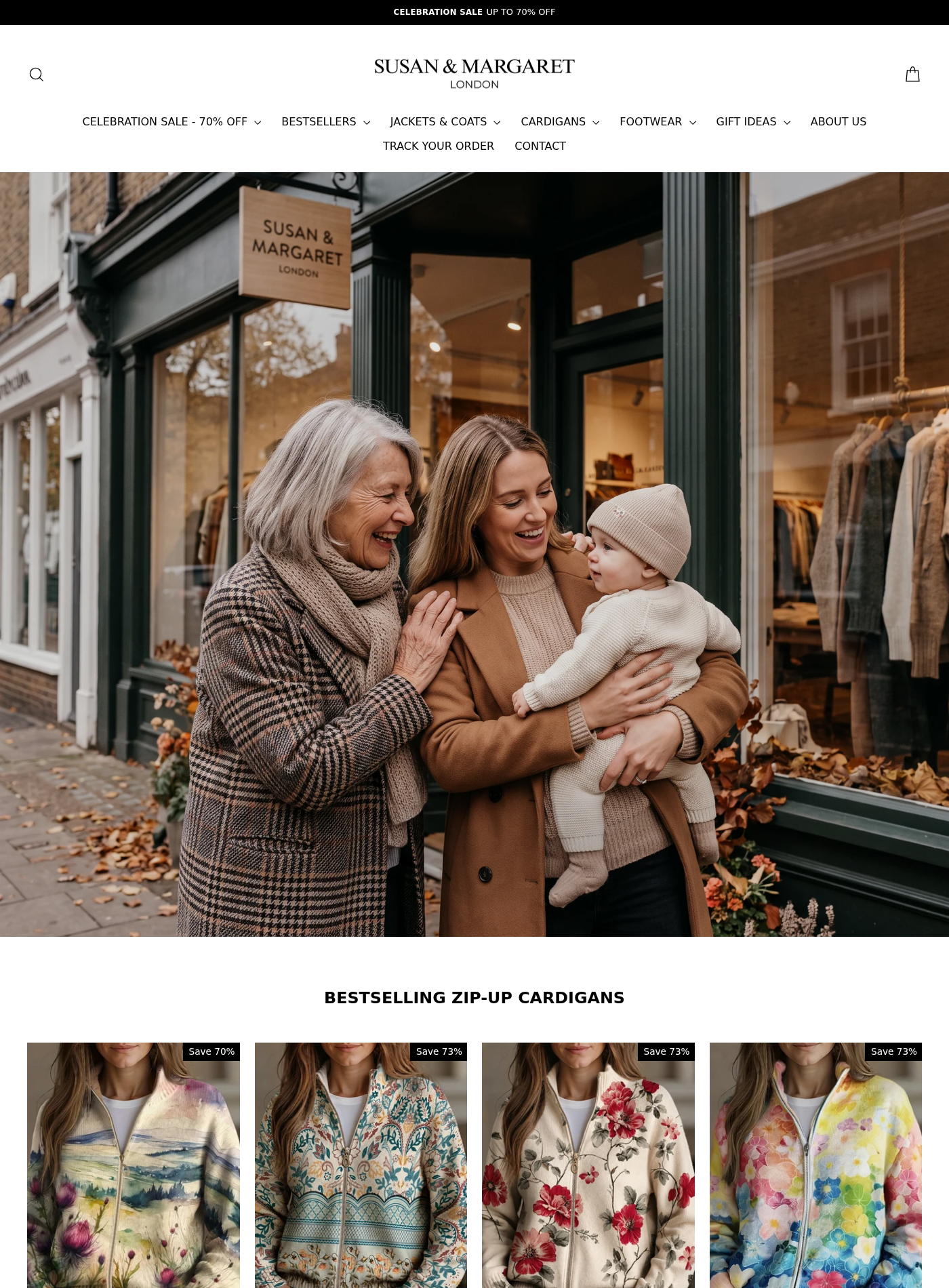
Susan & Margaret London looks like the digital continuation of a warm neighborhood boutique, complete with family history, London identity, and heavily reduced seasonal fashion.
That story becomes more complicated when the site’s age, sourcing disclosure, product presentation, and return responsibilities are read together.
Overview
The storefront presents decades of heritage on a six-month-old domain
The About page describes Susan, Margaret, and granddaughter Florence, connecting the shop with decades of family fashion experience.
The homepage says the business brings more than 25 years of industry knowledge to its collections.
Public registration records show the current domain was created in April 2026.
A new website can represent an older offline business, so that date alone does not disprove the story.
However, we found no prominent independent evidence tying the claimed long-running London boutique to this new online operation.
The site openly says it uses dropshipping
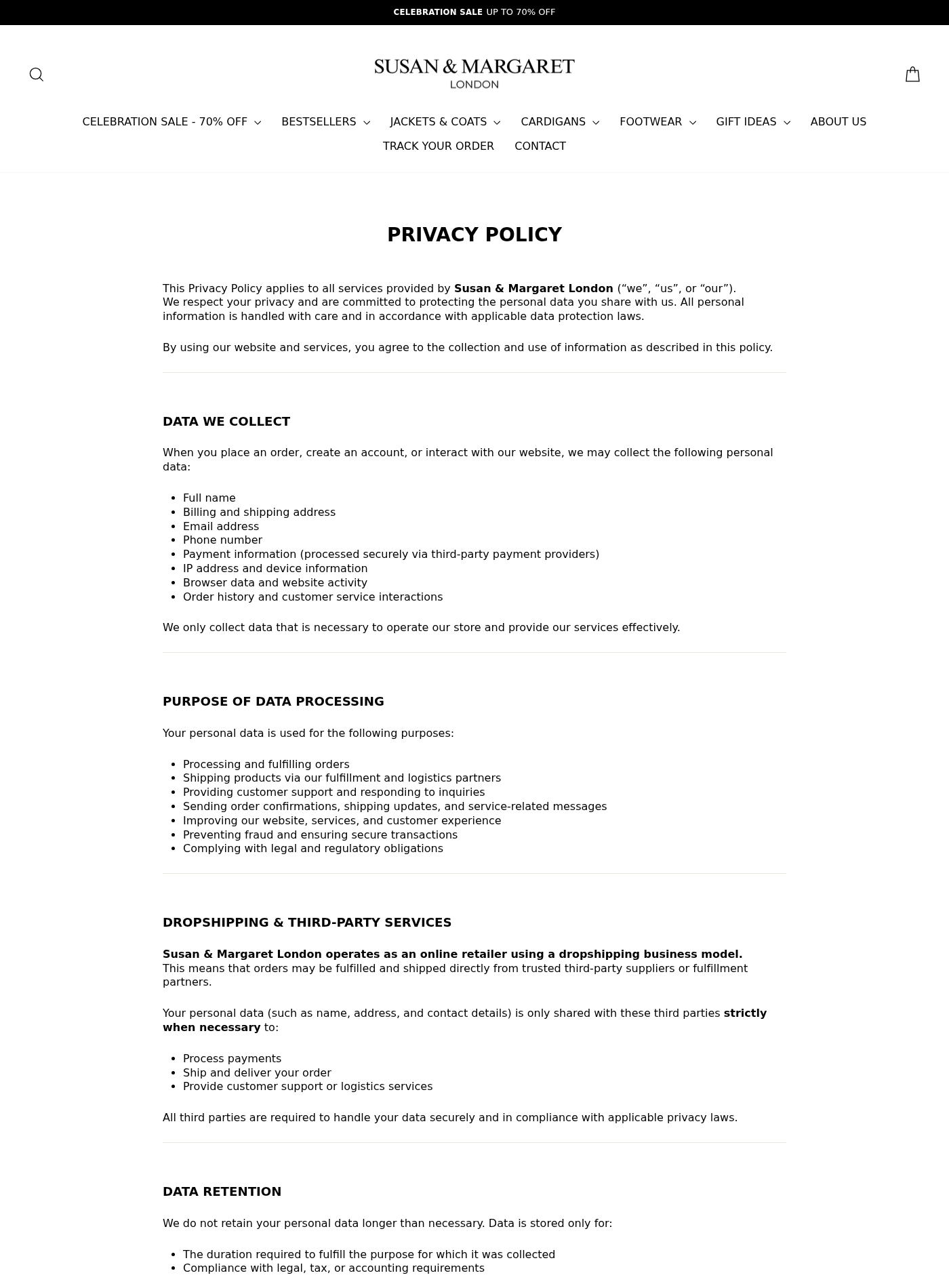
The privacy policy contains an unusually direct statement that Susan & Margaret London operates with a dropshipping business model.
It says orders may be fulfilled and shipped directly by trusted third-party suppliers or fulfillment partners.
Dropshipping is a legitimate logistics method, but it differs from the impression of browsing inventory selected inside a longstanding local shop.
It can also complicate delivery origin, sizing consistency, quality control, and return costs.
The disclosure matters because shoppers should evaluate the seller as a remote online retailer, not assume a traditional London stockroom.
Large discounts and buyer-paid returns shift risk toward the customer
The storefront advertised a celebration sale up to 70% off, with many items reduced from roughly £200 to about £55.
Repeated steep markdowns can create urgency and suggest luxury value without proving the higher reference price was normally charged.
The store offers 30-day returns, but customers are responsible for return shipping unless the seller confirms another arrangement.
A third-party supplier or overseas destination can make that postage expensive compared with the purchase price.
The practical question is not whether an item arrives, but whether its quality and return route match the boutique impression.
- The current domain was registered in April 2026.
- The site tells a multigenerational family-boutique story and claims more than 25 years of fashion experience.
- No independent proof of that long offline history was prominent in our review.
- The privacy policy explicitly identifies the operation as dropshipping.
- Third-party suppliers or fulfillment partners may ship customer orders directly.
- Many products display discounts around 70% from high reference prices.
- Customers generally pay approved return postage.
- The business should be judged as a new online dropshipping retailer, not automatically as a historic London shop.
How the Susan & Margaret London Boutique Marketing Funnel Works
Step 1: A personal family story creates trust before product evaluation
Names, generations, and a granddaughter narrative give the storefront warmth that anonymous fashion sites usually lack.
A shopper may feel they are supporting a small established boutique rather than ordering from a newly registered dropshipping website.
Human stories are not inherently deceptive, but meaningful heritage claims should be independently traceable.
Look for historical addresses, archived listings, older social accounts, company records, press coverage, and consistent ownership.
Do not let an emotional origin story substitute for current business details.
Step 2: London branding implies local curation and accountability
The name, storefront imagery, British prices, and Royal Mail references encourage a distinctly local interpretation.
Customers may reasonably expect UK-held stock, familiar sizing, domestic support, and a manageable return route.
The privacy disclosure says third-party suppliers can fulfill orders directly, which may produce a different experience.
Ask where the exact item ships from and where an unwanted garment must be returned.
A brand location and a parcel’s logistical journey are not necessarily the same.
Step 3: Large markdowns turn browsing into a closing-sale decision
Items were shown with high crossed-out prices and sale savings reaching roughly 70%.
That presentation makes delay feel costly and frames current prices as rare opportunities.
Search distinctive product titles and images because the same garment may appear through other dropship retailers at ordinary prices.
Reference prices should reflect real prior sales rather than decorative anchors chosen to magnify savings.
Compare fabric composition, dimensions, construction, and seller protections rather than discount percentages alone.
Step 4: Styled images carry more information than the written specifications
The homepage relies heavily on attractive model photographs and coordinated collections to communicate quality.
Images can be reused by suppliers, digitally altered, or generated without showing the exact delivered garment.
Inspect close-ups of seams, lining, fasteners, labels, texture, and actual customer photographs.
A product title containing orthopedic, leather, waterproof, or premium language should be supported by precise materials and testing.
If the written description stays vague, assume the image is aspirational rather than documentary.
Step 5: Third-party fulfillment creates distance after checkout
The retailer can accept payment while a separate supplier selects, packs, and sends the item.
That separation may explain longer tracking gaps, unfamiliar parcel origins, split shipments, or inconsistent packaging.
It can also make exchanges difficult when stock, sizing, and return approval depend on another company.
The seller remains responsible for honoring its promises to the customer, regardless of warehouse arrangements.
Document every stage rather than negotiating directly with an unknown shipper.
Step 6: The 30-day return depends on approval and customer-paid postage
A return window sounds reassuring until destination, tracking, and postage are known.
Customers should request written authorization before sending anything and keep garments unworn with original packaging and labels.
International tracked postage can consume most of a £55 refund, especially for bulky shoes or coats.
Ask whether a UK return address exists and who pays when an item differs materially from the description.
If answers remain unclear, treat the sale as difficult to reverse.
The Boutique Story Versus the Store’s Own Documents
A family narrative is not the same as a verified trading history
The site may accurately describe people with long fashion experience even if the online store is new.
What remains unverified is the connection between that experience and a continuing London retail business using this identity.
A real heritage claim should produce independently dated traces outside pages controlled by the seller.
Search historical business directories, archived websites, lease records, company filings, and old customer reviews.
Until found, treat the story as marketing copy rather than established corporate history.
The privacy policy gives the clearest operating description
Unlike the romantic homepage, the privacy policy plainly describes online retail using dropshipping and third-party fulfillment.
That sentence is important because it explains how the business can offer a broad changing catalog without visible stock information.
Dropshipping does not mean customers receive nothing, and many legitimate shops use external logistics.
The concern arises when presentation creates expectations of local boutique curation, inspection, and easy returns that operations cannot meet.
The legal disclosure should shape how buyers interpret every product and promise.
The current evidence supports misleading-impression concerns, not a universal fraud claim
We did not place an order and cannot say that every garment is poor or every refund is denied.
The site openly discloses dropshipping, which is more transparent than retailers hiding the model completely.
Nevertheless, the unverified heritage, fresh domain, dramatic sale anchors, and buyer-paid returns create a meaningful expectation gap.
Readers should avoid describing the company as nonexistent without official evidence.
The sharper conclusion is that the boutique story may convey more tradition and local operation than buyers can independently confirm.
How to Check a Dropship Fashion Listing
Reverse-search the product photographs and wording
Upload a clean garment image to multiple visual search tools and search an unusual sentence from the description in quotation marks.
Matches can reveal supplier listings, earlier names, alternative prices, fabric details, and ordinary customer photographs.
Identical imagery does not prove theft because stores can license assets from the same supplier.
It does show that a branded boutique name may not identify an exclusive design.
Judge the offer by price, protections, delivery, and accountability added by the retailer.
Use garment measurements instead of generic size labels
Small, medium, and large vary substantially among suppliers, countries, and product batches.
Compare bust, waist, hip, shoulder, sleeve, rise, inseam, foot length, and garment length with an item you own.
Ask whether the chart gives body measurements or finished garment dimensions and whether tolerance is allowed.
A costly international return makes size guessing especially risky.
If the seller cannot provide item-specific measurements, do not rely on photographs alone.
Verify materials and functional claims
Names such as leather, cashmere, orthopedic, waterproof, handcrafted, or premium should correspond to specific composition and construction.
Request percentages for every fiber and details about lining, sole, closure, care, and country of manufacture.
Orthopedic is not a substitute for professional fitting or evidence supporting a medical benefit.
Water resistance should identify the tested material and conditions rather than imply unlimited protection.
Vague answers signal that the seller may rely mainly on supplier copy.
Company, Address, and Fulfillment Checks
The storefront did not prominently connect its heritage to a verifiable company record
Susan & Margaret London operates as a brand, but the reviewed pages did not clearly establish decades under one registered entity.
A company name, number, formation date, directors, and trading address would allow buyers to test the story independently.
The payment descriptor should match the operator named on the receipt and legal pages.
If another entity appears, ask how it relates to the brand and who owes refunds.
A name that sounds traditional is not itself evidence of longevity.
A London image does not prove a London shop or warehouse
The homepage shows a physical boutique scene and uses London prominently in the brand identity.
That presentation can be decorative even when orders are processed online and shipped by suppliers elsewhere.
Search any listed address to see whether it is a retail unit, residence, mailbox, office, or unrelated business.
Do not visit or mail a return without explicit authorization.
Customers need the actual contracting and return addresses, not only the city inside a logo.
Support details should be tested before ordering
Send a product-specific question asking about stock location, fabric composition, size measurement, and return destination.
A reliable response should address each point plainly rather than repeat discounts or general reassurance.
Check whether the reply uses the store domain and identifies the company responsible for the transaction.
Save the exchange because it can clarify the representation made before purchase.
No response is especially important when the order would be expensive to return.
Third-party suppliers can fulfill orders without being the seller
The privacy policy says suppliers and fulfillment partners may ship products directly to customers.
A parcel origin, warehouse label, or overseas sender therefore may not match the storefront name.
That does not remove the retailer’s responsibility for accurate descriptions, legal rights, or promised refunds.
Do not let support redirect every problem toward an unnamed supplier with whom you never contracted.
Keep dealings with the seller and payment provider documented in writing.
What to Do if You Have Fallen Victim to This Scam
- Preserve the listing and boutique claims. Save photographs, materials, size chart, discount, delivery estimate, return promise, About page, and dropshipping disclosure.
- Record the unboxing. Film the parcel label, packaging, garment, tags, measurements, construction, color, and any damage before trying it on extensively.
- Compare the delivered item objectively. List each material, size, feature, and quality difference instead of relying only on general disappointment.
- Request a remedy from the retailer. Give the order number, delivery date, evidence, and desired refund or replacement within the published period.
- Keep the item returnable. Do not wash, alter, wear outdoors, remove labels, or discard packaging while a claim remains possible.
- Demand an authorized return destination. Ask whether it is in the United Kingdom, who pays postage, and which tracking service is required.
- Do not send to the parcel origin automatically. A supplier or fulfillment label may not be the approved return address.
- Escalate material misrepresentation promptly. Give the card issuer the original description, measurements, photographs, support record, and refusal or silence.
- Report misleading heritage or sale claims. Submit dated evidence to the advertising platform and relevant consumer authority.
- Secure the browsing device if redirects appeared. Run Malwarebytes and use AdGuard to reduce malicious pop-ups, tracking, and repeated deceptive fashion ads.
When an Online Boutique Is Worth the Risk
The operator is clear and independently verifiable
A trustworthy retailer names its legal entity, registration, working address, support routes, and dispute jurisdiction consistently.
Those details should align across the website, receipt, card statement, privacy policy, and return instructions.
An old-sounding brand name should not be the only evidence of longevity.
Independent records must support any specific claim about decades in business.
Transparency allows customers to distinguish real heritage from a newly created sales narrative.
Product information survives comparison
Materials, measurements, care, origin, construction, and functional claims should remain consistent across page, label, and support response.
Reverse-search results should not reveal the same item sold cheaply with contradictory composition.
Customer photographs should resemble the advertised cut, print, texture, and finishing.
The seller should explain what curation, quality control, warranty, or support justifies any price premium.
A boutique earns trust by adding accountable value beyond a supplier photograph.
Returns are practical, not merely permitted
A 30-day window helps only when the destination, cost, eligibility, and processing schedule are reasonable.
UK-focused marketing should disclose clearly if returns travel abroad at the buyer’s expense.
Defective or misdescribed goods should not be treated like ordinary change-of-mind returns.
The customer should receive authorization, tracking requirements, and a measurable refund deadline.
Practical reversibility is one of the strongest differences between a reliable boutique and a risky dropship offer.
Frequently Asked Questions
Is Susan & Margaret London a scam?
The evidence does not prove every order is fraudulent.
It does show a new dropshipping website using an unverified long-running boutique story and terms that can create costly disputes.
Does Susan & Margaret London use dropshipping?
Yes.
Its privacy policy explicitly says the retailer uses a dropshipping business model and third-party suppliers may fulfill orders directly.
Has the store existed for 25 years?
The website claims more than 25 years of fashion experience, while the current domain dates to April 2026.
We found no prominent independent proof connecting that claim to this online store.
Are the 70% discounts genuine?
The site displays substantial reductions from high reference prices.
Compare identical garments elsewhere and look for evidence that the higher prices were genuinely charged.
Who pays return shipping?
The published return information places ordinary return shipping on the customer.
Obtain the destination and cost before ordering because a supplier may be outside the United Kingdom.
Does London in the name mean orders ship from London?
No such conclusion should be assumed.
The site says third-party suppliers or fulfillment partners may send orders directly.
The Bottom Line
Susan & Margaret London combines the emotional credibility of a family boutique with the operating model of a newly registered dropshipping retailer.
The disclosure itself is useful, but it sits uneasily beside unverified heritage, London imagery, dramatic markdowns, and buyer-paid returns.
Treat the store as a new remote seller, verify every garment independently, and learn the real return destination before accepting the boutique story at face value.








