

The show is announced, tickets are suddenly hard to find, and someone online says they have a spare pair. It sounds like lucky timing.
Before sending money, there is one important question to settle: can that seller actually deliver tickets you will be allowed to use?
Overview
What the offer appears to promise
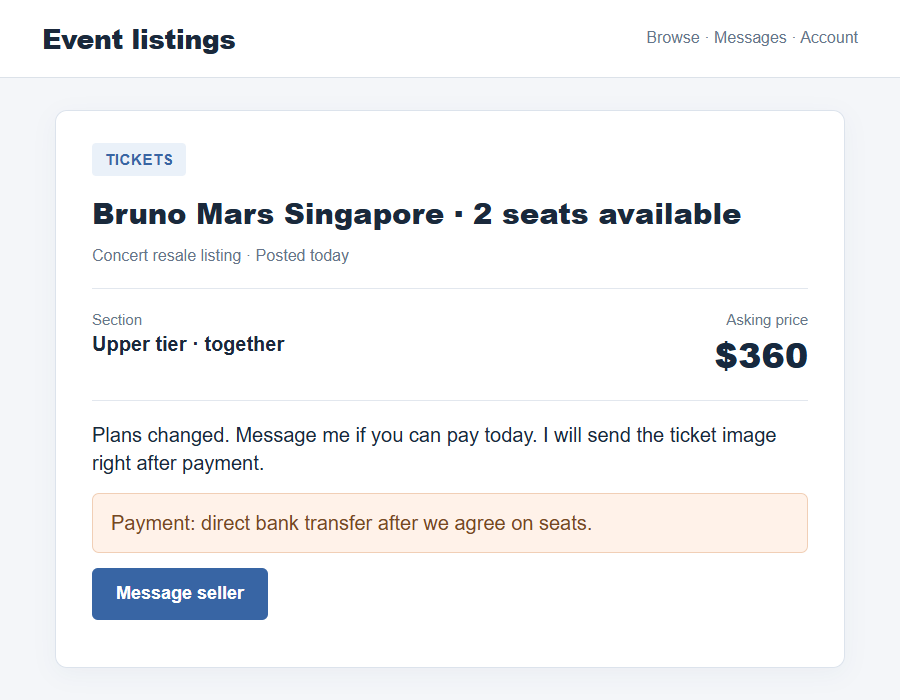
A listing may promise access to Bruno Mars’s Singapore concert through a spare ticket, a presale contact, or someone who can buy on your behalf.
The pitch usually works because it meets a genuine problem. Popular shows sell quickly, and the person searching for tickets may already expect disappointment.
A seller who says they can solve that problem instantly can feel helpful. That feeling is exactly why the payment method and transfer rules matter.
- The offer may appear in a social feed, marketplace listing, or private chat.
- The seller may show a receipt, seat map, or screenshot as supposed proof.
- Payment may be requested before any usable ticket can be independently verified.
- After payment, the buyer may receive nothing or an invalid ticket.
What the official warning actually says
Singapore Police warned about fraudulent listings ahead of ticket sales for Bruno Mars’s The Romantic Tour. The advisory describes nonexistent tickets and purchasing services.
Police said victims can receive no ticket or an invalid one. The warning was preventive, not a claim about every resale listing.
The advisory named Ticketmaster as the authorized seller and warned against resale. Current Ticketmaster help says its ticket-transfer feature will be available for this event.
Those statements are not permission for private resale. The current event page prohibits resale, and the venue warns that resold tickets will not be honored.
The practical assessment
A private seller promising transfer still presents serious risk. The existence of an official transfer button does not verify the seller, authorize resale, or guarantee entry.
Bruno Mars and Ticketmaster are not behind fraudulent listings. The scam is the unauthorized resale pitch or fake purchasing service using demand for the show.
It is possible for different listings to use different tricks. The police advisory does not identify one universal script, one payment account, or one specific seller.
Why This Concert Creates an Easy Opening
Concert ticket fraud often begins long before a buyer sees a checkout page. It begins with the feeling that a chance is slipping away.
When a major performer announces a show, fans search in groups, social comments, resale communities, and marketplaces. Scammers can place offers exactly where those searches happen.
A message saying “I cannot go anymore” is familiar and plausible. So is a claim that a friend has an extra ticket from presale.
The trouble is that these stories are almost impossible to verify through a chat. The buyer sees the words and images the seller chooses to provide.
Scammers can copy a real seat map, reuse a confirmation screenshot, or edit an image. None of those files proves control of a transferable ticket.
For this show, current Ticketmaster guidance allows a transfer feature, but the event page prohibits resale. A seller must explain how a paid private offer fits those rules.
If the answer is vague or demands payment first, do not treat the conflict as a minor technicality. The venue says resold tickets will not be honored.
How the Bruno Mars Ticket Scam Works
Step 1: A seller reaches fans outside the authorized ticket channel
The first contact may be a social post, a marketplace listing, or a reply to someone asking for tickets. The account may look ordinary.
It may have old posts, a recognizable name, or a profile photo. Those details only show that an account exists, not that it owns valid concert access.
Some offers advertise tickets outright. Others promise to obtain them through a contact, a presale route, or a supposed ticket-buying service.
The distinction matters because a buyer may be paying for a service that never had any route to fulfill the promise.
Step 2: The seller creates a believable reason for the bargain
A personal story lowers suspicion. The seller may claim travel plans changed, a companion canceled, or a duplicate order left them with seats to spare.
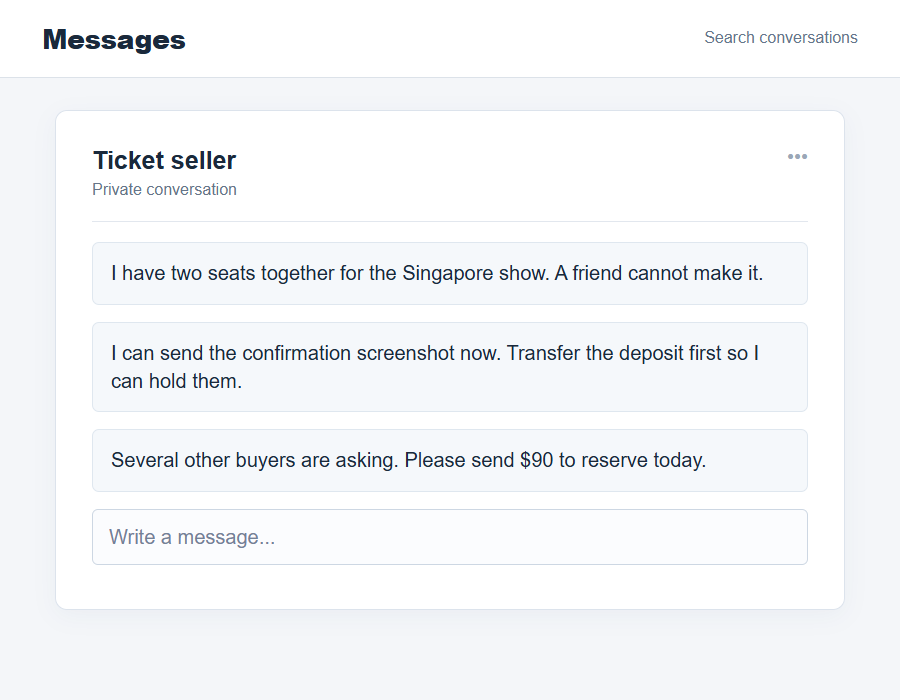
Other versions push urgency: several people are interested, a deposit will hold the seats, or the seller needs payment before a deadline.
These are common resale tactics, not verified details from one specific Bruno Mars listing. The reliable fact is the police warning about fraudulent offers.
The pressure is meant to make the buyer solve the seller’s timeline instead of checking the event’s actual transfer and resale conditions.
Step 3: A screenshot replaces verifiable ownership
The seller may send an image that resembles an order confirmation or a ticket. It could even contain a plausible seat section and purchase time.
An image does not reveal whether it was copied, altered, refunded, canceled, or previously shown to other buyers. It cannot establish that a private resale is authorized.
A common mistake is to ask for more screenshots. A determined scammer can provide more pictures without providing any new verifiable right to enter.
Ticketmaster says its transfer feature will be available. The useful question is whether a private paid resale is allowed; the event page says it is not.
Step 4: The conversation moves toward advance payment
Once the buyer is interested, the seller requests a deposit or full payment. A transfer to a personal account can look convenient and quick.
The request may be framed as a way to reserve the seats. Another version may promise to send the ticket immediately after the money arrives.
At this point, the buyer is accepting the largest risk while the seller has not delivered a ticket that can be checked through the authorized channel.
Some payment methods offer limited recovery when a buyer voluntarily transfers money. This is why payment choice matters before, not after, the conversation turns sour.
Step 5: The promised ticket fails to arrive or fails at the gate
The most direct outcome is silence. The seller blocks the buyer, removes the listing, or claims a technical problem after receiving payment.
A buyer may instead receive an image or file that looks like a ticket. It could be invalid, duplicated, canceled, or unusable under the event rules.
The danger is not limited to losing the ticket price. Travel, accommodation, and time can also be lost when someone discovers the problem on show day.
Police specifically warned about both non-delivery and invalid tickets. Neither outcome is fixed by a promise in a private chat.
What Makes a Listing Unsafe to Trust
The clearest warning sign is a private resale offer for an event whose official page prohibits resale. Start there before judging the account’s personality.
The following details add concern when they appear together. No single clue is required for a listing to be fraudulent.
- The seller asks for a bank transfer, deposit, or payment outside the authorized platform.
- The account refuses a simple explanation of how valid transfer would work.
- The seller sends only screenshots and urges you not to verify elsewhere.
- The price is unusually attractive when public demand is high.
- A supposed purchasing agent promises guaranteed access without a verifiable arrangement.
- The seller wants to move the conversation to a separate chat immediately.
People can be nervous, busy, or bad at answering questions. Those ordinary explanations do not make an unsupported payment request safe.
The goal is not to prove that every stranger is dishonest. It is to avoid a transaction where the buyer cannot verify that delivery is possible.
How to Check Tickets Without Relying on the Seller
Open the event page yourself through Ticketmaster’s official site or app. Do not use a link supplied by the person asking for money.
Read the event-specific sale, transfer, resale, and entry rules. Policies can differ between shows, and the rules visible in a generic help article may not apply.
The earlier police advisory described tickets as non-transferable. Current Ticketmaster help says transfer will be available, but its event page still prohibits resale.
If a seller treats the transfer feature as proof that paid resale is permitted, check the event terms. A transfer button is not buyer protection.
Do not send a small test deposit. A low first payment can be used to establish trust before a larger request appears.
If you are unsure whether a listing is fraudulent, Singapore’s ScamShield helpline can help you assess suspicious messages and numbers. It cannot certify a private ticket’s validity.
Report the listing to the platform where you found it. Police said they asked platforms, including Carousell, Facebook Marketplace, and TikTok, to remove resale listings.
Facebook Marketplace’s policy was also cited in the advisory as not allowing event ticket buying, selling, or trading content. A listing there is not an official ticket channel.
Why a Real Confirmation Still Might Not Help You
Fans often ask for the seller’s order email because it sounds like a sensible verification step. It can establish that an order existed at one point.
It cannot establish who currently controls the order, whether it was canceled, or whether entry rights can be passed to a different person.
The same applies to a QR code sent in advance. A code may be copied and offered to several buyers, leaving everyone to discover the problem at entry.
This event uses mobile-only tickets, according to Ticketmaster. A forwarded picture is not the same as a ticket appearing through its official account transfer process.
This is why the ticketing rules must be checked before the seller’s evidence. A genuine transfer capability and a resale ban can coexist.
If the organizer changes resale rules later, verify the update directly on the event page. Do not assume a private chat becomes authorized automatically.
A real buyer who changes plans may be disappointed by restrictive conditions. Their situation does not create a valid workaround for you.
The safest decision can feel frustrating: let a promising offer pass. That is easier than trying to recover a transfer after a fake seller vanishes.
Keep your own search inside channels that can authenticate both the ticket and the transaction. A payment processor alone cannot guarantee venue entry.
Finally, do not post your payment receipt or personal details publicly while warning other fans. Share the suspicious listing privately with the platform and police.
What to Do if You Have Fallen Victim to This Scam
- Stop sending money. Do not pay a transfer fee, verification fee, or replacement charge. An additional payment rarely solves a ticket that cannot be delivered.
- Contact the payment provider immediately. Explain that you paid for tickets that did not arrive or may be invalid. Ask whether a recall, dispute, or fraud report is available.
- Preserve the listing and conversation. Save the account URL, payment receipt, timestamps, chat history, ticket image, and any bank account or payment identifier.
- Report the seller to the platform. Use the listing’s fraud-reporting control, then record the report number or confirmation for your own file.
- Report the incident to police. In Singapore, report suspected ticket fraud through the police’s official channels. Include the full payment trail and seller details.
- Secure any account details you shared. If you entered a password on a link the seller supplied, change it through the genuine service and review active sessions.
- Watch for recovery offers. Someone promising to retrieve the ticket or money for an advance fee may be targeting you a second time.
If you only saw a listing and did not pay or share details, you generally do not need to change your passwords. Report the listing and move on.
If you opened a suspicious file or installed software during the exchange, scan the device with reputable security software such as Malwarebytes.
A blocker such as AdGuard can help reduce exposure to malicious advertising and lookalike sites, but it cannot verify ownership of a concert ticket.
Frequently Asked Questions
Are all Bruno Mars Singapore ticket listings scams?
No. The official Ticketmaster sale is legitimate. The warning concerns fraudulent offers and risky private resale claims, even when an official transfer feature exists.
Can a seller prove validity with an order screenshot?
No. A screenshot can be copied or altered, and it does not establish that the ticket may be reassigned to another attendee.
What if the seller offers to meet in person?
A meeting can confirm that a person exists. It does not prove the ticket will scan or that event rules allow its transfer.
Is a cheap ticket always fake?
Not always. Price alone is not a verdict. For this event, the official resale ban and venue entry warning are stronger reasons to avoid private offers.
Does a small deposit make the transaction safer?
No. It still puts money at risk before delivery. The seller may ask for more later or disappear after the first payment.
Where should I buy if I still want to attend?
Use the authorized Ticketmaster route identified in the police advisory and check the event’s current conditions directly before paying.
The Bottom Line
The Bruno Mars ticket scam turns real demand into a private payment request. The decisive question is not whether a screenshot looks convincing, but whether valid delivery is possible.
Ticketmaster now says transfer will be available, but the event prohibits resale. Buy through the authorized channel and walk away from unsupported private-sale promises.








