

NHL Glow is marketed as a quick route from an ordinary bedroom to a hockey arena, complete with league-style branding, rink imagery, countdown discounts, and hundreds of reviews.
Before treating it as official fan merchandise, buyers need answers about licensing, the projector itself, and a refund policy containing a surprisingly important blank space.
Overview
The page borrows heavily from the identity of professional hockey
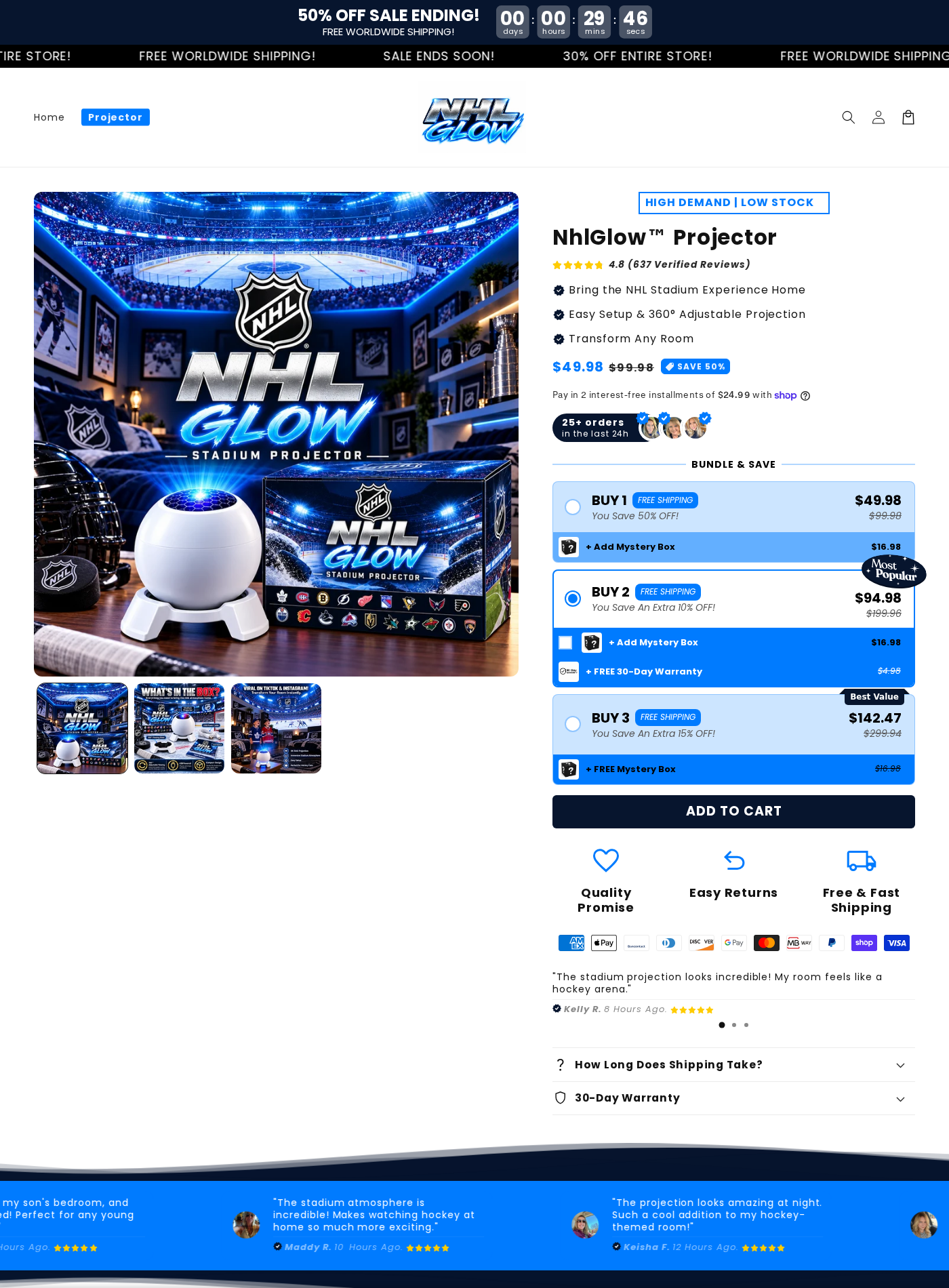
The store name, logo treatment, product artwork, and sales copy repeatedly use NHL language to frame a novelty room projector as a fan product.
During our inspection, the page promised a stadium experience at home and displayed a 4.8 score from 637 verified reviews.
It also showed a 50% countdown, a storewide 30% promotion, free worldwide shipping, and a notice that more than 25 orders arrived recently.
Those elements create the impression of popularity, urgency, and a recognized sports connection before the buyer studies the seller.
The National Hockey League itself is not accused of operating this store, and we found no clear licensing statement on the pages reviewed.
The refund promise conflicts with the sale-item exclusion
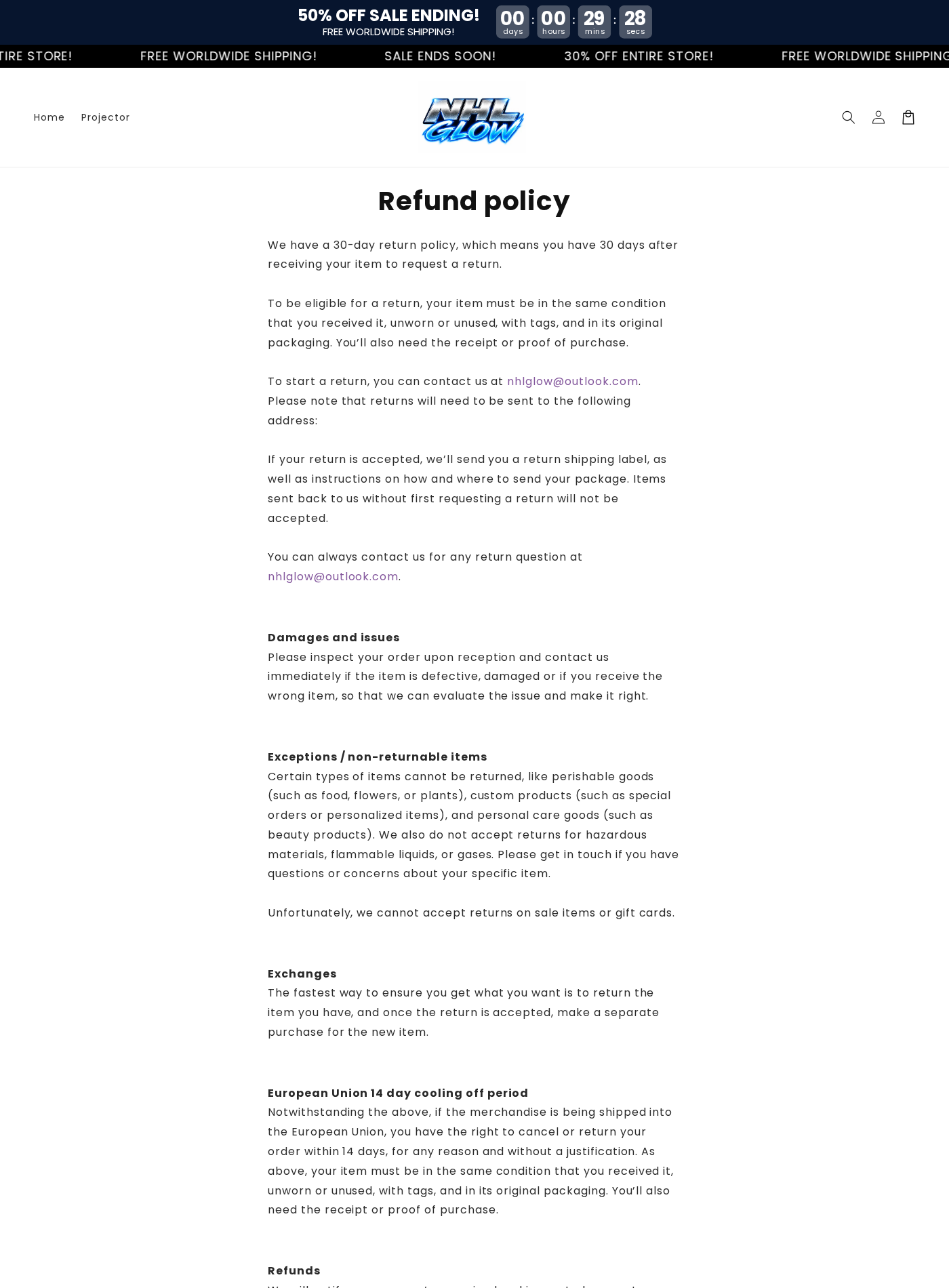
The product page states that customers can return the projector within 30 days and receive a full refund when unsatisfied.
The formal refund policy also begins with 30-day language and requires unused merchandise, tags, packaging, and proof of purchase.
Farther down, however, it says sale items cannot be returned.
Because the projector is displayed through prominent discounts and a sale countdown, buyers cannot easily tell whether the main product is excluded.
The policy’s return-address sentence ends after a colon, leaving the actual destination blank during our visit.
Ownership and authorization remain unclear
The public contact route uses nhlglow@outlook.com and a web form rather than a clearly named legal business.
No headquarters, company registration, support phone, or accountable product importer was visible in the inspected pages.
The terms refer generically to the jurisdiction where the business is headquartered without saying where that is.
Likewise, the store did not identify a licensing partner or explain its authority to sell merchandise using prominent NHL-related presentation.
These omissions make the order harder to assess even if a functioning projector ultimately arrives.
- The product page displayed 637 verified reviews and a 4.8 score.
- Promotional banners advertised both 50% and 30% reductions.
- One, two, and three-projector bundles were offered.
- A mystery-box option and free 30-day warranty appeared beside the main item.
- The page promised a full refund within 30 days when unsatisfied.
- The written policy says sale items cannot be returned.
- The published return-address field was left empty.
- No licensing statement, legal operator, or physical office was clearly shown.
How the NHL Glow Sales Funnel Can Create Brand and Refund Confusion
Step 1: Familiar league imagery supplies borrowed credibility
Sports fans recognize the NHL initials instantly, so the store does not need to build trust from an unfamiliar brand name alone.
The league-style logo and arena language can lead visitors to assume the product is official, licensed, or endorsed.
That assumption should never replace a visible licensing statement, authorized-retailer listing, or confirmation from the rights holder.
Check official NHL retail channels and the relevant team’s approved merchandise outlets before purchasing branded novelty electronics.
If authorization cannot be verified, treat the product as independent merchandise whose quality and intellectual-property status remain uncertain.
Step 2: Countdown banners make verification feel costly
The page displays a rapidly changing timer alongside a large reduction, suggesting the current price may vanish within minutes.
A separate scrolling banner advertises another storewide discount, reinforcing the feeling that immediate action secures unusual savings.
Persistent countdowns are marketing devices, not proof that stock, licensing, or the stated reference price has been independently verified.
Reload the page later or open it in a fresh session to see whether the deadline resets.
A legitimate opportunity remains worth evaluating after enough time to read the policy and identify the merchant.
Step 3: Reviews and recent-order notices simulate a busy fan community
Hundreds of verified reviews and a live-order message suggest many supporters have already accepted the offer.
Onsite labels are chosen by the store, and visitors cannot inspect the verification method behind them.
Repeated testimonials or highly similar language can make a review section look larger without adding independent evidence.
Search for customer photographs showing the parcel, device controls, projection quality, support replies, and card descriptor.
Independent evidence should answer questions the sales page avoids, not simply repeat that the product is amazing.
Step 4: Bundles and extras raise the amount at risk
The store presents discounted two-unit and three-unit packages beside the single projector.
A mystery box and warranty-style option can further increase the total without clarifying the core device’s manufacturer or measurable performance.
Fans buying gifts for several people may select a package before testing even one unit.
If the product disappoints, every opened device may conflict with the policy’s unused-condition requirement.
Choose one projector first and verify the quantity, add-ons, discount, shipping, and final currency before authorizing payment.
Step 5: The return promise changes after the sale language is considered
The product page makes dissatisfaction sound refundable within 30 days.
The detailed policy requires unused goods and separately excludes sale merchandise, even though discounts dominate the storefront.
An unopened-condition rule also prevents meaningful testing of light output, image quality, fan noise, and controls.
Ask support whether the exact discounted SKU can be opened, tested, and returned for dissatisfaction.
Keep the written answer, because a generic guarantee badge cannot resolve the sale exclusion later.
Step 6: A missing return address transfers uncertainty to the customer
The policy says returns must be sent to the following address, but no address followed that sentence during our check.
Without a destination, customers cannot estimate postage, customs forms, carrier acceptance, or delivery confirmation.
They must first rely on an Outlook mailbox to approve the request and supply essential instructions.
Never send a parcel to the address on the original label unless the seller explicitly authorizes it in writing.
If support does not provide a complete route promptly, contact the payment provider before the dispute period closes.
Is NHL Glow Official NHL Merchandise?
Branding alone does not prove a licensing relationship
Official sports merchandise normally identifies the licensee, rights holder, team marks, hologram, manufacturer, or authorized-retailer status.
We did not see that information on the product, policy, contact, or terms pages examined.
This absence does not independently prove infringement, because a license could exist without being displayed clearly.
It does mean a buyer should not describe or purchase NHL Glow as officially authorized without separate confirmation.
The league should be separated from the independent storefront
The NHL is a recognizable organization with its own official websites and licensed merchandise channels.
An unrelated seller can use similar words or styling in a way that causes shoppers to infer a connection.
Complaints about delivery, returns, or product quality should be directed to the merchant and payment provider, not assumed to be NHL customer-service issues.
If the branding appears unauthorized, consumers may also notify the league through its official contact routes.
Branded projections introduce additional product questions
Buyers should ask exactly which logos, teams, slides, or image patterns are included with the device.
A generic hockey effect is different from authorized club marks, and photographs may not show every included pattern accurately.
Confirm whether replacement images are available and whether advertised logos appear on the delivered item or only in promotional media.
The value depends on the actual licensed content as much as the inexpensive projection hardware.
Hardware, Pricing, and Review Claims
A stadium feeling is subjective, but specifications can be checked
Room photographs can exaggerate brightness through darkness, exposure, editing, and carefully chosen projection distance.
Useful specifications include lumens, resolution, focus range, image size, lens material, power source, cable length, and safe operating temperature.
The reviewed presentation emphasized atmosphere more than measurable optical performance.
Find ordinary customer video before assuming one small unit can create the same arena-like coverage shown in advertising.
Discount percentages require a credible reference price
A 50% label is meaningful only if the same product was genuinely sold at the higher comparison price for a reasonable period.
The simultaneous storewide 30% offer makes the pricing story more difficult to interpret.
Compare the current total with functionally similar projectors, including shipping, warranty, and local return cost.
Decide whether the product is worth $49.98 on its own rather than calculating savings from an unverified anchor.
A large onsite review count needs an independent trail
Six hundred thirty-seven verified reviews would normally leave a substantial footprint beyond one young sales page.
Look for dated unboxings, forum discussions, retailer feedback, and photographs that cannot be traced to the merchant’s own media.
Review volume is less persuasive when methodology, moderation, and purchaser verification are unexplained.
Give more weight to specific mixed feedback than perfect praise with no delivery or hardware detail.
Company, Address, and Fulfillment Checks
The legal seller is not plainly identified
NHL Glow functions as a storefront label, but the inspected pages did not name an incorporated business behind it.
That omission prevents simple checks of registration, management, operating history, and complaint records.
Ask for the exact legal entity and expected card descriptor before paying.
If the receipt later shows an unrelated name, preserve it and request an explanation from support.
The published return address is literally incomplete
The refund page introduces a return destination with a colon and then supplies no location.
This is not a minor decorative issue, because the address determines whether a promised refund is affordable and practically obtainable.
A responsible merchant should correct that omission or provide the destination before the order is placed.
Do not assume free worldwide shipping means free or domestic return shipping.
Support relies on a consumer Outlook mailbox
The visible email address is nhlglow@outlook.com rather than an address using the store’s own domain.
Free mailboxes can work, but they offer little evidence about staffing, continuity, or organizational accountability.
Send a detailed licensing and return question before purchasing and evaluate whether the answer is complete.
A response that ignores the exact SKU, sale exclusion, or return country leaves the central risks unresolved.
The manufacturer and fulfillment origin are not clear
The product page did not clearly identify the factory, model number, importer, or warehouse that ships each order.
Novelty projectors are widely manufactured and rebranded, so the physical device should be compared by specifications rather than name alone.
This does not prove NHL Glow’s unit is identical to a particular wholesale listing.
It does justify requesting packaging, compliance markings, plug type, country of origin, and warranty provider before buying.
What to Do If Your NHL Glow Order Has a Problem
- Save the brand and refund representations. Capture the NHL-style presentation, review count, countdown, sale price, 30-day promise, sale exclusion, blank address, cart, and confirmation.
- Check the exact quantity and extras. Compare the invoice with your intended bundle, mystery box, warranty option, shipping charge, and promotional code before fulfillment advances.
- Document delivery and first inspection. Film the sealed package, label, contents, accessories, startup, projection, noise, and any missing advertised image or team-related feature.
- Request written return eligibility. Quote both the satisfaction promise and sale exclusion, then ask whether your discounted product may be opened, tested, and returned.
- Obtain a complete destination. Require the recipient, street, city, postal code, country, authorization number, deadline, carrier, and responsibility for tracked postage.
- Keep the product unchanged. Preserve all tags, films, slides, manuals, cables, and packaging while support decides, because the policy requires unused condition.
- Escalate a stalled claim promptly. Send the payment provider the missing address, contradictory terms, correspondence, delivery evidence, and requested resolution before its deadline.
- Report misleading affiliation carefully. If official authorization cannot be confirmed, describe exactly what the page showed and avoid claiming the NHL operated the store.
How Hockey Fans Can Reduce the Risk
Verify authorization through an official channel
Search the NHL’s official shop and the relevant team’s authorized sellers for the product or merchant.
Look for a licensee name on the page and packaging rather than relying on logos alone.
If confirmation matters to the gift recipient, ask the rights holder or choose clearly licensed merchandise.
Preserve any seller statement about authorization with the purchase records.
Buy one unit before considering a bundle
A trial order tests optical quality, included artwork, shipping speed, packaging, and customer support.
It also limits the number of devices that might become nonreturnable after testing.
Ignore the lower per-unit figure when the underlying value and refund route remain unverified.
A bundle is a saving only when every unit is wanted, delivered, usable, and supportable.
Use payment protection and calendar the deadlines
Pay with a method that supports disputes for non-delivery, unauthorized quantity, or material misrepresentation.
Record the merchant’s 30-day language and the provider’s longer filing deadline separately.
Do not let repeated promises of a later address or replacement consume the time available to act.
Organized screenshots and concise dates are more useful than an angry but undocumented complaint.
Frequently Asked Questions
Is NHL Glow a confirmed scam?
We cannot conclude that every order is fraudulent from the evidence reviewed.
The site presents significant commercial risks, including unclear ownership, unverified licensing, conflicting refund language, and a missing public return address.
Is NHL Glow officially licensed by the NHL?
We found no clear licensing disclosure on the store pages inspected.
That is not proof no agreement exists, but buyers should verify authorization independently before treating it as official merchandise.
Can sale items be returned to NHL Glow?
The policy says sale items cannot be returned, while the main projector is promoted with strong discount language.
Ask support to confirm the exact SKU’s eligibility in writing before ordering.
Where is the NHL Glow return address?
The refund page’s address field was blank during our review.
Customers must obtain a complete approved destination from support before mailing anything.
Does NHL Glow provide a 30-day refund?
The product page and policy use 30-day language, but the conditions require unused goods and exclude sale items.
Those limitations may prevent the ordinary try-and-return experience implied by the sales page.
Is the NHL responsible for NHL Glow orders?
We found no evidence that the league operates the storefront.
Order problems should be pursued with the seller and payment provider while any brand-authorization concern can be reported separately through official NHL channels.
The Bottom Line
NHL Glow uses the power of familiar hockey branding to make a small projector feel like official fan gear, yet its seller, license status, and fulfillment chain remain unclear.
The practical warning is the collision between sale-driven marketing, a 30-day promise, unused-condition rules, a sale exclusion, and no visible return destination.
Verify authorization, start with one unit, and do not let a countdown replace the basic checks expected from any accountable retailer.








