

A message promises a gift card, free mobile data, or a holiday prize from a company you know. The page looks local and asks for a quick survey.
The fake giveaway scam does not always end at that page. The next site may have nothing to do with the brand that drew you in.
Overview
The prize page is a doorway, not the whole operation
Security researchers found a network of short-lived sites that borrow familiar brand names to advertise rewards, discounts, gifts, and special offers.
The first page is designed to attract and sort visitors. After interaction, traffic can be sent to a separate operator or a different scam.
That is why a page may disappear or redirect in an unexpected direction. The visible giveaway is only the entry point.
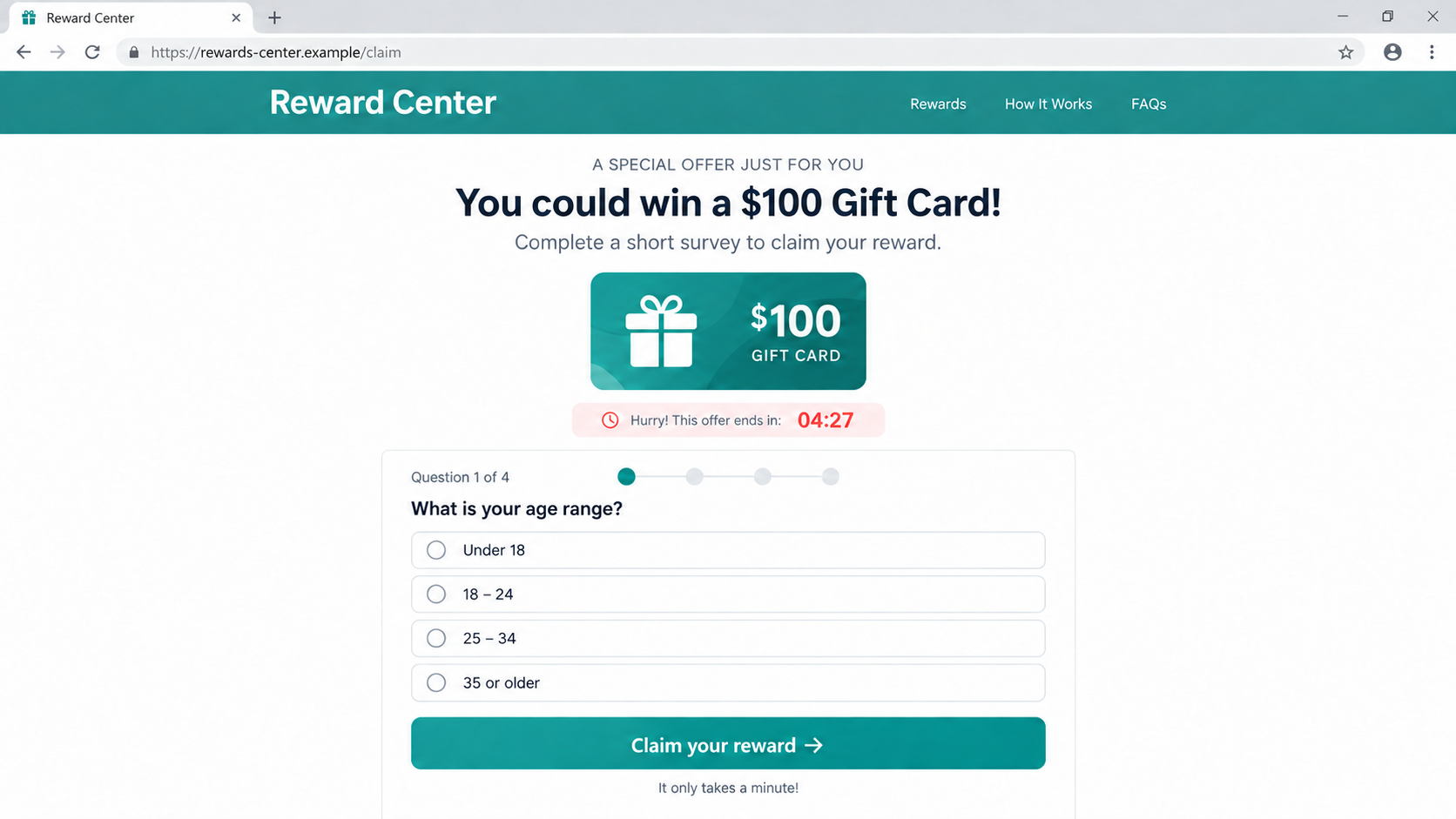
The image above is an editorial reconstruction, not a captured CloudSEK page. Its fictional address and generic wording show the kind of hook involved.
CloudSEK found broad reuse across regions and brands
CloudSEK’s April 2026 investigation describes hundreds of short-lived sites and thousands of domains tied to a large traffic-brokering infrastructure.
Researchers observed more than 300 brand names used across over 100 countries. That describes brands abused in lures, not brands involved in the operation.
They also documented country-specific wording and page themes. A holiday or retailer meaningful in one region may be swapped for another elsewhere.
CloudSEK traced onward routes toward investment fraud and account-takeover attempts, including Telegram-related abuse. Not every visitor reached the same endpoint.
The report establishes a deceptive traffic system. It does not count how many people paid or lost access after visiting it.
The safest check breaks the chain early
A brand’s logo and local language are weak evidence of an official campaign. The key question is whether the offer appears through that brand’s own channels.
Many pages are built for mobile visitors and may behave differently on a desktop. A failed desktop test does not prove a link is harmless.
- Open the company’s known app or website to check a prize claim.
- Do not forward a giveaway link merely because the page asks you to share it.
- Pause when a survey leads to a different domain or unrelated product.
- Never provide a messenger login code to claim a retail gift.
- Never connect a crypto wallet to redeem a store discount.
The confirmed scam lies in the false brand-linked lure and deceptive onward routing. The real companies named on these pages are being impersonated.
Why So Many Different Giveaway Pages Look Similar
A successful template is cheap to reuse. Change the logo, language, currency, and holiday reference, and the page can target another region.
CloudSEK observed lures tied to local retailers, banks, airlines, payment apps, telecom providers, and utilities. Familiarity is the point.
A free mobile-data offer makes sense in one market. An anniversary gift card may sound better in another. The machinery underneath can stay similar.
That scale can create a false impression of legitimacy. If friends in several places receive similar promotions, it may look like a broad campaign.
In fact, mass distribution is one way fraudulent pages spread. A request to share the link can recruit visitors into distributing it further.
A page may use a countdown, a small survey, or congratulatory animation. Those pieces make the visit feel like a normal promotion.
But answering a few questions does not create a genuine entitlement to cash, free travel, mobile data, or a gift card.
The operator can display a winning result to almost everyone. The apparent prize is a prompt to take another action, not proof of selection.
Short-lived sites also frustrate later checks. A link may be gone by the time a friend reports it or a security service examines it.
That disappearing act does not mean the offer was real for an hour. It can be part of the campaign’s disposable design.
How the Fake Giveaway Scam Works
Step 1: A familiar brand carries the invitation
The link arrives through messaging, social posts, or another shared channel. It says a recognizable company is distributing something valuable.
Some lures align with festivals, national holidays, or shopping seasons. The timing helps the promotion feel less random.
CloudSEK found more than 300 brand identities reused. A single logo is not a reliable way to identify the underlying operator.
The real brand may know nothing about the page. Check its own announcements before accepting a prize claim.
Step 2: The page adapts to the visitor
Researchers found mobile-oriented behavior and filtering based on the browser environment. A phone visitor may see a lure that a desktop visitor cannot.
This can reduce exposure to automated scanners and make the link feel tailored to the person who opened it.
Language, currency, and local imagery may also change. The same underlying template can present a different story in another country.
That personalization is not evidence the company recognizes you. It can be assembled from routine browser and location signals.
Step 3: The visitor completes a low-effort interaction
A survey, prize box, or similar activity gives the person a reason to stay. Each step makes the promised reward feel closer.
The page may ask for a share, click, or verification before revealing the next screen. Such tasks are easy to mistake for normal promotion rules.
They also help the network distinguish a curious visitor from someone willing to follow instructions.
The first two images in this article are fictional reconstructions, not evidence that every site uses exactly these buttons or amounts.
Step 4: A new destination takes over
After the initial interaction, traffic can be sent through redirecting domains. The brand-themed page is no longer in control of what the visitor sees.
CloudSEK characterized the infrastructure as a traffic broker: it attracts visitors, profiles them, and routes them toward downstream operations.
Those destinations may involve investment fraud, account-takeover attempts, or other deceptive offers. They are not necessarily run by the same visible page operator.
That distinction explains why a consumer may start with a gift card and end up facing a request unrelated to shopping.
Step 5: The next request targets something more valuable
A second screen may ask for a phone number or verification step. The illustration below shows a possible fictional transition, not an observed page.
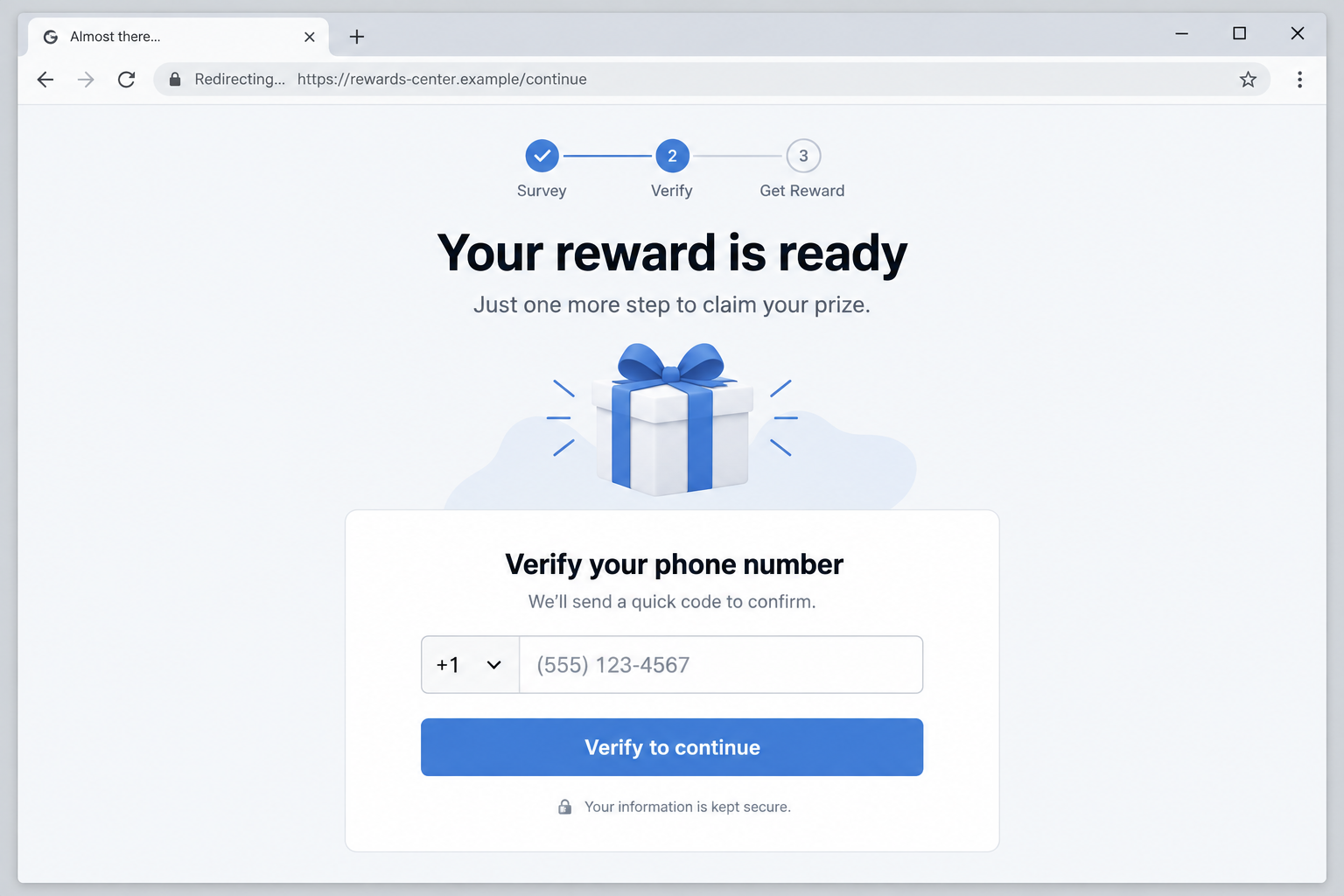
Other onward pages can pursue messaging-account access or crypto assets. A prize story does not justify a Telegram code or wallet connection.
Do not assume a request is safe because you already completed the survey. The earlier steps were designed to make the later demand seem earned.
If the destination changes domains, pause. Ask what relationship the new site has to the original company and why it needs your information.
Step 6: The link or brand can be replaced quickly
Short-lived domains let operators retire a page after warnings spread. A new address can carry the same template tomorrow.
That rotation makes a list of individual bad URLs less durable than understanding the pattern: brand promise, easy interaction, unrelated redirect.
It also limits certainty about one particular destination. A page reviewed today may behave differently later or for a different device.
Investigate a link safely, but do not conclude that everyone who received it saw the same final form.
What the Research Proves, and What It Does Not
CloudSEK observed connected infrastructure and repeated lure patterns across a large set of domains. This is not a single unhappy shopper’s complaint.
The analysis supports describing the fake giveaways as a coordinated deceptive funnel. It does not make every brand in the screenshots responsible.
It also does not establish that every visitor was charged. Some people may leave at the survey; others may reach a different downstream offer.
That uncertainty is important for a worried reader. Merely seeing a page is not equivalent to losing an account or wallet.
The response should match the actual interaction: what you entered, what you approved, and what page you reached.
Likewise, a browser that shows no prize page on desktop has not cleared the link. Mobile filtering can produce different results.
The generated images here explain the reader-facing pattern without pretending to document a particular live domain. The research itself is linked above.
How to Check a Promotion Without Following Its Link
Search for the offer inside the brand’s existing app or known website. A real promotion should have terms accessible outside a random message.
Look for the exact prize, eligibility rules, dates, and redemption route. A logo copied onto an unrelated domain is not enough.
If a friend sent the link, ask where it originated. Friends may share in good faith after being told a share is required to claim.
Do not rely on the friend’s confidence as proof. They may have received the same page and not yet seen the final redirect.
Check the browser address whenever the page changes. A switch from a brand-themed URL to an unrelated domain deserves a fresh decision.
Never provide a messenger login code as “verification” for a prize. That code is meant to protect an account, not authorize a reward.
Do not connect a cryptocurrency wallet or approve a wallet transaction to receive a retail discount. The permissions may expose assets.
If the page asks for a tiny fee, inspect the supposed merchant and terms before paying. A small charge can expose card details.
Close the page if you cannot verify the promotion independently. Missing a supposed reward is safer than accepting an unknown account request.
Some legitimate promotions use outside agencies, but they still publish coherent rules and support contacts through the sponsoring brand’s own channels.
A timer that resets when you reload the page is another reason to doubt urgency. It can be a visual prop rather than a real deadline.
Be wary when a page announces you won before checking eligibility. A universal “winner” message is useful for pushing every visitor onward.
Reporting the exact URL helps platforms remove that instance, even if the operators later create another page with a different address.
If a family member asks about a promotion, walk through the independent check together. That is more useful than forwarding a warning without context.
What to Do if You Have Fallen Victim to This Scam
- Map the route you actually took.
Record the first link, later domains, and whether you answered a survey, shared the message, entered data, paid, or approved a code.
You do not need to revisit the page to make this record. Browser history and saved messages are enough for a useful first account.
- Stop sharing the promotion.
Delete your forwarded post or message where possible. Tell recipients the link was unverified and may lead to a fraudulent destination.
Do not blame friends who already opened it. Clear information helps them assess their own exposure.
- Secure any account credentials or codes you supplied.
If you entered a messenger code, use that service’s official recovery and session controls immediately. End unfamiliar sessions and strengthen the account.
If you used a password, change it on the real service and anywhere it was reused. Protect the associated email account too.
- Act quickly if payment or wallet access was involved.
Contact the card issuer for card disclosures or charges. For crypto, stop granting permissions and seek qualified help to inspect wallet approvals.
Do not send more money to “unlock” a prize or recover funds. That request can be another stage of the fraud.
- Remove permissions and check the device when relevant.
Revoke suspicious browser notifications or downloaded apps. If a file was installed, run a reputable security check such as Malwarebytes.
AdGuard can reduce future exposure to malicious advertising, but it cannot undo a code entry, card disclosure, or wallet approval.
- Report the page and keep evidence.
Save screenshots, messages, dates, and payment records without publishing sensitive data. Report the impersonation to the real brand and your platform.
If money or account access was lost, report it to the appropriate cybercrime or consumer authority in your country.
Frequently Asked Questions
Does a familiar brand logo mean the giveaway is official?
No. The network studied by CloudSEK copied hundreds of brand identities. Verify an offer through the company’s own app or website.
Why did the page work on my phone but not my computer?
Researchers observed mobile filtering. Different devices or browser conditions can lead to different pages, so a desktop failure does not clear the link.
Did every visitor reach a crypto scam?
No. The traffic broker routed users toward different downstream threats. A specific person’s outcome depends on the path they actually followed.
Is the reward page shown here a captured scam website?
No. Both images are fictional editorial reconstructions with example addresses. They illustrate stages without identifying a live site as the operator.
What if I only answered survey questions?
Stop there and review what you disclosed. Basic answers carry less immediate risk than a password, code, payment, or wallet approval.
Can deleting the link undo information I entered?
No. Deletion stops further sharing but does not retract a submitted code or payment detail. Secure the affected account or card separately.
The Bottom Line
The fake giveaway scam uses a local-looking reward page to move people into a changing network of redirects and fraudulent requests.
The brand is the lure, not the proof. Check promotions through the company’s own channels and treat each new destination as a new risk decision.








